What is Vendor Compliance? Types, Rules & How to Manage

Vendor compliance ensures third-party vendors meet an organization's regulatory, security, and contractual standards. Learn the types, requirements, and process.
تم كتابته بواسطة
تم النشر في
Saturday, August 15, 2026
تم التحديث بتاريخ
August 15, 2026

Vendor compliance is the process of ensuring that an organization's third-party vendors meet the regulatory, security, contractual, and operational standards it requires. It confirms that the suppliers, service providers, and software vendors a business depends on follow the rules that protect its data, its customers, and its operations.

The scale of this task has grown sharply. EY's 2025 Global Third-Party Risk Management Survey found that newer third-party risk programs manage a median of 275 vendors each, and regulators now treat vendor oversight as mandatory rather than optional. The EU DORA and NIS2 directives and the United States SEC Regulation S-P amendments require documented due diligence and monitoring of service providers.

What is Vendor Compliance?

Vendor compliance is the discipline of verifying that third parties adhere to the standards an organization sets for them. Those standards span legal and regulatory obligations, security and data-protection controls, contractual terms, and internal policies. The goal is direct: confirm that a vendor operates the way the organization needs it to, both before and throughout the relationship.

Compliance differs from simply having a vendor under contract. A business can sign an agreement with a supplier and still have no assurance that the supplier encrypts data, holds the right certifications, or notifies anyone when an incident occurs. Vendor compliance turns those expectations into defined, verifiable requirements. It answers a single question: Does this vendor meet the standards the organization depends on?

Vendor Compliance vs Vendor Risk Management vs Vendor Management

Vendor compliance is often confused with vendor risk management and vendor management. The three overlap, yet each serves a different purpose.

Discipline What It Focuses On Scope
Vendor Compliance Whether vendors adhere to set standards and rules A defined checkpoint within the relationship
Vendor Risk Management Identifying, assessing, and controlling the risk a vendor poses Ongoing risk reduction across the vendor portfolio
Vendor Management The full commercial relationship, from sourcing to performance The entire vendor lifecycle

Vendor compliance is the narrowest of the three and sits inside both vendor risk management and the wider third-party risk management program. Compliance confirms that the rules are met; risk management decides which rules matter and what level of risk the organization accepts.

Types of Vendor Compliance

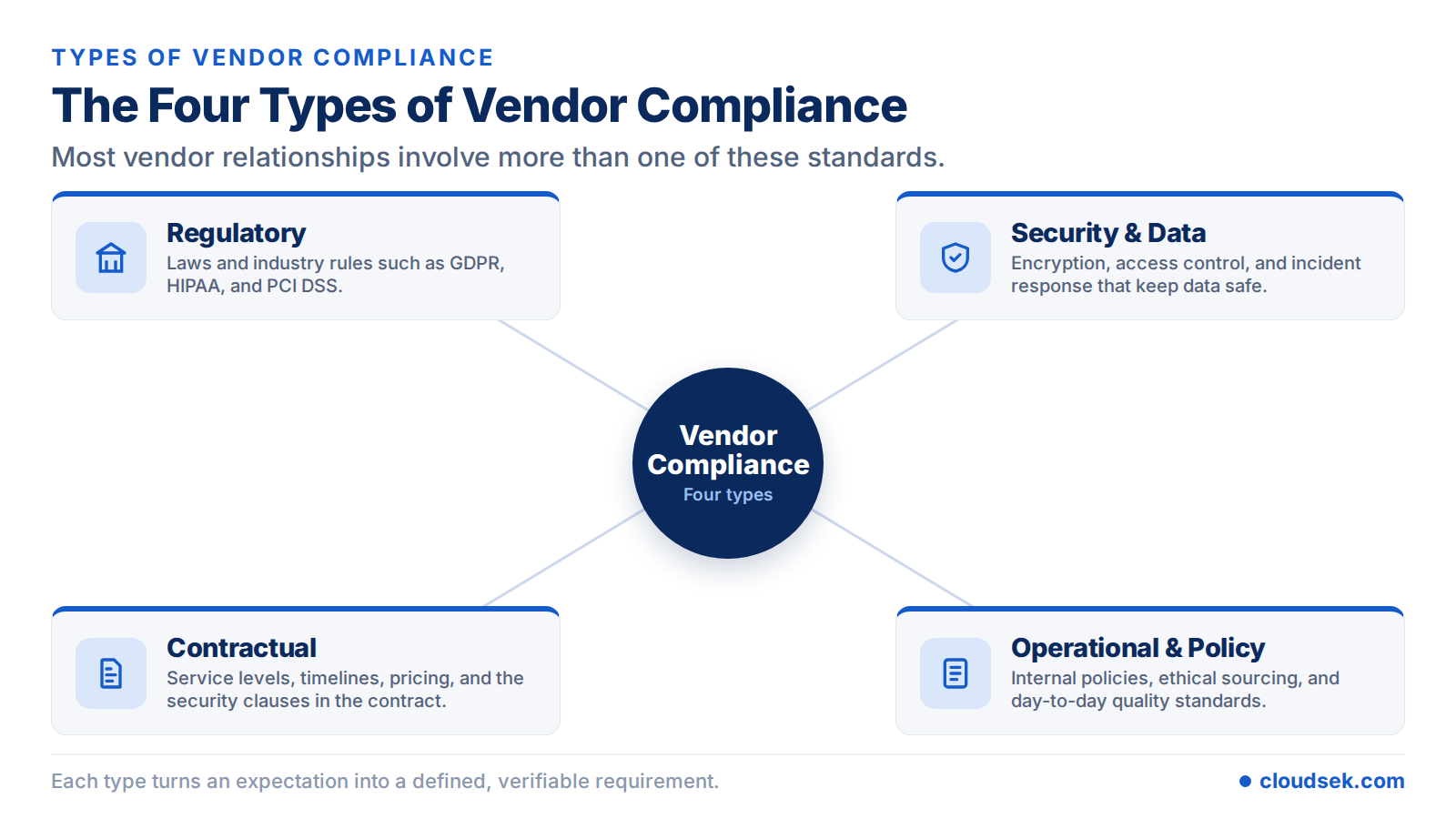
Vendor compliance covers four main types of standards, and most vendor relationships involve more than one.
vendor compliance types

1. Regulatory compliance

Adherence to the laws and industry regulations that apply to the data or service involved, such as GDPR for personal data, HIPAA for health information, and PCI DSS for payment cards. A vendor that processes regulated data inherits the obligations attached to it. A payroll provider handling employee records, for instance, falls under data-protection law alongside its client.

2. Security and data compliance

Adherence to the security and data-protection controls that keep information safe, including encryption, access control, and incident response. This dimension ties vendor compliance directly to breach prevention, because a compromised vendor is a common route for a supply chain attack that reaches the organization's data.

3. Contractual compliance

Adherence to the obligations written into the contract, including service levels, delivery timelines, pricing terms, and the security clauses the organization requires. Contractual compliance gives the organization legal recourse when a vendor falls short of what was agreed, such as missing a guaranteed uptime written into a service-level agreement.

4. Operational and internal policy compliance

Adherence to the organization's internal policies and quality expectations, such as a code of conduct, ethical sourcing, and performance standards. This dimension keeps vendors aligned with how the organization operates day to day.

Why Vendor Compliance Matters

Vendor compliance matters because a vendor's failure becomes the organization's problem. The consequences span across security, finance, law, and reputation.

  • Risk reduction. Confirming that vendors meet security standards before they handle data lowers the chance of a breach reaching the organization.
  • Regulatory protection. A documented program demonstrates the due diligence regulators expect and reduces exposure to fines.
  • Cost avoidance. Compliance prevents penalties, chargebacks, and the cost of incidents caused by vendors that fall short.
  • Business continuity. Holding critical suppliers to defined standards keeps services running and prevents disruption.
  • Reputation. Strong oversight protects the customer trust that a vendor-caused failure erodes.

The stakes are concrete. The Ncontracts 2025 Third-Party Risk Management Survey reported that 49% of financial institutions experienced a vendor-related cyber incident in the past year. Each incident carries investigation, notification, and recovery costs that fall on the organization, not the vendor.

Key Regulations and Frameworks for Vendor Compliance

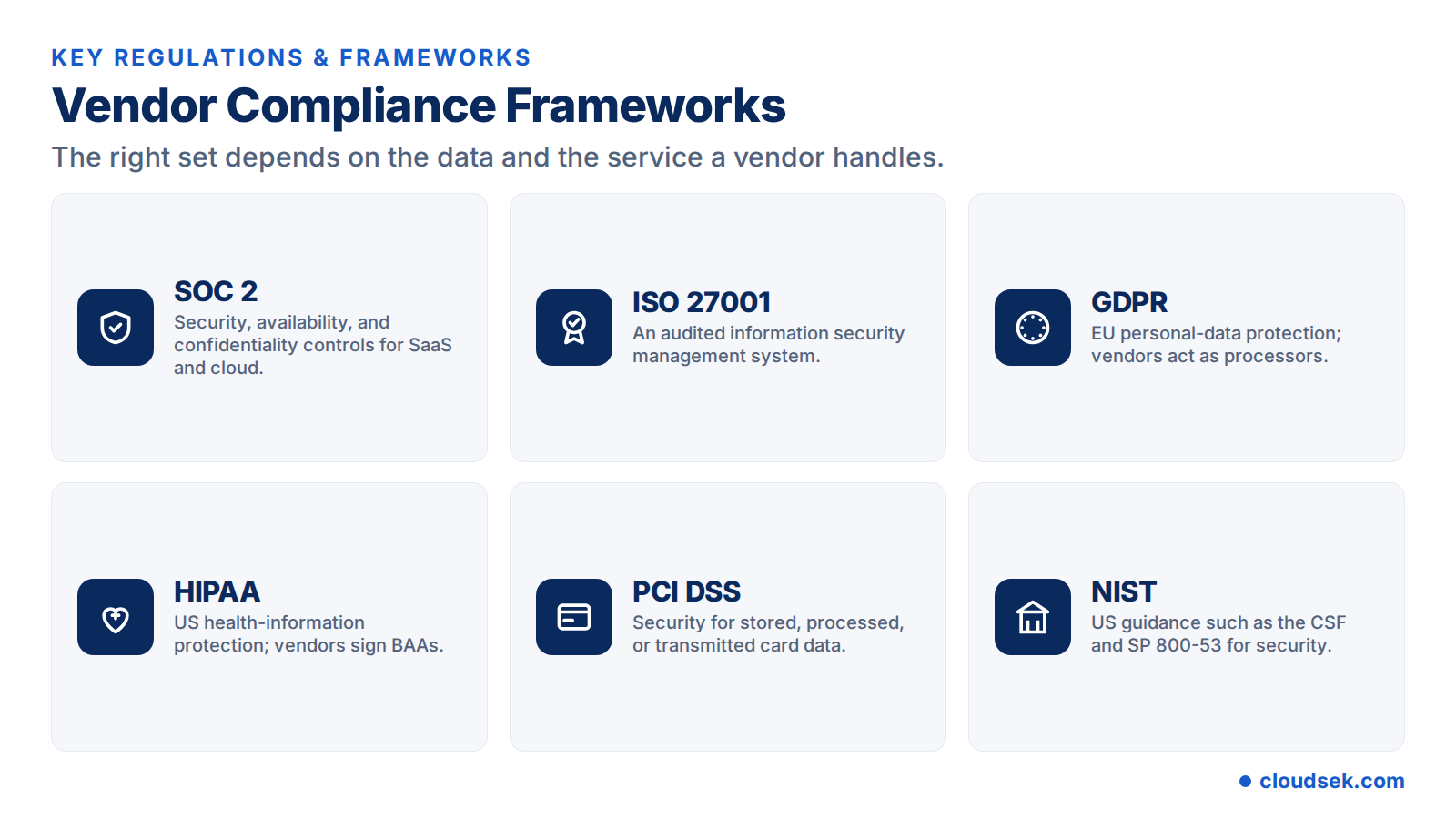
Vendor compliance programs hold vendors to recognized frameworks and regulations. The right set depends on the data and service involved.
vendor compliance regulations and frameworks
  • SOC 2. An attestation that a service organization manages data according to controls for security, availability, and confidentiality. It is common for SaaS and cloud vendors.
  • ISO 27001. An international standard for an information security management system, signaling a structured and audited security program.
  • GDPR. The EU regulation governing personal data. Vendors that process the data of EU residents carry obligations as processors.
  • HIPAA. The United States law protecting health information. Vendors that handle it sign business associate agreements.
  • PCI DSS. The security standard for any organization that stores, processes, or transmits payment card data.
  • NIST frameworks. United States guidance, including the Cybersecurity Framework and SP 800-53, used to structure and benchmark vendor security.

Vendor Compliance by Industry

The standards that matter most shift by sector, because each industry handles different data under different regulators.

  • Healthcare. HIPAA governs patient data, and vendors that handle it sign business associate agreements. A non-compliant vendor exposes protected health information, and the provider that engaged it.
  • Financial services. DORA, NIS2, the SEC, and banking regulators require active oversight of service providers, with particular scrutiny on vendor concentration and operational resilience.
  • Retail and e-commerce. PCI DSS governs payment card data, while supply-chain programs enforce delivery, labeling, and routing rules through chargebacks.
  • Technology and SaaS. SOC 2 and ISO 27001 form the common baseline, since these vendors hold customer data in the cloud and sell to security-conscious buyers.

Vendor Compliance Checklist

A vendor compliance program defines what each vendor provides and maintains. A practical checklist includes the following requirements:

  • Contractual security obligations. Specific, written security requirements rather than vague language, such as reasonable measures.
  • Framework alignment and certifications. Evidence such as a current SOC 2 report or ISO 27001 certificate.
  • Data-protection terms. How the vendor stores, processes, and returns or deletes the organization's data.
  • Breach-notification clause. A defined timeline and named contact for reporting a security incident.
  • Right to audit. The ability to verify a vendor's controls instead of relying on self-reporting.
  • Insurance. Cyber or liability coverage appropriate to the service the vendor provides.
  • Service-level agreements. Measurable performance and availability commitments tied to the contract.
  • Subcontractor disclosure. Visibility into the vendor's own suppliers, since a compromise among them becomes a fourth-party risk to the organization.

Defining these at the start of a relationship is far simpler than retrofitting them after a problem appears.

How to Build a Vendor Compliance Program

Building a vendor compliance program follows a repeatable sequence across the vendor lifecycle. Each stage feeds the next, so gaps close before a vendor gains access to data or systems.

  1. Define standards and policy. Document the regulatory, security, and contractual standards vendors meet, tied to the organization's risk appetite.
  2. Conduct due diligence and onboarding. Vet a vendor's security posture, certifications, and history before granting access, as part of a structured vendor risk assessment. The vendor's risk tier, set here, drives how much scrutiny it receives later.
  3. Embed requirements in contracts. Write the standards, audit rights, and breach-notification terms into the agreement before work begins.
  4. Assess compliance. Collect evidence through questionnaires, certifications, and documentation, then validate it rather than accepting it at face value. Independent evidence, such as a security rating or test result, carries more weight than a self-assessment.
  5. Monitor continuously. Track each vendor's compliance and security posture between formal reviews, not once a year.
  6. Manage issues and remediation. Log findings, assign owners and deadlines, and confirm that fixes are completed.
  7. Offboard securely. Revoke access, recover or delete data, and close out obligations when a relationship ends.

Continuous Monitoring: Why Point-in-Time Compliance Is Not Enough

A compliance check is accurate only on the day it happens. A vendor that passes an assessment in January can change its infrastructure, lose a certification, or suffer a breach by March, and a point-in-time review never sees it. This gap is the central limitation of compliance treated as a one-time event, and the longer the interval between checks, the wider the blind spot grows.

Continuous monitoring closes the gap. Rather than relying on an annual questionnaire, it tracks a vendor's external security posture and exposure on an ongoing basis, and flags changes as they happen. Continuous external monitoring of this kind catches a deteriorating posture, a new exposure, or early signs of compromise that a static attestation misses. Compliance confirms a vendor met the standard once. Monitoring confirms it still does.

Continuous monitoring of a vendor typically tracks:

  • Security posture changes, such as newly exposed services, open ports, or expired certificates.
  • Breach and incident signals that affect the vendor or its own suppliers.
  • Leaked credentials and data tied to the vendor are surfacing on the dark web.
  • Certification lapses, such as the loss or expiry of a required SOC 2 or ISO 27001 status.

What a Vendor Compliance Audit Involves

A vendor compliance audit is a structured review that verifies a vendor meets the standards set for it, rather than trusting self-reported answers. It typically covers four areas.

  • Documentation review. Examining certifications, policies, and prior audit reports, such as a SOC 2 Type II.
  • Control validation. Checking that stated security controls operate in practice, through evidence or testing.
  • Contract and SLA check. Confirming the vendor meets the obligations and service levels written into the agreement.
  • Findings and remediation. Recording gaps, assigning owners, and setting deadlines to close them.

An audit gives a deeper, evidence-based view than a questionnaire, though it captures a single point in time, which is why continuous monitoring runs alongside it.

Common Vendor Compliance Challenges

Vendor compliance programs run into a consistent set of obstacles, particularly as the vendor count grows.

  • Scale. Overseeing hundreds of vendors strains teams that are frequently small relative to the portfolio.
  • Manual processes. Spreadsheets and email do not keep pace with a large and changing vendor base.
  • Subjective self-reporting. Questionnaires capture what a vendor believes or claims, which can differ from what the vendor actually does.
  • Diverse risk profiles. Vendors range from critical data processors to low-risk suppliers, and uniform treatment wastes effort or misses risk.
  • Fourth-party blind spots. A vendor's own suppliers sit outside direct view, yet their compromise still reaches the organization.
  • Evidence management. Collecting, storing, and refreshing certificates and reports is a continuous administrative load.

Signs of a Vendor Compliance Problem

Certain signals indicate that a vendor is drifting out of compliance and warrants a closer review.

  • Lapsed certification, such as an expired or withdrawn SOC 2 report or ISO 27001 status.
  • Evasive responses to security questionnaires and requests for evidence, or long delays in answering.
  • A reported incident at the vendor or one of its own suppliers.
  • New external exposures, such as fresh vulnerabilities or exposed assets appearing on the vendor's footprint.
  • Repeated contractual misses, such as frequent missed service levels or recurring exceptions.

Catching these early is the difference between a managed remediation and a breach disclosure.

Vendor Compliance Best Practices

A focused set of practices keeps a vendor compliance program effective as it scales.

  • Maintain a central vendor inventory. Keep a current record of every vendor and what each can access, so no relationship goes unmanaged.
  • Tier vendors by risk. Concentrate the deepest scrutiny on vendors with access to sensitive data or critical systems.
  • Standardize onboarding and offboarding. Use consistent checklists so no step is skipped at either end of the relationship.
  • Automate evidence collection. Reduce manual effort and keep documentation current across the portfolio.
  • Monitor continuously. Pair periodic assessments with ongoing monitoring of each vendor's posture.
  • Coordinate across teams. Align procurement, IT and security, legal, and finance on shared expectations and escalation paths.
  • Measure with KPIs and KRIs. Track metrics such as assessment coverage, time to remediate, and the number of vendors out of compliance.

Vendor Compliance Management Software

As vendor portfolios grow, manual compliance becomes impractical, and many programs adopt software to manage it. Vendor compliance management tools centralize vendor records, contracts, and evidence, automate questionnaires and reminders, monitor posture, and report status to leadership. 

The aim is consistency at scale: every vendor measured against the same standard, with evidence on hand for auditors and a single view of status for leadership and regulators. Useful capabilities include a central vendor inventory, automated assessment workflows, continuous monitoring, and clear reporting.

Compliance tooling depends on accurate, current information about each vendor's security, and much of that signal sits outside the organization, on vendor infrastructure and across the open and dark web. 

CloudSEK SVigil monitors third-party and supply chain security posture continuously, surfacing vendor exposures and weakening posture as they appear rather than at the next review. Signals of this kind feed the security dimension of a vendor compliance program, showing when a vendor's real posture drifts from what its attestations claim. SVigil complements the compliance and governance tooling that manages contracts, evidence, and workflows, and does not replace it.

Frequently Asked Questions

What is a vendor compliance chargeback?

A vendor compliance chargeback is a fee a buyer deducts when a vendor breaks an agreed requirement, such as late delivery, incorrect labeling, or a missed routing rule. It is common in retail supply chains and offsets the cost of the violation.

Who is responsible for vendor compliance in an organization?

Responsibility is shared across procurement, IT and security, legal, and finance, usually coordinated by a vendor risk or compliance team. The organization that engages the vendor, not the vendor itself, holds final accountability to regulators for oversight.

How often should vendors be assessed for compliance?

It depends on the vendor's risk tier. High-risk vendors with access to sensitive data warrant assessment at least annually and after any major change, while low-risk vendors need review every two to three years. Continuous monitoring covers the gaps.

What happens if a vendor fails to meet compliance requirements?

The organization issues a corrective action plan with a remediation deadline, and applies contractual penalties or escalation if the vendor does not comply. Persistent non-compliance can end the relationship, and severe cases bring regulatory or legal exposure.

Is vendor compliance a legal requirement?

Indirectly, yes. No single law names vendor compliance, but regulations such as GDPR, HIPAA, DORA, and the SEC Regulation S-P require organizations to oversee the third parties that handle their data. Vendor compliance is how organizations meet those obligations.

What is a vendor compliance score?

A vendor compliance score is a rating that summarizes how well a vendor meets required standards, based on assessments, certifications, and monitoring data. It lets teams compare vendors quickly and prioritize the ones that fall below an acceptable threshold.

المشاركات ذات الصلة
Key Risk Indicators (KRIs): Types, Examples, and How They Work
Key risk indicators (KRIs) are metrics that flag rising risk before it becomes a loss. Learn KRI types, examples by category, thresholds, and KRI vs KPI.
What is Vendor Compliance? Types, Rules & How to Manage
Vendor compliance ensures third-party vendors meet an organization's regulatory, security, and contractual standards. Learn the types, requirements, and process.
What is Third-Party Data Breach? Causes, and Prevention
A third-party data breach exposes an organization's data through a compromised vendor. Learn how they happen, real examples, impact, and how to prevent them.

ابدأ العرض التوضيحي الخاص بك الآن!

جدولة عرض تجريبي
إصدار تجريبي مجاني لمدة 7 أيام
لا توجد التزامات
قيمة مضمونة بنسبة 100%

مقالات قاعدة المعارف ذات الصلة

لم يتم العثور على أية عناصر.