🚀 أصبحت CloudSek أول شركة للأمن السيبراني من أصل هندي تتلقى استثمارات منها
اقرأ المزيد
.avif)

Third-party risk management (TPRM) is the ongoing process of identifying, assessing, mitigating, and monitoring the risks that vendors, suppliers, and service providers introduce across the entire relationship.
The exposure is expensive and slow to contain: IBM's 2025 Cost of a Data Breach Report found that supply-chain compromise accounts for 15% of breaches at an average cost of $4.91 million and takes the longest of any vector to contain, at 267 days.
Third-party risk management gives organizations a structured program to govern that exposure from the moment a vendor is onboarded to the day the relationship ends. This guide covers what TPRM is, how it differs from a third-party risk assessment, the TPRM lifecycle, the frameworks and regulations that shape it, the challenges teams face, and the practices that keep a program effective.
Third-party risk management is the continuous discipline of governing the risks that external parties create for an organization. It runs as a standing program rather than a one-time check, and it spans the full vendor lifecycle from discovery through offboarding. The practice overlaps with vendor risk management (VRM) and supply chain risk management (SCRM), and it treats third-party cyber risk as a measurable exposure that changes over time. Every vendor with access to data, systems, or operations falls inside its scope.
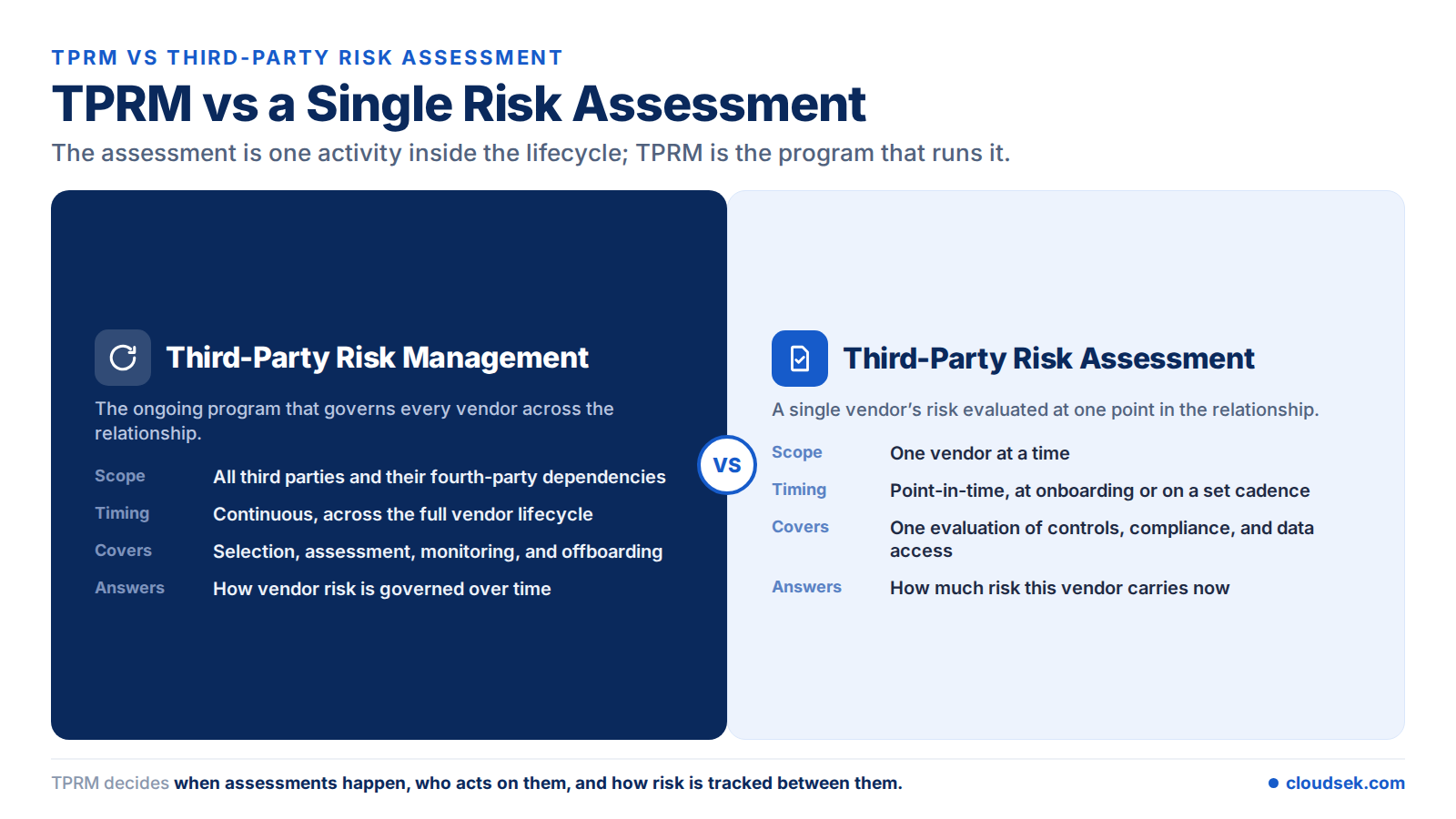
A third-party risk assessment evaluates a single vendor's risk at one point in the relationship. While Third-party risk management is the wider program that runs those assessments and governs every vendor across discovery, onboarding, monitoring, and offboarding. The assessment is one activity inside the lifecycle; TPRM is the system that decides when assessments happen, who acts on them, and how risk is tracked between them.
Third-party risk management matters because attackers follow the path of least resistance, and a vendor with weaker security becomes the way into a stronger target. SecurityScorecard research found that 29% of breaches originate with a third party. Five outcomes make the program essential:
Three recent incidents show how one vendor failure cascades across every organization connected to it:
A TPRM program governs several categories of third-party risk:
The TPRM lifecycle moves a vendor through seven phases, from first discovery to secure offboarding:
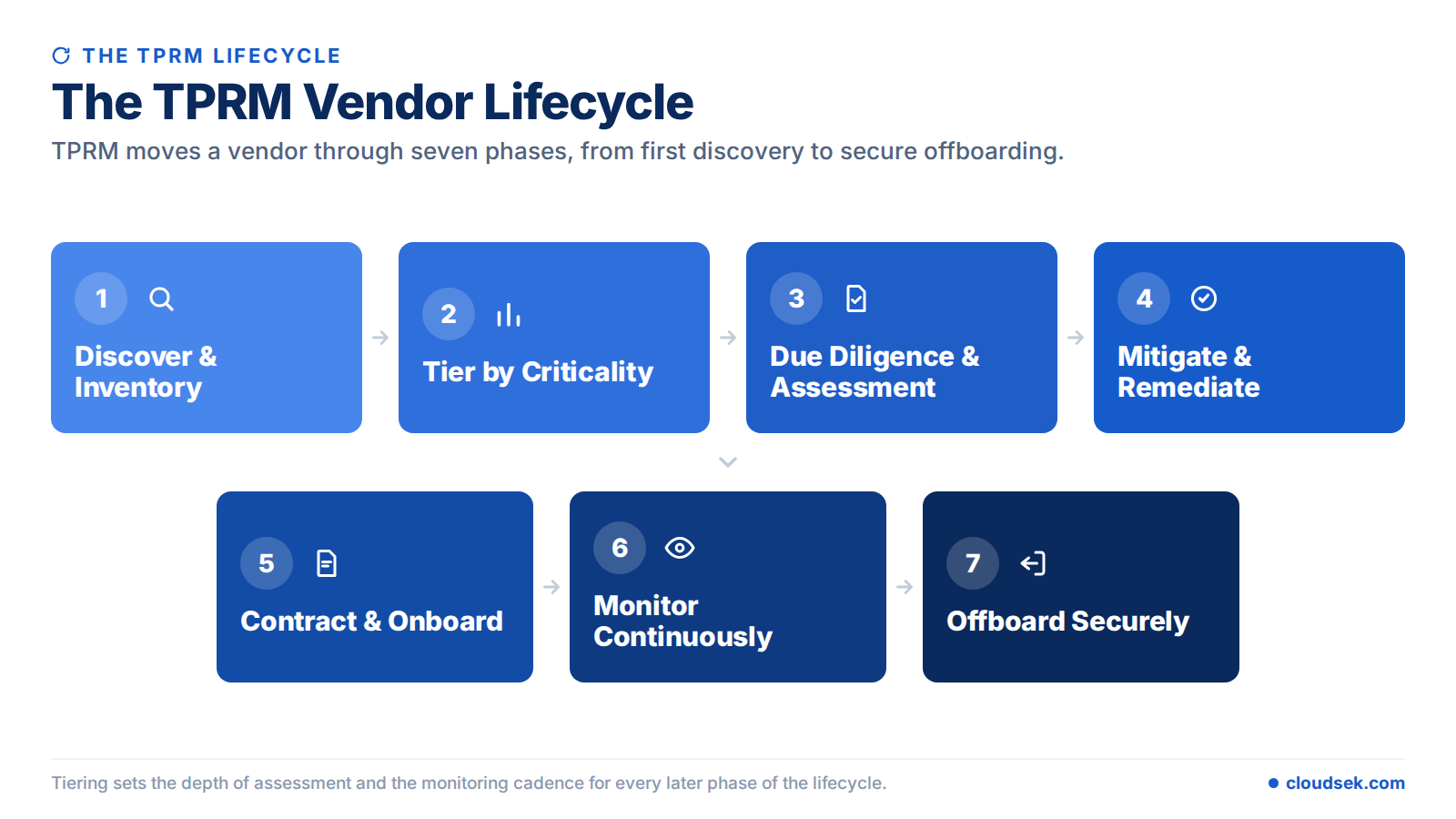
Tiering turns the lifecycle into a focused effort. A payroll provider with access to employee PII and bank details sits in the critical tier and warrants continuous monitoring, while a design contractor with no access to internal systems sits in a low tier reviewed once a year. The tier sets the depth of assessment and the monitoring cadence for every later phase.
Established frameworks give a TPRM program a consistent structure and a common language with vendors:
Regulators now treat vendor risk as the organization's responsibility. The rules that mandate third-party risk management include:
Tools reduce the manual load of third-party risk management and keep findings current. The capability categories that matter:
Choosing a TPRM tool comes down to a few criteria:
Most TPRM programs still run on questionnaires and annual reviews. The trouble is that a questionnaire captures a vendor on the day it arrives, while the vendor's real exposure keeps moving: new infrastructure appears, an employee's credentials leak, a dependency picks up a vulnerability. By the next review cycle, the picture is already out of date. Closing that gap is where CloudSEK's SVigil works.
SVigil fingerprints a vendor ecosystem and watches it over time, surfacing exposed assets, leaked credentials, and the fourth-party dependencies that sit behind each vendor. When a vendor's exposure changes, the security team sees it between assessments rather than after an incident.
SVigil covers the continuous-monitoring phase of the lifecycle. Governance, due diligence, contracts, and offboarding remain the program's own work. The program decides which vendors to trust; continuous monitoring confirms whether that trust still holds.
Vendor risk management focuses on risks from contracted vendors. Third-party risk management is broader, covering every external party, including suppliers, partners, and service providers, along with their fourth-party dependencies. The terms are often used interchangeably.
The NIST Cybersecurity Framework addresses third-party risk under its supply chain risk management category, and NIST SP 800-161 provides detailed supply-chain guidance. Both direct organizations to assess, monitor, and document vendor security.
Start by assigning ownership and defining risk appetite, then build a vendor inventory, tier vendors by criticality, set an assessment framework, and add continuous monitoring. Governance and automation hold the program together as it scales.
TPRM software combines vendor inventory, questionnaire automation, security ratings, attack-surface and credential-exposure monitoring, fourth-party mapping, and reporting. Most programs pair an assessment platform with continuous external monitoring.
Yes. Third-party risk management sits within governance, risk, and compliance (GRC), and it feeds vendor risk data into the wider enterprise risk and compliance program.
Continuous monitoring replaces point-in-time snapshots with a live view of vendor risk, flagging exposed assets and leaked credentials as they appear, so teams act before an incident rather than after one.
