🚀 أصبحت CloudSek أول شركة للأمن السيبراني من أصل هندي تتلقى استثمارات منها
اقرأ المزيد
.avif)

Cybercriminals increasingly use email-based social engineering attacks to steal credentials, deliver malware, bypass security controls, and gain unauthorized access to enterprise systems. Phishing and spear phishing remain among the most common attack methods because they exploit human trust rather than directly attacking security infrastructure.
In the second quarter of 2025, the Anti-Phishing Working Group (APWG) recorded 1,130,393 unique phishing attacks, the highest quarterly total since 2023 and a 13% increase over the previous quarter, underscoring how frequently attackers rely on deceptive communications to compromise organizations.
This article explains the key differences between phishing and spear phishing, including how both attacks work, how attackers target victims, how to identify them, and why spear phishing creates higher security risks for organizations. Understanding these differences helps individuals and organizations identify suspicious activity earlier and strengthen protection against various cyberattacks.
Phishing is a broad cyberattack that targets large numbers of users using generic fraudulent emails, messages, or websites. Attackers commonly impersonate trusted organizations such as banks, cloud providers, delivery services, or social media platforms to steal credentials, financial information, or authentication details.
For example, a phishing email may claim that a user’s bank account has been locked and ask the recipient to click a link and log in immediately. The link usually directs the victim to a fake login page designed to steal account credentials.
Spear phishing is a highly targeted cyberattack that uses personalized messages crafted for a specific individual, employee, or organization. Attackers often research their targets using publicly available information, business relationships, job roles, or social media activity to create more convincing and believable communication.
For example, an attacker may send a fake email to a finance employee, impersonating the company’s CEO, and request an urgent wire transfer. The message may include the employee’s name, company details, and realistic business language to appear legitimate.
Phishing and spear phishing attacks commonly aim to steal login credentials, financial information, sensitive business data, or deliver malware into enterprise environments. Attackers frequently use these attacks to gain unauthorized access, conduct financial fraud, deploy ransomware, or compromise business accounts.
Spear phishing and phishing differ in targeting precision, personalization, attacker effort, success rate, and business impact. The following are the main differences that will help you identify higher-risk attacks and improve protection.
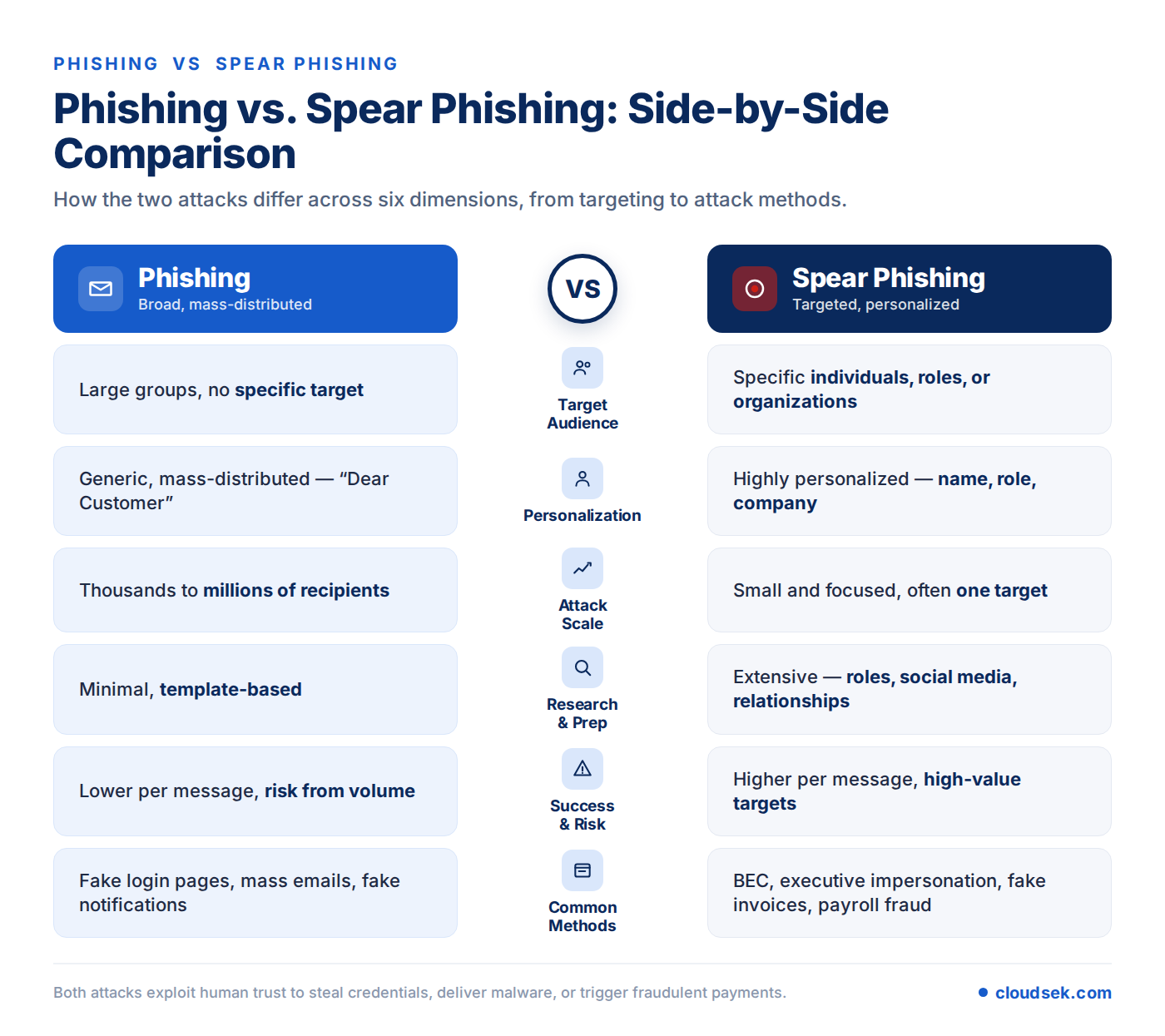
Phishing attacks target large groups of users simultaneously without focusing on a specific individual or organization. Attackers distribute the same fraudulent message to thousands or millions of recipients, hoping that some users will click on malicious links or share sensitive information.
Spear phishing attacks target specific individuals, departments, executives, or organizations carefully picked by attackers. Cybercriminals often focus on finance teams, HR departments, IT administrators, executives, or employees with access to sensitive business systems and financial information.
Traditional phishing messages usually contain generic language, broad warnings, and non-personalized communication designed for mass distribution. These emails often address users with phrases such as “Dear Customer” and contain minimal information related to the recipient personally.
Spear phishing attacks use highly personalized content to appear trustworthy and legitimate. Attackers frequently include the victim’s name, job title, company information, business relationships, recent activities, or internal references gathered through social media, public records, or previous data leaks.
Phishing campaigns operate at a large scale because attackers attempt to compromise as many users as possible with minimal effort. Automated email distribution tools help cybercriminals send massive numbers of phishing messages quickly across multiple organizations and industries.
Spear phishing attacks operate on a much smaller scale because attackers focus on high-value targets instead of broad victim groups. Each message is often crafted individually to increase credibility and improve the likelihood of successful compromise.
Phishing attacks require limited preparation because attackers rely on generic fraudulent templates and publicly available impersonation methods. Most phishing campaigns use fake login pages, spoofed domains, or mass email tactics without extensive research on recipients.
Spear phishing attacks require detailed research and preparation before attackers contact the target. Cybercriminals often analyze company structures, employee roles, social media profiles, business communications, and publicly exposed information to craft believable attack scenarios.
Generic phishing attacks generate lower success rates because many users recognize suspicious emails, poor grammar, fake domains, or unrealistic requests. However, phishing still creates widespread risk because attackers distribute these campaigns at extremely large volumes.
Spear phishing attacks create higher security risks because personalized communication increases trust and reduces suspicion. Employees are more likely to interact with malicious links, attachments, or payment requests when messages appear relevant to their role or organization.
Phishing attacks commonly use fake login pages, malicious attachments, fraudulent password reset emails, fake delivery notifications, and account verification requests. Attackers often impersonate banks, cloud providers, streaming platforms, or online services.
Spear phishing attacks frequently involve business email compromise (BEC), executive impersonation, fake invoices, payroll fraud requests, malicious file-sharing links, and targeted credential theft campaigns. Attackers often imitate executives, business partners, vendors, or internal employees to appear authentic.
Phishing and spear phishing attacks often include suspicious communication patterns, deceptive requests, and fraudulent content that help users identify malicious activity before compromise occurs.
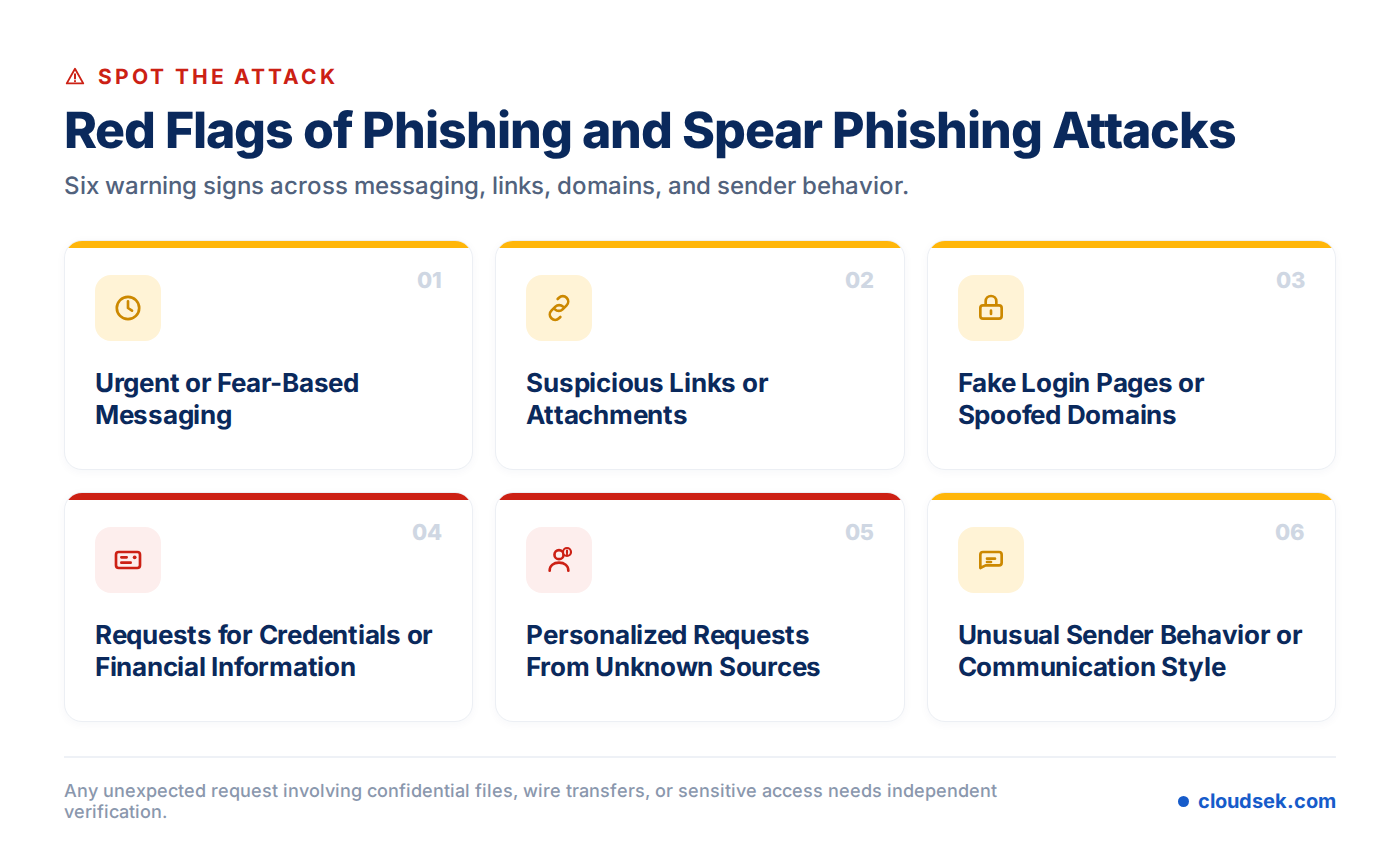
Attackers frequently create urgency or fear to pressure users into acting quickly without verifying the request. Messages commonly claim account suspension, failed payments, security alerts, tax issues, or urgent business requests to trigger immediate responses.
Malicious emails often contain suspicious links, unexpected attachments, or shortened URLs designed to deliver malware or steal credentials. Hovering over links may reveal misspelled domains, unrelated websites, or fake login pages that imitate trusted services.
Phishing attacks commonly direct users to fake websites that closely resemble legitimate login portals. Attackers frequently use spoofed domains with slight spelling changes, extra characters, or misleading subdomains to trick users into entering credentials.
Legitimate organizations rarely request passwords, payment details, authentication codes, or sensitive business information through unsolicited emails or messages. Attackers often impersonate banks, executives, vendors, or IT teams to steal confidential information directly from victims.
Spear phishing attacks often contain highly personalized information such as employee names, job roles, company references, or recent business activities. Unexpected requests involving confidential files, wire transfers, invoices, or sensitive access should always be verified independently.
Changes in writing style, unexpected requests, grammatical inconsistencies, or communication outside normal business patterns may indicate a phishing attempt. Attackers frequently impersonate trusted contacts but fail to match their typical tone, formatting, or communication behavior accurately.
Organizations can prevent phishing and spear phishing risks by strengthening user awareness, securing email communication, protecting identities, and monitoring suspicious activity continuously.
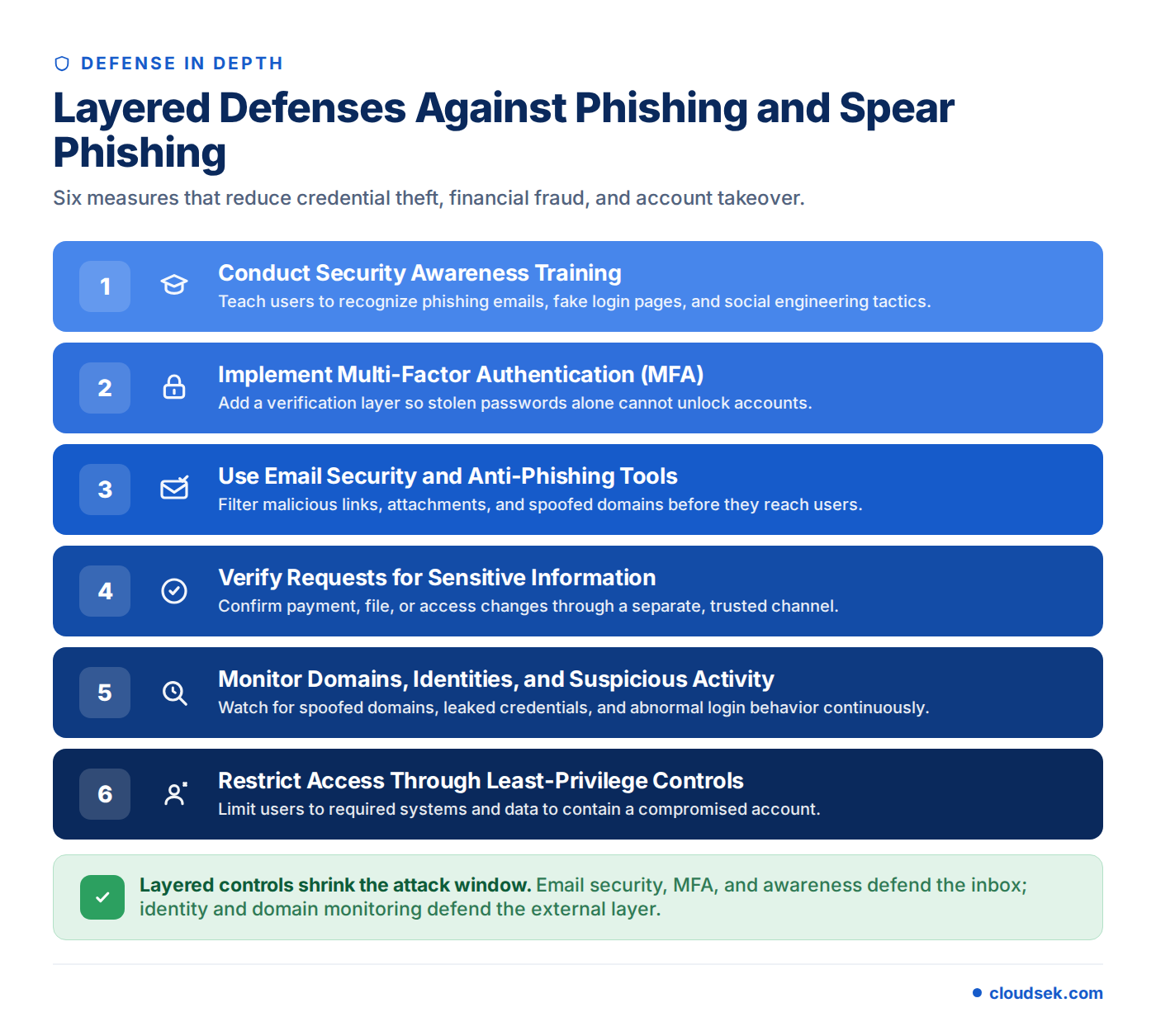
Security awareness training helps employees recognize phishing emails, fake login pages, suspicious attachments, and social engineering tactics. Regular training improves users' ability to identify fraudulent communication and reduces risky actions that lead to credential theft or malware infections.
Multi-factor authentication adds an additional verification layer beyond passwords during login attempts. MFA reduces the risk of account compromise because attackers cannot easily access accounts using stolen credentials alone.
Email security platforms help detect malicious links, suspicious attachments, spoofed domains, and fraudulent messages before they reach users. Anti-phishing technologies improve protection against malware delivery, credential harvesting, and business email compromise attacks.
Employees should verify unexpected requests involving passwords, financial transactions, confidential files, or account changes before responding. Independent verification through phone calls, internal communication channels, or direct confirmation helps prevent social engineering attacks.
Continuous monitoring helps organizations identify spoofed domains, compromised accounts, abnormal login behavior, and suspicious communication activity. Early visibility into phishing indicators improves incident response and reduces the likelihood of successful compromise.
Continuous monitoring helps organizations identify spoofed domains, compromised accounts, and suspicious activity before a campaign reaches an inbox, since attackers usually build that infrastructure, fake login pages, cloned brand assets, impersonation profiles, outside the network first. Platforms like XVigil scan the dark web, deep web, and surface web, along with phishing kit marketplaces, to flag that infrastructure early and support takedown before it's weaponized. Early visibility like this improves incident response and reduces the likelihood of successful compromise.
Least privilege access limits employees and users to only the systems and data required for their responsibilities. Restricting unnecessary permissions reduces the impact of phishing attacks if attackers successfully compromise user accounts.
Attackers build phishing infrastructure, spoofed domains, fake login pages, impersonation profiles, outside the network before launching a campaign. Platforms like XVigil monitor the dark web and surface web to catch it early and support takedown before it's used.
Phishing targets large groups of users using generic fraudulent messages, while spear phishing targets specific individuals or organizations using highly personalized communication.
Spear phishing is more dangerous because attackers research their targets carefully and create realistic messages that appear trustworthy. Personalized attacks increase the likelihood of credential theft, financial fraud, and unauthorized access.
Yes. Phishing attacks often deliver malicious attachments or links that install ransomware after users open infected files or enter credentials on fake websites.
Attackers personalize spear phishing emails using information gathered from social media profiles, company websites, public records, business relationships, previous data leaks, and employee job roles.
Finance, healthcare, government, technology, manufacturing, education, and legal industries are commonly targeted because they manage sensitive data, financial systems, and privileged business access.
Organizations reduce phishing risks through security awareness training, multi-factor authentication, email security tools, identity monitoring, least privilege access controls, and verification processes for sensitive requests.
