🚀 أصبحت CloudSek أول شركة للأمن السيبراني من أصل هندي تتلقى استثمارات منها
اقرأ المزيد
.avif)

A single leaked API key is enough to unlock an entire cloud environment. Secrets, the API keys, passwords, tokens, and certificates that software uses to authenticate, are the keys to the kingdom, and attackers hunt for them precisely because one exposed credential often opens everything behind it.
Secrets management is the discipline of storing, distributing, rotating, and controlling access to those credentials so they never sit unprotected. It has grown urgent enough that OWASP now ranks secret leakage among the top risks to the machine identities modern software runs on.
Secrets management is the set of tools and practices for securely handling the non-human credentials that applications, services, and infrastructure use to authenticate to one another. Its goal is to keep every secret encrypted, access-controlled, rotated, and audited across its entire lifecycle, rather than scattered and forgotten.
A secret is any credential that grants access to a system, and the category is broad:
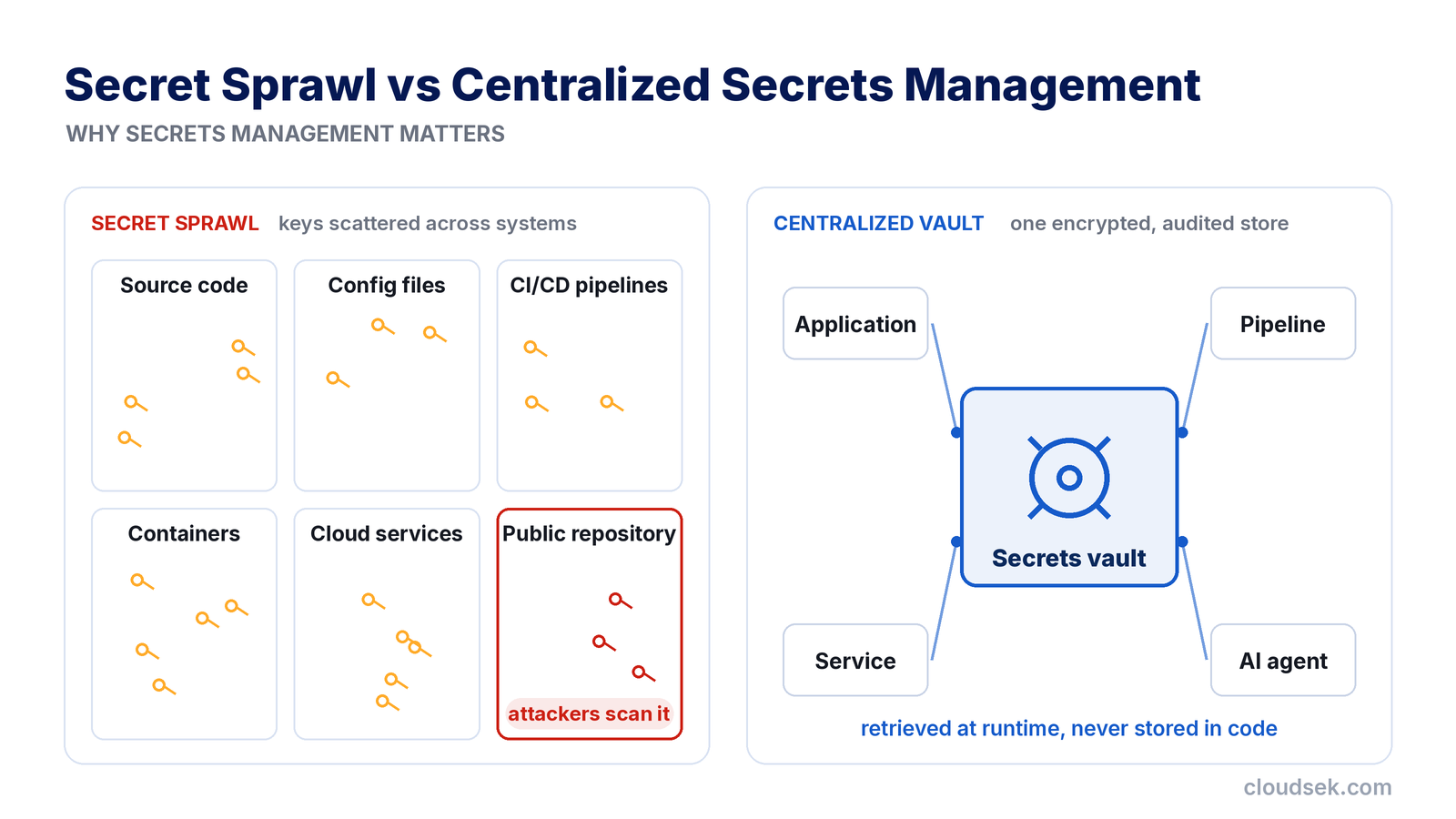
Modern software runs on thousands of secrets, and they multiply faster than teams keep track of them. Spread across source code, configuration files, CI/CD pipelines, containers, and cloud services, they create a condition known as secret sprawl. In that state, no one holds a full view of which secrets exist, where they live, or who has access to them.
The most common failure is the simplest: a developer hardcodes a key or commits a configuration file, and the secret lands in a repository for anyone to find. Security research has counted tens of millions of secrets leaked to public code repositories in a single year, a figure that roughly doubled in 2025 as AI coding assistants generated code faster than it could be reviewed.
A leaked secret rarely stays harmless. Attackers scan public repositories continuously, and a single exposed key has repeatedly led to full cloud-account takeover. CloudSEK's investigation into a company's exposed GitHub credentials traced how hardcoded secrets in a public repository put critical systems within an attacker's reach before the exposure was caught.
Secrets management replaces scattered, static credentials with a controlled lifecycle, built on four pillars.
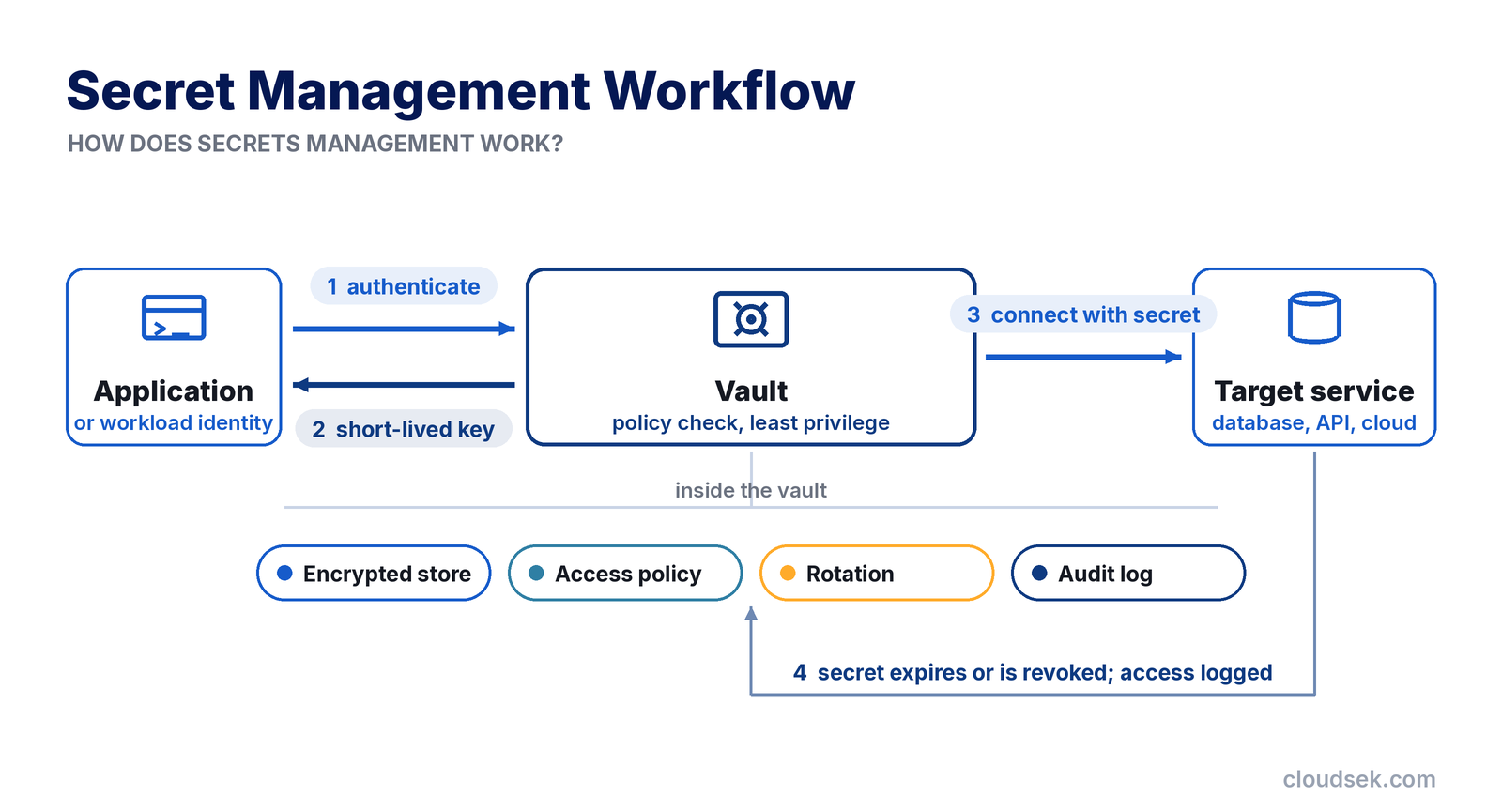
A secrets manager, or vault, stores every secret in one encrypted location instead of in code or configuration files. Applications retrieve secrets at runtime through an authenticated request, so the credential never lives in the source.
Fine-grained policies decide which identity reaches which secret. Role-based access control grants each application and person only the secrets they need, limiting the blast radius if any single identity is compromised.
Rotation replaces credentials on a schedule, so a stolen secret expires quickly. Dynamic secrets go further, generating a unique, short-lived credential for each request that is revoked automatically after use, leaving no long-lived secret to steal.
Every access is logged, creating a record of which identity used which secret and when. When a secret is exposed, or an identity is retired, it is revoked at once, cutting off access without disrupting the rest of the system.
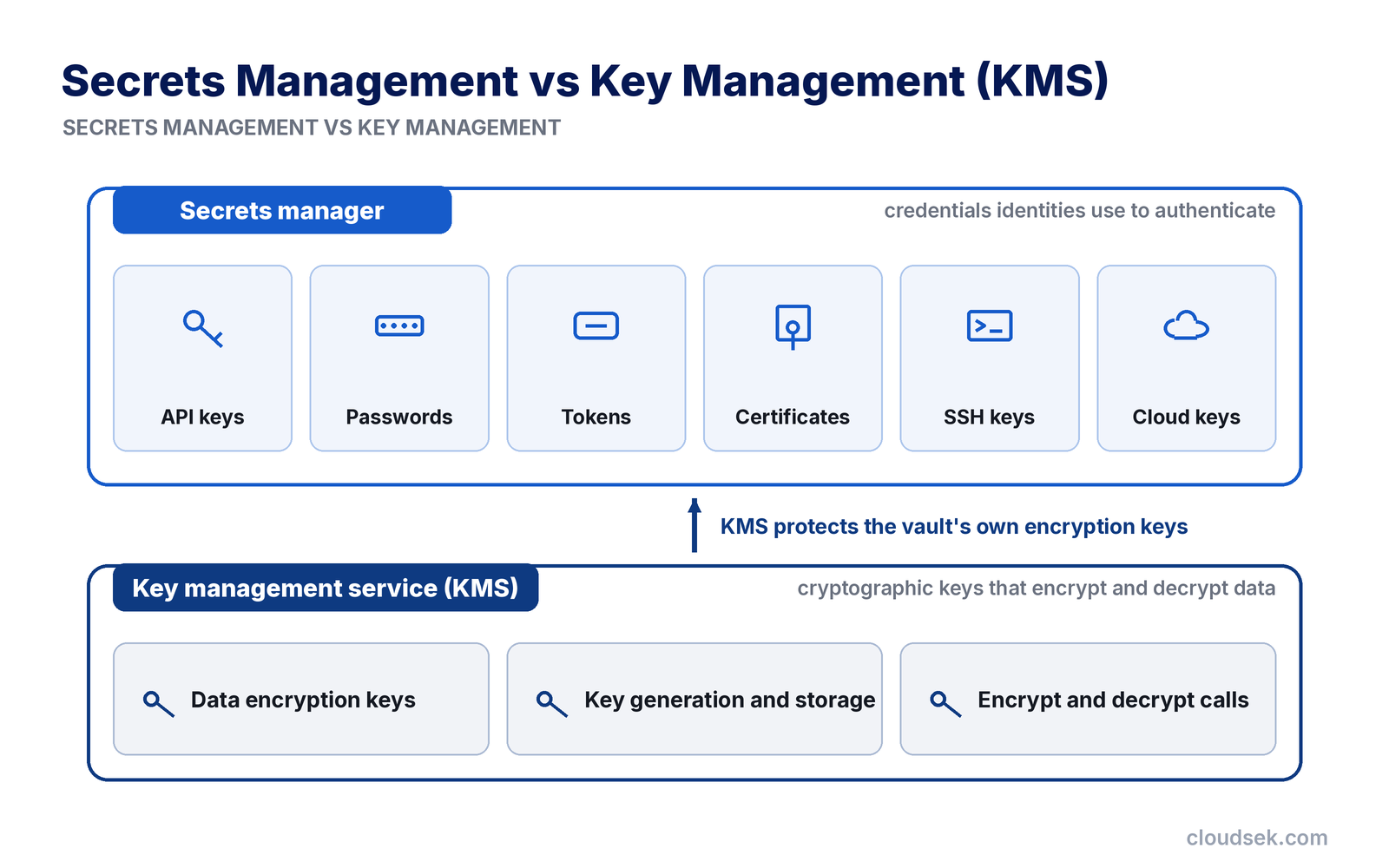
Secrets management and key management overlap without being the same. Secrets management handles the full range of credentials, API keys, passwords, tokens, and certificates that identities use to authenticate.
Key management, delivered through a key management service (KMS), focuses specifically on the cryptographic keys used to encrypt and decrypt data. A KMS often sits beneath a secrets manager, protecting the encryption keys that secure the vault itself, so the two work together rather than competing.
Managing secrets well is harder than storing them, and several obstacles recur:
These gaps carry real cost. In one 2025 breach, credentials stolen from a contractor in 2021 sat unrotated for years, until attackers used them to reach roughly 270,000 records, a failure of rotation and ownership rather than of any vault.
Effective secrets management follows a consistent set of practices, reflected in the OWASP guidance below:
Secrets management tools fall into a few categories, and many organizations combine them:
Secrets belong to machines far more than to people. Service accounts, workloads, containers, and automated pipelines each need credentials, and these non-human identities now outnumber human ones in most large organizations by a wide margin. OWASP's Non-Human Identities Top 10 places secret leakage near the top of that risk landscape.
Artificial intelligence has widened the surface again. AI agents, coding assistants, and the Model Context Protocol servers that connect models to tools all rely on API keys and tokens, often configured quickly and left exposed. CloudSEK's analysis of an unauthenticated MCP server showed how an exposed AI service led to stolen AWS credentials, a modern echo of the hardcoded-secret problem.
Password management secures human login passwords, while secrets management protects the machine credentials that applications and services use to authenticate. The two solve related problems for different identities.
Yes, but it is risky, because environment variables leak easily through logs, error messages, and process listings. A dedicated vault that injects secrets at runtime is safer.
Secrets need rotation on a regular schedule and immediately after any suspected exposure. Short-lived dynamic secrets reduce the need for manual rotation by expiring on their own.
IAM governs which identities exist and what they are allowed to do, while secrets management protects the credentials those identities use to prove who they are. The two work together.
No, any team that uses API keys, database credentials, or cloud services needs secrets management, regardless of size. Even a single leaked key risks a serious breach.
No, encryption protects a stored secret but does not handle access control, rotation, auditing, or revocation. Secrets management covers the full lifecycle, of which encryption is one part.
