🚀 أصبحت CloudSek أول شركة للأمن السيبراني من أصل هندي تتلقى استثمارات منها
اقرأ المزيد
.avif)

ROI in cybersecurity represents the measurable value gained from security investments compared to the costs incurred. Outcomes focus on reducing financial losses, improving operational efficiency, and minimizing risk exposure.
Most business investments generate ROI through increased revenue, but cybersecurity ROI comes from preventing losses and avoiding disruption. Value is driven by reduced breach impact, faster response, and stronger protection against evolving threats.
ROI is generated through a sequence of intelligence-driven actions that convert insights into measurable outcomes.
Calculating ROI requires structuring both cost and value into quantifiable components tied to real security outcomes and business impact.
Start by consolidating all direct and indirect costs, including licensing, integration effort, infrastructure, and analyst overhead required to operationalize intelligence. Total cost should reflect ongoing resource usage, not just initial investment.
Map historical incident data to estimate the average financial impact per security event, including downtime, recovery, and operational disruption. Value emerges by measuring how improved detection and response reduce both frequency and severity of incidents.
Measure improvements in analyst workflows by evaluating time saved in investigation, triage, and response processes. Translate those time savings into cost value using average labor cost per analyst.
Assess how intelligence reduces dwell time, limits attack surface exposure, and improves threat visibility across systems. Reduced exposure directly translates into avoided financial loss and operational disruption.
ROI = ((Total Benefits − Total Costs) / Total Costs) × 100
Final ROI combines cost avoidance, efficiency gains, and reduced risk into a single measurable output. This percentage reflects whether the investment delivers more value than it consumes.
Evaluate performance over a fixed period, typically 6 to 12 months, to capture integration maturity and workflow adoption. Consistent measurement across time provides a more reliable view of return.
Cost calculation breaks down when organizations treat threat intelligence as a tool expense instead of an operational capability.
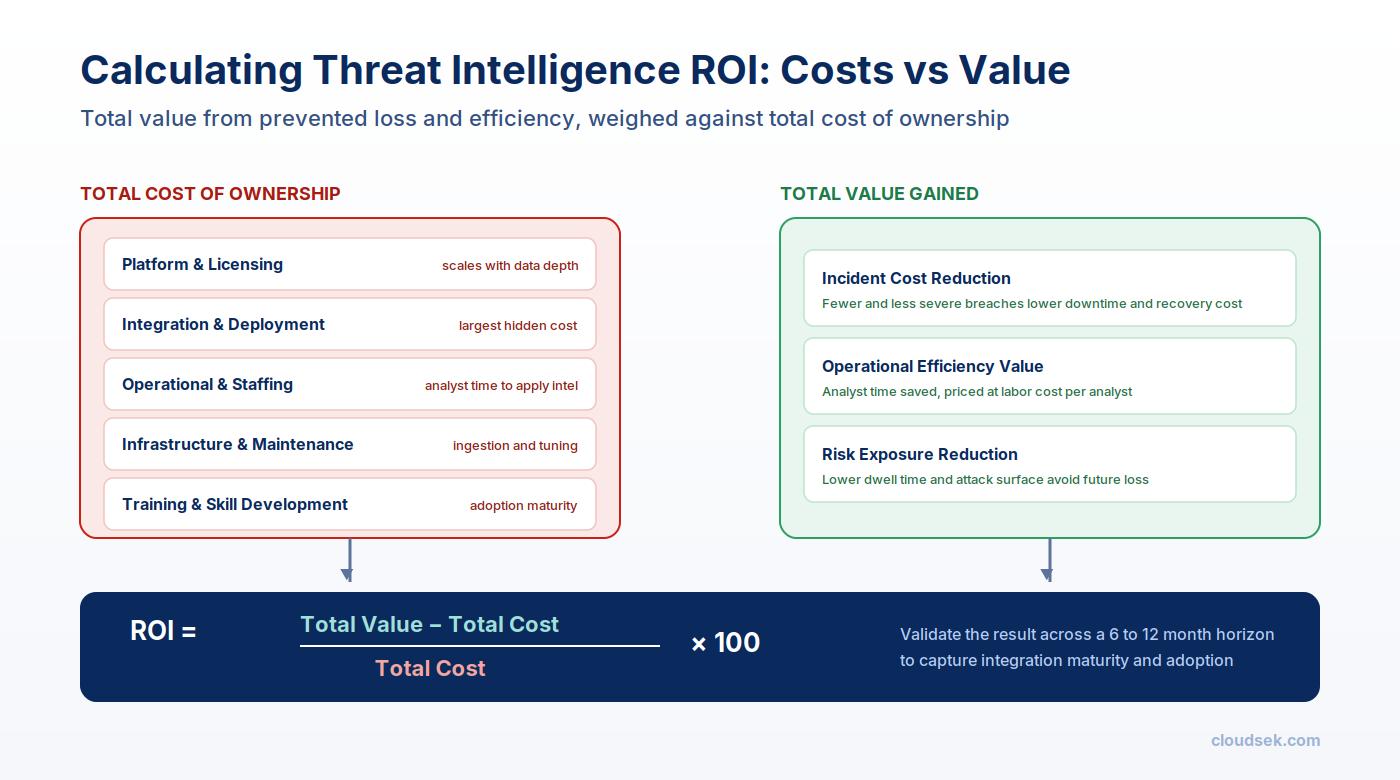
Licensing cost scales with intelligence depth, data enrichment, and the number of integrations required to make it usable. Lower-cost feeds often fail to deliver usable context, which shifts the burden to analysts and increases hidden operational cost.
Most of the actual investment sits in making intelligence usable inside existing detection and response workflows. Poor integration leads to intelligence sitting idle, which directly erodes any expected return.
Threat intelligence does not generate value on its own, it depends on how consistently teams apply it during investigations and response. If analysts spend time validating or reworking intelligence, operational cost increases without proportional return.
Continuous ingestion, correlation, and tuning require backend support that grows with data volume and system complexity. Without ongoing tuning, intelligence quality degrades, which reduces its impact on decision-making.
Value depends on how well teams can interpret intelligence and act on it without hesitation. Gaps in skill or process maturity slow down adoption and delay measurable return.
Return is not driven by features; it is driven by outcomes that directly reduce cost, time, and risk across security operations.
Time reduction in detection and response directly limits how far an attack can progress inside the environment. Shorter response cycles reduce containment cost and prevent escalation into high-impact incidents.
Consistent use of intelligence lowers the probability of successful attacks by identifying threats before execution. Even when incidents occur, earlier intervention reduces financial and operational damage, such as minimizing losses and ensuring quicker recovery times.
Noise reduction changes how teams allocate attention and effort during investigations. Fewer false positives mean less wasted time and more focus on threats that actually carry risk.
Efficiency gains show up when analysts can process more alerts and incidents without increasing headcount. Output increases not by working faster, but by removing friction from investigation workflows.
Automation removes dependency on manual validation and repetitive decision-making. Consistent execution of response actions reduces variability and improves overall operational reliability.
Decisions backed by contextual intelligence reduce uncertainty during incident handling. More accurate decisions lower the chances of misclassification, delayed response, or unnecessary escalation.
Impact extends beyond cost savings and reshapes how security influences business decisions, risk exposure, and operational continuity.
Security efforts begin to reflect actual business risk instead of generic threat coverage. Resources shift toward protecting systems and data that carry measurable financial impact.
Incident response decisions rely on contextual intelligence rather than fragmented signals. Fewer misjudgments reduce escalation, unnecessary actions, and cost amplification.
Consistent handling of threats reduces unexpected disruptions across systems and processes. Stable operations prevent cascading failures that affect productivity and service delivery.
Spending and effort move toward activities that deliver measurable outcomes instead of reactive workload. Reduced waste improves overall return without increasing budget.
Leadership gains a clearer view of risk exposure, incident patterns, and security performance. Strong visibility supports faster decisions without relying on assumptions or delayed reporting.
Organizations with controlled risk exposure build stronger trust with customers and partners. Reduced uncertainty supports growth without introducing operational instability.
Measurement only becomes useful when metrics are directly tied to cost impact, operational efficiency, and reduction in risk exposure.
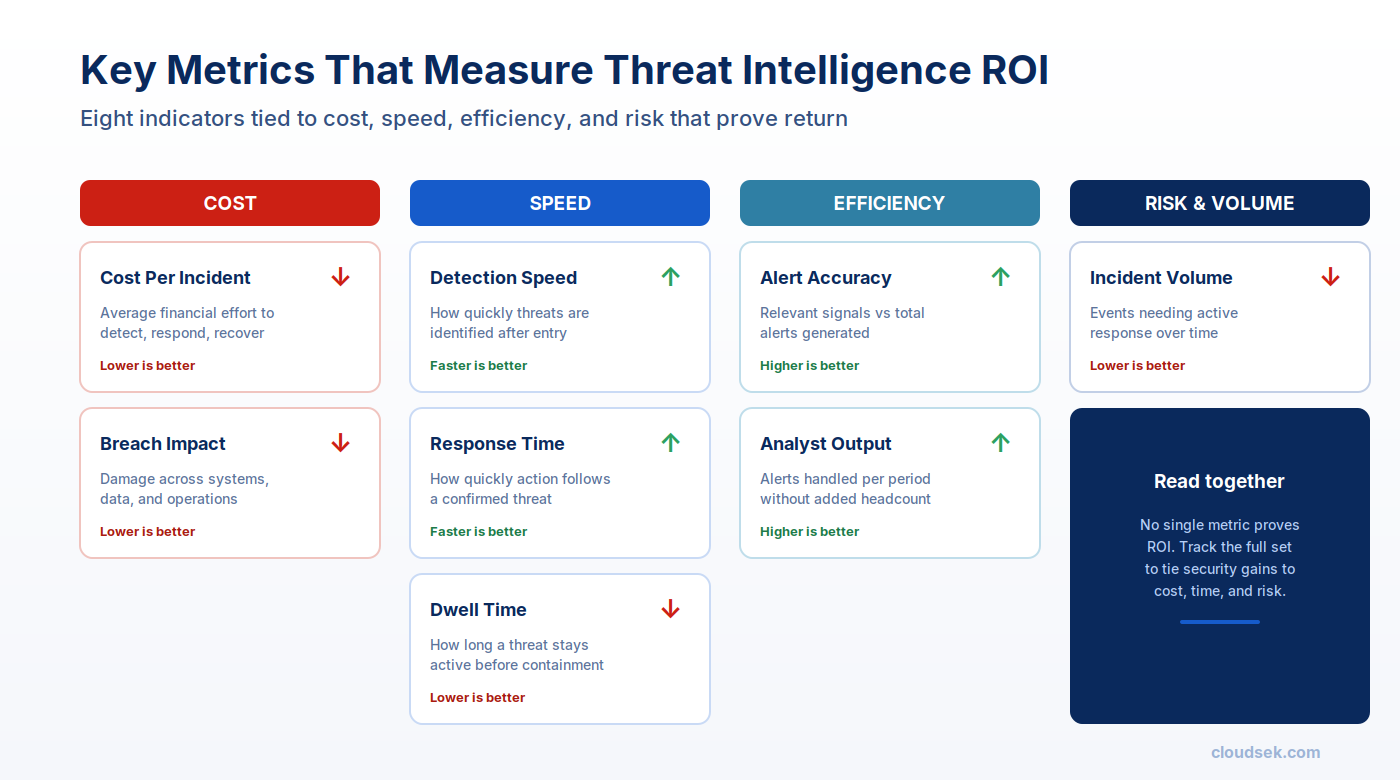
Cost per incident reflects the average financial effort required to detect, respond, and recover from a security event. Lower values indicate reduced effort and controlled impact across incidents.
Breach impact measures how much damage a successful incident causes across systems, data, and operations. Reduced impact signals stronger containment and limited financial exposure.
Detection speed captures how quickly threats are identified after entering the environment. Faster identification limits attacker activity and reduces remediation scope.
Response time measures how quickly action is taken once a threat is confirmed. Delayed response increases escalation risk and raises overall incident cost.
Dwell time tracks how long a threat remains active before detection and containment. Extended presence increases exposure, lateral movement, and recovery effort.
Alert accuracy reflects the proportion of relevant signals compared to total alerts generated. Higher precision reduces investigation effort and prevents resource drain.
Analyst output measures how many alerts or incidents can be handled within a fixed timeframe. Increased throughput without added staffing indicates stronger operational efficiency.
Incident volume tracks the number of security events that require active response over time. Declining volume suggests reduced attack success and lower operational workload.
Return does not appear instantly and depends on how quickly intelligence becomes part of daily security operations.
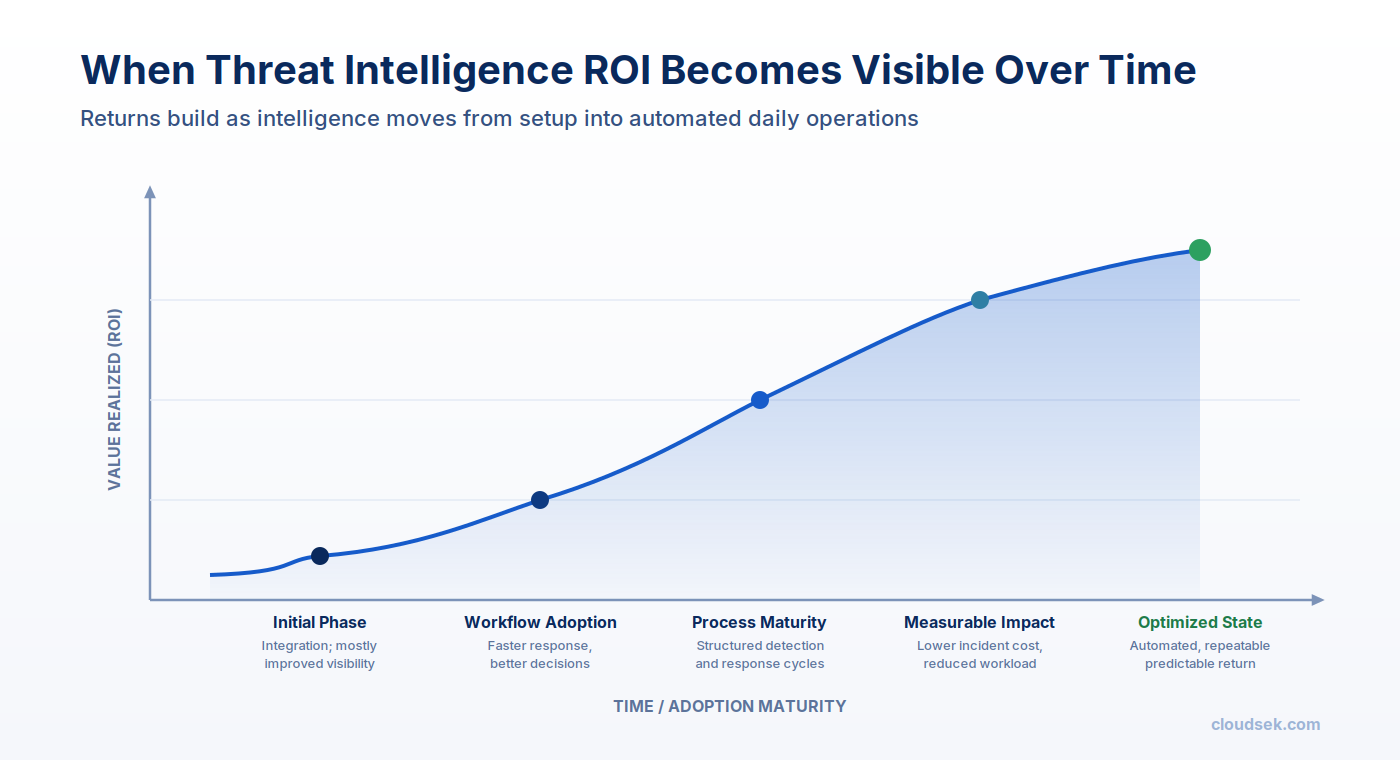
Early activity focuses on integrating intelligence into existing tools and workflows. Output during this stage is limited, with most value tied to improved visibility rather than measurable cost savings.
Teams begin using intelligence consistently during investigations and response actions. Increased usage starts reducing response time and improves decision quality across incidents.
Security processes become more structured as intelligence is embedded into detection and response cycles. Consistent execution reduces inefficiencies and begins to show measurable operational gains.
Cost reduction becomes visible through lower incident impact, reduced workload, and improved efficiency. Financial benefits start aligning with operational improvements at this stage.
Intelligence is fully integrated into automated workflows and decision-making processes. Sustained performance improvements lead to predictable and repeatable return over time.
CloudSEK improves ROI by shifting security operations from reactive response to predictive, intelligence-driven execution that lowers both cost and risk exposure. The platform detects initial attack vectors such as leaked credentials, exposed APIs, and compromised vendors at the point where they first appear, so teams act on early signals instead of paying for post-incident cleanup. AI-driven filtering and severity scoring cut alert volume before it reaches analysts, which keeps investigation hours pointed at threats that are real.
Automation across surface, deep, and dark web sources removes the manual effort behind continuous monitoring. XVigil covers more than 500 sources and defends against 200+ initial attack vectors across 8 attack surfaces, which eliminates the cost of running separate tools for each surface. Implementation cost stays controlled because CloudSEK intelligence pushes into existing workflows through 50+ application integrations, including ServiceNow for incident management and Cortex XSOAR for automated response playbooks, so security teams keep the stack they already own.
Financial value becomes visible when proactive detection prevents large-scale losses before they materialize. CloudSEK currently protects 400+ organizations across financial services, government, technology, and telecom, covering external risk monitoring, third-party risk visibility, and automated takedown workflows.
Faster detection and response time has the highest impact on ROI as it directly limits how far an attack can progress. Reduced dwell time lowers both financial damage and recovery effort.
ROI typically becomes measurable once intelligence is integrated into daily workflows and actively used during investigations. Visible impact often appears within a few months, while financial returns strengthen over time.
Smaller teams often see faster ROI due to immediate efficiency gains and reduced manual workload. Improved prioritization allows limited resources to focus on high-impact threats.
Cost reduction comes from preventing incidents, reducing investigation effort, and limiting response time. Avoided breaches and lower operational workload directly decrease total security spending.
Key indicators include reduced cost per incident, faster detection and response time, lower alert volume, and shorter dwell time. Consistent improvement across these metrics reflects measurable return.
