🚀 أصبحت CloudSek أول شركة للأمن السيبراني من أصل هندي تتلقى استثمارات منها
اقرأ المزيد
.avif)

Ransomware threat intelligence is the collection, analysis, and delivery of data on ransomware groups, their tactics, their infrastructure, and their victims, used to predict and disrupt attacks before encryption begins. It is a focused branch of cyber threat intelligence built around the extortion ecosystem.
In 2025, 138 ransomware groups claimed more than 7,300 victims, a 45 percent rise in a single year, which is why this discipline has become central to enterprise defense.
This guide explains what ransomware threat intelligence is, why it matters, its four types, what it tracks, where it comes from, how security teams use it, and how it differs from general threat intelligence.
Ransomware threat intelligence is the practice of gathering and analyzing information about ransomware operators and turning it into action that reduces risk. It tracks who the active groups are, how they break in, what vulnerabilities they exploit, which sectors they target, and where they publish stolen data. The output ranges from executive-level trend reports to machine-readable indicators that feed detection systems.
It is a specialized subset of broader threat intelligence. General threat intelligence covers every category of adversary, from nation-state espionage to commodity malware. Ransomware threat intelligence narrows the lens to the extortion economy: ransomware-as-a-service operators, their affiliates, the dark web leak sites where they name victims, and the negotiation and payment patterns that define how attacks end. This focus is what lets it deliver early warning that generic feeds cannot.
The people who rely on it span the security organization. Security operations teams use it to tune detection, threat intelligence analysts use it for attribution, incident responders use it to understand the group they are facing, and chief information security officers use it to brief leadership on sector risk. Third-party risk teams use it to judge which vendors are most exposed.
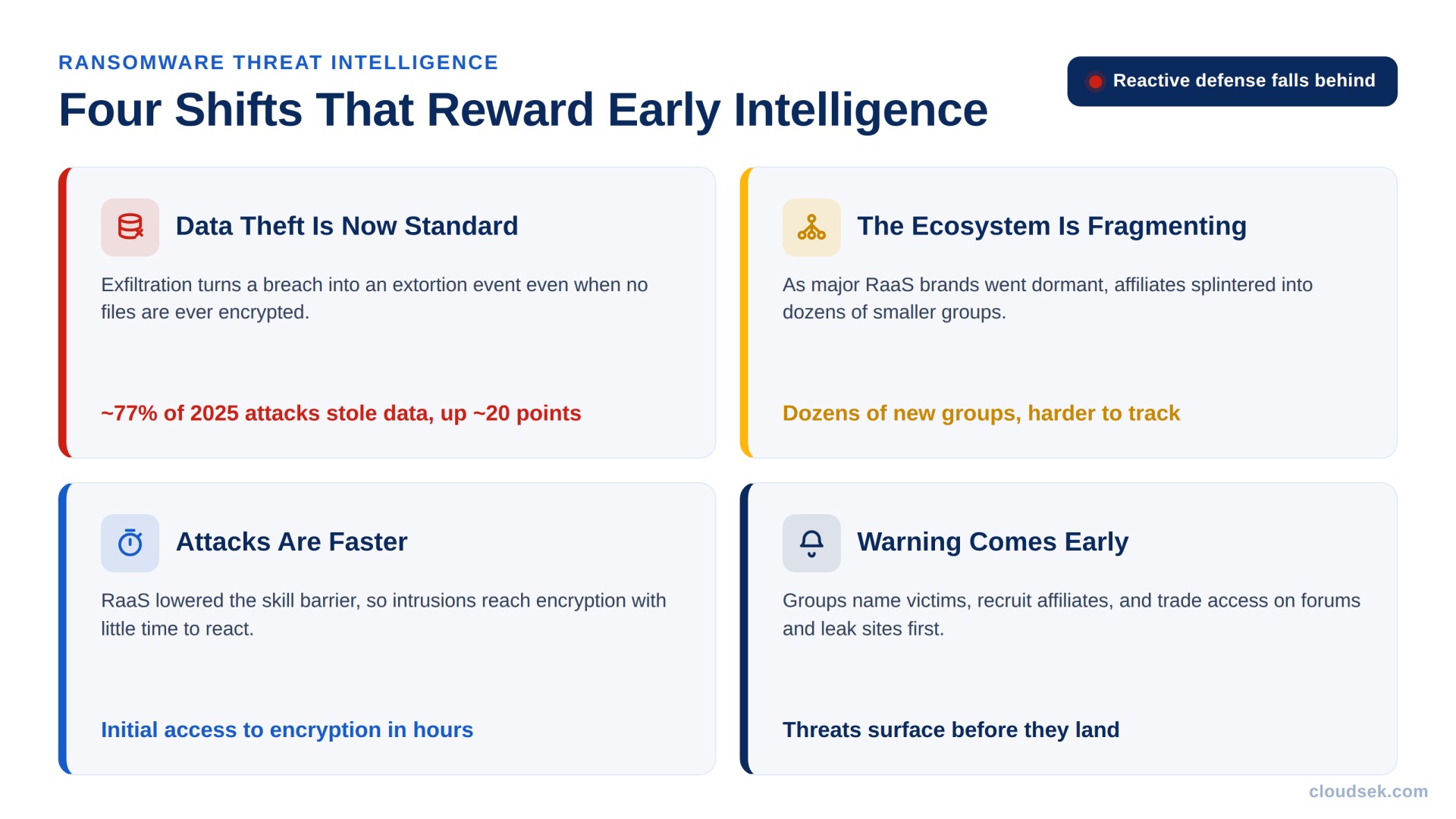
Ransomware threat intelligence matters because the threat is large, growing, and changing shape. Beyond the sheer volume of victims and active groups, the way attacks work has shifted in ways that reward early intelligence and punish a purely reactive defense.
Ransomware threat intelligence is delivered in four types, each serving a different audience and purpose.
Effective ransomware threat intelligence monitors six categories of activity that together describe the full extortion lifecycle.
Ransomware threat intelligence draws from sources that are distinct from generic threat feeds because the extortion ecosystem operates in its own venues. Most of these sit on the deep and dark web, which is why external threat intelligence collection is central to the discipline. The main sources appear below.
Monitoring these venues is continuous rather than periodic. Aggregated dark web Telegram channels that mirror ransomware operations let analysts identify new victims and anticipate sector-specific targeting as it develops.
Security teams put ransomware threat intelligence to work in five main ways, spanning prevention, detection, and response.
Ransomware threat intelligence and general threat intelligence share methods but differ in scope, sources, and output. The table below summarizes the distinction.
Ransomware threat intelligence is best understood as a deep specialization within threat intelligence, not a separate field. It applies the same analytical discipline to a single, high-impact threat where speed and source access decide whether an organization learns of a campaign in time to act.
Ransomware moves faster than any periodic report can keep up with, so CloudSEK Threat Intelligence treats it as a live feed rather than a quarterly summary. The platform monitors global ransomware activity with real-time alerts and impact assessments, identifies the sectors and vulnerabilities under active targeting, and tracks a database of more than 30,000 threat actors alongside the CVEs they are actively exploiting. Visibility is tailored to a customer's industry and region, so an alert reflects the groups that actually threaten that organization rather than the landscape at large.
That focus turns raw monitoring into lead time. When a group names a victim, weaponizes a new vulnerability, or steps up activity against a sector, the signal reaches defenders while there is still room to patch, reset access, and harden exposed systems. CloudSEK's own research into operators such as the Qilin ransomware group shows the depth behind those alerts, tracing attack agendas, techniques, and leaked data across the open, deep, and dark web so security teams can act before an intrusion escalates into encryption or extortion.
Ransomware threat intelligence is external knowledge about groups, tactics, and victims that predicts and contextualizes attacks. Detection is the internal capability that identifies an attack in progress. Intelligence makes detection sharper by telling it what to look for.
It monitors leak sites, forums, and Telegram channels where groups recruit affiliates, trade access, and name victims. These signals often appear before a target is breached or publicly disclosed, giving defenders time to harden systems and reset exposed access.
Ransomware leak sites are dark web pages where groups publish data stolen from victims who refuse to pay. They matter because they reveal which organizations have been hit, what data is exposed, and which groups and sectors are most active.
It cannot name a date, but it can estimate likelihood. By matching an organization's industry, region, technology, and exposed vulnerabilities against the groups actively targeting those traits, it identifies which organizations and vendors face elevated risk.
Ransomware-as-a-service rents attack tools to affiliates who split the proceeds with developers. It complicates intelligence because affiliates launch many small, short-lived operations, fragmenting the landscape into dozens of groups that are harder to track.
It identifies the group behind the attack and supplies its known tactics, typical ransom demands, and history of honoring agreements. That context shapes containment priorities and informs negotiation decisions during a live incident.
