🚀 أصبحت CloudSek أول شركة للأمن السيبراني من أصل هندي تتلقى استثمارات منها
اقرأ المزيد
.avif)

Executive impersonation is a social engineering attack in which a threat actor poses as a senior executive (CEO, CFO, or other C-suite leader) to deceive employees, partners, or customers into transferring funds, sharing sensitive data, or bypassing security controls. The executive is the lure, not the victim. The real targets are usually finance, accounts payable, HR, or legal staff who can move money, release data, or change account details.
It exploits authority and trust rather than technical vulnerabilities, which is why it slips past tools that scan for malicious links and attachments. Because these messages often carry no malware, link, or attachment, email gateways pass them straight to the inbox. The tactic is a form of spear-phishing.
The FBI Internet Crime Complaint Center recorded $2.77 billion in business email compromise losses across 21,442 complaints in 2024, and executive impersonation sits at the center of that category.
Executive impersonation is growing for two reasons that reinforce each other: executives now have large public digital footprints, and generative AI has made exploiting them cheap and convincing.
Every executive leaves a trail across the surface, deep, and dark web: LinkedIn profiles, interviews, press quotes, social posts, and leaked credentials. That trail hands an attacker the executive's role, writing style, voice, and relationships, which is everything needed to build a believable fake. The more visible the leader, the larger this external attack surface becomes.
Generative AI removes the last barrier. Fake voices and videos are now cheap and fast to produce, sharply lowering the bar for impersonation fraud. In January 2024, an employee at a Hong Kong firm wired $25 million after a video call with what turned out to be deepfakes of the CFO and colleagues. Deloitte projects generative AI could push US fraud losses from $12.3 billion in 2023 to $40 billion by 2027.
The takeaway reframes the problem. Executive impersonation is not only an email security issue. It is an external attack surface issue, built from the executive's exposed footprint and increasingly delivered through voice and video. The defense has to start where the attack does: outside the inbox.
Executive impersonation runs through four stages, from research to the final fraudulent request.
Attackers map the organization's hierarchy and communication patterns using LinkedIn profiles, company websites, press releases, and social media. They learn who reports to whom, who approves payments, and how executives phrase their requests.
Next comes the executive's identity, obtained or fabricated through three routes: registering a lookalike domain, harvesting leaked executive credentials from the dark web, or compromising the genuine account. This stage is where defenders have the earliest opportunity to detect an attack, because impersonation infrastructure often appears before the first fraudulent message is sent.
Attackers disguise the message origin through display-name spoofing, lookalike domains, or email authentication bypass. When an attacker controls a compromised genuine account, the message passes every technical authenticity check because it originates from real account infrastructure.
The attacker sends an urgent request that aligns with the executive's real responsibilities: approving a wire transfer, releasing employee tax records, or making an exception to policy. The request is timed for pressure and often reinforced across channels, with an email followed by a phone call or a message on a collaboration platform.
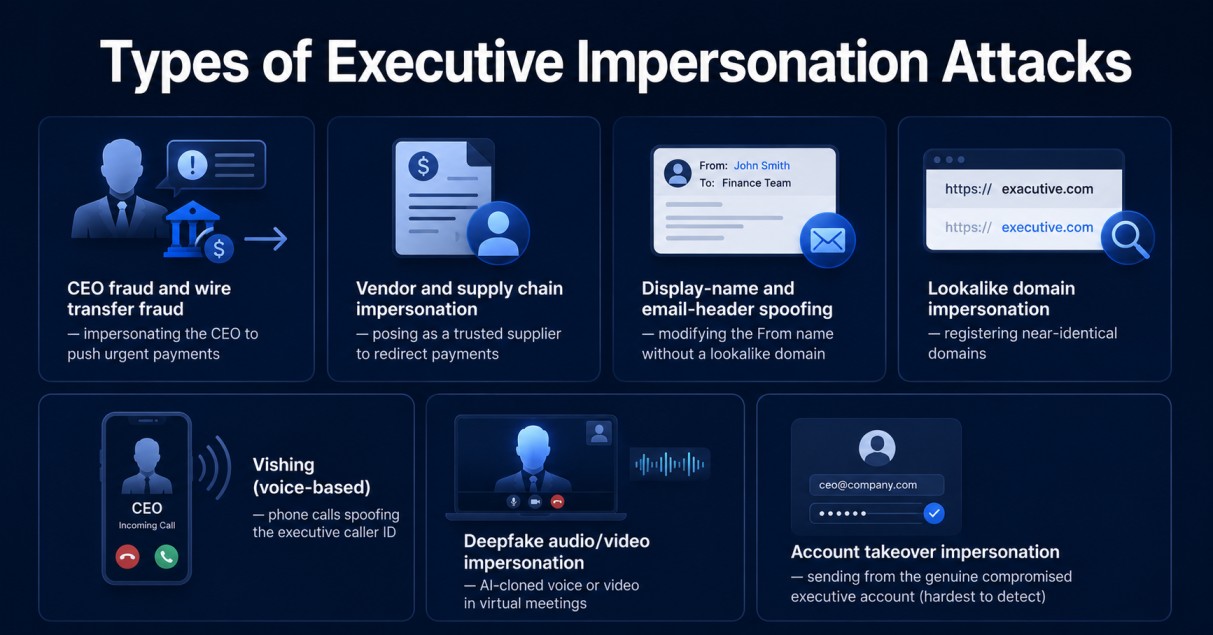
Executive impersonation takes seven common forms, each establishing trust through a different method.
Posing as the chief executive, the attacker sends urgent payment requests to finance staff, often citing a confidential acquisition or time-sensitive deal.
A trusted supplier is mimicked to redirect invoice payments or change bank account details, with the request timed to coincide with normal billing cycles.
By modifying the sender's display name, a message from an unrelated address appears to come from a named executive, exploiting clients that hide the underlying address.
A near-identical domain (such as a swapped or added character) is registered so the sender address survives casual inspection.
Phone calls spoof the executive's caller ID while requesting an urgent payment from a finance or HR employee, operating outside email visibility.
An AI-cloned voice or video reinforces a fraudulent request in a phone call or virtual meeting, lending it a familiar face and voice.
The fraudulent request arrives from the executive's genuine, compromised account, which is the hardest variant for email security tools to detect.
These four terms in this space overlap and are frequently confused. The distinction that matters most is direction: in whaling, the executive is the victim, while in executive impersonation, the executive is the disguise.
Executive impersonation is a descriptive tactic rather than a formal category in security frameworks. CEO fraud is the most common financial form, whaling runs in the opposite direction by targeting the executive, and BEC is the broad reporting category the FBI uses to track all of it.
Five documented cases show the financial scale of executive impersonation and the methods attackers used.
Beyond these public incidents, CloudSEK's investigation of CEO impersonation campaigns documented attackers impersonating chief executives over WhatsApp, using the executives' publicly available photos as profile pictures to pressure employees into fraudulent payments.
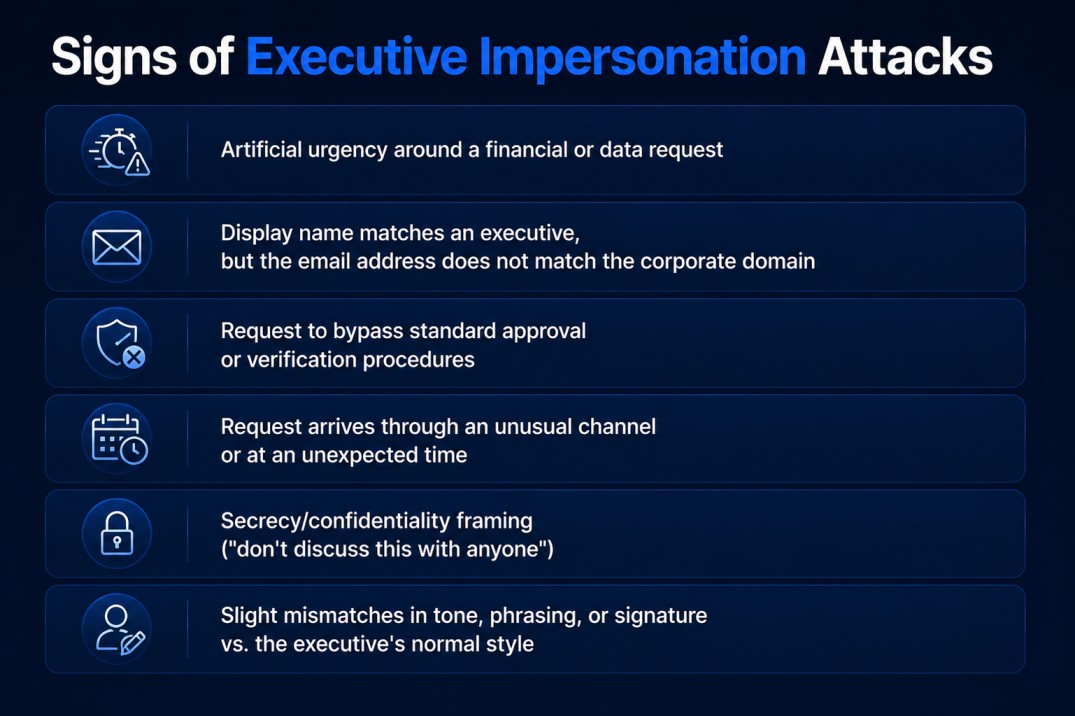
Six signals indicate a message or call may be an executive impersonation attempt.
Defending against executive impersonation works in two layers: spotting the attack early through visibility, and stopping it through controls and verification so no single request can succeed on its own.
Most executive impersonation defenses act at the moment the fraudulent message arrives. CloudSEK XVigil acts earlier, during the preparation stage, by detecting the infrastructure that attackers assemble before the first request is ever sent. The platform continuously monitors for newly registered lookalike domains, fake executive profiles on social media, leaked executive credentials surfacing on the dark web, and brand-impersonation assets across the surface, deep, and dark web.
That early visibility changes the defender's position. A lookalike domain flagged the day it is registered can be taken down before it sends a single email. A leaked executive credential surfaced on a dark web market can be reset before it enables an account takeover. XVigil pairs this monitoring with end-to-end takedown support, so impersonation domains, fake apps, and fraudulent profiles are removed from circulation rather than left active for attackers to weaponize.
Phishing is usually broad and relies on malicious links or attachments. Executive impersonation is targeted and typically carries no malware, using a senior leader's authority to make a payment, data, or policy request look legitimate.
Because authority and recognizability make the request work. Employees recognize a high-profile leader and are more likely to trust and act on the message, and an executive can plausibly demand urgent payments or policy exceptions that a junior name could not.
No. It increasingly spans phone calls, collaboration platforms, social media, and deepfake video, so defenses limited to email leave clear gaps. The 2024 Hong Kong case used a deepfake video call, not an email.
Yes. Attackers create fake executive profiles on platforms like LinkedIn and messaging apps, often using the leader's real photo, to reach employees or customers outside any email security control. CloudSEK has documented CEO impersonation run over WhatsApp using executives' public photos.
Pause and verify the request through a separate trusted channel, such as calling a known number rather than replying. A clear, blame-free reporting process helps staff raise concerns quickly.
Yes. It involves wire fraud, identity fraud, and related crimes that carry criminal penalties in most jurisdictions. The FBI tracks these attacks under business email compromise and pursues international enforcement against the networks behind them.
