🚀 أصبحت CloudSek أول شركة للأمن السيبراني من أصل هندي تتلقى استثمارات منها
اقرأ المزيد
.avif)

A data leak is when sensitive information becomes exposed due to weak security settings, human mistakes, or system gaps. Private data ends up accessible to people who were never meant to have access.
Such situations often go unnoticed since no direct attack takes place during the exposure. Information can remain openly available across systems or platforms until someone eventually discovers it.
Risks increase significantly when large volumes of data stay exposed for extended periods. According to researchers at CloudSEK, a 2025 incident exposed 6 million records from Oracle Cloud, affecting over 140,000 tenants, highlighting how severe the impact of a single leak can be.
Data leaks occur when gaps in security allow sensitive information to become exposed in digital systems. These gaps often come from misconfigured settings, poor access controls, or simple human errors.
Cloud environments are a common source of leaks, especially when storage systems are left publicly accessible. Internal actions like accidental sharing or weak password practices can also expose critical data without immediate detection.
Third-party integrations and outdated systems further increase the risk by creating unnoticed vulnerabilities. Over time, these small weaknesses combine to create entry points where sensitive information can quietly become visible.
Although the terms are often used interchangeably, data leaks and data breaches are different security incidents.
A data leak occurs when sensitive information is unintentionally exposed due to misconfigurations, weak access controls, software flaws, human error, or accidental sharing. The exposure may exist for days or even months before anyone notices, and it does not necessarily involve a malicious attacker.
A data breach, on the other hand, occurs when an unauthorized individual intentionally accesses, steals, or exfiltrates sensitive information. Most breaches involve an active attack, such as compromised credentials, malware, ransomware, or exploitation of vulnerabilities.
In many cases, a data leak becomes the starting point for a data breach. An attacker may discover an exposed cloud storage bucket, leaked credentials, or an unsecured database and then use that information to gain deeper access into an organization's environment.
Understanding the difference is important because preventing data leaks reduces the opportunities attackers have to execute successful data breaches.
Threat intelligence detects data leaks through continuous monitoring, analysis, and real-time identification of exposed sensitive information.
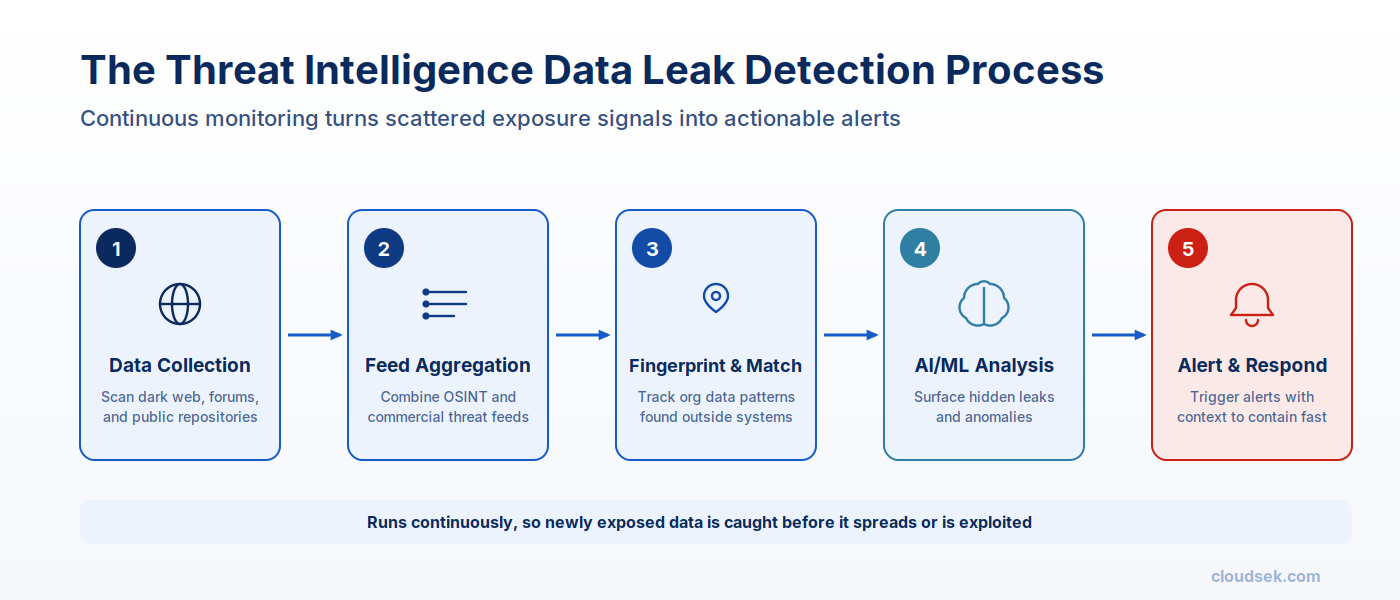
Monitoring begins with scanning environments where leaked data commonly appears, including dark web forums, marketplaces, and public repositories. These sources often contain exposed or traded information linked to organizations.
Multiple data sources are combined through open-source and commercial threat feeds to improve visibility. Aggregation helps connect scattered data points and identify patterns across different environments.
Threat intelligence platforms use hashes, unique identifiers, regular expressions, metadata, and digital fingerprints to identify sensitive information or known datasets when they appear outside authorized environments. Matches found outside secure environments indicate potential exposure that needs attention.
AI and machine learning help prioritize findings, correlate related indicators, reduce false positives, and identify anomalous patterns across large datasets, enabling analysts to investigate potential data leaks more efficiently.
Detected leaks trigger alerts with relevant context for security teams to act quickly. Faster response helps contain exposure and reduce overall impact.
Sensitive data can appear across different layers of the internet and internal systems, which makes broad monitoring essential.
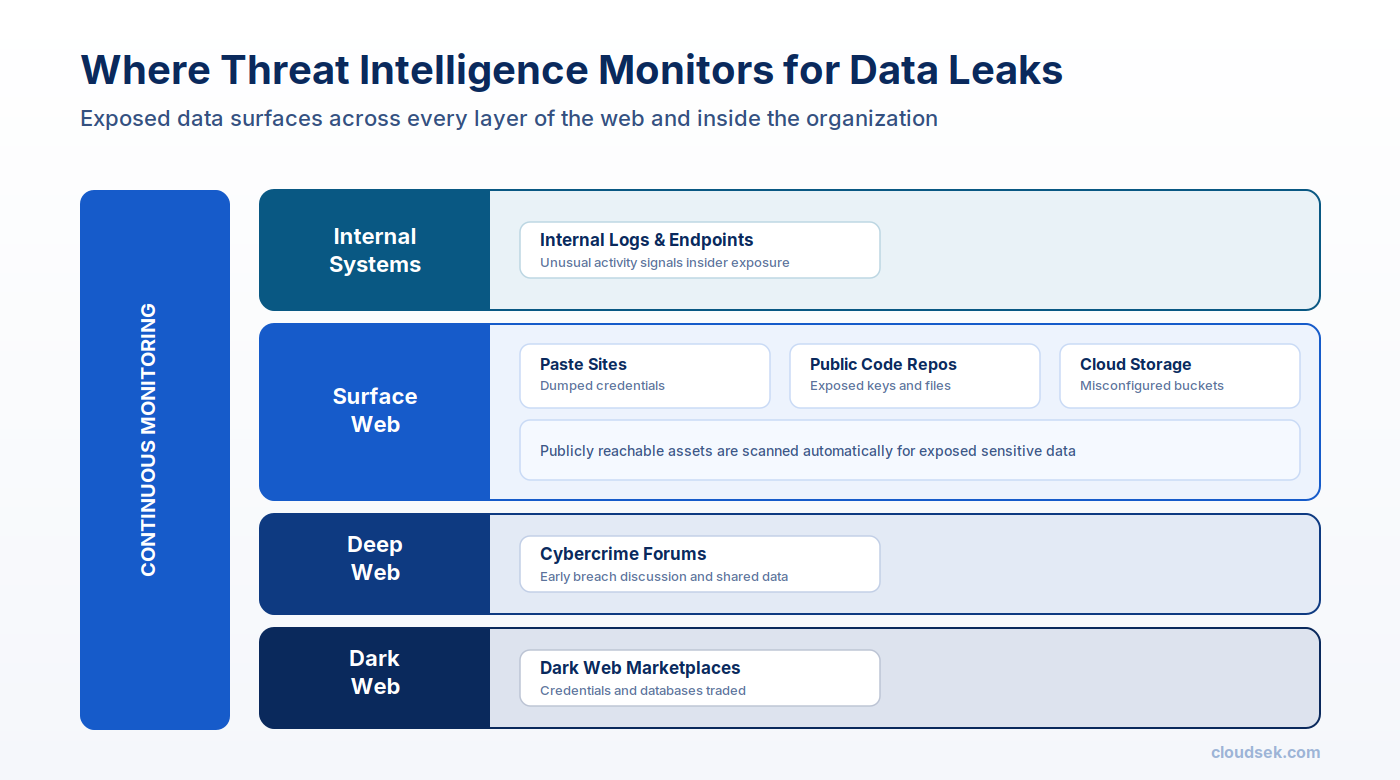
Leaked data is often sold or shared in hidden marketplaces where threat actors trade credentials, databases, and access. Continuous monitoring helps uncover these listings early.
Hackers frequently discuss breaches and share exposed data in closed or semi-private forums. These platforms provide early signals of potential leaks.
Public paste platforms are commonly used to dump leaked credentials or snippets of sensitive data. Automated scanning helps detect such exposures quickly.
Developers sometimes accidentally expose API keys, credentials, or sensitive files in repositories. Monitoring these platforms helps catch leaks caused by human error.
Misconfigured cloud buckets and open databases are a major source of data leaks. Regular scanning identifies publicly accessible storage containing sensitive information.
Modern data leak detection relies on a combination of security tools that work together to identify and respond to exposed information.
Threat platforms collect and organize threat data from multiple sources into a single view. Correlation across datasets helps identify patterns linked to potential leaks.
SIEM platforms correlate security logs and events to detect suspicious activity that may indicate a data leak or compromise, such as unusual authentication attempts, abnormal data transfers, or unauthorized access.
DLP solutions monitor, classify, and control sensitive data in use, in motion, and at rest, helping prevent unauthorized transmission or sharing of confidential information. Know DLP best practices.
Behavioral analytics focuses on identifying unusual user activity within systems. Sudden changes in access patterns can signal insider threats or compromised accounts.
External monitoring tools scan the internet for exposed assets and leaked data. Early detection across public sources reduces the risk of widespread impact.
Minimizing the impact of exposed sensitive information depends heavily on how quickly and effectively it is identified.
Leaked data can be discovered quickly before it spreads across public or hidden platforms. Faster detection limits the chances of misuse or exploitation.
Many regulations require organizations to monitor and protect sensitive data. Continuous detection helps meet compliance standards and avoid penalties.
Monitoring for leaks shifts security from reactive to preventive. Organizations gain visibility into risks before they turn into full-scale incidents.
Timely alerts provide security teams with the context needed to act quickly. Faster response reduces exposure time and limits overall impact.
Detecting exposed sensitive information becomes difficult due to the scale, complexity, and evolving nature of digital environments.
Large amounts of data are generated and processed across systems every second. Identifying meaningful signals within this volume often becomes time-consuming and resource-intensive.
Detection systems can flag harmless activity as potential threats. Excessive alerts make it harder for security teams to focus on real risks.
Sensitive information is sometimes hidden using encryption or obfuscation techniques. This makes it harder to identify whether exposed data is truly at risk.
Attackers constantly change how they share and hide leaked data across platforms. Detection methods need continuous updates to keep up with these changes.
Not all environments provide full access for monitoring and analysis. Gaps in visibility can leave certain exposures undetected for longer periods.
CloudSEK XVigil continuously monitors an organization's external digital footprint to identify indicators of data exposure before they escalate into larger security incidents. Rather than waiting for customers or regulators to report leaked information, XVigil searches for early warning signals across the open, deep, and dark web.
The platform continuously monitors cybercrime forums, dark web marketplaces, Telegram channels, paste sites, public code repositories, cloud storage exposures, and other publicly accessible sources where threat actors commonly advertise or share compromised data.
Using AI-assisted correlation, digital fingerprinting, and threat intelligence enrichment, XVigil identifies leaked credentials, exposed API keys, sensitive documents, customer records, source code, databases, and references to an organization's domains, brands, or employees. Findings are validated and prioritized based on severity, credibility, and potential business impact.
When a potential data leak is detected, XVigil provides contextual alerts that include the source of exposure, the type of affected data, associated threat actors (where known), and recommended remediation actions. This enables security teams to investigate quickly, contain the exposure, rotate compromised credentials, notify affected stakeholders, and reduce the likelihood of the leak progressing into a full-scale breach.
By combining continuous external monitoring with actionable threat intelligence, CloudSEK XVigil helps organizations discover data leaks earlier, shorten response times, and strengthen overall cyber resilience.
