🚀 أصبحت CloudSek أول شركة للأمن السيبراني من أصل هندي تتلقى استثمارات منها
اقرأ المزيد
.avif)

Cyber resilience is the ability of an organization to prepare for, withstand, respond to, and recover from cyberattacks while continuing operations. Cyber resilience accepts that attacks will happen and keeps critical services running during and after an incident.
Traditional security aims to stop threats before they happen. Cyber resilience combines prevention, detection, response, and recovery into one approach, so the goal shifts from only defending systems to maintaining business continuity throughout an attack.
Cyber resilience applies across networks, cloud systems, endpoints, and data environments. Even when a system is compromised, critical services stay available, which reduces downtime, limits damage, and speeds recovery.
Cyber resilience focuses on maintaining operations during and after attacks, while cybersecurity focuses on preventing attacks before they happen.
Cybersecurity protects systems, networks, and data with tools and controls that block attacks and reduce vulnerabilities. Cyber resilience takes a broader view. It accepts that some attacks succeed and keeps systems functioning, responding, and recovering. Cybersecurity acts as the defensive layer, and cyber resilience keeps the business running when that layer fails.
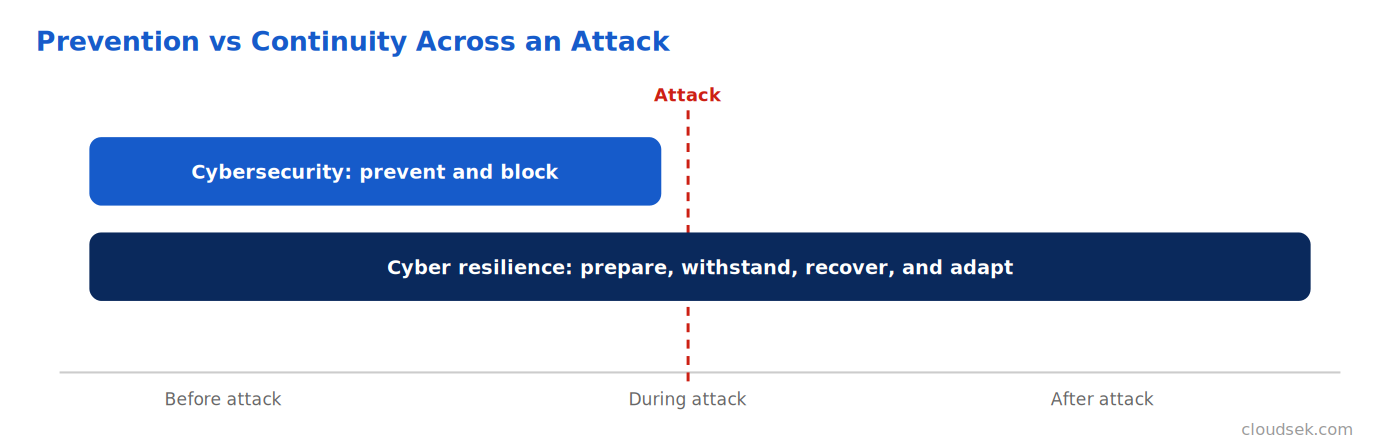
Cyber resilience matters because attacks are inevitable, and an organization needs to keep operating during and after an incident. Modern threats bypass traditional defenses, exploit vulnerabilities, and disrupt systems, and when systems fail, operations stop, revenue falls, and customer trust erodes.
The scale of disruption is documented. IBM's Cost of a Data Breach Report 2025 found that 86% of breached organizations reported operational disruption, which is exactly the loss cyber resilience is built to prevent. Cyber resilience delivers six measurable benefits:
Cyber resilience rests on five components that organizations put in place as building blocks. These are the capabilities; the next section shows how they operate as a continuous process.
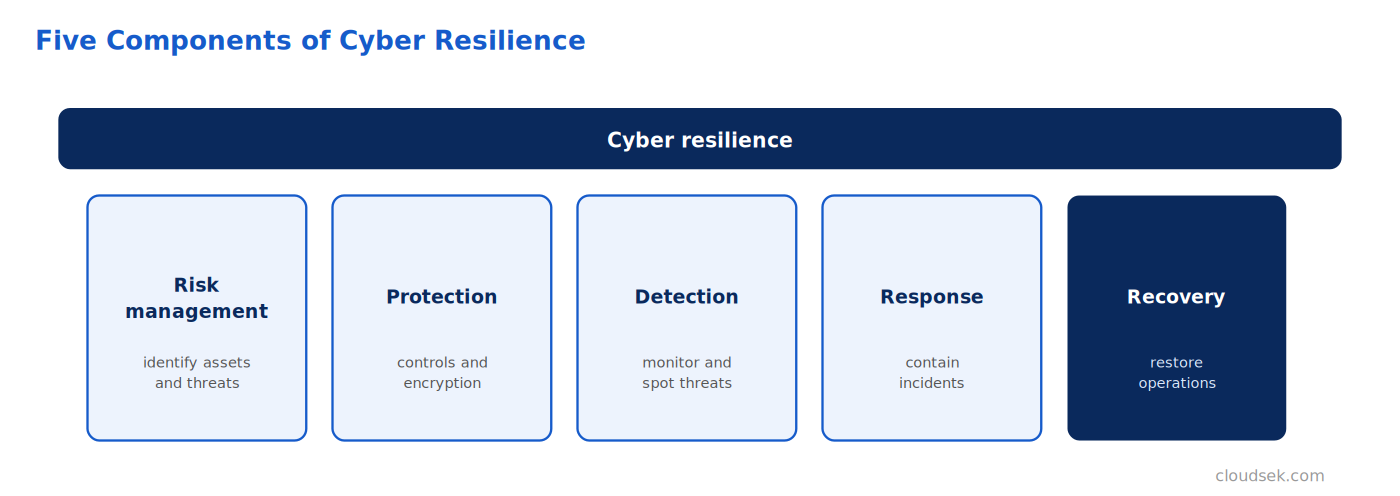
Risk management identifies critical assets, threats, and vulnerabilities across the environment. Organizations classify data, map systems, and assess exposure, so high-risk areas receive priority protection.
Protection mechanisms secure systems and data through access controls, encryption, endpoint security, and network defenses. Layered protection limits entry points and blocks unauthorized access to critical resources.
Detection capabilities give real-time visibility into system activity. Monitoring tools analyze logs, user behavior, and network traffic to identify anomalies, which reduces attacker dwell time and limits the spread of an attack.
Response planning defines clear actions for security incidents, including roles, communication steps, and containment procedures. Well-defined processes drive fast, coordinated action during an attack.
Recovery processes restore systems, applications, and data after disruption. Backups, disaster recovery plans, and failover mechanisms return operations to normal quickly and maintain service availability.
Cyber resilience runs as a continuous lifecycle. Where the components are the building blocks, the lifecycle is how they operate over time, looping back so each incident strengthens the next response.
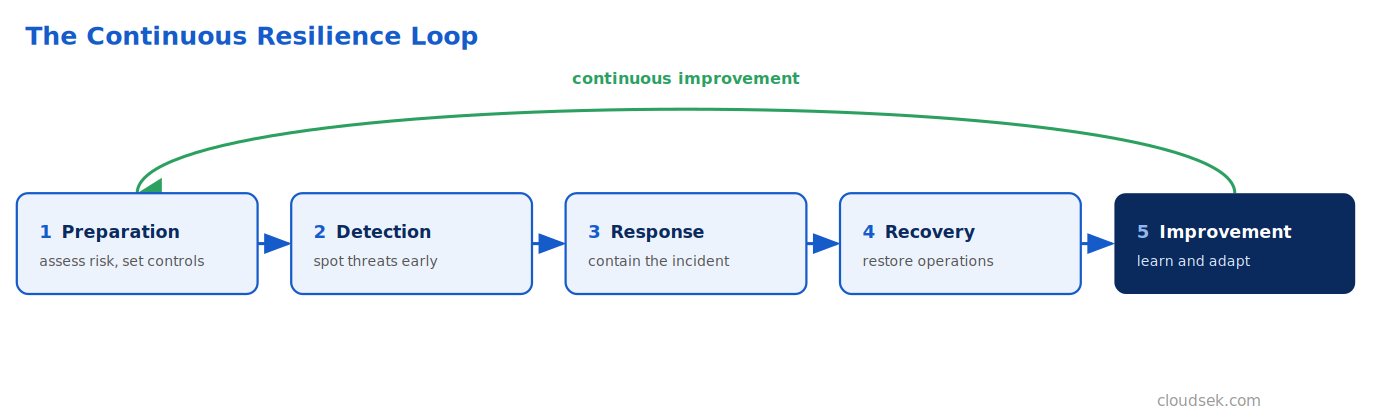
Preparation builds the foundation before an attack. Organizations identify critical assets, assess risks, and put security controls in place so systems stay ready for likely threats.
Detection identifies threats as they occur. Monitoring tools track system activity, user behavior, and network traffic, which surfaces attacks before they cause major damage.
Response contains and manages the incident. Security teams isolate affected systems, stop malicious activity, and prevent further spread, which reduces impact and disruption.
Recovery restores systems and data after an incident. Backups and recovery plans return operations to normal quickly, which minimizes downtime and business impact.
Improvement strengthens future resilience. Organizations analyze what happened, fix weaknesses, and update strategies, which lowers the risk of similar attacks and closes the loop back to preparation.
Five challenges affect visibility, coordination, and real-world readiness during cyber incidents.
On-premise systems, cloud platforms, and hybrid infrastructures each use different tools and controls. Managing security across these layers reduces visibility and slows detection and response.
Attackers use ransomware, zero-day exploits, and social engineering to bypass defenses. The constant change requires ongoing updates, monitoring, and adaptation.
Limited budget, skilled staff, and tooling weaken defenses. Many organizations lack experienced security teams, which reduces their ability to monitor systems and respond quickly.
Disconnected security tools fail to share data, which creates visibility gaps and slows analysis. Poor coordination between teams delays response and increases impact.
Without validation, incident response and recovery plans fail when a real incident hits. Regular simulations and drills reveal gaps and improve readiness.
Seven strategies build cyber resilience across systems, visibility, and recovery.
Strong access controls restrict access by role, and the principle of least privilege limits users to what they need. This contains the impact of compromised credentials and prevents unauthorized lateral movement.
Continuous monitoring gives real-time visibility across endpoints, networks, and cloud systems. Tracking user behavior and system activity surfaces anomalies early and shortens attacker dwell time.
Incident response plans define clear actions for cyber incidents, including roles, communication steps, and containment procedures. A structured response lets teams act quickly and reduce damage.
Secure, regular backups protect critical information and support business continuity. Reliable recovery processes restore data quickly after ransomware or data loss, which reduces downtime.
Regular risk assessments identify vulnerabilities and weaknesses across infrastructure, applications, and processes. Continuous assessment prioritizes security improvements and lowers risk.
Employee awareness reduces human-related risks such as phishing and social engineering. Training teaches users to recognize suspicious activity and respond correctly, which makes them a first line of defense.
Simulation exercises such as ransomware drills and incident response tests show how systems and teams react to real scenarios. These exercises reveal gaps and improve readiness for actual incidents.
Cyber resilience relies on integrated tools that provide visibility, access control, detection, and fast recovery.
SIEM platforms collect and correlate data from networks, endpoints, and applications. Centralized logging detects suspicious activity in real time and supports faster investigation.
EDR solutions monitor endpoint activity such as processes, file changes, and user actions. Endpoint-level visibility identifies threats early and enables quick containment.
Backup and recovery systems store secure copies of critical data across isolated environments. Regular backups restore data after ransomware or system failure, which reduces downtime.
Threat intelligence platforms supply current information on attacker tactics, techniques, and infrastructure, including malicious IPs and domains. Current intelligence improves detection accuracy and strengthens response decisions.
IAM systems control authentication and access, enforcing policies such as multi-factor authentication and role-based access. Strong identity control reduces unauthorized access and limits the impact of compromised accounts.
Most of cyber resilience runs inside the organization through backup, failover, and incident response. The preparation stage depends on knowing what is coming from outside. CloudSEK Threat Intelligence strengthens that stage. It tracks threat actors, exploited CVEs, ransomware activity, and dark web exposure relevant to an organization's sector, so teams prepare for the threats most likely to reach them.
CloudSEK Nexus AI extends this by correlating external exposure, leaked credentials, and threat activity into predictive attack paths. Knowing the routes attackers would take helps teams harden the highest-impact weaknesses before an incident, which reduces how often the response and recovery stages get tested.
CloudSEK works outside the network and complements the backup, recovery, and incident response controls at the core of cyber resilience rather than replacing them.
The main goal of cyber resilience is to maintain operations and recover quickly from cyberattacks.
No. Cyber resilience includes cybersecurity but extends to response, recovery, and continuity after an attack.
The five key components of cyber resilience are risk management, protection, detection, response, and recovery.
Cyber resilience is important for businesses because it keeps operations running during cyber incidents and reduces downtime, financial loss, and reputational damage.
Cyber resilience is achieved through preparation, continuous monitoring, incident response, and recovery planning, tested regularly through simulations.
Threat intelligence supports cyber resilience by giving early warning of the threats most likely to target an organization, which strengthens the preparation and detection stages before an attack begins.
