🚀 أصبحت CloudSek أول شركة للأمن السيبراني من أصل هندي تتلقى استثمارات منها
اقرأ المزيد
.avif)

Continuous Attack Surface Management (CASM) is a cybersecurity process that continuously discovers, analyzes, and reduces all exposed digital assets in real time.
Organizations operate across cloud platforms, SaaS tools, and external services, which creates a constantly changing digital footprint. This footprint includes domains, IP addresses, APIs, and applications. Many organizations lack visibility into a significant portion of these assets, which increases exposure because attackers actively scan for unknown and unmanaged entry points.
CASM maintains real-time visibility and evaluates risk from an external perspective. The approach identifies exploitable weaknesses such as misconfigurations, open ports, and outdated systems. Continuous monitoring paired with ongoing remediation reduces unnecessary exposure and shrinks the window in which an attacker can identify and exploit an initial access vector.
Modern digital environments expand faster than traditional security visibility allows. Cloud adoption, SaaS usage, and remote work continuously add internet-facing assets, including applications, APIs, and cloud resources that change daily. Rapid expansion creates gaps because new assets often remain untracked or unmanaged.
Attackers actively search for these gaps. Unknown or forgotten assets become primary targets because they lack monitoring and security controls. A single exposed test subdomain, a misconfigured storage bucket, or an unmaintained vendor integration can become the initial access vector for a much larger compromise.
CASM addresses this by maintaining real-time awareness of all exposed assets, which aligns defensive effort with how attackers actually operate. The practical outcomes include:
CASM works through a structured six-stage process that delivers visibility, accurate risk detection, and continuous risk reduction. Each stage corresponds to a core CASM capability.
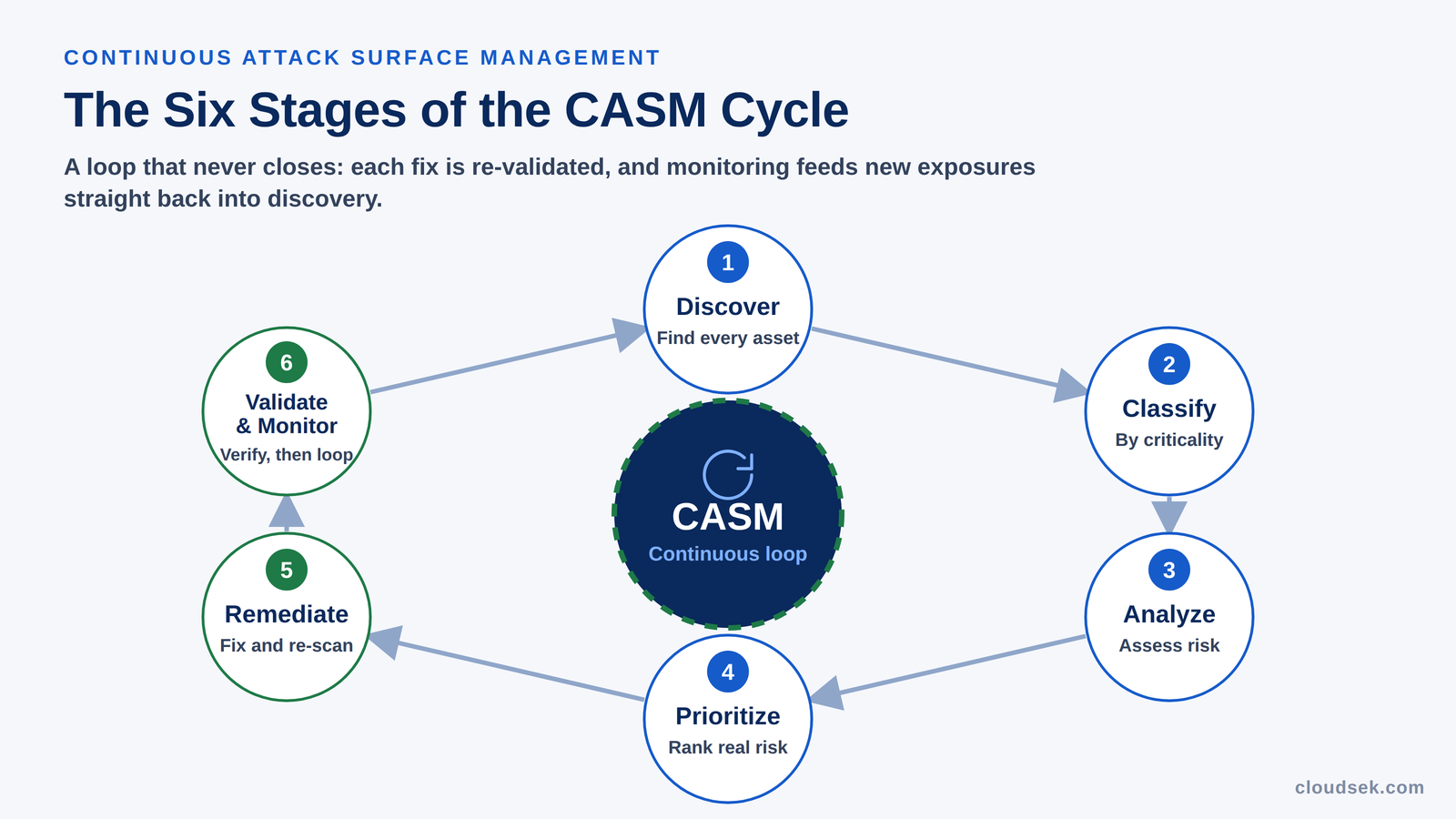
Asset discovery identifies all internet-facing assets across the organization, including domains, IP addresses, APIs, cloud services, and web applications. The process uncovers known systems along with shadow IT and orphaned assets that exist outside standard tracking. Continuous discovery detects newly created or exposed assets the moment they appear, so the inventory never goes stale.
Asset classification organizes discovered assets based on their importance and business context. Assets get grouped into categories such as critical, sensitive, or low-risk. Business ownership is assigned to each asset, which improves accountability and speeds up response actions when issues arise.
Risk analysis evaluates each asset for security weaknesses such as misconfigurations, open ports, exposed services, and outdated software. Each issue is assessed for exploitability and potential impact, which determines how dangerous the exposure actually is rather than how it looks on paper.
Threat prioritization ranks identified risks based on severity and real-world exploit potential. High-risk vulnerabilities that attackers can exploit easily receive immediate attention. This is where most CASM programs either succeed or fail. Without prioritization, security teams drown in low-impact findings while genuine initial access vectors sit untouched.
Continuous remediation removes or reduces identified risks through direct action: patching vulnerabilities, fixing misconfigurations, and disabling unused assets. After fixes are applied, systems get re-scanned to confirm the exposure is gone and to catch any new risks introduced by the change itself.
Validation and monitoring create a continuous feedback loop. Every fix is verified through re-scanning and ongoing observation. Continuous monitoring detects new exposures caused by system changes, configuration drift, and shadow IT, which keeps the attack surface controlled rather than periodically audited.
CASM covers four major attack surface types that represent the full range of external exposure points.
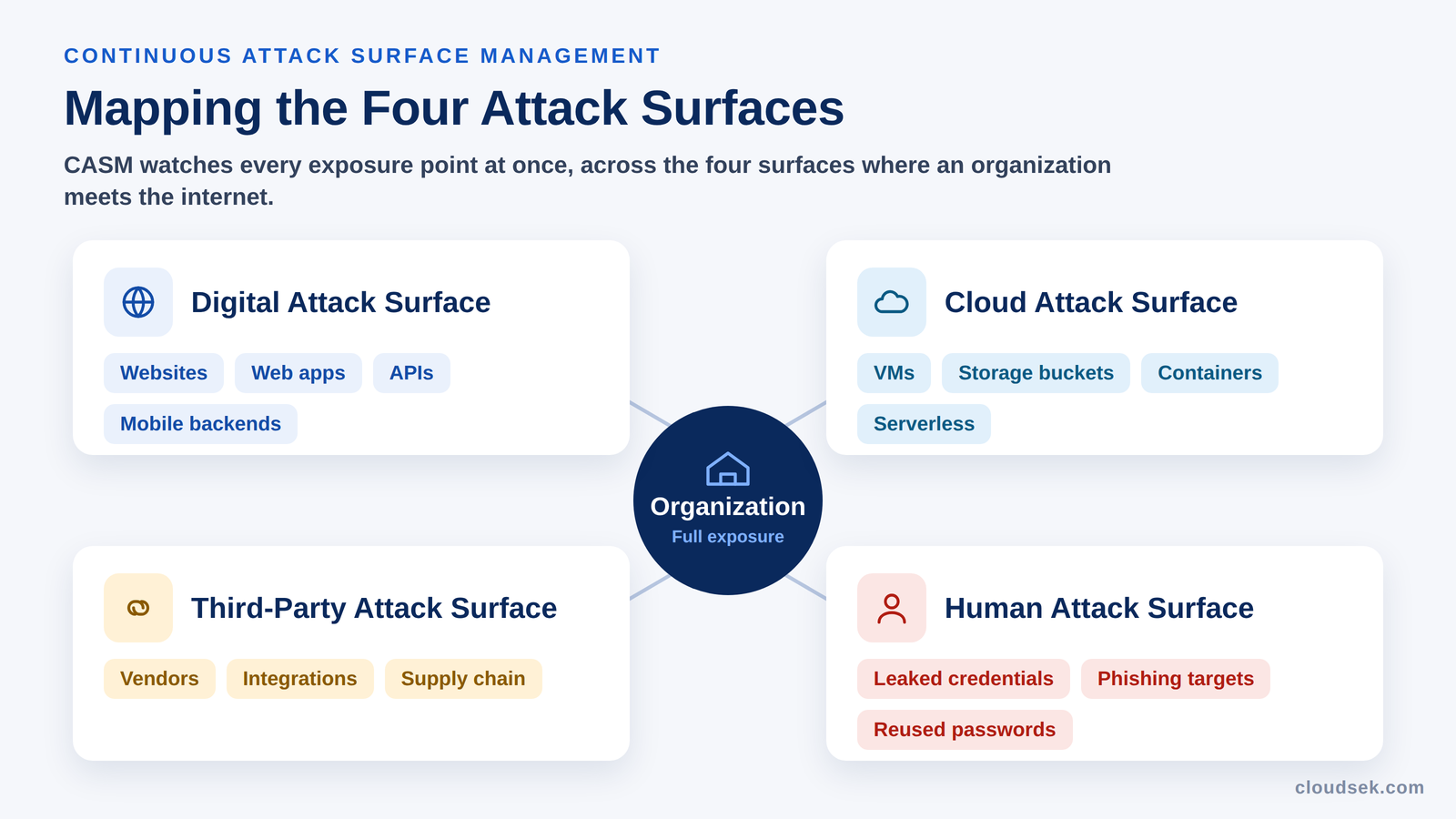
The digital attack surface includes all internet-facing applications and services: websites, web applications, APIs, and mobile backends. Any exposed service that users or systems reach over the internet belongs in this category.
The cloud attack surface includes resources hosted on cloud platforms: virtual machines, storage buckets, containers, and serverless functions. Misconfigured cloud resources are now one of the most common causes of cloud breach, because they often expose data or compute directly to the public internet.
The third-party attack surface includes external vendors and partners connected to the organization through integrations, shared systems, and supply chain dependencies. Weak security on a third-party system raises the organization's own risk, because attackers routinely use vendor compromises as indirect entry points into the primary target.
The human attack surface includes risks tied to user behavior and identity exposure: leaked credentials, phishing targets, and reused passwords. Employees, contractors, and partners are deliberately targeted because attackers exploit human error to bypass technical controls entirely.
CASM supports the practical workflows where continuous visibility and risk detection are most critical.
Most organizations agree continuous attack surface management is the right model. Operationalizing it is where programs stall. Four challenges show up consistently, and each maps to a discipline that resolves it.
Modern enterprises run workloads across multiple cloud providers, SaaS platforms, and external services. Maintaining a complete and accurate inventory of thousands of assets distributed across different systems is genuinely difficult, and most discovery tools miss a meaningful share of what exists. The fix: automate asset discovery and define an inventory baseline so new or unknown assets surface by comparison rather than by manual audit.
Detection processes generate noise. Security teams spend hours investigating findings that do not represent real risk, and the most dangerous exposures get lost in the queue. The fix: prioritize exploitable risks by ranking findings against exploit likelihood and business impact, and treat CVSS severity as one input, not the only input.
Different security tools use different formats, workflows, and data structures. When systems do not communicate, visibility fragments and response slows. The fix: feed CASM output into the SIEM, SOAR, ticketing, and vulnerability management tools the team already operates so action follows detection.
Many discovered assets have no assigned owner, which delays remediation. Combined with the broader cybersecurity skills shortage, this means even well-prioritized findings sit waiting for someone with the time and authority to act. The fix: assign explicit asset ownership to a team or individual for every asset in the inventory.
The hardest problem behind all four is that an exposed asset is not the same thing as an attack path. A CASM program that surfaces ten thousand exposures without telling the team which exposures actually open a route to a crown-jewel system has shifted the workload, not reduced the risk. Closing that gap is what separates a continuous discovery program from a predictive attack path intelligence program.
Most CASM programs stall at the same point: traditional scanners produce long lists of exposed assets without telling security teams which exposures actually create initial access vectors an attacker can use. CloudSEK BeVigil is built to close that gap by running the CASM loop continuously across an organization's external attack surface.
BeVigil fingerprints internet-facing infrastructure and scans eight surfaces (web applications, mobile applications, APIs, cloud, CVE, DNS, SSL, and network), which handles discovery and classification in a single continuous pass rather than a periodic audit. It then analyzes each asset for misconfigurations, known CVEs, weak SSL configurations, DNS issues, subdomain takeovers, and exposed credentials in code, surfacing the specific weaknesses that function as initial access vectors. More than 600 tag classifiers and query-language filters handle prioritization, so analysts work the exposures that actually open an attack path instead of triaging undifferentiated CVSS lists. Re-scanning after fixes closes the validation loop, catching new exposures introduced by configuration drift or fresh deployments before they become entry points.
A working CASM program comes down to six disciplines.
Organizations that operate cloud, SaaS, or distributed systems need CASM, because their attack surface expands daily and traditional periodic assessments cannot keep up.
CASM operates continuously in real time. That is the core distinction from periodic vulnerability assessments, which produce a snapshot view that goes stale within days in fast-moving cloud environments.
CASM covers both internal and external assets across a continuous monitoring loop. External Attack Surface Management (EASM) is a subset focused specifically on internet-facing assets viewed from an attacker's perspective. Most CASM programs rely on an EASM capability to deliver the external visibility internal scanners cannot provide.
CASM fits organizations of all sizes, including small businesses with growing digital assets. Smaller teams benefit most from automation and continuous visibility, because they lack the headcount to run periodic audits at the cadence cloud environments demand.
CASM uses continuous scanning, DNS analysis, and external reconnaissance to identify assets that do not appear in internal inventories. This is the only reliable way to surface shadow IT and orphaned systems.
No. CASM expands the scope of vulnerability management to include unknown and external assets, but vulnerability management remains essential for known, internal systems.
Continuous discovery is necessary but not sufficient. A complete program also needs to correlate individual exposures into validated attack paths so security teams know which exposures, if remediated, actually break an attack chain. CloudSEK BeVigil is designed for this model, surfacing the exposures that create real initial access vectors rather than long lists of findings teams cannot act on.
CASM is used heavily in industries with large digital footprints, including financial services, healthcare, technology, and government.
Implementation typically takes a few days to a few weeks, depending on the environment's size and complexity. Cloud-heavy organizations with many third-party integrations are at the longer end of that range.
