🚀 CloudSEK featured in the 2026 Frost Radar™!
Read more
.avif)

A VPN protocol is a set of rules that controls how data is encrypted, authenticated, and transferred between a device and a VPN server.
Every VPN connection in use runs on one protocol or another. That protocol decides which cipher encrypts the session, how the two sides prove identity, which transport carries the packets, and what happens when the network changes underneath the connection.
Those choices produce the differences a user actually notices day-to-day. A WireGuard tunnel and an OpenVPN tunnel to the same server differ in speed, battery use, and how well they survive a restrictive firewall.
Almost every practical difference between VPN protocols comes down to four design choices. Marketing language about security strength rarely explains any of them.
Handshake cost comes first in any comparison that reflects real use. Establishing a tunnel means exchanging keys and verifying identity, and the number of round trips involved determines how long a connection stalls before traffic flows. WireGuard completes this in one exchange. OpenVPN runs a full TLS negotiation.
Cipher selection follows the handshake and matters less than most buyers expect. Modern protocols use “ChaCha20-Poly1305” or “AES-GCM”, both fast on current hardware. Older designs carry weaker algorithms that remain in the specification for compatibility.
Transport choice matters far more than most published comparisons admit. UDP sends packets without waiting for acknowledgement, which suits real-time traffic. TCP retransmits lost packets, which works well on a clean network and degrades badly on a congested one, because the tunnel and the application inside it both retry.
Port choice decides where the tunnel works at all. Traffic on TCP port 443 looks like ordinary HTTPS and passes almost any firewall. Traffic on a distinctive UDP port is trivially blocked by a network that wants to block VPNs.
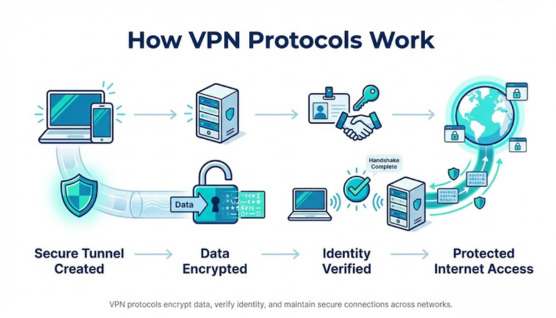
A VPN protocol builds an encrypted tunnel and then keeps it alive. The sequence is the same across protocols, and the efficiency of each step differs.
The client opens a request to the server, and the two sides agree on which protocol governs the session. They then authenticate each other using certificates, pre-shared keys, or user credentials, which prevents an unauthorized device from joining.
Key exchange follows authentication as the next step in the same negotiation. Both ends settle the cryptographic material that encrypts the session, and the tunnel opens once that material is agreed. Outbound traffic is encrypted, split into packets, and routed through it.
The server decrypts arriving traffic and forwards it to its destination, then encrypts the response and returns it. Session management runs continuously after that, handling packet delivery, periodic re-keying, and reconnection when a device moves between networks.
A VPN protocol supplies the rule set, and a VPN tunnel is the encrypted pathway those rules produce. One works as the blueprint, the other as the structure built from it.
The distinction matters most when comparing one commercial service against another. Two providers can both advertise an encrypted tunnel while running entirely different protocols underneath, and the resulting tunnels differ in overhead, cipher, and resilience.
Deployments today run on a short list of protocols, from modern open-source designs to legacy options that survive only for backward compatibility.
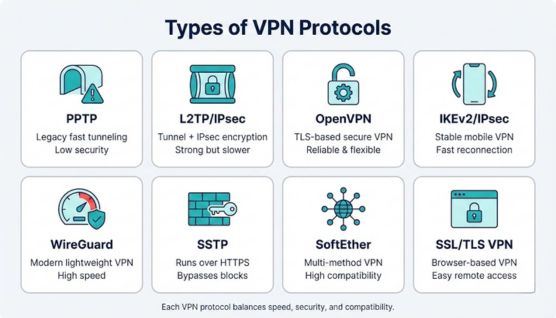
WireGuard runs on roughly 4,000 lines of code, small enough for a single reviewer to audit in full. It uses ChaCha20-Poly1305 for encryption and the Noise Protocol Framework for its handshake, with no cipher negotiation at all. The result is the fastest option on most hardware and the lowest battery cost on mobile. Enterprise policy controls need supporting tooling, since the protocol itself deliberately has none.
OpenVPN has the longest independent audit history of any option here. It runs TLS through OpenSSL for key exchange and works over either UDP or TCP, which makes it adaptable to unfriendly networks. Configuration depth is its strength and its weakness, since a poorly configured OpenVPN deployment can be weaker than a default WireGuard one. CPU overhead limits throughput on low-powered devices.
IKEv2 handles key negotiation while IPsec handles the encryption of the traffic. Its distinguishing feature is MOBIKE, which lets a tunnel survive a switch from Wi-Fi to cellular without a full reconnect. Native support on iOS, Android, and Windows makes it the default for corporate mobile fleets. It carries the most active post-quantum standards work of any VPN protocol. Some networks filter IPsec traffic outright, which is why a fallback option belongs in any mobile rollout.
SSL/TLS VPNs deliver remote access through a browser portal or a lightweight client instead of a full device tunnel. Running over port 443 gives them the best firewall compatibility of any option. Access is commonly limited to specific applications or portals, which suits controlled remote work and does not replace a network-level tunnel.
SSTP tunnels traffic through TLS on port 443, so it blends into normal HTTPS and passes restrictive networks. Microsoft developed it, and native support outside Windows is thin. TCP-based tunneling means retransmission overhead stacks up on unstable links.
SoftEther functions as an open-source multi-protocol platform, not a single protocol. It can carry traffic over its own SSL-VPN protocol, OpenVPN, L2TP/IPsec, or SSTP from one server, which suits mixed device fleets. Security strength follows entirely from which underlying protocol a given connection uses, so it needs pinning in configuration and verification before rollout.
L2TP provides tunneling with no encryption of its own, so IPsec supplies the security layer. Double encapsulation adds overhead that modern alternatives avoid. Broad built-in support across operating systems keeps it in use for simple remote access where setup speed outweighs performance.
PPTP became obsolete for any traffic that matters more than a decade ago. Its MS-CHAPv2 authentication has been practically breakable since then, and its encryption offers no meaningful protection. Speed and legacy device support are the only reasons it still appears, and neither justifies its use on sensitive traffic.
Ranked from strongest current recommendation to legacy, the practical differences look like this.
Matching the protocol to the network and the device settles most of these decisions, and current threat activity rarely changes the answer.
Consumer comparisons optimize for streaming speed above everything else. Enterprise deployments optimize for a different set of properties entirely.
Policy granularity decides the outcome in most corporate deployments. A corporate tunnel needs per-user access rules, device posture checks, and session logging that feeds security operations. IKEv2/IPsec and SSL/TLS VPNs integrate with identity platforms for this. WireGuard needs an orchestration layer bolted on top.
Access scope matters just as much as policy granularity does. A full network tunnel gives an authenticated user reach across the internal network, which is the behavior zero trust architectures were designed to remove. Application-level access through an SSL/TLS VPN limits that reach without replacing the whole remote access model.
Split tunneling attracts more bad decisions than any other setting here. Routing only corporate traffic through the tunnel cuts bandwidth cost and improves user experience, and it leaves the rest of the device talking directly to the internet with no inspection. Teams that allow it need endpoint controls covering what falls outside the tunnel, since a phishing page loaded on the split path reaches the same user who holds the VPN session.
Throughput ceilings come down to hardware more than to protocol design. IPsec reaches line rate on appliances with cryptographic offload, while WireGuard leads on commodity servers without it. Either way, the figure belongs in a procurement test rather than a vendor datasheet, and information security management programs record it as a measured control.
No mainstream VPN protocol shipped post-quantum key exchange by default as of 2026. Encrypted traffic captured now can be stored and decrypted later once a capable quantum computer exists, which makes this a present concern for long-lived secrets. Cloudflare made post-quantum IPsec generally available in April 2026, an early production deployment of the approach.
IKEv2 leads on this front by a clear margin among mainstream protocols. RFC 9370 allows additional key exchange rounds beyond the initial one, and an active IETF draft specifies hybrid ML-KEM within that structure. RFC 8784 offers an interim path using pre-shared keys.
OpenVPN inherits its post-quantum position directly from the TLS layer beneath it. OpenSSL 3.5 added ML-KEM support in 2025, so an OpenVPN control channel can negotiate hybrid post-quantum TLS 1.3 when both ends run a current build.
WireGuard has no native post-quantum key exchange in the mainline protocol. Its optional pre-shared key field can carry material produced by a higher-layer quantum-resistant exchange, which is how the deployments claiming post-quantum WireGuard actually work.
CloudSEK's threat intelligence team has been tracking a campaign it calls FortiBleed, aimed at internet-facing firewalls and SSL VPN gateways. The operators left their own back-end server browsable on the open internet, and the 319 files inside held a database of validated device credentials alongside their tooling, automation scripts, scheduled jobs, and command histories.
No zero-day vulnerability was involved in any part of it. The credentials came from reuse, brute force, and offline hash cracking against exposed devices, which means the strongest available protocol on those gateways would have changed nothing. Gateways reachable from the internet sit inside the external attack surface, whatever protocol they terminate.
Protocol comparisons never reach this part of the problem at all. CloudSEK XVigil tracks credentials circulating on criminal markets and the access listings naming specific organizations, which is the signal that arrives before anyone uses the login. Protocol choice sets the strength of the tunnel. Patch velocity on the gateway, credential hygiene, and knowing what is already exposed decide whether that tunnel is protecting anything.
Yes. Most clients expose a protocol setting, and switching requires a reconnection rather than a reinstall or a new subscription.
No. WireGuard is both the fastest common option and cryptographically strong. Speed differences come from handshake design and code size.
SSTP and SSL/TLS VPNs, because both run over TCP port 443 and resemble ordinary HTTPS traffic to a filtering device.
Yes, in some cases. OpenVPN runs over TCP where WireGuard cannot, and its configuration depth suits environments with unusual routing requirements.
Yes, for content and destination. The provider still sees that a VPN connection exists, along with its timing and volume.
It varies by fleet. IKEv2/IPsec suits managed mobile devices, while SSL/TLS VPNs suit contractor and unmanaged-device access.
