🚀 CloudSEK featured in the 2026 Frost Radar™!
Read more
.avif)

Modern cyber threats are no longer driven by random exploits or isolated vulnerabilities. Attackers operate with intent, planning, and clear objectives, which makes understanding threats as important as fixing weaknesses. Threat assessment provides the structure needed to evaluate who may attack, how an attack could unfold, and which parts of an organization are most exposed.
According to the IBM Cost of a Data Breach Report 2023, organizations that use threat assessment by implementing threat intelligence and automated detection tools reduced the average breach lifecycle by over 80 days compared to those without these capabilities. By basing security decisions on how attackers actually act and the risks that exist right now, threat assessment helps organizations shift from reacting after attacks to taking smart, proactive steps to stay protected."
Threat assessment is a structured process used to identify potential threats, understand how they could cause harm, and evaluate how likely they are to impact an organization. It focuses on who might attack, what they could target, and how an attack could unfold, based on current exposure and real-world conditions.
In cybersecurity, threat assessment examines assets, threat actors ,attack methods, and existing defenses together. The goal is not to list every possible risk, but to determine which threats are realistic and require attention now. This allows security teams to move from assumptions to evidence-based decisions.
Also, threat assessment differs from general risk analysis because it emphasize on active threats and attacker behavior rather than theoretical weaknesses. It provides a clear picture of credible threats so organizations can prioritize controls, resources, and response planning effectively.
Threat assessment matters because it helps organizations focus on realistic and relevant threats instead of theoretical risks. By understanding who is likely to attack, what they are targeting, and how they operate, security teams can allocate time and resources where they reduce the most risk. This approach improves preparedness, shortens response time, and prevents security efforts from being spread too thin.
Threat assessment is built on a set of core components that work together to form an accurate view of risk.
Threat assessment works by combining three inputs: what the organization runs, what is exposed or weak, and how real attackers are behaving. The outcome is a prioritized set of credible threats that security teams can act on, backed by evidence from asset data, vulnerability and configuration findings, threat intelligence, and control effectiveness.
Here is the Step-by-Step Threat Assessment Process:
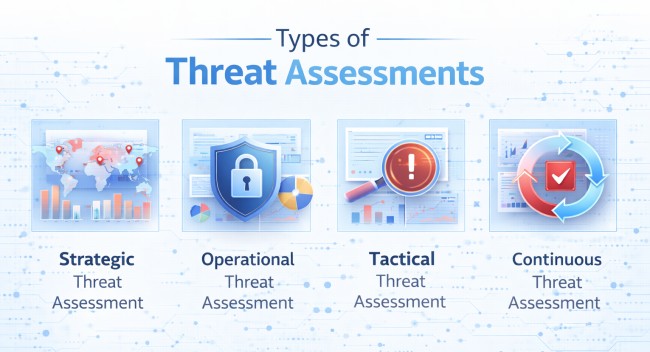
Threat assessments are performed in different ways depending on the level of decision-making and the speed of change in the environment.
Threat assessment and risk assessment serve different purposes, even though they are closely related. Threat assessment focuses on the attacker—who is likely to attack, how they operate, and which attack paths are realistic based on current exposure. It is driven by attacker intent, capability, and active threat activity.
Risk assessment focuses on overall business risk by combining threats, vulnerabilities, and impact into a broader evaluation. It considers a wide range of risks, including cyber, operational, compliance, and third-party risks, even when no active attacker interest is present.
The key difference lies in timing and focus. Threat assessment is dynamic and threat-driven, updating as attackers, infrastructure, and exposures change. Risk assessment is broader and more periodic, used to guide long-term governance, compliance, and investment decisions.
In practice, threat assessment feeds into risk assessment. Threat assessment explains how an attack would realistically happen, while risk assessment explains what that attack would mean for the business.
Threat assessments involve multiple roles across an organization, each contributing a specific perspective and responsibility.
Threat assessment is difficult because environments change constantly, and attackers adapt faster than most security programs. Even mature organizations struggle to maintain accurate visibility, align technical findings with business risk, and keep assessments relevant over time.
Incomplete asset visibility
Threat assessment fails when organizations do not know what they own or what they expose. Unknown cloud resources, shadow IT, forgotten subdomains, and unmanaged identities create blind spots that attackers can exploit without resistance.
Rapidly evolving threat landscape
Threat actors change tools, techniques, and targets frequently. Assessments that rely on outdated threat models or static assumptions quickly lose accuracy and fail to reflect current attacker behavior.
Alert fatigue and data overload
Security teams often receive large volumes of alerts, scan results, and intelligence feeds. Without proper filtering and context, critical threat signals are buried, making it hard to identify which threats are realistic and urgent.
Misalignment between technical and business risk
Threat assessment loses value when technical findings are not translated into business impact. Vulnerabilities and attack paths must be tied to operational disruption, data loss, or regulatory consequences to support effective decision-making.
Here are some examples showing how organizations used threat assessment to reduce real risk.
Maersk
After the NotPetya attack, Maersk adopted a structured threat assessment to understand how nation-state malware could spread through flat networks and shared credentials. By reassessing attack paths and prioritizing segmentation and identity controls, Maersk reduced blast radius and improved recovery readiness across global operations.
Target
Post-breach, Target used threat assessment to analyze how third-party access and credential abuse enabled lateral movement. This assessment led to tighter vendor access controls, network segmentation, and monitoring of high-risk authentication paths, reducing the likelihood of similar supply-chain-driven attacks.
Colonial Pipeline
Following the ransomware incident, Colonial Pipeline applied threat assessment to identify credential-based access as a critical threat scenario. The assessment drove mandatory MFA, reduced VPN exposure, and improved monitoring of remote access systems, directly addressing the attack path that caused the outage.
Adobe
Adobe used threat assessment to evaluate how attackers could exploit exposed development systems and cloud assets. By mapping realistic attack paths and prioritizing misconfiguration fixes, Adobe strengthened its cloud security posture and reduced the risk of large-scale data exposure.
CloudSEK strengthens threat assessment by providing continuous visibility into external threats, exposed assets, and attacker behavior. CloudSEK’s Attack Surface Intelligence helps organizations identify unknown internet-facing systems, shadow IT, and misconfigured cloud resources that materially change threat likelihood.
Through Threat Intelligence and Digital Risk Protection, CloudSEK correlates active threat actor campaigns, leaked credentials, and early targeting signals from the open, deep, and dark web. This context enables security teams to base threat assessments on real attacker intent and current exposure, not static assumptions, improving prioritization and decision accuracy.
