🚀 CloudSEK featured in the 2026 Frost Radar™!
Read more
.avif)

Spoofing is the forgery of origin information in digital communication, so a system accepts an attacker's traffic, message, or call as coming from a trusted source.
Industrial scale turns this from a nuisance into a business problem. Ahead of one holiday shopping season, CloudSEK researchers identified more than 2,000 fake storefronts built to impersonate well-known retail brands, including a cluster of over 750 typosquatted domains sharing the same page templates and phishing kits.
None of this requires a software flaw or a stolen password. The attacker supplies false identity data, and the receiving system accepts it because the protocol was never designed to check.
Spoofing works because the internet's core protocols verify format, not origin. A packet, a DNS response, or an email header is processed when it is correctly structured. Nothing in the base design asks whether the sender is who the field claims.
SMTP was written to move mail between cooperating systems. It accepts whatever sender address a client declares. TCP/IP was written to route packets efficiently and accepts whatever source address a packet carries.
ARP goes further and has no authentication at all. Any device on a local network can claim any IP address, and other devices update their tables without question.
Authentication was bolted on later in every one of these protocols. SPF, DKIM, DMARC, and DNSSEC are optional layers added above the original design. Spoofing succeeds wherever they are missing, misconfigured, or left unenforced.
A spoofing attack moves from studying which identity field a system trusts to exploiting its acceptance. A DNS cache poisoning attempt shows each step of that sequence.
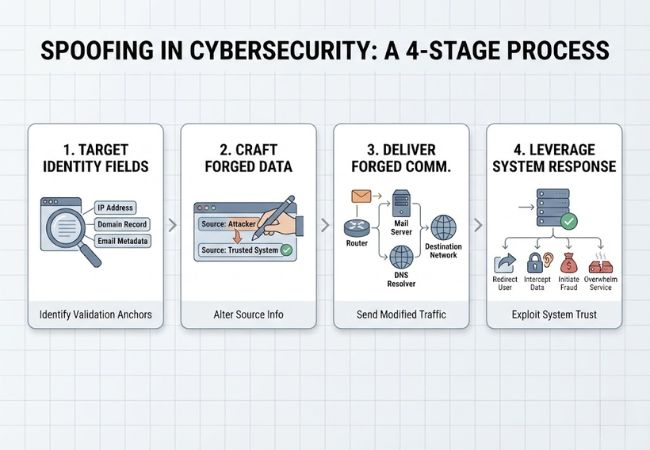
The attacker works out which identifier the target system treats as a trust anchor. That might be an IP address field, a DNS record, or an email header. In the DNS case, the attacker studies how a resolver validates and caches responses.
Forged values go into packet headers, DNS responses, or message structures directly. Formatting has to match protocol specification precisely, or the data gets rejected on arrival. A fraudulent DNS response is built to match a real query and timed to arrive first.
Modified traffic travels through ordinary routers, mail servers, and resolvers. Infrastructure processes well-formed traffic without checking its true origin, so nothing looks structurally wrong. The forged DNS response reaches the resolver along the same path a genuine one would take.
Acceptance of the false identity lets the attacker redirect users, intercept traffic, initiate fraud, or flood a service. The resolver caches the forged record and begins sending users to an attacker-controlled server. Every subsequent lookup inherits the poisoned answer.
Each spoofing type targets a different identifier, and the layer it operates at decides who is able to fix it.
IP spoofing falsifies the source address in a packet so traffic appears to come from a trusted system. Distributed denial-of-service campaigns rely on it to hide origin. ARP spoofing binds an attacker's MAC address to a legitimate IP on a local network, which enables interception of internal traffic. MITRE catalogs both under adversary-in-the-middle techniques, alongside DHCP spoofing and evil twin access points.
DNS spoofing, known as cache poisoning, corrupts resolution data so users reach malicious servers while the address bar looks correct. Resolver software carries real exposure here. ISC disclosed CVE-2025-40778 in October 2025, a flaw rated 8.6 where BIND 9 accepted unsolicited records in answers and cached them. Proof-of-concept code followed within a week, and no workaround existed beyond patching.
Email spoofing forges sender fields so a message appears to come from a colleague, an executive, or a supplier. Business email compromise schemes depend on it to move fraudulent payment instructions. Related guidance on email spoofing covers the mechanics in detail.
Website spoofing clones a legitimate page to harvest logins and payment data. Valid TLS certificates are free and instant for any domain an attacker registers, so the padlock icon confirms encryption and says nothing about ownership. These sites sit at the center of most brand impersonation campaigns.
Caller ID spoofing falsifies the number shown on an incoming call to impersonate a bank, a government agency, or an internal extension. Telephone signalling carries the same design gap as early internet protocols, since the displayed number is supplied by the caller rather than verified by the carrier.
Counterfeit mobile and desktop applications impersonate a brand to harvest credentials or deliver malware. Fake app detection matters because these reach users through channels they already trust, including official stores and search results.
Spoofing falsifies identity signals, and the attacks below put that falsification to different uses. Teams confuse these terms constantly, so the phishing and spoofing distinction is worth setting out precisely.
Damage follows from trust granted under a false identity, and it lands before anyone recognizes the deception.
Detection looks for inconsistency between what an identity field claims and what the surrounding evidence shows.
Prevention means adding the origin verification that base protocols left out. Each layer needs its own control.
SPF lists authorized sending servers, DKIM signs message content, and DMARC binds both results to the visible sender domain. Publishing DMARC at reject stops forged mail from a protected domain from reaching inboxes.
Routers configured to drop packets carrying forged source addresses cut off IP spoofing at the boundary. This practice is defined in “BCP 38”, and its effectiveness scales with how many operators apply it.
DNSSEC signs DNS responses cryptographically so a resolver can verify authenticity. Keeping resolver software patched matters just as much, since cache poisoning flaws appear in mature software regularly.
Dynamic ARP inspection validates MAC-to-IP bindings against a trusted table at the switch. Unauthorized mappings are dropped before any device updates its cache.
Multi-factor authentication devalues credentials captured through a spoofed page. Zero trust removes implicit trust inside the network, so a spoofed identity signal grants nothing automatically.
Every anti-spoofing control has a boundary, and vendors rarely state where it falls. Knowing the gaps decides where the remaining budget goes.
Identity manipulation keeps adapting to cloud infrastructure, synthetic media, and large-scale automation.
Email authentication and network filtering protect infrastructure an organization owns. Spoofed domains sit outside it, registered by someone else, hosted elsewhere, and aimed at customers who never see the internal controls.
XVigil, CloudSEK's digital risk protection platform, monitors surface, deep, and dark web sources for that activity. Its permutation engine generates and tracks typosquatted variations of a brand's domains, catching lookalikes at registration and in underground forums before they go live. Fake applications, cloned login portals, and impersonation pages surface through the same process.
Detection on its own leaves the fraudulent site running and collecting data. An in-house team packages the evidence registrars, and hosts require and drives each case to confirmed removal, with CloudSEK reporting more than 2,200 domain takedowns in a single quarter at a 96 percent success rate and an average turnaround close to four business days.
Yes, in most jurisdictions when used to defraud or gain unauthorized access. Some forms, such as caller ID masking by call centers, remain lawful.
Yes. Forged identity data alone can redirect traffic, intercept communications, or trigger fraudulent payments with nothing installed on any device.
No. HTTPS encrypts the connection. An attacker who registers a lookalike domain obtains a valid certificate for it within minutes.
Sometimes. Header analysis reveals the originating server, though attackers route through compromised hosts and relays that obscure the true source.
Publish SPF, DKIM, and DMARC records, enforce multi-factor authentication, and verify payment changes by phone on a previously known number.
Liability varies by jurisdiction and sector. Reputational cost and customer remediation fall on the impersonated brand regardless of legal fault.
