🚀 CloudSEK featured in the 2026 Frost Radar™!
Read more
.avif)

Layer 7 is the top layer of the OSI model, where application protocols such as HTTP, DNS, FTP, and SMTP are interpreted, and application data becomes meaningful.
Lower layers move bytes between machines, and Layer 7 decides what those bytes mean: a login request, an API call, a file upload, or a search query.
Attackers exploit exactly that meaning. A request that looks perfect at the packet level becomes credential stuffing, injection attacks, or a resource-draining flood once the application parses it.
That gap between valid syntax and hostile intent puts Layer 7 at the center of both application delivery and application security.
The OSI model splits network communication into 7 layers, each building on the one below it.
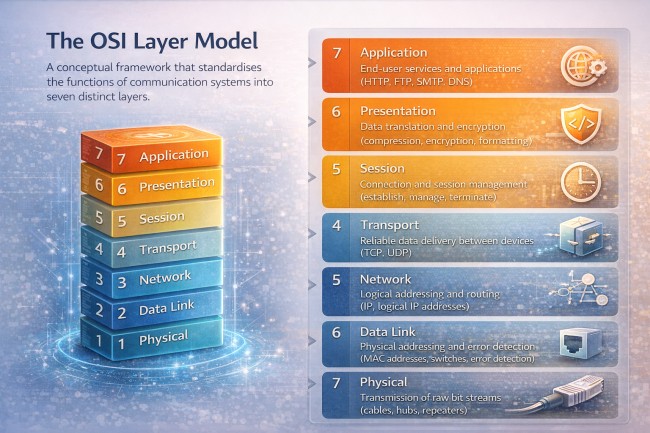
Real networks follow the TCP/IP model, which collapses OSI layers 5, 6, and 7 into a single application layer. Engineers still use OSI numbering because it gives precise vocabulary for where a control operates: a Layer 4 load balancer reads ports, and a Layer 7 load balancer reads URLs.
Layer 7 turns raw transport data into application actions, and six functions carry most of that work.
Application protocols differ in shape, and the differences decide what security controls inspect.
HTTP/1.1, HTTP/2, and HTTP/3 carry web pages, single-page applications, and REST APIs. HTTP/2 multiplexes many streams over one TCP connection, and HTTP/3 runs over QUIC on UDP, which changes how proxies and inspection tools see traffic.
gRPC and WebSocket extend the same infrastructure to binary and long-lived connections. Both sit above HTTP, and both need controls that understand their framing instead of generic HTTP rules.
DNS resolves names to addresses for almost every other transaction, which makes DNS logs one of the richest detection sources on a network.
SMTP, IMAP, and POP3 handle mail transport and retrieval, while MQTT and AMQP move messages between services and IoT fleets.
FTP, SFTP, and cloud storage APIs move files between systems, and legacy FTP deployments remain a common source of credential exposure. Remote access protocols such as SSH and RDP terminate application sessions that require their own authentication and monitoring.
TLS encrypts application data, and OSI terminology places that encryption at Layer 6, since it is a presentation-layer function.
In deployment terms, TLS runs directly above TCP and below HTTP, so security teams treat TLS termination as the point where Layer 7 inspection becomes possible at all.
Devices described as Layer 7 share one property: they read application content and make decisions on it, not on IP addresses and ports.
A WAF inspects HTTP requests and responses against signatures, schemas, and behavioral rules, then blocks, challenges, or rate-limits what fails. Tuning decides its value, since rules left in detection-only mode log attacks without stopping them.
An API gateway authenticates callers, validates request schemas, enforces quotas, and routes calls to backend services. Gateway policy is where most practical API security enforcement happens, because it stands in front of every documented endpoint.
A Layer 4 load balancer forwards connections using IP addresses and ports, treating payloads as opaque.
Layer 7 load balancers terminate the connection, read URLs, headers, and cookies, then route to different backends by path, session affinity, or content type.
CDNs and reverse proxies apply the same reading to caching, compression, and origin shielding.
Each of these functions requires the proxy to decrypt and parse traffic, so they double as security enforcement points.
Outbound controls read the same protocol data in the other direction, filtering destinations, inspecting downloads, and applying policy per user and application.
Access proxies in a zero trust architecture extend that model to private applications, replacing network-level VPN access with per-request authorization.
Layer 7 floods send valid HTTP requests against expensive endpoints: search queries, login pages, cart operations, and API calls that hit databases.
Each request costs the server far more than it costs the attacker, so a modest request rate exhausts CPU, memory, database connections, and worker threads.
Scale compounds that asymmetry beyond what origin capacity absorbs. Cloudflare reported hyper-volumetric HTTP floods from the Aisuru and Kimwolf botnet peaking above 200 million requests per second, part of a year in which DDoS activity rose 121%.
Requests at that scale arrive from device populations large enough to make per-address blocking useless.
Low-and-slow variants invert the approach by minimizing traffic volume. Slowloris-style attacks hold connections open with partial requests, consuming connection slots while generating almost no traffic volume, which keeps them invisible to bandwidth-based detection.
Some Layer 7 attacks exploit flaws in protocol implementations instead of application logic. HTTP/2 Rapid Reset (CVE-2023-44487) used rapid stream cancellation to drive record-breaking floods against major providers in 2023.
MadeYouReset (CVE-2025-8671), disclosed in August 2025, revived the technique by tricking servers into resetting streams themselves, which bypassed the Rapid Reset mitigations vendors had deployed. CERT/CC coordinated disclosure across affected implementations including Apache Tomcat, Netty, and F5 BIG-IP, each with its own CVE and patch.
The OWASP Top 10:2025 ranks broken access control first, security misconfiguration second, and software supply chain failures third, with server-side request forgery folded into the access control category.
Attackers reach every one of those categories through Layer 7 requests that look syntactically valid.
Business logic abuse needs no malformed input at all. Coupon stacking, price manipulation, mass data scraping through legitimate endpoints, and parameter tampering all use the application exactly as designed, which leaves signature-based rules with nothing to match.
Automated traffic drives much of the malicious load at Layer 7. Bots test stolen credentials across login endpoints, scrape pricing and content, and probe APIs for objects belonging to other users.
API-specific abuse deserves separate attention from generic web attacks. Broken object-level authorization, undocumented shadow endpoints, and exposed API keys give attackers direct data access without triggering a single injection signature, and distributed botnet infrastructure spreads the attempts across enough addresses to defeat rate limits.
Layer 7 security judges what a request is trying to do, while network-layer security judges where traffic comes from and how much of it arrives. Both matter, and neither substitutes for the other.
Application-layer defense requires visibility into application data, and several trends work against it.
Encryption now covers nearly all web traffic, so inspection requires terminating TLS at a proxy or deploying agents at the application itself.
Termination adds latency, key management burden, and privacy obligations, and encrypted ClientHello removes even the server name from passive observers.
HTTP/3 over QUIC encrypts transport metadata that older tooling parsed freely, and multiplexed streams complicate per-request accounting. Middleboxes built for HTTP/1.1 semantics misread these protocols or fail open, a gap attackers probe deliberately.
Controls protect only the endpoints they know about. Deprecated versions, staging hosts, partner integrations, and undocumented endpoints receive production traffic while falling outside WAF and gateway policy.
That gap explains most cases where a protected organization gets hit through an unprotected path.
Securing Layer 7 works best as discovery first, enforcement second, and tuning continuously.
Cloud-hosted applications inherit part of this stack from the provider. Managed gateways, load balancers, and WAF services shift operational work while leaving policy quality, schema definitions, and logging decisions with the customer, a split covered in cloud security shared responsibility models.
TLS maps to Layer 6 in OSI terms, since encryption is a presentation function. In practice, it runs between TCP and application protocols such as HTTP.
No. Layer 7 defines the protocols and services applications use to communicate, while the application is the software a person actually operates.
Layer 7 filtering allows or blocks traffic based on application content such as URLs, HTTP headers, request methods, or API parameters.
Layer 8 is informal jargon for the user or, in some usage, organizational politics. No such layer exists in the OSI model.
Yes. Layer 7 load balancing, caching, compression, and content-based routing reduce origin load and shorten response times.
Yes, for network-based tools. Agents running inside the application read requests after decryption, avoiding a separate TLS termination point.
Enforcement at Layer 7 belongs to WAFs, API gateways, and the application teams that own the code. CloudSEK works earlier in that chain, answering which applications and APIs exist on the internet under an organization's name.
CloudSEK BeVigil fingerprints internet-facing infrastructure and scans web applications, APIs, cloud assets, DNS, and SSL configurations for exposures, which surfaces the forgotten subdomain, the staging login page, and the undocumented endpoint that no gateway policy covers. Closing those gaps decides whether Layer 7 controls protect the whole attack surface or only the part someone remembered to route through them.
