What Is IoMT Security? Devices, Risks, and Controls
IoMT security protects connected medical devices and patient data from cyber threats, ensuring safe care, reliable workflows, and regulatory compliance.
IoMT security is the practice of safeguarding connected medical devices, clinical networks, and patient health data against cyber threats, unauthorized access, and malicious disruption.
Most IoMT exposure begins outside the device itself, on the hospital's public web assets. CloudSEK's BeVigil platform found a publicly accessible JavaScript file on a diagnostic chain's website. That single file held API keys, authentication tokens, and unsecured endpoints. Together, they opened access to millions of medical records.
A large hospital runs several thousand connected devices at any given moment. Each one sends data that clinicians act on. One weak device puts both patient safety and protected health information at risk.
What Makes IoMT Security Harder Than Enterprise IT Security
Hospitals cannot apply standard IT security practices directly to medical devices. The following constraints shape every decision, and each one removes an option that enterprise IT teams take for granted.
Patient safety outranks uptime: a device cannot be rebooted during surgery or an ICU shift. Security work gets scheduled around care, never the other way around.
Devices stay in service for a decade or more: many run Windows CE or VxWorks. Vendors stopped issuing patches for those platforms years ago.
Nobody has a full inventory: a large hospital runs 10,000 or more connected devices. Teams learn a device exists only after it appears in an incident.
Vendors ship inconsistent security: authentication, encryption, and update practices differ by manufacturer. One unified policy rarely fits every department.
Clinical protocols predate modern security: HL7 v2, DICOM, and CoAP were designed for interoperability. Message integrity and session authentication were never part of the specification.
Devices Inside the IoMT Ecosystem
IoMT covers five core device classes across home care, wards, and diagnostic suites. Each class connects differently, lasts a different length of time, and carries its own patching limits.
Wearables: ECG patches, glucose monitors, and remote monitoring sensors. They connect over Bluetooth, Wi-Fi, and mobile apps. The app or the API behind it carries more risk than the device itself.
Clinical devices: infusion pumps, ventilators, anesthesia machines, and cardiac monitors. They run continuously in ICUs and communicate over HL7 v2 or proprietary protocols.
Imaging systems: MRI, CT, ultrasound, and X-ray systems. They use DICOM and connect to PACS and RIS platforms. Attackers treat them as pivot points into the wider hospital network.
Implantables: pacemakers, neurostimulators, and insulin pumps. These devices last for years and cannot be patched easily once implanted.
Clinical operational technology: lab analyzers, robotic surgery systems, and medication-dispensing cabinets. Many run legacy platforms that vendors no longer support.
Patient Safety and Cost Impact of IoMT Failures
IoMT attacks reach patients directly, and the damage extends well past stolen records. Research covered by Help Net Security found that 22 percent of healthcare organizations have suffered attacks that hit medical devices. Three-quarters of those incidents disrupted patient care, and 24 percent forced patient transfers to other facilities.
Financial exposure in healthcare matches the clinical exposure almost exactly. IBM's Cost of a Data Breach 2025 placed healthcare at $7.42 million per breach, the highest of any industry for the fifteenth year running.
Most of the damage traces back to three failure patterns. Attackers manipulate device data, which leads clinicians toward wrong decisions. Ransomware locks imaging or laboratory systems and stops diagnostics across a department. Weak devices act as entry points into EHR servers, and flat networks let that movement run unchecked.
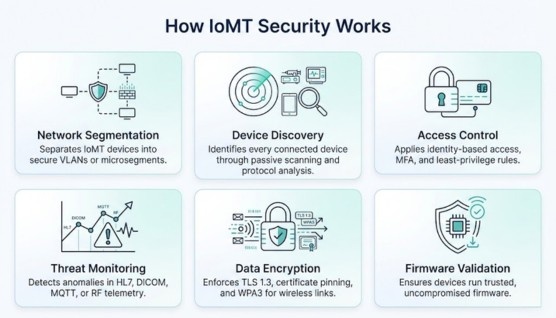
How IoMT Security Works
IoMT security works through layers that operate together across the device lifecycle. No single layer holds on its own. Each one limits what an attacker reaches after clearing the previous one.
Device discovery: passive scanning and protocol analysis identify every connected device. Inventory comes first, because segmentation and monitoring cannot cover what nobody has recorded.
Network segmentation: devices move into secure VLANs or microsegments. A compromised pump then cannot reach the imaging network or the EHR.
Access control: identity-based access, multi-factor authentication, and least privilege decide who interacts with each device.
Threat monitoring: analysis of HL7, DICOM, MQTT, and RF telemetry surfaces tampering and abnormal device behavior.
Data encryption: TLS 1.3, certificate pinning, and WPA3 protect clinical data as it moves across wired and wireless links.
Firmware validation: integrity checks confirm each device runs trusted firmware. Validation continues through the device lifecycle, not only at purchase.
How IoMT Devices Are Attacked
Attackers reach IoMT devices through mainly six recurring methods, and device age enables most of them. Outdated software, weak wireless links, and flat networks supply the rest of the openings.
Firmware Exploits
Legacy firmware on infusion pumps and imaging consoles allows remote code execution. Many of these devices cannot be patched at all. They become permanent footholds inside the clinical network.
Wireless Interception
RF interception, Bluetooth replay, and Wi-Fi downgrade attacks expose wearables and implantables. Weak or outdated encryption raises the success rate of each method.
Network Pivoting
Unsegmented devices let attackers move sideways into PACS, EHR, and administrative systems. Exposed protocols such as SMB, RDP, and HL7 carry that movement. This pattern turns a low-value monitor into a route toward high-value records, and mapping the attack path early breaks the chain before it reaches records.
Device Spoofing
Attackers clone device identifiers and impersonate a monitor or a pump. The cloned device feeds false vitals into clinical dashboards. Man-in-the-middle positions follow from the same technique.
Ransomware Against Clinical Workflows
Ransomware aimed at imaging, laboratory, or surgical systems halts care across departments. Encryption is not always necessary. Downtime alone delays diagnostics and treatment.
Advanced Device Attacks
Skilled actors use device cloning, RF replay, downlink command manipulation, and cryptographic downgrade techniques. Targets range from cardiac wearables to implantables. Some groups now deploy malware built to target device firmware and evade security operations teams.
AI and Cloud Risks in the IoMT Attack Surface
AI in clinical decision-making and cloud-connected architecture are widening the IoMT attack surface together. One targets the data feeding clinical models. The other targets the infrastructure connecting devices to the cloud.
Data poisoning: attackers alter vitals or sensor readings to skew model output. A poisoned sepsis model delays a lifesaving intervention.
Model manipulation: altered training data or inference pathways push diagnostic systems toward wrong classifications. Radiology tools reading PACS images carry this risk directly.
Diagnostic drift: gradual data tampering shifts predictions slowly over time. Clinicians rarely notice the pattern until it is well established, which makes the AI attack surface harder to audit than a conventional system.
Cloud credential compromise: one stolen credential set exposes an entire device fleet. Least-privilege identity and regular key rotation contain the damage.
FHIR API weaknesses: these APIs connect systems cleanly, and weak TLS enforcement or missing token validation turns them into a large-scale PHI disclosure route.
Edge gateway compromise: gateways bridging devices and cloud networks let attackers manipulate MQTT or CoAP traffic in transit when left unhardened.
Zero Trust for IoMT Devices
Zero trust fits IoMT because presence on the hospital network proves nothing about a device. Zero trust replaces network-based trust with four verification practices.
Device identity: every pump, console, and wearable carries its own cryptographic identity. Authentication replaces trust based on an IP address.
Microsegmentation: policy restricts device-to-device communication. A compromised device stays contained instead of becoming a launch point.
Just-in-time access: clinicians and technicians receive temporary, role-based rights to configure devices. Standing privileges disappear.
Continuous verification: posture scoring checks firmware state, certificates, and behavior in real time. Access reflects current risk instead of a one-time login check.
Regulations and Standards Governing IoMT Security
Regulatory obligation for IoMT security comes from various sources across the device lifecycle. Manufacturers carry part of that obligation, and hospitals carry the rest.
HIPAA: requires administrative, physical, and technical safeguards for PHI. IoMT devices fall under its encryption, logging, and access rules.
FDA guidance: covers pre-market and post-market expectations. Manufacturers must supply software bills of materials, secure development practices, patch processes, and vulnerability disclosure. Incomplete cybersecurity documentation now blocks market approval.
NIST Cybersecurity Framework: supplies the identify, protect, detect, respond, and recover structure that most hospital programs use to measure maturity.
IEC and ISO standards: IEC 81001-5-1 governs the health software security lifecycle, IEC 62304 sets medical device software safety requirements, IEC 60601-1 covers electrical safety, and ISO 14971 defines the manufacturer risk management process.
EU MDR Annex I: sets explicit cybersecurity and safety requirements for devices sold in the European Union, including coordinated vulnerability disclosure.
Manufacturer practice decides how much of this reaches the hospital. Encrypted communications, authenticated commands, and hardened firmware reduce risk from day one. Predictable patch schedules and clear service-level agreements let hospitals plan maintenance around patient care. Weak vendor practice becomes a third-party risk that no internal control fully offsets.
IoMT Security Roadmap for Hospitals
Hospitals must build IoMT security in three phases over roughly the first year. Visibility comes first, because every later control needs an accurate record of what is connected.
First 30 days: establish a baseline. Run automated device discovery to build a real inventory. Segment the highest-risk devices into secure VLANs. Turn on passive network monitoring, which surfaces anomalies without touching clinical operations.
Days 30 to 90: fix the structure. Automate SBOM collection so every device's software components stay documented. Standardize firmware update policy across departments. Enforce secure configuration baselines on newly discovered devices. Audit FHIR API permissions and remove access that has widened over time.
Beyond 90 days: integrate the program. Feed IoMT telemetry into the security operations workflow alongside the rest of the network. Deploy device posture scoring for continuous verification. Run tabletop exercises with clinical and security teams together. Extend wireless spectrum monitoring to catch RF attacks that network tools miss.
IoMT Incident Response Steps
IoMT incident response follows five steps in a fixed order. Clinical safety governs each one. Containment never comes at the cost of active patient care.
Triage by clinical dependency. First, identify the affected devices and rank them by patient impact. Life-support and other high-risk systems come first.
Isolate without stopping care. Second, use microsegmentation, or a controlled physical disconnect where necessary, to contain compromised devices while other workflows continue.
Assess the root cause. Third, analyze HL7 logs, DICOM flows, and device telemetry to establish how the compromise happened and which other systems were reached.
Remediate and verify. Fourth, apply patches, restore firmware, or replace unsafe devices. Verify configuration and security posture before any device rejoins the clinical network.
Communicate to every stakeholder. Fifth, notify clinical leaders, compliance teams, manufacturers, and regulators. Timely notification satisfies HIPAA and FDA post-market reporting expectations.
IoMT Security with CloudSEK
Internal controls protect the devices a hospital knows about. Attackers start with what is visible from outside. Exposed portals, forgotten subdomains, vendor apps, and leaked API keys all sit on the public internet, and none of them appear in a device inventory. The diagnostic chain described at the start of this guide lost millions of records through exactly that gap.
BeVigil, CloudSEK's external attack surface monitoring platform, fingerprints internet-facing healthcare infrastructure. It scans continuously across web applications, mobile apps, APIs, cloud, CVE, DNS, SSL, and network surfaces. Exposed credentials inside mobile health apps and public JavaScript files surface through the same process.
CloudSEK XVigil covers the dark web side, tracking stolen patient records and leaked credentials before they are used. SVigil monitors vendor posture across the supply chain. Nexus AI links those findings into validated attack graphs, so a hospital sees which exposure actually leads to clinical systems and fixes that one first.
IoMT Security FAQs
Are IoMT devices more vulnerable than traditional IT systems?
Yes. Most run outdated software and cannot be patched on a normal schedule, which leaves known vulnerabilities exposed for far longer.
Can implantable devices like pacemakers be hacked?
Yes, though documented cases remain rare. Encryption and access controls on modern devices keep this a low-probability, high-consequence risk.
Does IoMT security disrupt clinical workflows?
No, when implemented correctly. Modern IoMT security relies on passive monitoring, which observes network traffic without altering device operation.
Is HIPAA compliance enough to secure IoMT devices?
No. HIPAA protects PHI specifically. Device-level security comes from FDA guidance, the NIST framework, and the IEC and ISO standards.
How often should IoMT devices be patched?
As soon as the vendor releases an update and clinical conditions allow. Devices that cannot be patched need network segmentation instead.
What does an SBOM do in IoMT security?
A software bill of materials lists every software component inside a device. Teams use it to identify affected devices when a vulnerability is disclosed.
Who is responsible for IoMT device security?
Both parties. Manufacturers own secure design, patches, and disclosure, while hospitals own inventory, segmentation, access control, and monitoring.
Cybersecurity risk management is the process of identifying, assessing, and treating cyber risk. Explore its steps, frameworks, quantification, and best practices.
A keylogger secretly records every keystroke to steal passwords and data. Learn its types, how it works, its infostealer evolution, and how to detect and remove it.
Smishing is phishing by text message, using fake SMS to steal data and money. Learn how it works, its scam types, red flags, and how to spot and prevent it.
.avif)