🚀 CloudSEK has raised $19M Series B1 Round – Powering the Future of Predictive Cybersecurity

What Is Data Security Posture Management? DSPM Guide

DSPM helps organizations find and secure sensitive data in cloud environments by identifying exposures, mapping access, and prioritizing real risks.
Published on
Tuesday, December 9, 2025
Updated on
December 9, 2025

Key Takeaways:

  • DSPM discovers, classifies, and evaluates sensitive data across cloud and SaaS environments to show exactly where data resides and how exposed it may be.
  • It eliminates visibility gaps created by multi-cloud adoption by linking sensitive data to identities, permissions, configurations, and movement patterns.
  • DSPM improves security outcomes by prioritizing high-impact risks, strengthening access governance, aligning with compliance frameworks, and reducing the burden of manual audits.
  • With continuous monitoring, risk scoring, and data-aware remediation, DSPM reinforces cloud security posture and helps teams act on exposure risks with greater accuracy.

What Is DSPM?

Data Security Posture Management (DSPM) is a cybersecurity approach that discovers, classifies, and analyzes sensitive data across cloud and hybrid environments. It provides visibility into where critical information is stored and how exposed it may be due to misconfigurations, shadow data, or excessive privileges.

Unlike traditional security tools that focus on infrastructure, DSPM centers security on the data itself, making it easier to evaluate real risk at the asset level. It maps sensitive data, access paths, and associated controls to help organizations strengthen compliance and identify meaningful exposure points.

DSPM also connects data sensitivity with identity context, storage configuration, and policy alignment to reveal who can access information and how it moves across services. With this foundation, the next step is understanding how DSPM performs these actions across complex cloud ecosystems.

Why Is DSPM Important in Modern Cloud Environments?

Cloud and SaaS adoption has scattered sensitive data across multiple platforms, making it difficult to track where it lives and how it is protected. This distributed footprint creates blind spots where misconfigurations, excessive permissions, and forgotten copies can introduce silent exposure risks.

Manual audits and disconnected security tools struggle to follow data across accounts, regions, and services. As a result, teams often know risks exist but lack clarity on which ones matter most or where they originate.

DSPM overcomes these challenges by linking sensitive data to the identities, applications, and cloud resources that interact with it. This context becomes the foundation for understanding how DSPM evaluates data behavior, exposure, and access conditions across cloud environments.

How Data Security Posture Management Works

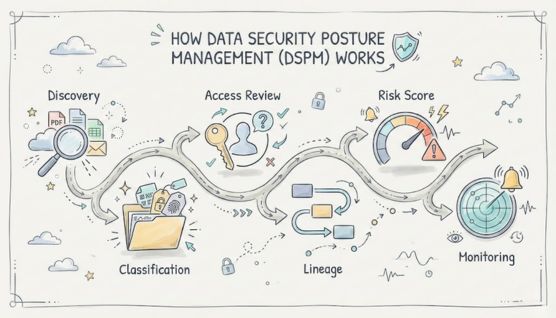
DSPM works by discovering sensitive data, analyzing who can access it, and monitoring exposure risks across cloud and SaaS environments.

how dspm works

Sensitive Data Discovery

DSPM scans cloud storage, databases, data lakes, and SaaS applications to locate PII, PHI, credentials, and other sensitive assets. It also uncovers shadow data and unmanaged copies that may introduce hidden exposure risks.

Data Classification & Context

Each dataset is classified based on sensitivity, business impact, and regulatory relevance. Metadata such as ownership, purpose, and retention requirements enhances prioritization.

Access & Permissions Analysis

DSPM evaluates users, roles, service accounts, and API keys to determine who can access sensitive assets. This highlights excessive privileges, unused access paths, and identity risks, reinforcing least-privilege controls.

Data Flow & Lineage Tracking

DSPM tracks how data moves across services, pipelines, applications, and integrations. Lineage reveals unintended propagation, unsecured transfers, and downstream exposure points.

Risk Scoring & Prioritized Findings

Risk scoring combines data sensitivity with access levels and configuration weaknesses to identify true exposure severity. This prioritization helps teams address the most impactful risks first.

Continuous Monitoring & Alerts

DSPM monitors configuration drift, permission changes, encryption gaps, and unusual data behavior. Alerts identify new exposures quickly so teams can act before issues escalate.

Together, these capabilities form the functional base of DSPM and lead into the components that make a DSPM solution effective.

What Are the Core Components of a DSPM Solution?

DSPM solutions include several essential components that work together to protect cloud data throughout its lifecycle.

Data Inventory

A complete index of all data assets across cloud accounts and regions provides a centralized view of storage locations. This helps eliminate blind spots and reveals shadow data.

Data Lineage

Lineage maps how data moves between systems, pipelines, backups, and integrations. Understanding these flows helps identify propagation risks and unintended exposure paths.

Encryption & Key Management Insights

DSPM evaluates encryption settings, KMS usage, key rotation schedules, and unencrypted assets. These insights highlight weak cryptographic controls that could lead to compliance violations.

Risk Scoring & Prioritization

Exposure severity is evaluated using a scoring framework that blends sensitivity, access depth, and configuration weaknesses. This makes it easier to focus resources on the most critical vulnerabilities.

Automated Remediation

Some platforms offer automated actions such as removing public access, correcting permissions, or enforcing encryption. Automation reduces response time and eliminates manual operational load.

Operational KPIs for DSPM

Strong DSPM programs measure performance using operational metrics that reflect real exposure reduction.

  • Exposed records identified: the amount of sensitive data discovered in risky locations.
  • Time to remediate: average time from detection to mitigation of exposure.
  • Critical findings reduced: decrease in high-severity risks after DSPM adoption.
  • Classification accuracy: precision of sensitivity labeling with minimal false positives.
  • Policy violations detected: number of access, encryption, or configuration issues prevented early.

These metrics demonstrate DSPM’s impact on reducing exposure and improving cloud security posture.

Micro-Case Example

A DSPM scan identified an object store containing over 95,000 sensitive records with publicly accessible permissions. Automated remediation removed public access within minutes and reduced the exposure window dramatically, demonstrating the value of continuous monitoring and prioritization.

What Are the Key Benefits of DSPM?

Breach Prevention

DSPM identifies high-impact data risks early, reducing the likelihood of accidental exposure or unauthorized access. This proactive insight strengthens the overall security posture.

Regulatory Confidence

DSPM aligns sensitive data with requirements such as GDPR, HIPAA, and SOC 2. Automated evidence efforts reduce audit workloads and simplify compliance reporting.

Operational Clarity

Security teams gain visibility into which data assets, identities, and cloud resources require immediate attention. This reduces alert fatigue and improves decision-making.

Resource Efficiency

DSPM reduces the time spent on manual audits, data mapping, and multi-tool correlation. Teams avoid chasing low-risk findings and maintain higher productivity.

Identity Strengthening

Linking data to user roles and service accounts improves identity governance and reduces privilege creep. This enhances Zero Trust alignment.

Faster Remediation

Risk-driven prioritization and automated fixes shorten response times. Organizations can resolve issues before they escalate into incidents.

How Does DSPM Compare to CSPM, DLP, and Data Governance Tools?

DSPM focuses on securing sensitive data, while CSPM, DLP, and data governance address different aspects of cloud security and compliance.

Category DSPM CSPM DLP Data Governance
Primary Focus Data exposure & access risk Cloud configuration posture Data exfiltration prevention Policies & lifecycle
Core Capability Discovery, classification, lineage, access mapping Misconfigurations, drift detection Monitor/block data movement Metadata & stewardship
Scope Cloud storage, databases, SaaS Cloud resources & IAM configs Endpoints, email, network Enterprise-wide data rules
Identity Context Strong identity-to-data mapping Config-focused Per-user enforcement Ownership tracking only
Output Exposure insights Posture alerts Egress controls Governance metadata
Strength Finds and ranks sensitive data risks Prevents misconfigurations Stops unauthorized data movement Aligns data with business rules
Limitation Not infra posture Not content-aware Limited cloud-native visibility Not risk-focused

DSPM vs CSPM

DSPM maps sensitive data and access risks, while CSPM analyzes cloud configurations and policy violations. Together they reveal whether misconfigurations expose sensitive assets.

DSPM vs DLP

DLP monitors data in motion to prevent exfiltration, while DSPM evaluates data at rest across cloud services. DSPM improves DLP accuracy with better discovery and classification.

DSPM vs Data Governance

Data governance sets policies and ownership standards, while DSPM identifies real exposure conditions. Governance defines expectations; DSPM shows whether environments meet those expectations.

What Are the Common Use Cases for DSPM?

Shadow Data Discovery

DSPM uncovers unmanaged, duplicated, or forgotten data across cloud environments. This reduces hidden exposure risks.

Access Governance

Access governance identifies excessive permissions, unused access paths, and risky identity-to-data relationships. These insights reinforce least-privilege strategies.

Compliance Alignment

DSPM maps sensitive data to frameworks like GDPR, HIPAA, and SOC 2. Automated tagging and reporting simplify audits.

Exposure Prevention

Exposure prevention identifies misconfigurations such as public access, weak encryption, or insecure sharing settings. Addressing these early prevents accidental leaks.

Incident Response Support

DSPM shows which sensitive data was exposed and who interacted with it. This improves the speed and accuracy of incident investigations.

Data Lifecycle Oversight

Date lifecycle oversight highlights outdated copies, unnecessary retention, and unsecured data propagation. Teams can enforce lifecycle and retention policies effectively.

Different Data Security Posture Management (DSPM) Tools

Cloud-Integrated DSPM Platforms

Cloud-integrated DSPM solutions scan cloud services and databases to identify sensitive information and exposure conditions. They provide continuous visibility by linking sensitivity with configuration and access context.

Data Discovery & Classification Engines

These tools uncover sensitive data across repositories and assign sensitivity categories. Classification builds the foundation for meaningful risk evaluation.

Identity-Aware DSPM Solutions

They map access paths across users, roles, service accounts, and API keys. This helps organizations strengthen least-privilege policies.

Risk Prioritization Frameworks

These tools score exposure by blending sensitivity with access depth and configuration weaknesses. Prioritization directs attention to high-impact issues.

Automated Remediation Tools

These solutions take corrective actions such as adjusting permissions or correcting misconfigurations. Automation reduces manual effort and enforces consistent policies.

Compliance-Driven DSPM Capabilities

They align sensitive data with major regulations and provide audit-ready evidence. This reduces the effort required for compliance assessments.

What Should Organizations Consider When Choosing a DSPM Tool?

  • Breadth of Data Coverage: Must detect sensitive data across storage types and environments for full visibility.
  • Identity-to-Data Mapping: Should correlate data with users, roles, and service accounts for accurate access insights.
  • Classification Accuracy: Needs reliable sensitivity labeling with minimal false positives.
  • Risk Scoring Model: Should reflect sensitivity, access depth, and configuration risk.
  • Remediation Capabilities: Automation is essential for fast, consistent fixes.
  • Integration Flexibility: Must integrate with IAM, CSPM, SIEM, SOAR, and governance systems.
  • Scalability & Performance: Should handle large, dynamic cloud environments without lag.
  • Compliance Support: Must map data to major frameworks and provide audit-ready evidence.

FAQs About DSPM

What does DSPM actually protect?

DSPM protects sensitive data such as PII, PHI, financial information, and internal business records. Its purpose is to reduce exposure caused by misconfigurations, excessive access, and unmanaged copies.

Does DSPM replace CSPM or DLP?

DSPM does not replace CSPM or DLP because each tool addresses a different layer of security. It enhances both by adding data-centric visibility.

How often does DSPM scan for new data?

Most DSPM platforms perform continuous or near-real-time scanning. This ensures that changes in data storage and permissions are detected quickly.

Who typically uses DSPM?

Security teams, cloud engineers, compliance leaders, and governance groups use DSPM insights. Each team applies these insights from different operational perspectives.

Does DSPM help with compliance?

DSPM supports compliance by classifying sensitive data and mapping it to frameworks like GDPR and HIPAA. It also simplifies audits by providing accurate lineage and exposure evidence.

What environments does DSPM support?

DSPM typically supports multi-cloud, hybrid, and SaaS environments through API integrations. This provides broad visibility across diverse data ecosystems.

Final Thoughts

DSPM provides deep visibility into how sensitive data is stored, accessed, and exposed across modern cloud environments. This allows teams to focus on the risks that matter most and respond with greater precision.

As cloud adoption expands, organizations need data-centric insight to maintain a strong security posture. DSPM provides the foundation for exposure reduction, coordinated governance, and long-term resilience.

‍

Related Posts
What Is API Security?
API security protects APIs from unauthorized access, threats, and misuse using authentication, validation, monitoring, and strict access controls.
What Is Malware Vs. Ransomware?
Malware is harmful software that infiltrates systems, while ransomware is malware that encrypts files for payment. Learn how they differ and how to stay protected.
What Is Data Risk Assessment?
A data risk assessment identifies sensitive data, evaluates threats, and scores risk to help organizations reduce exposure across all environments.

Start your demo now!

Schedule a Demo
Free 7-day trial
No Commitments
100% value guaranteed

Related Knowledge Base Articles

No items found.