🚀 CloudSEK featured in the 2026 Frost Radar™!
Read more
.avif)

IT Asset Inventory is a centralized and structured record of all technology assets an organization owns, leases, or actively uses. It provides a centralized view of technology resources across the entire IT environment.
It includes any hardware, software, virtual system, or connected device that operates within the organization’s infrastructure. These assets may be physical, cloud-based, or subscription-driven, as long as they support business operations.
IT Asset Inventory focuses on recording accurate and current asset information. It documents essential identifying details so organizations know what assets exist and where they are located.
According to ServiceNow’s State of ITAM Report, organizations underestimate their IT asset count by an average of 30%, which creates visibility gaps and increases risk exposure.
IT Asset Inventory is important because accurate asset visibility directly affects security, operations, compliance, and cost control.
Organizations need a clear view of all technology assets in use. Complete visibility eliminates blind spots and ensures no system operates without oversight.
Security controls depend on knowing which assets require protection. An accurate inventory ensures devices and applications receive timely updates and monitoring.
During outages or security events, teams rely on inventory records to identify affected systems quickly. Clear asset tracking reduces investigation time and speeds recovery.
Regulatory requirements demand documented asset records. A maintained inventory supports reporting accuracy and audit verification.
Understanding owned and active assets prevents duplicate purchases, unused licenses, and unnecessary infrastructure spending.
IT Asset Inventory includes all technology assets that support business operations across physical, virtual, and cloud environments.

Here are the 5 main types of assets:
Hardware assets include physical devices used within the organization. Examples include servers, laptops, desktops, network switches, routers, storage systems, and mobile devices. These assets form the physical foundation of the IT infrastructure.
Software assets include installed applications, operating systems, enterprise platforms, and licensed tools. This category covers productivity applications, security software, databases, and subscription-based software services.
Cloud and virtual assets include virtual machines, containers, SaaS subscriptions, and cloud-hosted workloads. These assets operate in external or hybrid environments but remain part of the organization’s active IT environment.
Network-connected assets include printers, IP phones, security cameras, access control systems, and IoT devices connected to the corporate network. These devices require tracking because they interact with the internal system.
Digital infrastructure components include critical databases, directory services, and configuration repositories that support IT operations. These elements function as managed assets because they store, process, or control business systems.
IT Asset Inventory stores structured information that clearly identifies and describes each asset within the environment.
Each asset has a unique identifier such as a tag number, serial number, or system ID. The record includes the assigned owner, department, or responsible team.
The inventory records where the asset is physically located or which environment it operates in. This may include office location, data center rack, or cloud region. Network details, such as IP address or domain association, are documented when applicable.
Technical details describe the asset’s configuration. For hardware, this includes processor type, memory capacity, and storage. For software, this includes the version number and installation details.
The record reflects installed software versions and update status. This information confirms whether systems remain current and aligned with internal standards.
Each asset includes lifecycle information such as active, in maintenance, retired, or decommissioned. Lifecycle tracking ensures visibility into operational and non-operational assets.
IT Asset Inventory works by identifying assets, recording their details, and keeping that information accurate over time.
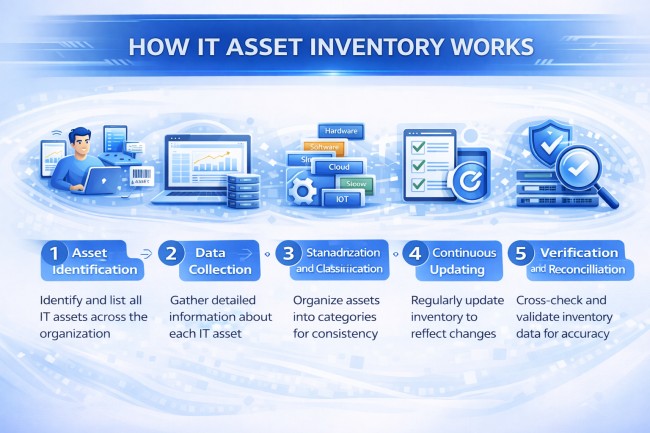
Here is a step-by-step process of how IT asset inventory works:
The process begins by identifying every device, system, and application connected to the environment. This includes physical hardware, installed software, and cloud resources currently in use.
Once identified, essential details are collected for each asset. These details include asset name, ownership, location, configuration, and current status.
Collected information is organized into a consistent format. Assets are grouped by type, function, or department to maintain clarity and simplify tracking.
Inventory records must stay current. When assets are added, removed, replaced, or modified, the inventory is updated to reflect the change.
Periodic reviews confirm that recorded assets match actual assets in operation. Any discrepancies are corrected to maintain accuracy.
The key difference is that IT Asset Discovery finds assets, IT Asset Inventory records assets, and IT Asset Management (ITAM) governs the full lifecycle of assets. In simple terms, Discovery identifies. Inventory documents. ITAM controls the assets.
IT Asset Discovery focuses on detecting devices, systems, and software connected to the environment. It answers the question: “What is present on the network right now?”
IT Asset Inventory organizes discovered assets into a structured and maintained record. It answers the question: “What assets do we officially track and recognize?”
IT Asset Management uses inventory data to manage procurement, deployment, maintenance, compliance, cost, and retirement. It answers the question: “How are assets managed from acquisition to disposal?”
IT Asset Inventory requires accuracy and continuous updating, but several operational factors make maintaining complete visibility difficult.
Here are some common challenges:
Shadow IT and Unmanaged Devices: Shadow IT refers to systems and applications used without formal IT approval. Employees may install software or connect personal devices that bypass official tracking. These unmanaged assets create visibility gaps and increase security risk.
Incomplete or Outdated Data: Inventory records lose value when details are missing or not updated. Missing ownership, configuration information, or status data reduces accuracy and weakens operational control.
Dynamic Cloud and Virtual Environments: Cloud infrastructure changes rapidly. Virtual machines, containers, and SaaS instances can appear and disappear automatically. Without continuous tracking, inventory records quickly fall behind.
Manual Tracking Limitations: Spreadsheets and manual updates cannot keep pace with modern IT environments. Human error, delayed updates, and inconsistent data formats reduce reliability.
Lack of Ownership and Accountability: When no clear responsibility exists for maintaining inventory records, updates become inconsistent. Defined accountability ensures that asset information remains accurate and current.
Organizations can implement IT Asset Inventory by defining a clear scope, establishing structured tracking, assigning responsibility, and maintaining continuous accuracy.
Begin by defining what qualifies as an IT asset. Policies specify which hardware, software, cloud resources, and connected devices must be recorded. A clear scope prevents tracking gaps.
Designate responsible teams or roles to maintain the inventory. Clear accountability ensures updates occur consistently and standards are followed.
Organizations implement reliable discovery methods such as network scanning, endpoint monitoring, and cloud integrations. Structured tracking ensures assets are identified across all environments.
All asset information is stored in a single authoritative system. Centralization prevents duplication and inconsistent records across departments.
Automation updates inventory records when assets change. Validation mechanisms detect discrepancies between recorded data and active assets.
Organizations perform scheduled reviews to confirm inventory accuracy. Regular verification maintains long-term reliability.
By defining scope, assigning accountability, centralizing data, automating updates, and verifying regularly, organizations can establish a structured and sustainable IT Asset Inventory process.
IT Asset Inventory provides a clear and structured record of all technology assets used within an organization. It establishes visibility across hardware, software, cloud resources, and connected devices, creating a reliable foundation for operational control.
Accurate inventory records support security oversight, compliance readiness, and cost awareness. Without a maintained inventory, organizations operate with incomplete knowledge of their technology environment.
By defining scope, assigning ownership, applying structured discovery, and maintaining continuous updates, organizations ensure that their IT Asset Inventory remains accurate and dependable. Consistent asset visibility strengthens decision-making and reduces operational uncertainty across the entire IT landscape.
