🚀 CloudSEK featured in the 2026 Frost Radar™!
Read more
.avif)

A virtual firewall is a software-based security system that inspects and controls network traffic inside virtual and cloud environments.
It does the same job as a traditional firewall. The difference is that it runs as software inside a virtual machine or beside a cloud workload. No physical hardware needed.
Proximity to the workload gives this design its real value. A virtual firewall runs beside the workload it protects. When that workload moves to another host or another region, the policy travels with it.
Traditional firewalls were built around a single, fixed network boundary. Traffic crossed a clear line between the internet and the corporate network. A hardware appliance stood on that line and inspected everything passing through.
Cloud infrastructure erased that boundary across most modern environments. Applications now run across regions, providers, and container platforms. Workloads appear and disappear within minutes. A fixed inspection point no longer sees most of what happens.
Traffic patterns have changed along with the architecture that carries them. Data moving between users and applications is called north-south traffic, and a perimeter firewall handles it well. Data moving between internal systems is called east-west traffic, and a perimeter firewall never sees it at all.
The gap matters most in east-west traffic between internal systems. A web server calls a database. One microservice calls another. Without inspection at that level, an attacker who compromises a single system moves sideways without resistance. Mapping that attack path afterwards is far harder than blocking the connection in the first place.
A virtual firewall reads traffic as it moves between systems and decides what happens to each connection. The decision runs continuously, not once at setup.
The firewall examines every connection request before allowing it to proceed. It reads source, destination, port, protocol, and connection behavior. Deeper implementations inspect application-layer content and match it against known attack patterns.
A rule set defines permitted and refused connections in explicit terms. The firewall compares each connection against those rules in order and applies the first match. Anything with no match falls to the default action, and that default is deny.
Cloud workloads move between hosts, availability zones, and entire regions. A virtual firewall attaches policy to the workload identity instead of an IP address. The rules stay attached during migration, scaling, and redeployment.
Virtual firewalls inspect traffic based on how systems communicate rather than only where traffic enters or exits the network.
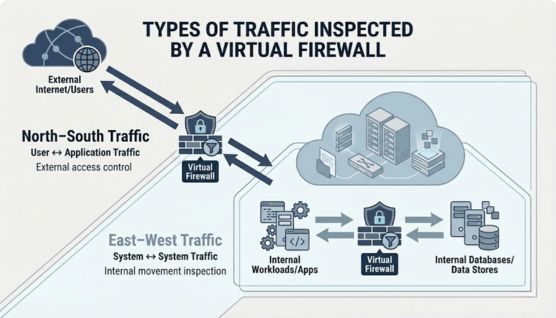
North–south traffic refers to data moving between users and applications, such as access from the internet. Monitoring this traffic helps control entry points and limit external exposure.
East–west traffic occurs when systems within the same environment communicate with each other. Inspecting this traffic helps detect and restrict unauthorized internal movement.
Deployment architecture follows the shape of the environment being protected. NIST examined this problem in SP 800-125B, which treats virtual machines as end-nodes of a virtual network and names firewall deployment architecture as one of the configuration areas that decides whether those machines stay protected.
Public cloud applications get created, scaled, and replaced on a constant cycle. A virtual firewall runs next to those workloads and enforces rules without any hardware dependency. Provisioning happens through the same automation that builds the workload.
Multiple systems share one internal network inside a virtualized data center. A virtual firewall controls which of those systems can reach each other. Segmentation at this level stops a single compromised host from touching everything on the same subnet.
Many organizations run cloud and on-premises infrastructure side by side. Policy tends to drift between the two. A virtual firewall applies one rule set across both, which removes the gap that appears when each environment is configured separately.
Containers communicate constantly and live for very short periods. Traditional network controls cannot keep pace with that churn. Virtual firewalls and native network policy work at the pod and service level instead of the host level.
Both firewall types perform the same enforcement job on network traffic. They differ in how they are deployed, where they run, and how quickly they adapt.
Neither approach retires the other in most real deployments. Organizations run hardware at the physical boundary and virtual firewalls inside the environments behind it.
Cloud platforms already ship with traffic controls, which causes real confusion about what a virtual firewall adds. The controls operate at different depths.
Security groups filter traffic at the individual instance level only. They match on port, protocol, and source, and they keep no memory of what a connection contained. Network access control lists work at the subnet level without state, so return traffic needs its own rule.
A virtual firewall reads considerably further into the traffic itself. It tracks connection state, identifies applications regardless of port, inspects payloads for known attack patterns, and applies one policy across accounts and providers. Security groups cannot express any of that.
Web application firewalls address an entirely different layer of the stack. One runs in front of a web application and inspects HTTP requests for injection, scripting, and abuse. A virtual firewall governs network reachability instead. Teams needing both protections run both products.
Feature depth varies widely from one virtual firewall product to another. These capabilities decide whether a deployment does real work or simply records traffic.
A virtual firewall enforces exactly what it is told to enforce. Most failures trace back to configuration and coverage rather than to the product.
Broad allow rules get written during troubleshooting and never removed. Over time, the policy permits far more than anyone intended. Rule review has to be scheduled, because nobody notices an over-permissive rule during normal operation.
Firewall management planes reachable from the internet invert the whole control. CloudSEK researchers recovered a command-level record from an access broker who targeted internet-facing appliances across more than a dozen countries, with exploits staged for at least twelve CVEs. Management access was the objective in that operation, not the workloads behind it.
A firewall protects only the traffic that actually routes through it. Shadow deployments, forgotten test environments, and unregistered public IP addresses fall outside every policy. Inventory gaps become policy gaps automatically.
Encryption now covers most internal traffic in modern environments. Inspecting it requires decryption, which costs performance and raises privacy questions. Many teams switch inspection off, and the firewall then sees connection metadata alone.
Cloud providers secure the underlying infrastructure and nothing above it. Customers secure what runs on that infrastructure. Teams misreading the split leave workloads with no traffic control at all, and exploitation of exposed services remained the most common initial infection vector in Mandiant's 2026 incident response data for the sixth year running.
Most of the value comes from how the deployment is run, not from which product is chosen. These practices keep a policy accurate as the environment changes underneath it.
Organizations reach for virtual firewalls when they need precise control over how software components talk to each other.
A firewall rule only protects an asset somebody knew to write a rule for. Overlooked subdomains, test servers left running, and public IP addresses assigned outside the standard process receive no policy at all. They stay reachable, and no internal console reports them as a problem.
BeVigil, CloudSEK's external attack surface monitoring platform, looks at the estate the way an attacker does. It fingerprints internet-facing assets and scans continuously across web applications, mobile apps, APIs, cloud, CVE, DNS, SSL, and network surfaces. Exposed management interfaces and unregistered services surface through that process, which is external attack surface management doing the job a rule set cannot.
Yes. Enforcement logic is the same in both. Security comes from rule quality and placement, not from whether the firewall runs as software.
Yes, to a degree. It consumes CPU and memory from the host, and deep inspection costs more than basic filtering.
Yes, with a third-party product. Native cloud firewall services from each provider work only inside that provider's environment.
No. A virtual firewall controls network reachability. Endpoint protection watches what runs on the host after a connection is allowed.
Platform or network engineering writes the rules in most teams, while security defines the policy standard and reviews exceptions.
No standard names it directly. PCI DSS, HIPAA, and ISO 27001 require network segmentation, and a virtual firewall is a common way to deliver it.
