🚀 CloudSEK featured in the 2026 Frost Radar™!
Read more
.avif)

A darknet is a privacy-focused overlay network designed to hide the location and identity of users and hosted services, typically requiring specialized software such as Tor to access.
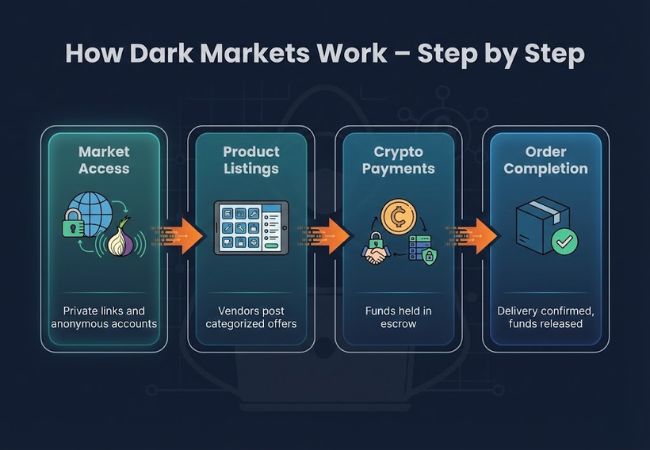
Dark markets are marketplaces that operate on these networks to trade illicit goods, services, stolen data, credentials, and access to compromised systems.
In simple terms:
Not all darknet activity is illegal. Networks such as Tor are also used for privacy, journalism, censorship circumvention, and secure communication. Dark markets represent only one type of activity that can exist on these networks.
For security teams, dark markets are particularly important because they can reveal whether an organization’s stolen credentials, customer data, internal access, or other compromised assets are being advertised or sold.
Markets form the visible layer, while forums, paste sites, and Telegram channels carry a growing share of the same trade. CloudSEK's breakdown of the deep web and dark web covers how the networks themselves route traffic.
Darknets are designed to separate a user’s identity from the destination they access. Unlike a typical VPN or proxy, which routes traffic through a single intermediary, networks such as Tor distribute that connection across multiple relays.
Tor typically routes traffic through three relays. The entry relay can see the user’s IP address but not the final destination, while the exit relay can see the destination but not the user’s original IP address. Onion services operate entirely within the Tor network and do not require an exit relay. Instead, the user and the service connect through a rendezvous point, helping conceal the physical location of the server.
Other anonymity networks use different architectures. I2P operates its own internal network of sites, known as eepsites, and is designed largely for anonymous peer-to-peer communication. Hyphanet distributes encrypted content across participating nodes, reducing reliance on a single identifiable server or storage location.
Dark markets replace legal enforcement with platform rules, reputation, and escrow, and the mechanics are remarkably consistent from one market to the next.
Trust carries the entire business. A market that fails to keep vendors honest, stay online under DDoS pressure, or resist phishing of its own login page loses users within weeks.
That pressure explains the engineering behind CAPTCHAs, mirror management, and PGP-signed address announcements.
Drug listings dominate the volume, and the listings that reach an enterprise sit in a narrower set of categories.
Pricing in these categories tells defenders something useful. A listing that prices domain administrator access to a named industry in a named country tells a defender how the market values what it already holds.
Fragmentation defines the current ecosystem, which has run without a dominant market since Hydra fell in 2022.
Chainalysis put aggregate darknet market flows at roughly $2.6 billion for 2025 in its 2026 Crypto Crime Report, up from about $2 billion the year before, which shows enforcement suppressing individual venues without reducing total trade.
Enforcement still lands hard on individual markets. Archetyp, the longest-running drug market, was dismantled in June 2025 with more than 600,000 registered users, over 17,000 listings, and at least €250 million in transactions, according to EU enforcement reporting.
Displacement follows every seizure within days. Users migrate to successor markets, and Russian-language platforms continue to handle the largest volumes.
Much of the credential and card trade has moved to Telegram channels and automated shops that need no marketplace at all, a shift covered in dark web monitoring trends.
Markets die in four recognizable ways, and the pattern repeats reliably enough that veteran users treat every market as temporary.
That instability shapes criminal behavior in ways defenders can use. Vendors keep copies of data across several markets, so a takedown rarely removes anything, and stolen credentials resurface for years under new listings.
No enterprise control reaches inside a dark market itself. What a security team controls is how fast it learns that its data is there, and what it invalidates in response.
Organizations gain nothing from browsing these markets directly, and they gain a great deal from knowing the moment their name appears in one.
CloudSEK XVigil monitors dark markets, forums, Telegram channels, paste sites, and code repositories for exposure tied to an organization's assets, covering leaked credentials, compromised accounts, data dumps, access listings, and phishing infrastructure built against the brand.
Findings arrive with source, timestamp, and context, so a security team can reset what is listed and brief leadership on what left the perimeter. CloudSEK's guide to choosing a monitoring tool covers how to test that coverage before committing to a vendor.
No, in most countries, including the US, UK, and EU. A few states restrict or block anonymity networks, and local law decides the answer.
Browsing alone is not an offence in most jurisdictions. Purchasing, selling, or viewing certain categories of content crosses into criminal conduct.
No. I2P and Hyphanet run their own networks with different designs, and several smaller anonymity networks exist alongside them.
A market processes transactions with escrow and ratings. A forum hosts discussion, reputation, and deals arranged privately between members.
An autoshop is an automated store selling stolen cards, credentials, or stealer logs instantly, with search filters and no human vendor interaction.
No. Listings on hidden services rarely come down on request, so the practical response is invalidating whatever the data unlocks.
Yes, in specific cases. De-anonymization comes from operational mistakes, payment trails, or shipping evidence, not from breaking the network itself.
Most run for months to a few years. Seizures and exit scams end the majority, and the longest-lived markets rarely pass five years.
Yes. Journalists, researchers, and people under censorship use them for secure communication, secure drop sites, and access to blocked information.
