🚀 CloudSEK featured in the 2026 Frost Radar™!
Read more


RBAC (role-based access control) grants access through roles assigned to users, while ABAC (attribute-based access control) decides each request by evaluating attributes of the user, the resource, the action, and the surrounding context. Choosing between these two shapes how an organization scales permissions, passes audits, and contains a stolen account.
Ranked against every other web application risk, broken access control holds first place in the OWASP Top 10:2025, and both RBAC and ABAC exist to keep an organization off that list.
Vendor guides frame the choice as a fork, yet the standards bodies that defined both models never treated it that way. Coverage below walks each model with examples, traces one request through both, tables the differences, and lands on the hybrid many mature systems run.
RBAC is an access control model that attaches permissions to roles and assigns roles to users, so nobody receives access individually. When an analyst joins the fraud team, one role assignment hands over everything the job needs, and when the analyst moves on, removing the role revokes it all in one step.
The formal definition of the model belongs to NIST, whose role-based access control project standardized RBAC into levels that build on each other:
Built into the design, though, is a ceiling: a role is a fixed bundle decided in advance, so conditions such as “only their own records” or “only during business hours” have nowhere to live inside a role name.
ABAC is an access control model that evaluates rules against attributes instead of checking a role. NIST’s Guide to Attribute-Based Access Control, Special Publication 800-162, defines the approach as evaluating attributes of the subject, the object, the requested operation, and, in some cases, the environment against policy that describes what is allowable.
Attributes fall into 4 working families, and policies mix them freely:
Written out, an ABAC policy reads like a sentence. A manager approves an expense in their own department when the amount sits under their approval limit, and that single rule covers combinations that otherwise demand a fresh role for every department-and-limit pairing.
Picture a contractor opening a salary file at 9 PM from a personal laptop, and run the same request through both models.
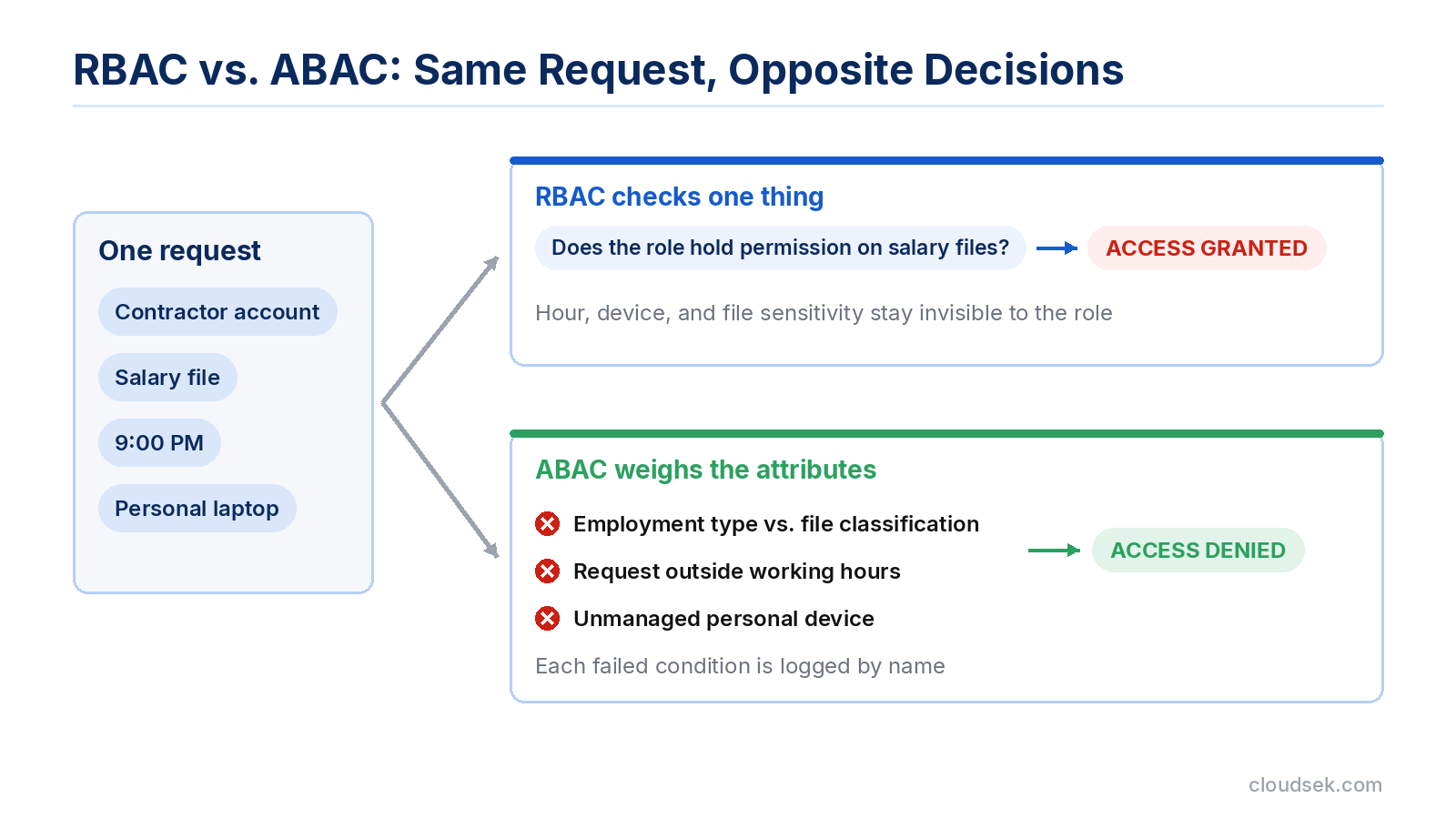
Under RBAC, the system asks one question: does the contractor role carry permission on salary files? If someone granted that permission last year for a project nobody remembers, access opens, since the model has no way to see the hour, the device, or the file’s sensitivity.
Run through ABAC instead, the policy weighs employment type against the file’s classification, notices the request arriving outside working hours from an unmanaged device, and denies, logging exactly which conditions failed. Same identity, same file, opposite outcome, and the difference is everything the second model was allowed to see.
The Comparison table below contains all major differences between RBAC and ABAC:
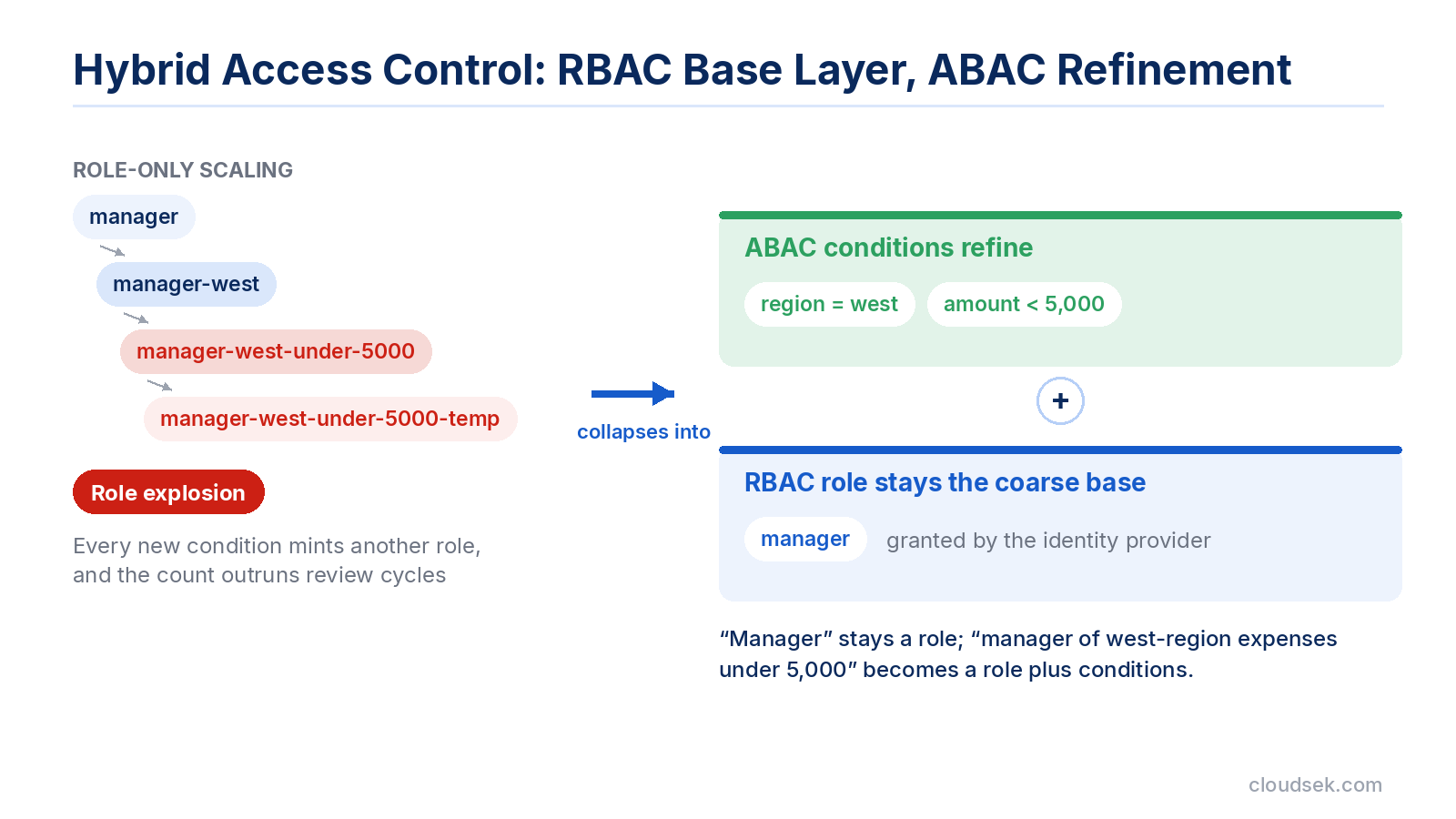
Scaling is the row that decides real choices. A role-only system answers every new condition by minting another role, manager, then manager-west, then manager-west-under-5000, and the count outruns anyone’s ability to track it; the spiral the next section names.
Evaluation cost deserves its own planning line. A role check runs close to a lookup, while attribute evaluation executes per request, so high-traffic systems move decisions into a dedicated policy engine that scales horizontally and caches attribute reads, keeping latency flat as rules grow. List views raise the same cost question at scale, and mature setups compile the policy into a database filter so a thousand-row screen never runs a thousand checks.
Role explosion is RBAC’s signature failure. Exception after exception becomes a new role, overlapping bundles accumulate, review cycles stop being honest, and permissions pile up inside long-lived roles until a compromised account inherits far more reach than anyone intended.
Failure on the ABAC side arrives quieter and dirtier. A policy engine confidently enforces whatever the attributes say, so when the department field lags a transfer by 3 weeks, decisions stay wrong for 3 weeks with perfect consistency. Policy sprawl compounds the problem, since overlapping conditions get hard to reason about, and nobody notices the rule that never fires.
Neither pattern is hypothetical, and both grow from the same root: access rules drifting away from the reality they encode. Governance, recertification, and attribute hygiene decide which model stays trustworthy, more than anything in the models themselves.
Situations, more than preferences, decide the fit:
Treating both models as layers, rather than rivals, is where mature systems land. Roles supply the coarse base that identity providers already hand out, and attribute conditions refine the places a role runs out, so “editor” stays a role while “editor of documents they own” becomes a role plus a condition.
NIST’s ABAC guide treats roles as one kind of subject attribute, so RBAC can run inside an ABAC system rather than against it. Neutrality from the body that defined both models says more than any vendor’s verdict.
Relationship-based access control (ReBAC) extends the family by deciding through relationships instead of roles or attribute sets. Permission flows from a graph: the owner of this folder, a member of that group, a manager of this user, which is the model behind Google’s Zanzibar system and the sharing behavior familiar from collaborative documents. ReBAC fits where sharing itself is the product, and it layers with roles and attributes the same way those 2 layer with each other.
Across the field, the direction points toward convergence. The OpenID AuthZEN specification, ratified in early 2026, standardizes how systems ask an external engine for access decisions. AI agents push the same way, since software acting on a person’s behalf needs per-action choices no upfront role captures. Those agents also carry their own credentials, such as API keys and MCP server access, and leaked AI keys bypass every model above just as stolen passwords do. CloudSEK AIVigil finds and validates leaked AI API keys and probes exposed MCP servers for unauthorized access.
Zero trust leans on the identical shift from one-time grants to continuous evaluation, a pattern NIST’s microservices guidance already prescribes for service-to-service calls. Moving From RBAC to ABAC: A Migration Path
For teams already running roles, the move toward attributes works as a refinement rather than a rebuild, and 4 steps keep it controlled:
Every model above decides what a credential is allowed to do, and none of them knows whether the person holding it is the owner. A stolen login that arrives with a valid role, and in a context the policy expects, passes either model. Stolen session cookies are worse, since they carry an already-authenticated session past both the password check and MFA.
Defense against that gap lives outside the access architecture. CloudSEK XVigil monitors dark-web markets, forums, and infostealer logs for an organization’s leaked credentials, validates whether they still work, and flags employee machines that show signs of infection, so teams can reset passwords and revoke sessions before replay. CloudSEK Nexus AI correlates that exposure with other external signals into potential attack paths, showing which leaked identities sit closest to critical assets and should be prioritized. Access design decides what an identity may do; exposure monitoring catches the cases where the identity is no longer who it claims to be.
Neither model is inherently more secure. ABAC narrows the blast radius through per-request, context-aware decisions, while RBAC’s simplicity keeps reviews honest, and real security tracks the quality of role hygiene or attribute data underneath either model.
An ACL (access control list) attaches permissions directly to each resource, listing who touches it, while RBAC groups permissions into roles assigned to users. ACLs suit small, static sets of resources; roles scale across an organization.
PBAC (policy-based access control) is an umbrella approach expressing access rules as centrally managed policies, typically combining roles and attributes in one policy layer. In practice, PBAC operates as the packaging around a hybrid RBAC-ABAC setup.
XACML (eXtensible Access Control Markup Language) is the OASIS standard defining an ABAC architecture and policy language, built around policy decision, enforcement, information, and administration points. Modern engines keep the architecture while replacing its XML syntax.
Role explosion signals appear when roles outnumber employees or when hundreds of near-duplicate roles differ by one permission. Audits finding thousands of roles across a mid-sized directory confirm the spiral has outrun governance.
Yes, a small team can start directly with ABAC when its product needs per-record rules from day 1, such as multi-tenant isolation.
