🚀 CloudSEK featured in the 2026 Frost Radar™!
Read more
.avif)

Open source attack surface management (ASM) is the practice of discovering, monitoring, and reducing an organization's internet-facing exposure using publicly available tools, open data sources, and free intelligence instead of commercial platforms.
The focus is everything an attacker can see without touching the organization's internal network. This includes domains, subdomains, IP ranges, exposed services, certificates, leaked credentials in public repositories, DNS records, and cloud-hosted assets. Every one of these is a potential initial access vector, the entry point an attacker uses to begin an intrusion.
Open source ASM stitches together data from search engines, certificate transparency logs, passive DNS providers, code search platforms, and reconnaissance tools to build the same external view an adversary would build during reconnaissance. The goal is straightforward: see what attackers see, before they act on it.
Open source ASM matters because the external attack surface has outgrown what most security teams can track manually, and because adversaries already use open source tools for reconnaissance.
It exposes assets internal inventories miss. Shadow IT, forgotten subdomains, deprecated cloud instances, and developer environments rarely appear in CMDBs but routinely appear in attacker reconnaissance. According to IBM's 2024 Cost of a Data Breach Report, 38% of breaches in 2024 originated from unknown or unmanaged assets. Gartner has also noted that roughly 40% of enterprise infrastructure remains invisible to IT teams.
It shifts security from reactive to proactive. Identifying an exposed admin panel, an expired SSL certificate, or a leaked AWS key before an attacker chains it into an attack path is fundamentally cheaper than incident response after the fact.
It is low-cost and accessible. Tools like Amass, Subfinder, and Shodan are free or near-free. For small security teams, internal red teams, and researchers, open source ASM is often the only economically viable path to external visibility.
It supports continuous monitoring. External exposure changes daily. New subdomains spin up, certificates expire, code gets pushed to public repos. Scripted open source workflows can track these changes on an automated cadence.
It mirrors the attacker's perspective. Adversaries do not have a privileged view inside the network. They build their target picture from the outside in, using many of the same tools defenders can use. Open source ASM closes the asymmetry.
A functional open source ASM workflow has five working parts. They are usually assembled from separate tools rather than packaged together.
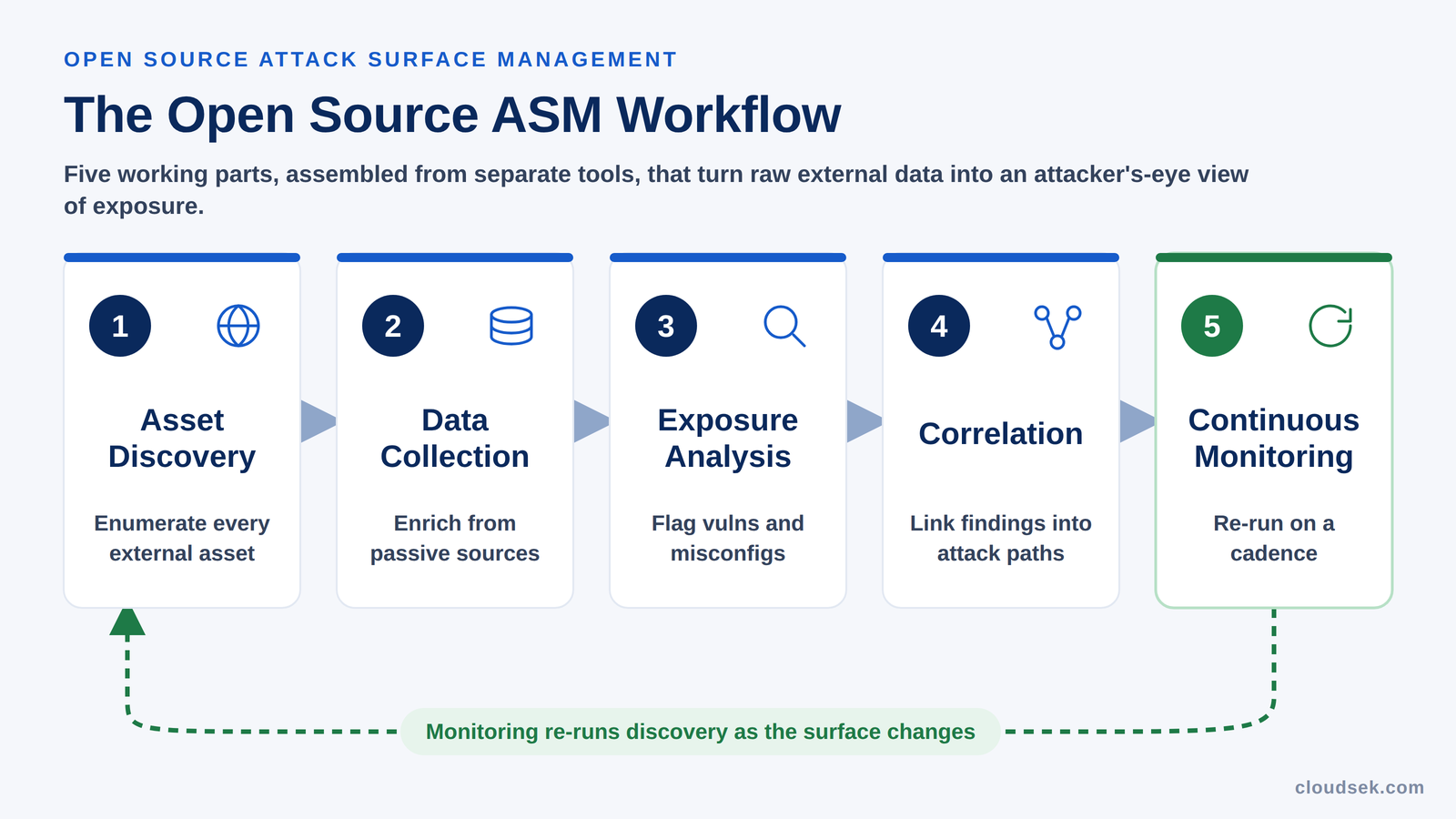
Asset discovery. This is the engine that enumerates everything externally tied to the organization, including root domains, subdomains, IP ranges, ASNs, mobile apps, cloud buckets, and exposed services. The output is the raw asset inventory everything else depends on.
Data collection. Raw discovery is enriched with information from passive DNS, certificate transparency logs, WHOIS records, public code repositories, and internet-wide scan databases. The quality of the final picture depends on the breadth of sources pulled in.
Exposure analysis. Collected data is examined for vulnerabilities, misconfigurations, exposed credentials, weak SSL/TLS settings, subdomain takeover candidates, and indicators of compromise. This is where raw data becomes actionable risk.
Correlation. Disconnected findings (a subdomain here, a leaked credential there, an exposed service somewhere else) are linked into a coherent picture. Correlation is what turns a pile of alerts into an understanding of how an attacker could chain weaknesses into an attack path.
Continuous monitoring. Discovery and analysis are re-run on a cadence so new assets, new exposures, and configuration drift are caught as they appear, not at the next annual audit.
External asset discovery. Mapping the full set of internet-facing assets tied to an organization, including the shadow IT that never made it into the CMDB: a SaaS instance marketing spun up, a staging environment a developer published, a regional office's own SSL certificate. This is the foundation every other use case depends on.
Vulnerability identification. Finding outdated services, missing patches, weak configurations, and exposed credentials in public code. An exposed Elasticsearch instance or a publicly accessible admin console can sit unpatched for months. Continuous open source scanning shortens the window between exposure and detection.
Threat monitoring. Tracking changes to the external attack surface over time, including new subdomains, expired certificates, and newly exposed services.
Red team reconnaissance. Simulating the attacker's view of the organization to test detection and response readiness.
Compliance and audit support. Validating that public-facing assets meet baseline security configurations required by regulators or internal policy.
Open source ASM works, but it comes with real friction.
Data quality varies. Passive sources are often stale, incomplete, or contradictory. Findings need human validation before they drive action.
Tooling complexity. A serious open source ASM workflow chains together five to ten tools, each with its own configuration, output format, and update cadence. Keeping the stack running is itself a project.
Scale. A handful of subdomains can be triaged manually. A 5,000-domain enterprise estate cannot. Without automation and prioritization logic, open source ASM collapses under its own output.
Analyst dependency. Free tools produce noise. Separating real exposures from false positives requires experienced analysts, and analyst time is rarely free.
The honest tradeoff: open source ASM gives flexibility, transparency, and near-zero licensing cost. Commercial platforms give automation, scale, and crucially, the ability to correlate external attack surface findings with other risk signals into a unified attack path view. Most mature security programs use both. Open source serves ad-hoc reconnaissance, red teaming, and research. Commercial platforms serve production-grade external monitoring.
Open source tools are strong at discovery. They are weak at turning thousands of discovered exposures into a prioritized picture of which ones an attacker can actually chain into an initial access vector.
CloudSEK BeVigil continuously fingerprints an organization's internet-facing infrastructure and identifies the exposures that matter, including known CVEs, weak SSL configurations, DNS misconfigurations, subdomain takeover candidates, and credentials exposed in public code. For teams that have outgrown ad-hoc open source workflows, BeVigil extends what open source ASM begins.
Use multiple tools in parallel. No single open source tool covers every discovery source. Amass handles deep DNS enumeration. Subfinder gives fast passive subdomain discovery. Shodan surfaces exposed services. theHarvester pulls OSINT. Running them together produces a meaningfully more complete picture than any one alone.
Validate before acting. Open source data is noisy. A "vulnerable" service may be patched, decommissioned, or a honeypot. Validate findings against current ground truth before opening tickets.
Automate the boring parts. Discovery, enrichment, and diffing should run on a schedule, not on demand. Human attention should be reserved for triage and response.
Prioritize by exploitability, not severity. A medium-severity vulnerability on an internet-facing authentication endpoint matters more than a critical CVE on an internal staging server. Prioritize based on what an attacker could actually chain into an initial access vector.
Integrate with existing workflows. Findings that sit in a CSV are findings that do not get fixed. Pipe results into the ticketing system, SIEM, or vulnerability management platform the team already uses.
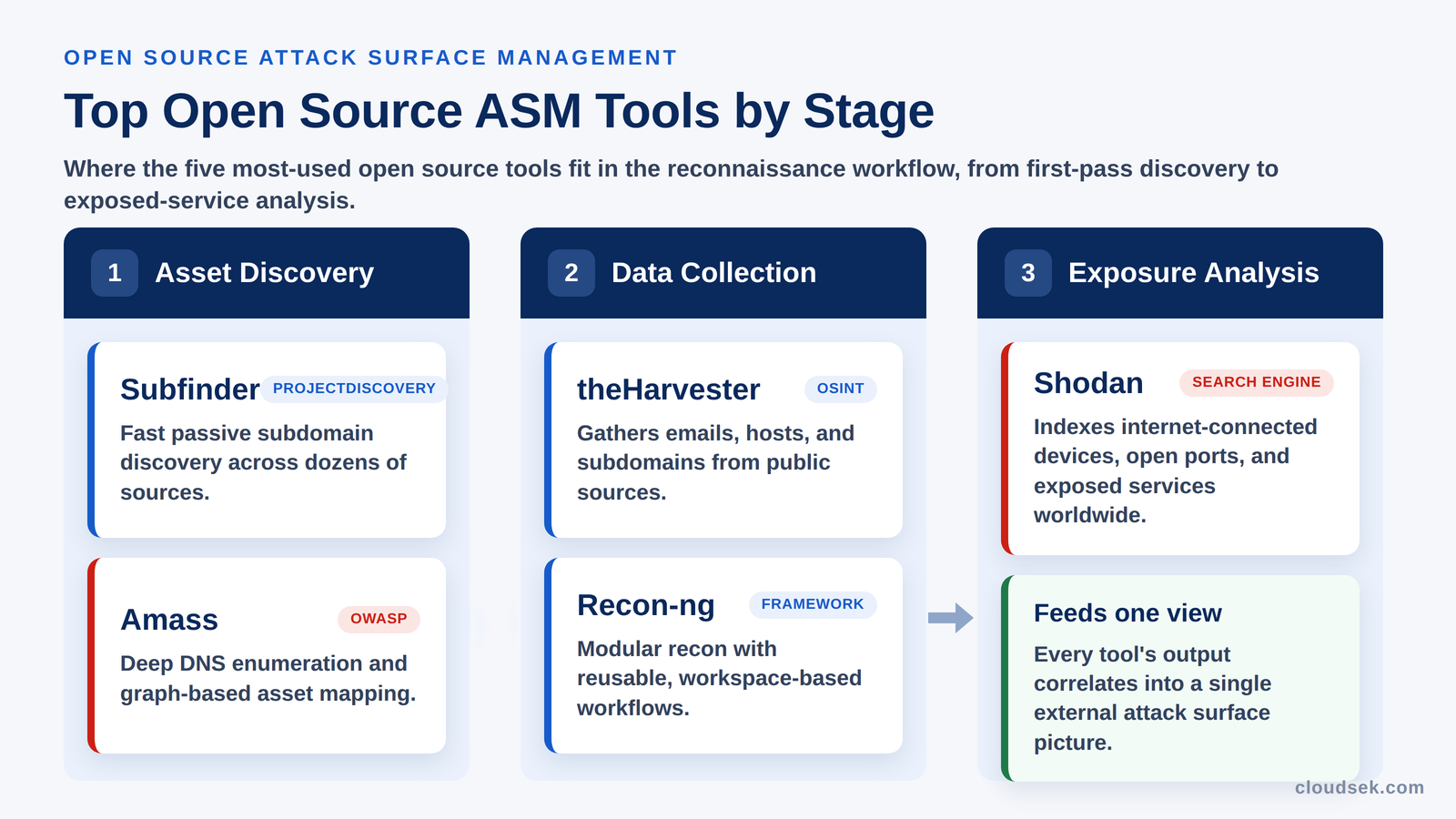
Amass. OWASP's flagship reconnaissance framework. Amass performs deep DNS enumeration, brute-forcing, certificate transparency analysis, and graph-based asset mapping. It produces relationship-aware output showing how discovered assets connect. This is useful for understanding the topology of an organization's external footprint, not just listing it.
Subfinder. A passive subdomain discovery tool from ProjectDiscovery, optimized for speed. Subfinder queries dozens of passive data sources concurrently and returns clean, deduplicated subdomain lists without sending traffic to the target. It is the standard first-pass discovery tool for most external reconnaissance workflows.
theHarvester. An OSINT collection tool for emails, subdomains, hostnames, employee names, and IPs from search engines, PGP key servers, and public databases. Useful for the early-reconnaissance phase where the goal is mapping the organization's surface before deeper scanning.
Recon-ng. A modular reconnaissance framework with a Metasploit-style interface. Recon-ng organizes data collection into modules for domain enumeration, host discovery, vulnerability checks, and credential harvesting, and stores findings in a structured workspace. The modular design makes it useful for building repeatable, customized reconnaissance workflows.
Shodan. The defining search engine for internet-connected devices. Shodan continuously scans the global IPv4 space and indexes banner data, exposed services, open ports, and device fingerprints. A single query can surface every exposed RDP instance, every internet-facing Elasticsearch node, or every device running a vulnerable software version tied to an organization. For external service exposure, nothing in the open source ecosystem matches its coverage.
To identify and monitor an organization's externally exposed assets (the initial access vectors an attacker would target) using publicly available tools and data sources instead of commercial platforms.
The tools are free or near-free. The true cost is analyst time spent configuring the toolchain, validating findings, and acting on results. For most enterprises, the labor cost exceeds what a commercial license would have been.
Internal red teams, penetration testers, bug bounty hunters, threat researchers, smaller security teams without ASM budget, and most large enterprises as a complement to commercial platforms.
It is sufficient for discovery and reconnaissance. It is not sufficient for correlating findings with dark web exposure, threat actor activity, AI system risks, and third-party vendor exposure into a unified attack path. Production-grade external visibility at enterprise scale typically requires a commercial platform that handles correlation, prioritization, and continuous monitoring.
External attack surface management (EASM) is the broader category that describes what the discipline does. Open source ASM is one way to do it using free tools. Commercial EASM platforms are the other.
No. Open source tools focus on traditional internet-facing assets like domains, services, and code repositories. They do not analyze AI-enabled applications, model-serving APIs, or AI infrastructure for risks like prompt injection, model abuse, or training data exposure. This is a separate discipline handled by dedicated AI security platforms.
