🚀 CloudSEK featured in the 2026 Frost Radar™!
Read more
.avif)

Ahmia is the best overall dark web search engine in 2026 for users who want safer, research-focused access to public onion services. Its cleaner indexing, abuse-removal process, and stronger suitability for verification make it a better starting point than broad crawlers that often return cloned, inactive, or risky links.
Dark web search engines are important because onion services are not indexed like normal websites and cannot be opened through standard browsers. Tor Metrics data cited in 2025 privacy research estimated more than 150,000 onion services serving nearly 4 Gbps of traffic, showing how large and difficult-to-navigate the hidden web has become.
Finding the right option depends on the purpose of the search, not just the size of the index. Some tools work better for broad discovery, some support private research, and others are more useful for automation, threat intelligence, or cross-checking suspicious onion links.
A dark web search engine is a discovery tool that helps users find . onion websites hosted on the Tor network, which standard browsers and mainstream search engines cannot reach. Researchers, journalists, security teams, and privacy-focused users rely on it to locate hidden services without depending only on scattered directories, forum mentions, or manually shared links.
Dark web indexing works differently from normal web search because onion services are unstable, harder to crawl, and often short-lived. Search engines in this space usually depend on limited crawlers, submitted links, cached pages, public directories, and manually maintained indexes to surface relevant results.
Search results should be treated as leads, not proof that a site is safe or legitimate. Onion addresses can change, disappear, or be copied by scam mirrors, so careful validation matters before any deeper research begins.
Dark web search engines were evaluated based on active availability, onion-service reach, indexing method, result quality, privacy posture, and practical usefulness for research. Tools with stronger public presence, cleaner discovery flow, and clearer use cases were prioritized over outdated or poorly maintained options.
Result volume was not treated as the main ranking factor because larger indexes often include inactive links, scam mirrors, duplicate pages, and unsafe destinations. Search engines that support safer discovery, better filtering, repeatable monitoring, or cross-checking were considered more useful for serious investigations.
Final placement also reflected the main user intent behind every tool, including journalism, OSINT, cybersecurity research, privacy-led browsing, and threat intelligence monitoring. The goal was to compare all options for real-world value rather than popularity alone.
Every option below serves a distinct purpose, from safer onion discovery and large-scale crawling to private browsing, automated tracking, backup validation, and directory-led exploration.
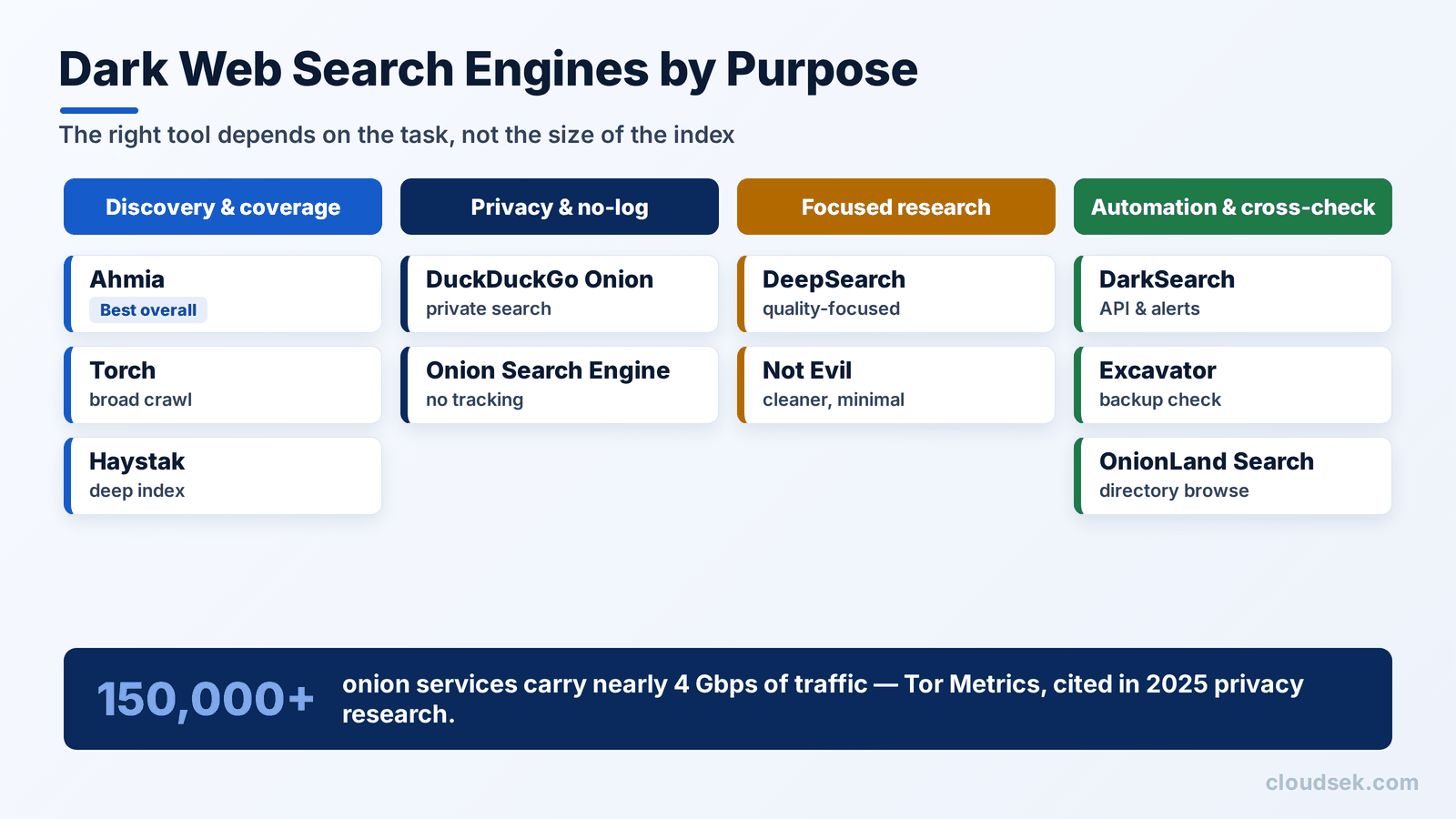
Launched in 2014 by Juha Nurmi during Google Summer of Code with Tor Project mentoring, Ahmia is the best overall dark web search engine in 2026 for safer public .onion discovery. A research-led origin, curated indexing, and an abuse-removal process place it ahead of many anonymous Tor tools.
Quality control puts this option in the lead position. Reported harmful material can be removed from the index, reducing exposure to scam pages, abusive content, and low-value results during early casework.
First-pass discovery, link validation, academic review, and controlled Tor analysis are its primary use cases. Security teams, journalists, and OSINT analysts benefit most from accurate leads over raw result volume.
Torch has been publicly referenced since the early 2010s and remains one of the oldest names tied to large-scale dark web search. Reach is its defining advantage, especially for users who need to move beyond curated indexes and inspect a wider hidden-service landscape.
Large result sets can reveal mirrors, older traces, forgotten pages, and obscure destinations smaller engines may miss. Extra volume also brings duplicate links, inactive pages, scam copies, and unsafe destinations beside legitimate findings.
Wide-sweep work fits this option best. Threat researchers can rely on it for keyword expansion, mirror hunting, underground ecosystem mapping, and obscure lead collection after lower-noise sources have narrowed the topic.
Haystak belongs in this 2026 list since deep indexing helps users examine a keyword, entity, leak mention, alias, or underground topic across a wider result base. Active in dark web search discussions since around 2016, it suits evidence gathering more than quick one-off lookup.
A larger searchable footprint helps trace repeated appearances across scattered pages. Brand names, threat actor aliases, credential patterns, exposed-data mentions, and historical clues become easier to follow during spread analysis.
Cyber threat intelligence tools, fraud investigators, and monitoring groups get the most value after an initial review round. At this stage, the goal changes from finding one source to understanding how far a signal travels across Tor-based services.
DuckDuckGo Onion is best understood as a private search option inside Tor, not as a deep dark web crawler. Founded in 2008, usable through Tor since 2010, and upgraded with a v3 onion service in 2021, it supports preparation before dedicated indexing begins.
Private open-web searching is its primary role. Public reports, organization names, breach mentions, legal records, threat actor context, and news material can be gathered in a Tor-friendly environment before moving into darker sources.
Privacy advocates, activists, media teams, and sensitive-source handlers benefit from this setup. Better background material leads to sharper keywords, clearer entity tracking, and fewer random queries inside noisy platforms.
DeepSearch adds a fresher quality-focused choice to the 2026 list compared with older names carrying weak activity signals. Recent dark web discussions place it around cleaner Tor-based discovery rather than maximum result count.
Precision matters more than scale here. A selective experience can reduce time lost on spam-heavy pages, repeated links, unrelated destinations, and stale results.
Controlled investigations are the natural fit. Source comparison, focused assessment, and fresh lead collection become easier after classic engines return too much noise or too many repetitive pages.
Not Evil still matters through its minimalist Tor search experience for users who prefer restraint over clutter. Publicly referenced since the late 2010s, it remains recognizable among people who want a lighter interface instead of inflated indexing claims.
Focused queries work well in this environment. Simple result pages support careful reading, low-distraction exploration, and first-pass searching without pushing users directly into high-noise areas.
Compliance reviewers, academic users, and policy-sensitive investigators are the best match. Documentation, controlled exploration, and lower-noise analysis matter more here than collecting the largest possible number of links.
Automation separates DarkSearch from traditional dark web search engines. Publicly visible around 2019–2020, it is built around repeatable querying and monitoring rather than one-off manual browsing.
Programmatic search supports keyword tracking, brand monitoring, leaked credential checks, threat actor alias tracking, exposed-data mentions, and recurring indicator collection. Those outputs can feed dashboards, alerts, reports, and SOC processes with less manual effort.
Security operations teams, brand protection units, and intelligence pipelines benefit most from this model. Current endpoints should be verified before publication since dark web services often change mirrors, availability, or connection points.
Privacy posture defines Onion Search Engine more than feature depth. Active since 2017 according to its public positioning, it emphasizes no tracking, no cookies, no JavaScript, and no unnecessary third-party code.
Direct keyword matching is the practical strength. Tor-based searches become easier without relying only on forums, directories, pasted link lists, or manually shared addresses.
Lightweight sessions suit privacy-led Tor users, independent investigators, and people who want a simple no-log experience. Advanced cases may still need deeper indexing, filtering, automation, or wider signal collection.
Excavator adds the most value as a backup discovery tool. Recent 2026 onion-directory references show it as an active alternative with uptime visibility, making it a better current choice than older options with unclear status.
Redundancy helps reduce single-source blind spots. A secondary index can confirm whether a keyword, address, suspicious phrase, or hidden-service mention appears beyond the primary engine being checked.
Verification-stage work is the right place for this option. Link checkers, incident analysts, and dark web monitoring teams can use it to resolve dead links, incomplete results, and conflicting references.
OnionLand Search has a different role, leaning toward directory-style exploration rather than keyword-first searching. Referenced since around 2018, it helps users browse categories, related services, and adjacent resources after direct terms become too narrow.
Category-led browsing can uncover surrounding communities, mirrors, forums, marketplaces, and topic clusters missing from a single query. This structure supports context expansion once the core area is already known.
Exploratory mapping is the best use case. Analysts studying dark web ecosystems can place it later in the process to understand surrounding services, related destinations, and broader topic clusters.
Safe access matters because dark web search engines can surface real onion sites alongside cloned pages, phishing traps, malware links, scam mirrors, and abandoned services.
A safe setup reduces the chance of turning dark web research into accidental exposure, malware infection, identity leakage, or unsafe link interaction.
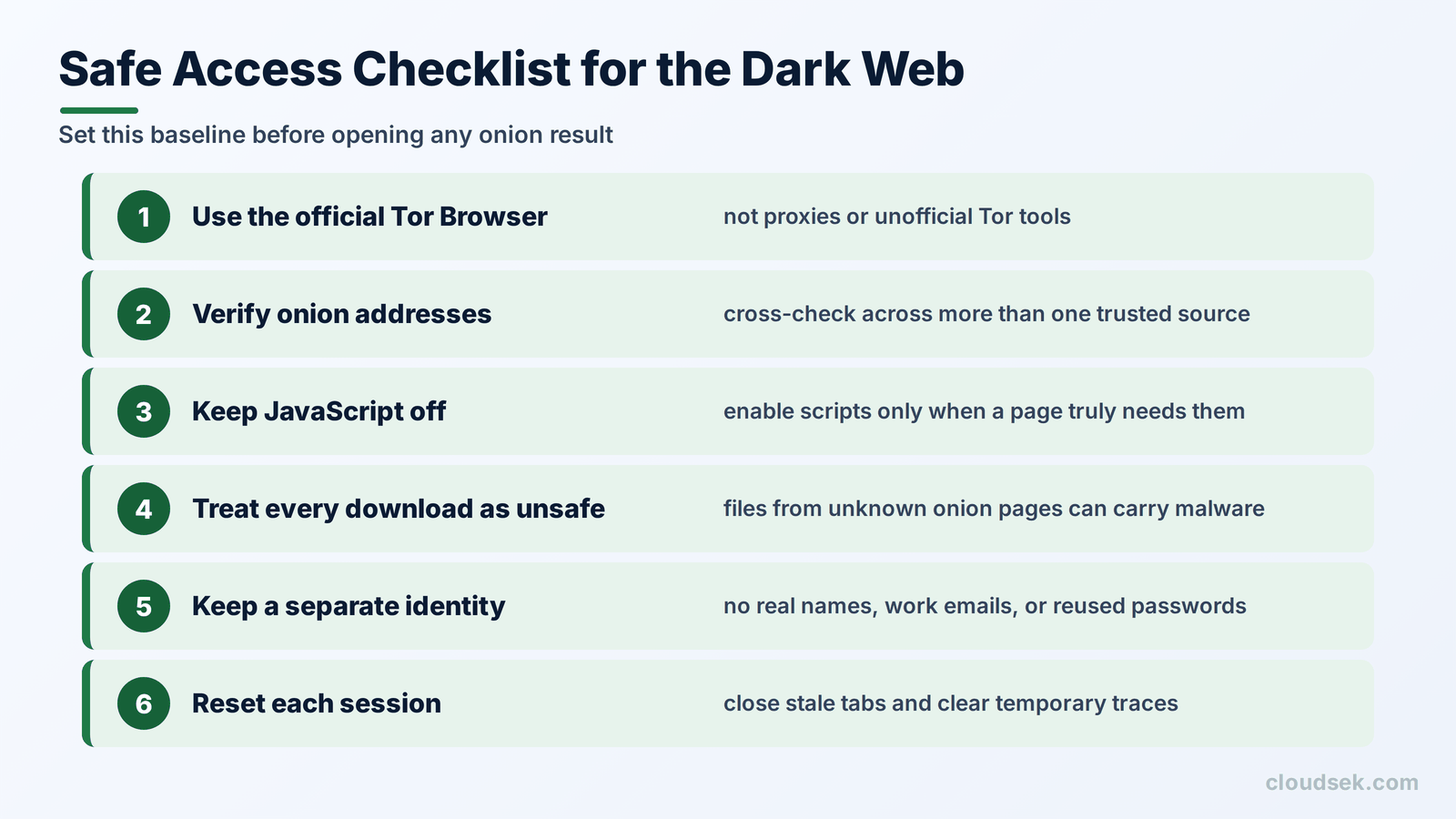
Open .onion sites only through the official Tor Browser. Regular browsers, random proxy pages, and unofficial Tor tools can weaken privacy protections and may route traffic through unsafe intermediaries.
Compare important onion addresses across more than one trusted source before visiting them. Scam mirrors often copy the design of known services, so even a small address change can send users to a fake page.
Keep JavaScript disabled unless a page genuinely needs it to function. Scripts can increase browser fingerprinting, enable tracking behavior, trigger redirects, or expose the browser to exploit attempts.
Treat files from unknown onion pages as unsafe by default. Archives, documents, executables, and attachments can carry malware, reveal device details, or create risk beyond the browser session.
Dark web research should never connect with real names, personal emails, reused passwords, work accounts, or payment details. A separate identity setup reduces the risk of linking normal online activity with Tor sessions.
End each session with basic cleanup, including closing stale tabs, removing temporary traces, and avoiding saved suspicious pages. Better browsing discipline reduces exposure from copied mirrors, old links, and repeated access patterns.
Ahmia is the best overall dark web search engine in 2026 for users who need a safer starting point, cleaner public onion discovery, and better control during early research. Torch and Haystak are better for wider searches, while DarkSearch fits teams that need automation, recurring checks, or threat intelligence workflows.
No single dark web search engine can verify every onion link or guarantee safe access. The right choice depends on the task: private searching, deep indexing, broad crawling, no-log lookup, backup validation, or directory-style exploration.
Dark web search engines should be used as discovery tools, not trust systems. Safe browsing habits, address verification, script control, download avoidance, and identity separation remain essential before opening any result.
Not on their own, but unsafe habits can. Use Tor Browser, a separate identity, and script control during any session.
No. Most update irregularly, since onion sites frequently disappear, rotate addresses, or shift to new mirrors.
No. Treat every result as untrusted until verified, some may lead to phishing pages, malware, or scam mirrors.
Some claim no-log searching, but that's rarely independently verified. Safer browsing depends on Tor Browser and identity separation, not a privacy claim alone.
