🚀 CloudSEK featured in the 2026 Frost Radar™!
Read more
.avif)

Bug bounty platforms create a trusted space where organizations invite security researchers to uncover vulnerabilities before criminals can exploit them. Valid reports move through defined rules, safe-harbor terms, triage workflows, and reward models instead of scattered or risky disclosure.
Modern security testing now spans web apps, APIs, cloud systems, mobile products, infrastructure, smart contracts, and AI-driven services. No single team can examine every exposure alone, which is why structured research programs have become part of practical security operations.
Google’s Vulnerability Reward Program paid $17.1 million in rewards during 2025, including major payouts across Chrome, Google Cloud, Android, and Google devices. Numbers at that scale show why bug bounty platforms remain important in 2026 for researchers, security teams, and organizations trying to identify exploitable weaknesses earlier.
Bug bounty platforms are not built for the same purpose. Some focus on large public programs, some operate invite-only research networks, some specialize in managed pentests, and others concentrate on blockchain ecosystems or responsible disclosure.
Assessment started with the factors researchers encounter after joining a program rather than marketing claims published on vendor websites. Program availability, payout history, scope quality, researcher reputation, validation speed, and long-term opportunity were examined across every platform included in this list.
Ranking decisions also accounted for specialization. Platforms serving Web3 security, enterprise environments, beginner-friendly disclosure, private engagements, and regulated industries were evaluated against their direct peers instead of being measured against a single universal standard.
Bug bounty choices in 2026 cover public vulnerability reporting, beginner practice, vetted enterprise work, managed pentests, Web3 rewards, and responsible disclosure.
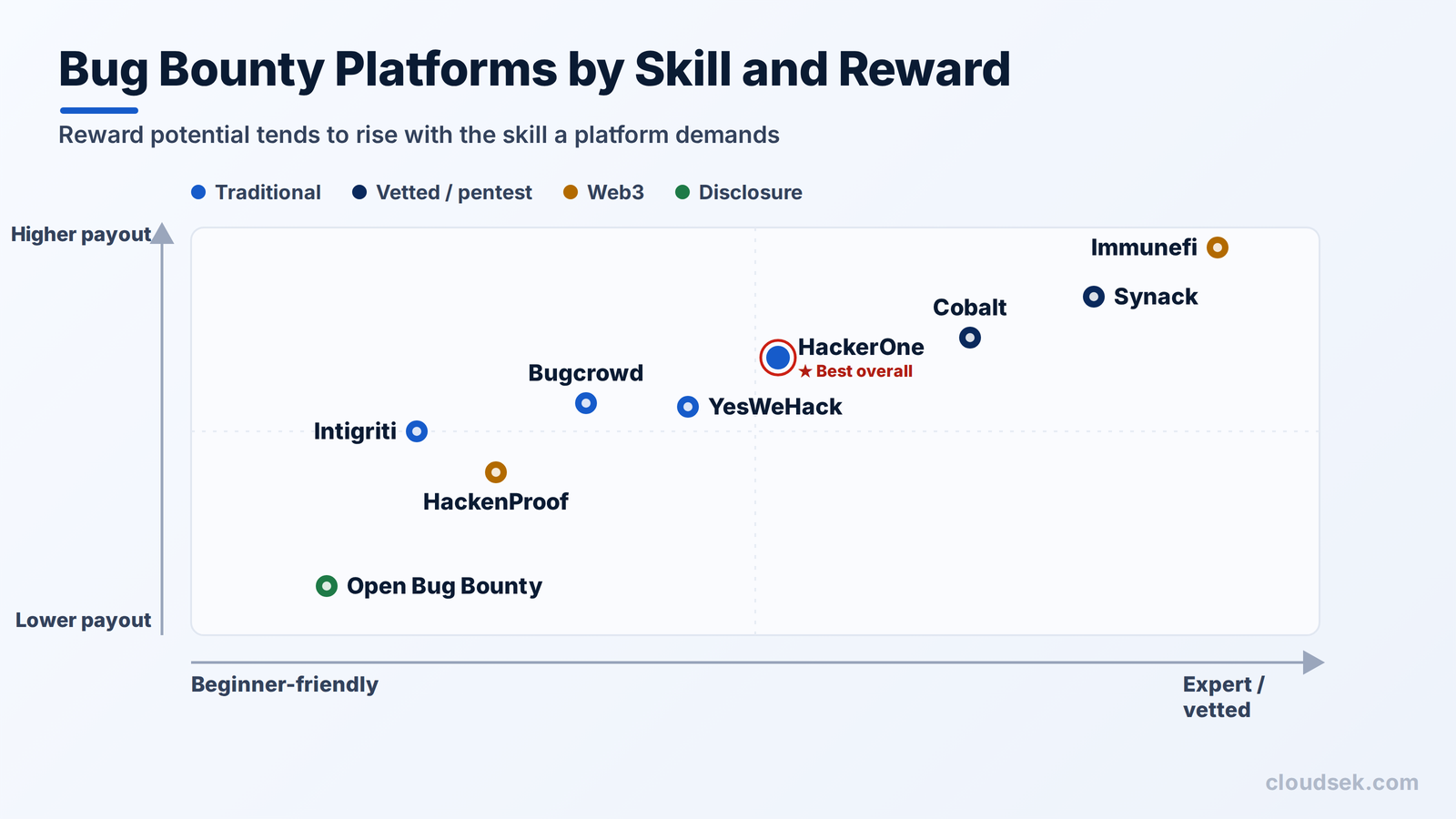
HackerOne earns top placement through scale, enterprise trust, learning depth, and multiple earning paths. Hunters can move across public bounty programmes, vulnerability disclosure programmes, private invitations, pentest engagements, live hacking events, and skill labs inside one mature ecosystem.
Official figures list $380 million+ rewarded to hackers, 1,000+ active bug bounty programmes, and 25+ CTF levels for skill development. Such depth suits beginners learning responsible reporting as well as advanced hunters pursuing higher-impact work.
Crowded targets remain a challenge on popular listings. Accurate reproduction steps, impact explanation, boundary discipline, and professional communication matter more than sending many low-value findings.
Start with learning resources, then move into programmes aligned with the current skill level.
Variety gives Bugcrowd a clear edge. Public bounties, private invitations, vulnerability disclosure programmes, managed bug bounties, and assessment-style engagements give users several ways to gain experience and earn rewards.
Bugcrowd’s 2026 hacker report found 82% of hackers use AI, 61% find more critical vulnerabilities in teams, and 65% have avoided disclosure due to no safe reporting path. Structured briefs, safe harbour language, and triage channels become important in such an environment.
Public listings can build points, submission history, and confidence before private work becomes realistic. Busy targets attract duplicates, so deeper reconnaissance and sharper validation often decide whether a finding stands out.
Treat every bounty brief as a rulebook before starting any test.
Starting bug bounties can feel overwhelming, and Intigriti reduces early friction with a cleaner interface, simpler programme pages, and a beginner-friendly reporting flow. New hunters can move from public opportunities into advanced work across web applications, mobile assets, cloud environments, and European organisations.
Scale also supports serious earning potential. Intigriti lists 150,000+ verified researchers and €60 million+ paid in bug bounties, giving it enough depth for real progress without making first steps feel too heavy.
European roots add value for users seeking transparent rules, privacy-aware environments, and regulated industries. Advanced hunters may prefer larger global enterprise volume elsewhere, but Intigriti remains a practical place to build early momentum.
Handle profile setup carefully because account choices and verification steps affect future participation.
Privacy, regional trust, and professional disclosure make YesWeHack a strong EU-focused choice. It suits users interested in public and private bounty opportunities tied to regulated, compliance-heavy, or privacy-conscious environments.
Identity verification anchors participation. YesWeHack’s help centre says KYC verification is required to submit reports and receive private programme invitations, while Dojo remains available for practice without KYC.
Such trust checks can appeal to teams needing stronger researcher accountability. Hunters get a more controlled environment with defined expectations, careful boundaries, and a regional community built around responsible reporting.
Finish trust verification early, then use practice environments before moving to live targets.
Synack takes a different route from traditional bounty marketplaces. The Red Team model serves vetted professionals who want private, controlled, enterprise-grade offensive testing rather than open public competition.
More than 1,500 trusted researchers make up the Synack Red Team. Entry follows a five-step vetting process covering resume review, technical assessment, background plus ID verification, behavioural interview, onboarding, and training.
Higher entry barriers are part of Synack’s value. Proven experience, certifications, disciplined reporting, and reliable communication matter more here than speed or public-programme volume.
Admission depends on technical skill, identity trust, and professional conduct.
Cobalt feels closer to a professional pentest marketplace than a traditional bounty board. Planned engagements, defined deliverables, protected environments, peer review, and enterprise delivery shape Cobalt’s model.
Cobalt says core pentesters average 11 years of experience and hold certifications such as CISSP, OSCP, and CREST. Experience at that level makes Cobalt more suitable for seasoned testers than casual beginners exploring a first public bounty.
Professionals who prefer structured projects may find Cobalt aligned with consulting-style work. Predictable engagement flow, lead collaboration, and quality review create a different rhythm from competitive bounty hunting.
Core entry focuses on project readiness, technical depth, and trust verification.
Money at risk changes Web3 bounty hunting. Immunefi is one of the leading Web3 bug bounty platforms, focusing on smart contracts, DeFi protocols, bridges, blockchain infrastructure, governance logic, and on-chain systems where a single critical flaw can expose funds or protocol control.
A 2026 Immunefi research report found 93.9% of bug bounty programmes active for five or more years had logged at least one confirmed paid critical disclosure. Such data show why long-running Web3 programmes need repeated external review rather than one-time audits alone.
Standard web testing knowledge is not enough here. Solidity expertise, protocol reasoning, local-fork testing, proof-of-concept discipline, and impact modelling carry more weight than basic web vulnerability patterns.
Rule compliance and proof quality can decide payout eligibility.
HackenProof bridges crypto research and conventional application testing. The target mix includes smart contracts, blockchain protocols, web applications, APIs, mobile apps, and infrastructure.
Recent HackenProof data shows 400+ programmes, $26 million+ in bounties paid, 80,000+ researchers, and 1,100+ confirmed critical vulnerabilities across nine years of operation. Active listings also include DeFi, smart contract, web, mobile, and infrastructure opportunities.
Crypto exchanges, wallets, protocols, and blockchain projects can use HackenProof for ongoing disclosure rather than relying on one-time audits only. Hunters get a hybrid route where profile credibility, reputation, and report quality can unlock stronger work.
Profile credibility matters before higher-value reporting.
Open Bug Bounty is included on this list for a different reason: it is better for learning and practising responsible disclosure than for earning consistent bug bounty rewards. Researchers can report website vulnerabilities through a coordinated disclosure process, while website owners get a free way to review and address verified findings.
Public counters show nearly 2 million coordinated disclosures and more than 1.66 million fixed vulnerabilities. Reporting pages also reference coordinated and responsible disclosure based on ISO 29147 guidelines.
New researchers can use Open Bug Bounty to build safer habits around non-intrusive testing, evidence quality, and respectful communication. Organisations with higher-risk assets may still need a paid bounty programme, managed testing partner, or internal vulnerability management process.
Use Open Bug Bounty as a safe disclosure practice route, not a guaranteed earning channel.
Bug bounty platforms are structured marketplaces where organizations invite approved researchers to find and report vulnerabilities under defined rules. They turn external testing into controlled programs with legal boundaries, validation queues, severity review, and reward handling.
Companies use bug bounty programs to receive credible findings from outside internal teams without opening systems to unsafe testing. Researchers use them to work on real targets, build reputation, earn payouts, and practice responsible disclosure.
Most bug bounty ecosystems support public programs, private invitations, vulnerability disclosure, and managed testing models. A well-run marketplace makes vulnerability reporting easier to control, verify, prioritize, and connect with business risk reduction.
Bug bounty platforms are important because they turn external vulnerability discovery into a controlled, traceable, and reward-based process for organizations and researchers.
Choosing the right bug bounty program depends on payout goals, skill level, target type, disclosure rules, and how much structure a user needs before testing begins.
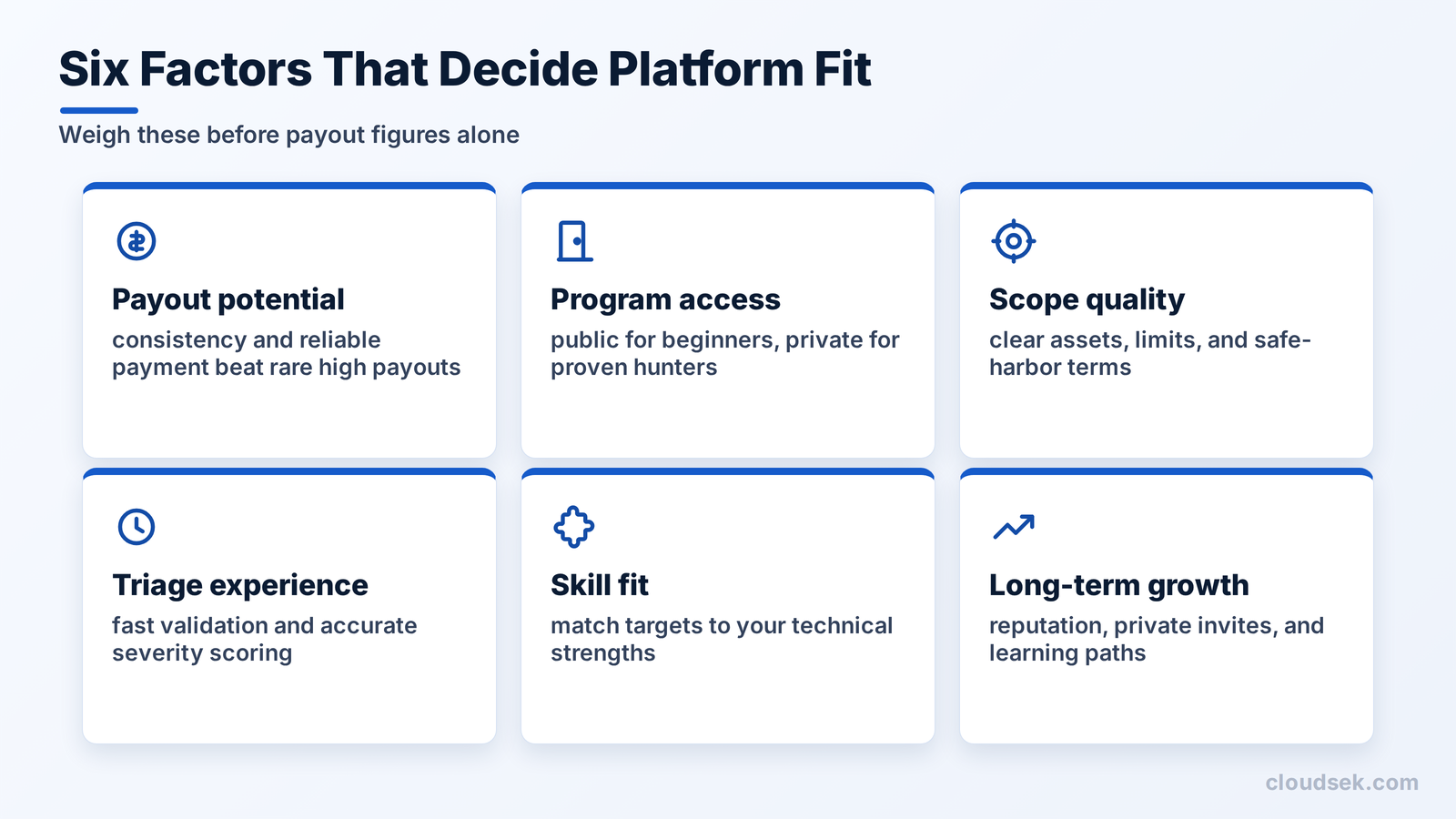
Reward size matters, but consistency matters more. A platform with predictable bounty ranges, fair severity review, and reliable payment handling is often more valuable than one showing high payouts only for rare critical findings.
Public programs are easier for beginners, while private invitations usually require proven report quality and platform reputation. Managed pentests and vetted networks suit experienced testers who prefer structured engagements over open competition.
Good scope pages explain approved assets, excluded systems, testing limits, rate restrictions, and safe-harbor terms. Weak or vague boundaries increase confusion, duplicate work, and rejection risk.
Fast validation gives researchers quicker feedback and helps organizations act before exposure grows. Strong triage also improves severity accuracy, reduces back-and-forth, and keeps reports moving toward resolution.
Every option does not suit every researcher or organization. Web apps, APIs, cloud assets, mobile products, infrastructure, smart contracts, and responsible disclosure routes require different technical strengths.
A good choice should support more than one report. Reputation building, private invitations, learning resources, verified payouts, and higher-value opportunities all matter for long-term progress.
Bug bounty selection in 2026 should begin with intent, skill level, asset type, and reporting maturity. Broad ecosystems suit users who need learning paths, public opportunities, and steady reputation growth; vetted networks, managed pentests, and Web3 programs serve deeper technical work.
Reward size should not drive the decision alone. Target boundaries, safe-harbor terms, triage quality, identity checks, payout reliability, and private access shape long-term value.
Organizations should match a bounty model to internal remediation capacity, validation needs, and disclosure maturity. Strong outcomes come from clear rules, quick review, accountable owners, and a process that turns validated findings into risk reduction.
Triage times vary by platform, but most established programs review submissions within a few days. Managed platforms often deliver faster responses because dedicated teams handle validation.
A clear proof-of-concept is expected for most submissions to help reviewers confirm the issue quickly. Strong PoCs also increase acceptance rates and reduce back-and-forth communication.
Beginners can earn, but initial progress is slow while learning methodology and gaining report quality. Earnings improve as experience grows and invitations to private programs increase.
Some vulnerabilities affecting infrastructure or widely used software can receive CVE assignments. Web-only issues typically do not qualify because they are limited to individual applications.
Reports can be rejected for reasons like low severity, duplication, or out-of-scope testing. Reviewing program rules and refining testing strategy helps reduce rejections over time.
