🚀 CloudSEK featured in the 2026 Frost Radar™!
Read more
.avif)

AsyncRAT is an open-source remote access trojan that gives an attacker persistent, interactive control over a compromised Windows system.
The tool was published on GitHub in January 2019 under the pseudonym NYAN-x-CAT. It was written in .NET as a rework of the older Quasar RAT project. Anyone could download the source, change it, and recompile it, and criminal groups did exactly that within months.
Security teams rarely encounter AsyncRAT as the whole of an intrusion. It arrives after phishing has already succeeded, and it remains in place as the access mechanism for whatever comes next.
Most malware stays under the control of whoever wrote it. AsyncRAT went the other way. The source code sat in public, and the barrier to building a working remote access tool dropped to almost nothing.
Anyone with basic .NET knowledge could modify the code and produce a build that would appear new to signature-based scanners. Small edits to strings, encryption salts, and serialization routines were enough to break existing detection rules.
Each modified build became a starting point for the next one. Developers borrowed from each other, added plugins, and renamed the result. The outcome is a lineage rather than a single strain, and detection written against one sample regularly misses the malware built from the sample beside it.
Research by ESET, reported in July 2025, traced more than 30 forks and variants descending from the original AsyncRAT code. Telemetry from that work put DcRat at 24 percent of unique sample infections and VenomRAT at 8 percent. Tens of thousands of machines were infected by the family over a single year.
DcRat rewrote how data moves between the implant and the server. VenomRAT built on DcRat and added stealth features, bundled plugins, and offensive capability that needs no external modules. Both are treated as separate threats in most detection catalogs.
Naming matters far less than observed behavior when hunting this family. A team that hunts only for the string AsyncRAT will miss most of it, so behavioral analysis carries more weight than any sample-specific indicator.
AsyncRAT provides attackers with multiple post-compromise capabilities that support remote control, information theft, and persistent access.
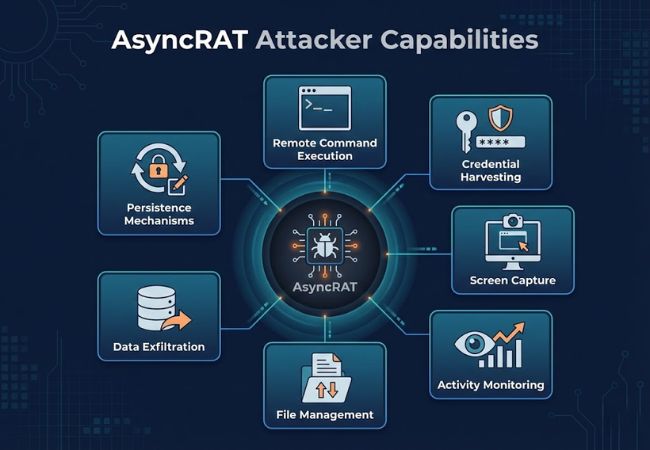
This capability allows attackers to execute system commands on the infected host. Remote execution enables configuration changes and deployment of additional malicious payloads.
Credential harvesting focuses on extracting authentication data from browsers, applications, and user input. Stolen credentials often enable privilege escalation and access to additional systems.
Screen capture provides visual insight into user activity by recording on-screen content. Captured data is commonly used to identify sensitive information or operational workflows.
Activity monitoring allows attackers to observe user behavior and system interaction over time. This capability supports reconnaissance and timing of follow-on actions.
File management enables remote uploading, downloading, and modification of files. These actions support data theft and preparation for further malicious activity.
Data exfiltration focuses on transferring stolen information out of the infected environment. Sensitive files and collected credentials are commonly targeted.
Persistence mechanisms allow AsyncRAT to remain active after system restarts or user logouts. Startup execution methods and registry modifications are commonly used to maintain access.
AsyncRAT does not break into systems through any exploit of its own. A user runs it. Every common delivery route is built around getting a person to click or open something.
Email remains the primary delivery route for AsyncRAT campaigns worldwide. Messages impersonate suppliers, couriers, or internal departments and press the recipient to act quickly. Targeted spear phishing works the same way with research behind it.
Attachments carry executables, compressed archives, shortcut files, or documents with embedded scripts. Opening the file starts the first execution stage. The visible content is a decoy invoice or notice that looks entirely routine.
A small first-stage loader lands on the host and fetches AsyncRAT from a remote server. The loader itself carries little that looks malicious. This keeps the initial footprint small and delays detection until the main payload arrives.
Modern campaigns chain several small steps together across separate files. A shortcut file calls a script, that script calls another, and a later stage pulls down the payload. Each step does very little on its own, which makes any single event look unremarkable.
Operators host payloads on legitimate file-sharing platforms and tunneling services. Traffic to those domains is already allowed in most environments. Reputation-based blocking fails here, and this pattern now appears across many current threat campaigns.
Once running, AsyncRAT connects outward and waits for instructions. The design choices behind that behavior explain why it stays hidden for so long.
The infected host opens the connection to the attacker's server. Nothing needs to reach inward through a firewall. Perimeter rules built to block inbound access have no effect on this pattern.
AsyncRAT uses the .NET async model, which lets several actions run at the same time. Keylogging, file transfer, and command execution proceed in parallel. Machines stay responsive, and the user notices nothing unusual.
Encryption protects the command traffic, and standard application protocols carry it. Inspection tools see an ordinary outbound session. Content-based detection has very little to work with.
Registry run keys and scheduled tasks restart the implant after a reboot. Retry logic reconnects automatically after network loss. Access survives both events without any attacker involvement.
Domains and IP addresses used for control change regularly. Blocklists built from yesterday's indicators go stale quickly. Detection anchored to infrastructure alone fails within days.
The capability set explains why an AsyncRAT detection is rarely the end of the investigation.
An AsyncRAT detection means an attacker already holds interactive access to the host. The tool is commodity crimeware, and state-sponsored groups use it too. CISA and partner agencies listed AsyncRAT among the commodity malware and dual-use applications employed by Andariel in advisory AA24-207A, published in July 2024 on North Korean espionage against defense, aerospace, and nuclear targets.
That dual usage removes any safe assumption about who is on the other end. The same binary appears in low-effort spam campaigns and in state espionage operations.
Consequences follow from the level of access the implant hands over. Credentials get reused to reach other systems. One controlled endpoint becomes a route into shared resources. Established access makes ransomware deployment straightforward at a later date, and long dwell time raises every one of those costs.
Detection works by correlating host behavior with network activity. Single indicators change between builds, so coverage mapped to MITRE ATT&CK techniques holds up better than a list of file hashes.
A document or archive should not spawn a scripting host or a .NET process. Execution chains of that shape are a strong early signal. These chains persist longer than any legitimate task started the same way.
New registry run keys and scheduled tasks appear around the time of infection. On their own, they mean little. Paired with an odd parent process, they become high-confidence evidence.
Repeated outbound connections to an unfamiliar destination at regular intervals indicate control traffic. Timing regularity survives encryption. It remains visible even when payload inspection is impossible.
Process creation, memory activity, and configuration changes tell one story when viewed together. A security operations workflow that links those events separates real compromise from isolated noise.
Endpoint detection platforms perform well when execution, persistence, and communication are tied into a single case. Static indicators expire with each new fork, and the same weakness applies across the wider commodity malware landscape.
Reducing the chance a user runs the payload comes first. Shortening the window an attacker holds control comes second. Both goals need separate controls.
Removing the implant is the smallest part of the work. An attacker held interactive access for as long as the connection stayed open, and everything reachable from that host has to be treated as exposed.
Detection on the endpoint happens after the implant lands. The campaign behind it starts earlier. Operators register infrastructure, prepare lures, and buy access before any payload runs, and that preparation is visible to anyone watching the right sources.
CloudSEK Threat Intelligence tracks malware campaigns, threat actors, and actively exploited vulnerabilities, and turns that activity into intelligence tailored to an organization's industry and region. Coverage of remote access trojan campaigns includes the infrastructure being used, the lure themes in circulation, and the groups deploying each fork.
Intelligence of that kind changes what a detection means. An alert stops being an isolated endpoint event and becomes a known campaign with documented next steps, which lets a team scope the intrusion in hours instead of days.
Possession of the code is not an offence in most jurisdictions. Installing or running it on a system without authorization is a criminal act.
Sometimes. Signature detection catches known builds, and recompiled forks with altered strings and encryption routines pass unnoticed at a high rate.
No. The original build targets Windows through the .NET framework, though some forks add cross-platform loader components.
It varies with monitoring quality. Poorly instrumented environments have carried infections for months, while correlated detection narrows that to days.
No. Credentials, session tokens, and files were already taken. Remediation has to cover identity cleanup alongside malware removal.
No. The base build has no worm capability, and certain forks add USB spreading plugins that change this behavior.
