🚀 CloudSEK featured in the 2026 Frost Radar™!
Read more
.avif)

API-driven threat intelligence is the automated sharing of cyber threat data between security systems using APIs. Security platforms exchange structured data such as indicators of compromise and attack patterns instantly across connected environments.
Automated workflows replace manual sharing methods like emails or file transfers in cybersecurity operations. Continuous data exchange ensures that threat intelligence remains updated, consistent, and ready for immediate action.
Security operations centers use API-driven intelligence to process large volumes of threat data efficiently. Faster data flow improves detection speed, strengthens coordination, and supports proactive threat response.
API-driven threat intelligence works through automated pipelines that collect, transmit, process, and activate cyber threat data across interconnected security systems.
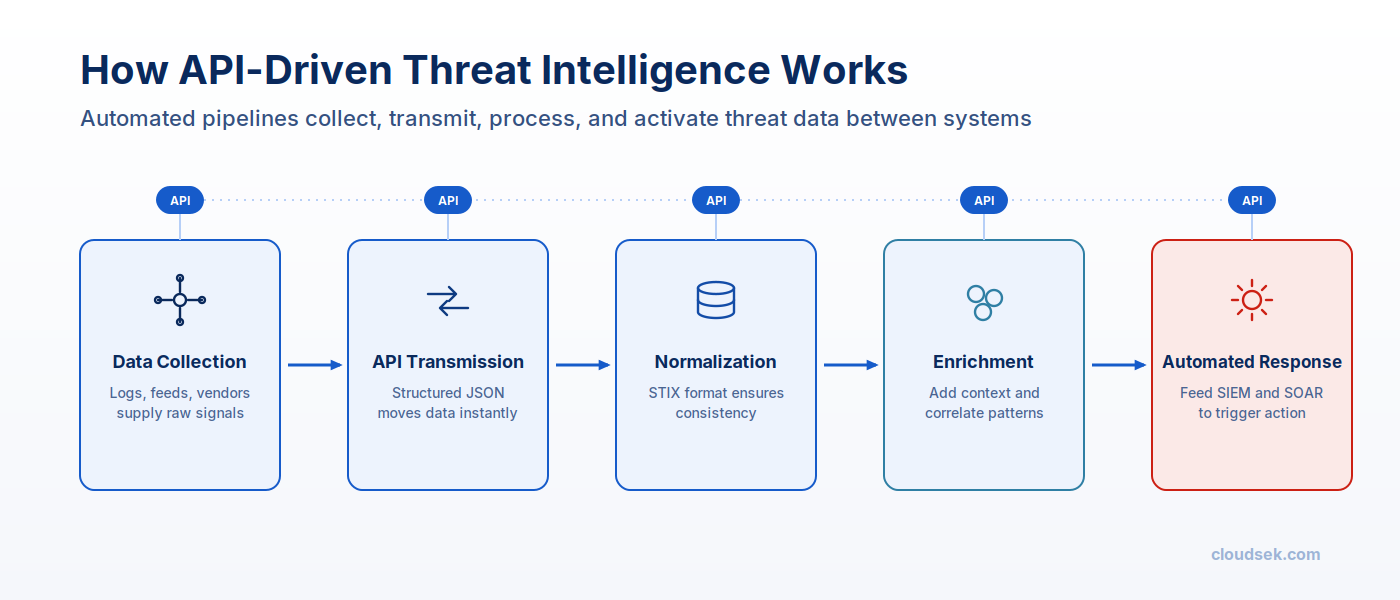
Threat data originates from internal logs, external threat feeds, and cybersecurity vendors. Sources provide raw intelligence such as malicious IPs, file hashes, and abnormal activity signals.
APIs transfer threat data between systems in structured formats like JSON. Automated communication removes delays caused by manual sharing methods.
Incoming data is formatted using standards like STIX to ensure consistency across systems. Standardization enables seamless interpretation and interoperability between tools.
Systems enhance raw data with context such as geolocation, severity scores, and historical behavior. Correlation with existing events helps identify patterns and potential threats faster.
Processed intelligence integrates into SIEM and SOAR platforms for action. Systems trigger alerts, automate responses, and support threat hunting without manual intervention.
Multiple forms of cyber threat data move through APIs to give security systems the context needed to detect, analyze, and respond to threats effectively.
Indicators of Compromise include specific data points such as malicious IP addresses, file hashes, domains, and URLs that signal a potential breach. Security systems continuously compare incoming traffic and logs against these indicators to quickly identify known threats and trigger alerts for further investigation.
Indicators of Attack focus on suspicious behavior patterns like unusual login attempts, privilege escalation, or lateral movement within a network. Behavioral monitoring through APIs allows security tools to detect ongoing or unknown attacks that do not match traditional signature-based indicators.
Tactics, Techniques, and Procedures describe how attackers plan and execute their operations, offering insight into their strategies rather than just their tools. Security teams use this intelligence to understand attacker behavior, map activities to MITRE ATT&CK frameworks, and anticipate future attack steps.
Vulnerability data highlights known weaknesses in systems, often tracked through CVEs, while exploit data shows how those weaknesses are actively used by attackers. Continuous API updates help organizations prioritize patching efforts based on real-world exploitation trends instead of theoretical risks.
Threat intelligence feeds deliver a steady stream of updated threat data collected from multiple sources, including vendors and open-source communities. APIs enable direct ingestion of these feeds into security platforms, ensuring detection systems always operate with the most current threat landscape.
Reputation data assesses whether an IP address, domain, or file is associated with malicious activity, while infrastructure data identifies attacker-controlled systems such as command-and-control servers. Security tools use this intelligence to block or flag suspicious connections before they can cause damage.
Phishing intelligence includes information about malicious email campaigns, spoofed domains, and attacker techniques designed to deceive users. API-driven sharing allows email security systems to detect and block these threats automatically, reducing the risk of credential theft and unauthorized access.
Standardized formats and protocols make it possible for different security systems to exchange threat intelligence without compatibility issues or data loss.
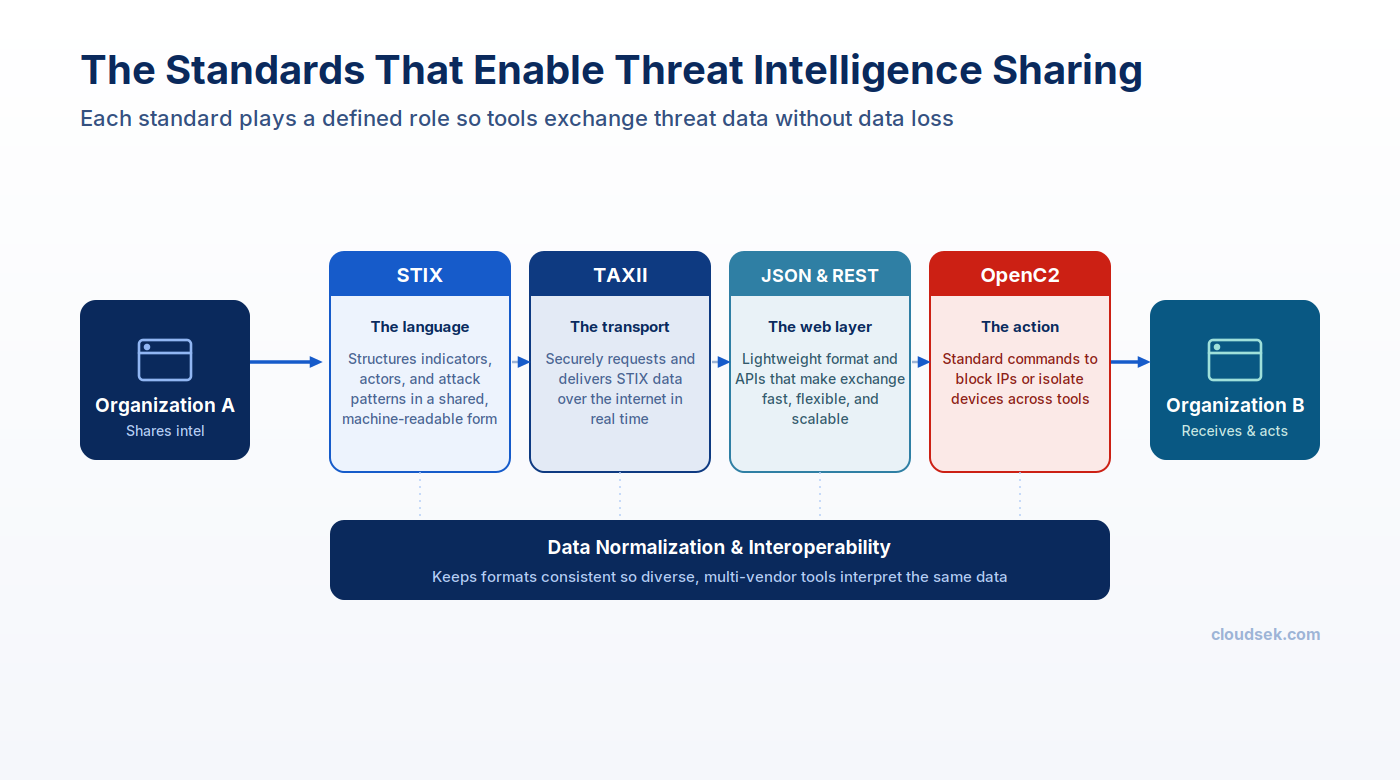
STIX provides a structured language for representing cyber threat intelligence in a consistent and machine-readable format. Security tools use STIX to describe indicators, attack patterns, relationships, and threat actors in a way that can be easily shared and understood across platforms.
TAXII acts as the transport mechanism that allows systems to securely exchange threat intelligence over the internet. It defines how data is requested and delivered, enabling organizations to share intelligence in real time without relying on manual distribution methods.
Read More: Leveraging STIX and TAXII
JSON serves as a lightweight data format for structuring threat intelligence, while REST APIs handle communication between systems. Together, they allow fast, flexible, and scalable data exchange, making integration between modern security tools much easier.
OpenC2 defines a standardized way for security systems to send commands and execute actions such as blocking IPs or isolating devices. This enables coordinated and automated responses across different tools using a common language.
Data normalization ensures that threat intelligence from different sources follows a consistent structure and format. Interoperability standards allow diverse security tools to interpret and use this data effectively, reducing friction in multi-vendor environments.
Security teams connect multiple tools and workflows to ensure threat data moves quickly from detection to response without manual delays.
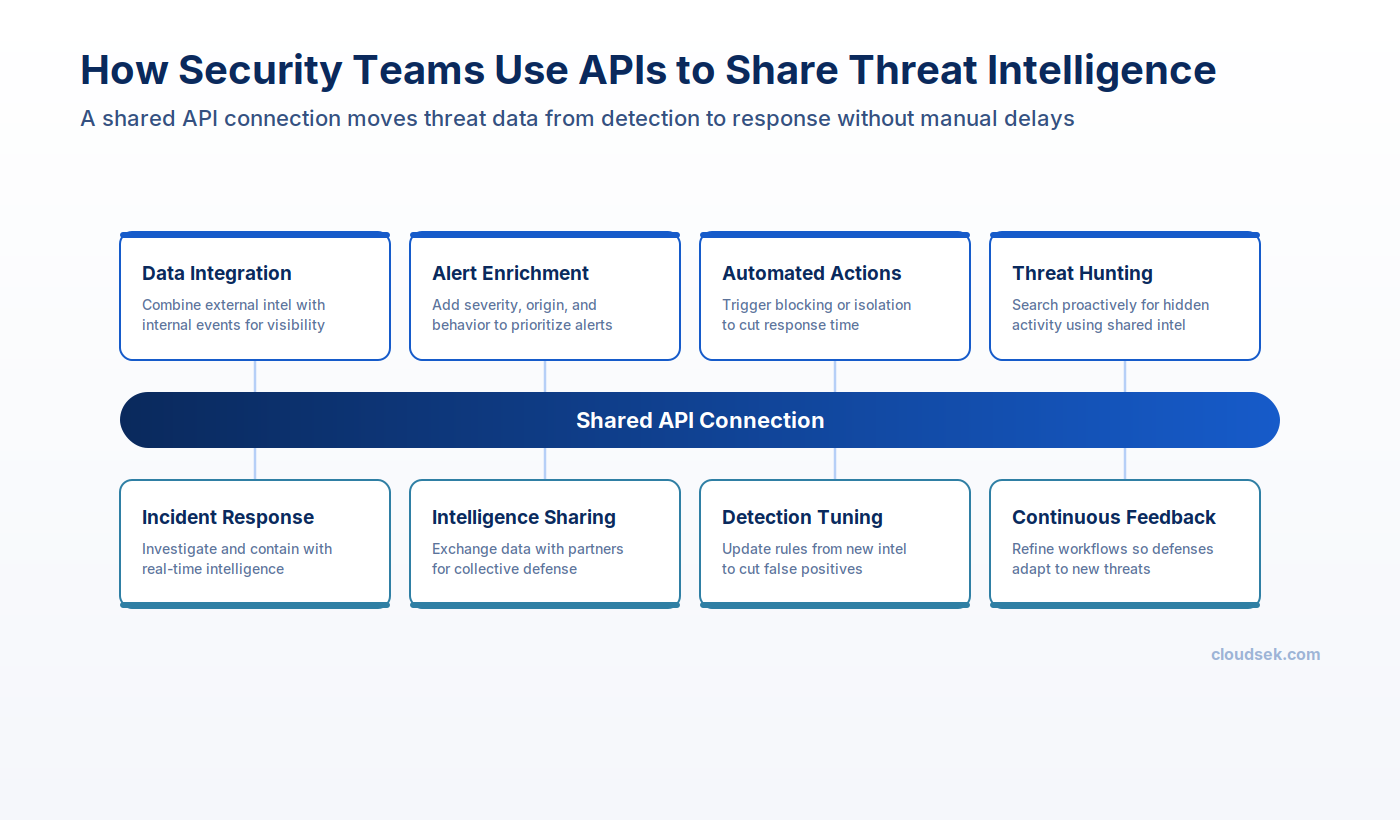
Different systems pull external intelligence and combine it with internal event data to improve visibility. Correlating multiple data sources helps uncover hidden threats across environments.
Incoming intelligence adds context to alerts by including severity, origin, and behavior patterns. Enriched alerts help analysts prioritize incidents more accurately.
Predefined workflows trigger responses such as blocking traffic or isolating affected systems. Automation reduces response time and limits the impact of active threats.
Analysts use shared intelligence to proactively search for suspicious activity within networks. Contextual insights make it easier to identify advanced or hidden threats.
Response teams use real-time intelligence to investigate and contain security incidents. Faster access to relevant data improves decision-making during critical situations.
Organizations exchange threat data with partners, vendors, and industry groups to strengthen collective defense. Shared visibility helps identify widespread attacks targeting multiple entities.
Security teams continuously update detection rules based on new intelligence. Improved rules reduce false positives and increase detection accuracy over time.
Ongoing feedback loops refine workflows and improve system performance. Adaptive processes ensure defenses evolve alongside changing threat landscapes.
API-driven threat intelligence improves detection speed and automation but also introduces challenges related to data quality, integration, and security.
Organizations apply API-driven threat intelligence across multiple security operations to improve detection, automate response, and strengthen overall defense strategies.
Security teams use shared intelligence to proactively search for hidden threats across networks and endpoints. Access to continuously updated data helps analysts identify suspicious patterns that traditional detection methods may miss.
According to IBM Security, organizations that actively perform threat hunting reduce dwell time by up to 28%. Continuous intelligence flow allows teams to detect threats earlier and respond before significant damage occurs.
Automated workflows use incoming intelligence to trigger immediate response actions such as blocking malicious traffic or isolating affected systems. Faster execution reduces the time attackers have to move within a network.
A report by Ponemon Institute found that automation can reduce incident response time by over 50%. Integrated systems ensure that response actions are consistent and based on real-time threat data.
Security teams use real-time vulnerability and exploit data to prioritize patching efforts based on actual risk. Focus shifts from theoretical weaknesses to actively exploited vulnerabilities.
Data from the Cybersecurity and Infrastructure Security Agency shows that a majority of successful breaches exploit known vulnerabilities. Continuous intelligence updates help organizations fix critical issues before attackers take advantage of them.
Organizations monitor third-party risks by sharing threat intelligence across partners, vendors, and service providers. Broader visibility helps detect threats that originate outside internal systems.
Research from Gartner indicates that supply chain attacks are expected to impact 45% of organizations globally. Shared intelligence enables early detection of risks spreading across interconnected environments.
Selecting the right platform ensures efficient data sharing, accurate detection, and seamless integration across security environments.
Compatibility with existing security tools determines how effectively intelligence flows across systems. Strong integration support ensures smooth data exchange without additional complexity.
Reliable intelligence sources improve detection accuracy and reduce false positives. High-quality data helps teams focus on real threats instead of noise.
Fast data ingestion and processing enable quicker threat detection and response. Delays in processing can reduce the effectiveness of shared intelligence.
Growing organizations require platforms that can handle increasing data volumes and system connections. Scalable solutions ensure long-term usability without performance issues.
Strong authentication and access control mechanisms protect sensitive threat data. Secure platforms prevent unauthorized access and reduce risk exposure.
User-friendly dashboards and workflows improve efficiency for analysts and response teams. Clear visualization helps teams act on intelligence faster.
Threat intelligence platforms simplify security operations by automating how data is collected, processed, and acted upon across connected systems.
Platforms collect threat data from multiple internal and external sources through API connections. Centralized aggregation ensures all intelligence is available in one place for analysis.
Collected intelligence is distributed across connected tools without manual intervention. Consistent data flow ensures every system operates with the same updated information.
Automated workflows trigger actions such as alert creation, blocking malicious activity, and updating rules. Reduced manual effort allows teams to respond faster and more efficiently.
Incoming intelligence is correlated with existing alerts and logs to identify real threats. Correlation improves accuracy and helps reduce noise from false positives.
Platforms coordinate actions across multiple tools to ensure consistent response execution. Synchronized responses prevent gaps in security coverage during active incidents.
Systems remain updated through continuous data exchange between connected environments. Ongoing synchronization ensures security operations adapt to new threats in real time.
API-driven threat intelligence has transformed how security teams handle cyber threats by enabling continuous and automated data exchange. Faster access to actionable intelligence allows organizations to detect and respond to threats with greater precision.
Modern security operations depend on seamless integration between tools, where data flows without delays or manual effort. Connected systems improve visibility, reduce response time, and help teams stay ahead of evolving attack patterns.
Stronger collaboration, better data accuracy, and scalable workflows make API-driven approaches essential for proactive cybersecurity. Organizations that adopt these models build more resilient defenses and improve their ability to manage complex threat landscapes.
