🚀 أصبحت CloudSek أول شركة للأمن السيبراني من أصل هندي تتلقى استثمارات منها
اقرأ المزيد
.avif)

An SSL misconfiguration is an incorrect or insecure setting in a website's SSL/TLS certificate, protocol, or cipher configuration that weakens encryption and exposes data to interception. Common examples include expired certificates, weak ciphers, and outdated protocols such as TLS 1.0.
The risk remains widespread: Qualys SSL Pulse, which monitors 150,000 popular sites, recorded TLS 1.3 support at 75.3 percent as of June 2025, meaning roughly a quarter of major sites still rely on older protocol configurations.
SSL misconfigurations come in several common types, each enabling its own attacks, browser errors, and trust failures. The following breaks down what they are, the attacks they enable, the browser errors they trigger, how to detect them, and how to prevent and fix them.
SSL and TLS are often used interchangeably, though they are not the same. Transport Layer Security (TLS) is the modern successor to the deprecated Secure Sockets Layer (SSL) protocol, and the term SSL persists out of habit. A misconfiguration can affect either the certificate that proves a site's identity or the protocol and cipher settings that encrypt the connection. The site still looks secure, but the flawed setup can leave its traffic exposed, spoofable, or flagged as untrusted.
Most misconfigurations come from a few sources: manual certificate management that misses renewals, certificate sprawl across large estates, legacy settings kept for backward compatibility, and server or content-delivery-network configurations that were never hardened. The consequences split into two groups. Security problems include interception, man-in-the-middle attacks, and downgrade attacks. Trust and availability problems include browser warnings, failed handshakes, and lost visitors who abandon a site that looks unsafe.
These eight SSL misconfigurations account for most real-world exposure. The table below pairs each one with the risk it creates and the fix that resolves it.
Attackers exploit SSL misconfigurations through five well-documented techniques, each enabled by a specific weakness in the configuration.
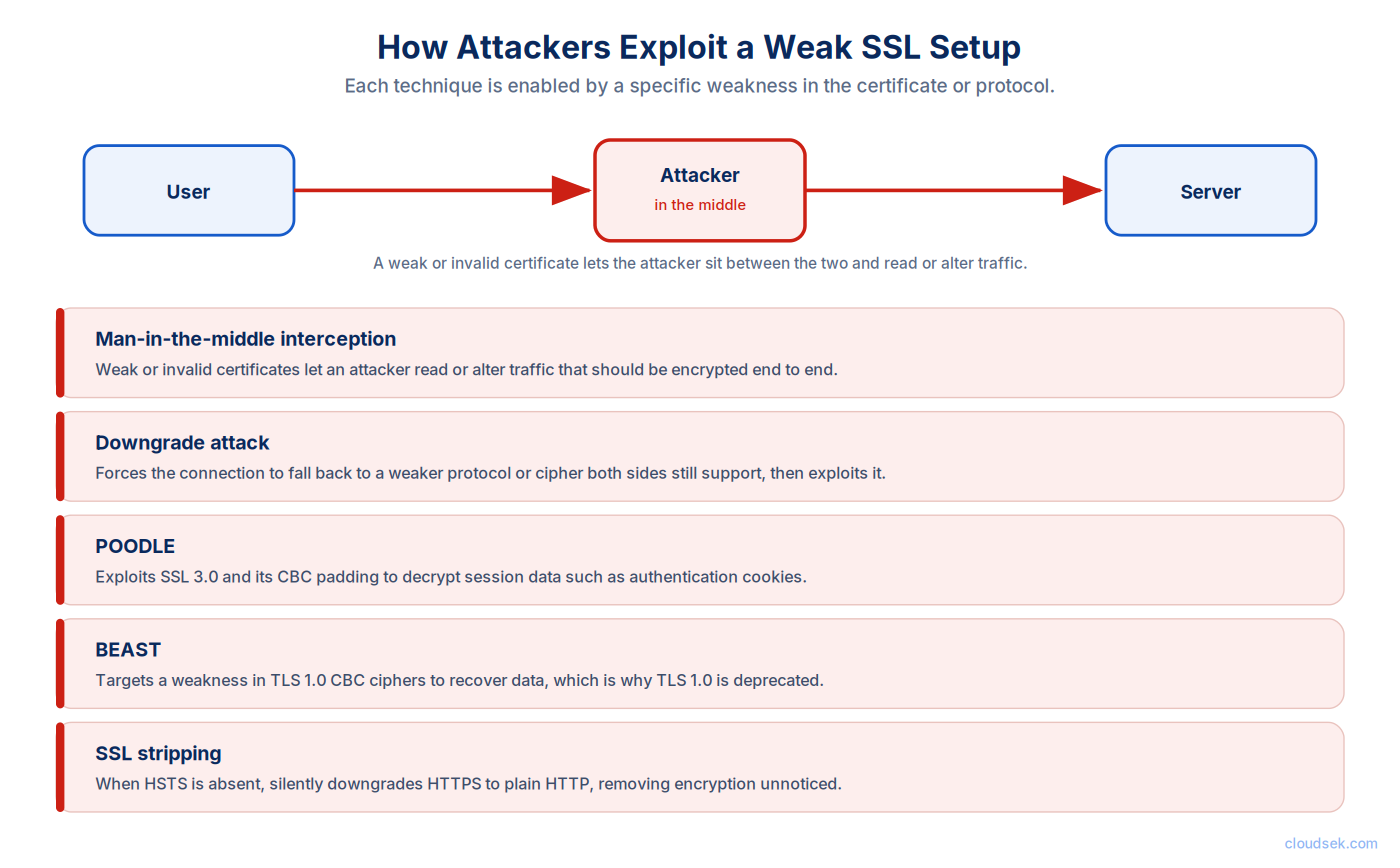
Enforcing TLS 1.2 and TLS 1.3, disabling legacy protocols and ciphers, and enabling HSTS closes most of these attack paths at once.
Browser SSL errors are the visible symptoms of an underlying misconfiguration. The table below maps the most common messages to their cause.
Detecting SSL misconfigurations combines an external scan with a focused certificate and protocol audit. A four-step approach surfaces the issues that matter.
Preventing SSL misconfigurations rests on modern configuration and disciplined certificate management. Six measures close the gaps that attackers exploit.
SSL misconfiguration sits alongside two related external-surface exposures, and the connection between them clarifies why they are managed together.
SSL misconfiguration is an external attack surface problem, which the CloudSEK BeVigil addresses. The platform discovers an organization's internet-facing assets and the SSL certificates serving them, then scans for misconfigurations such as expired and soon-to-expire certificates, weak protocols and ciphers, and incomplete chains. It surfaces the certificate exposure that an attacker would probe across the entire estate, not just the assets that a team remembers to check.
Continuous discovery is what makes the difference. Certificate estates drift constantly as services launch and renewals lapse, so a weak or expiring certificate is flagged as it emerges rather than after a browser warning appears or an outage takes a service offline. Treating certificate health as an ongoing signal, not a periodic audit, removes the window in which a misconfiguration goes unnoticed.
TLS, or Transport Layer Security, is the modern successor to SSL, the Secure Sockets Layer protocol that is now deprecated. The term SSL persists out of habit, but every secure connection today uses TLS. SSL misconfiguration commonly refers to SSL/TLS settings together.
Expired certificates and outdated protocol support are the most common. Roughly a quarter of major sites still lack TLS 1.3, and lapsed certificates remain a frequent cause of outages and browser warnings that erode user trust.
Run the Qualys SSL Labs Server Test for a graded report on protocols, ciphers, and the certificate chain. Tools such as testssl.sh and sslyze add deeper checks, and continuous external scanning catches misconfigurations that appear after a one-time test.
Yes. Weak or outdated configurations enable man-in-the-middle interception, downgrade attacks such as POODLE and BEAST, and SSL stripping when HSTS is missing. Each lets an attacker read or alter traffic that the connection was meant to protect.
No. TLS 1.0 is deprecated under IETF RFC 8996, blocked by all major browsers, and banned by PCI DSS and NIST guidance. It is vulnerable to BEAST and POODLE, and any server still advertising it fails modern compliance scans.
An expired certificate breaks the trust check, triggering browser warnings that drive users away and can halt transactions. While expiry alone does not hand attackers the traffic, the warnings it causes are often exploited to normalize clicking through security alerts.
