🚀 أصبحت CloudSek أول شركة للأمن السيبراني من أصل هندي تتلقى استثمارات منها
اقرأ المزيد
.avif)

A Signal app scam is a fraud or account takeover attempt that exploits Signal's encryption and trusted reputation to trick users into sending money, surrendering data, or linking their account to a device an attacker controls. The Federal Trade Commission recorded $1.9 billion in losses to scams that began on social media and messaging platforms in 2024, the single highest-loss category ranked by how scammers reached the victim. Signal app scams sit inside that surge, where privacy-first design shields the people running the fraud.
Signal app scams span employment fraud, romance manipulation, fake giveaways, and a Signal-specific device-linking attack that hijacks accounts through malicious QR codes. Each scam carries recognisable warning signs. This article maps the common Signal scam types, the red flags that expose them, the steps that prevent them, and the response that limits damage after contact.
Signal is a free, open-source messaging app from the non-profit Signal Foundation that applies end-to-end encryption to every text, call, and file. Scammers target Signal because the same privacy that protects honest users conceals the operators behind the fraud. Encryption, minimal stored data, and pseudonymous sign-up leave a thin evidence trail for investigators.
Signal's large, privacy-conscious user base gives fraudsters a concentrated pool of high-value targets. The platform's reputation for security creates a trust halo: a message that arrives inside an encrypted app feels safer than the same message in email or SMS, and that misplaced confidence lowers the guard scammers depend on.
Signal scams follow a consistent four-stage pattern: an unsolicited first contact, a trust-building phase, a manufactured sense of urgency, and a final request for money, credentials, or account access. The opening message arrives as a cold text, a fake group invite, or a spoofed alert from a company's “support” team.
Every variant below runs on social engineering rather than a technical flaw in Signal. The fraud succeeds through human trust, which is why recognition matters more than any single setting.
The scams below account for most fraudulent activity reported on Signal. Each entry describes how the scam operates and the tell-tale sign that exposes it.
Employment scams use fake recruiters and forged job offers to extract money and personal data. A fraudster posing as a known company sends an unsolicited offer, moves the conversation to Signal, then requests upfront payment for equipment or training, or sends a counterfeit check and asks for part of it back. FTC data shows reported losses to job and employment-agency scams climbed from $90 million in 2020 to $501 million in 2024. The tell-tale sign: a legitimate employer never requires payment to start work.
Customer support fraud impersonates a brand's service team to harvest credentials and payment details. The scammer claims an account problem, manufactures urgency, then pushes a phishing link or a request for login data under the pretext of identity verification. The tell-tale sign: genuine support teams do not open contact through Signal or request passwords.
Romance scams build a fabricated relationship, then exploit the emotional bond for money. The scammer invests weeks in trust, invents a crisis such as a medical bill or a travel emergency, and requests funds. The pig-butchering variant steers the target toward a fake investment platform once the relationship forms. The tell-tale sign: a romantic contact who refuses video calls and redirects toward money or crypto.
Crypto and investment scams promise guaranteed returns to drain funds into attacker-controlled wallets. The fraudster shares fabricated profit screenshots, pressures fast deposits, and blocks withdrawals once money arrives. The tell-tale sign: any promise of guaranteed returns paired with urgency to deposit.
Giveaway scams impersonate brands and influencers to collect fees and personal data. A message announces a prize the target never entered, then requests a processing or shipping fee to release it. The tell-tale sign: a fee demanded to receive a prize from a contest the target never joined.
Wrong number scams open with a message sent “by mistake,” then convert the exchange into rapport and extraction. The scammer leans on friendly language, fabricated shared history, and details pulled from social media to seem genuine. The tell-tale sign: a stranger who keeps the conversation alive long after an apparent wrong number.
Sextortion scams coerce intimate images, then threaten release unless the victim pays. The scammer escalates quickly toward explicit exchange, captures the material, and demands money or cryptocurrency. The tell-tale sign: rapid pressure toward intimate content from a recent contact.
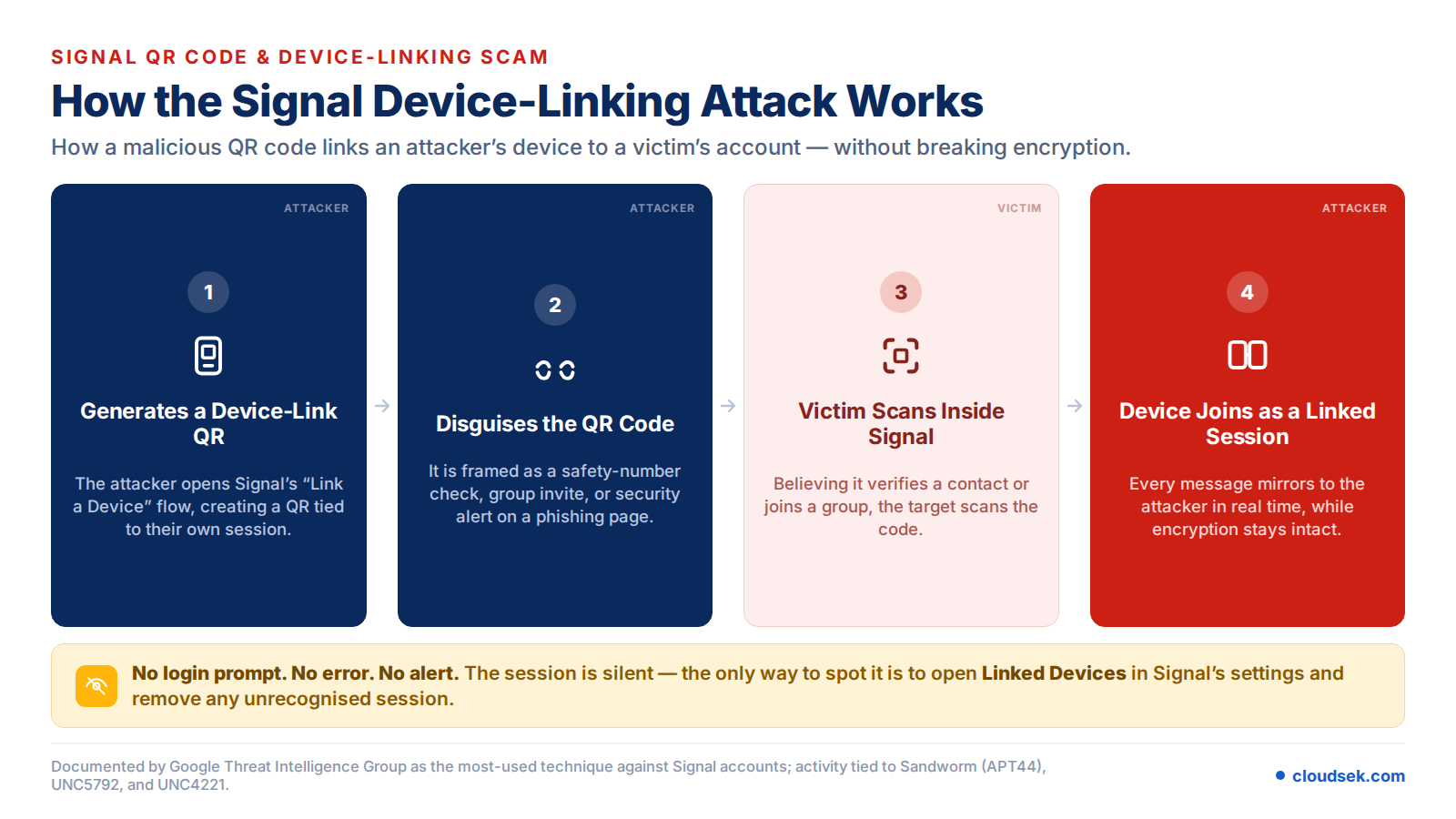
The Signal device-linking scam tricks a user into scanning a malicious QR code that connects an attacker's device to the victim's account. Signal's encryption stays intact; the linked session is what the attacker hijacks, mirroring every message in real time.
The attack works through Signal's own “Link a Device” feature. An attacker opens that flow on their phone, which generates a QR code tied to their session, then disguises the code as a contact-verification step, a safety-number check, a group invite, or a security alert. The moment the target scans it inside Signal, the attacker's device joins the account and begins receiving copies of every message.
The attack leaves no login prompt, no error, and no visible confirmation, so the victim notices nothing. A 2026 evolution targets Signal's Secure Backups recovery key, which exposes the entire chat history rather than future messages alone.
The Google Threat Intelligence Group found device-linking abuse to be the technique Russia-aligned actors most often use against Signal accounts, with activity attributed to Sandworm (APT44) and tracked clusters UNC5792 and UNC4221. Reported targets concentrate on senior officials, military personnel, civil servants, and journalists, the high-value accounts where Signal carries sensitive conversations.
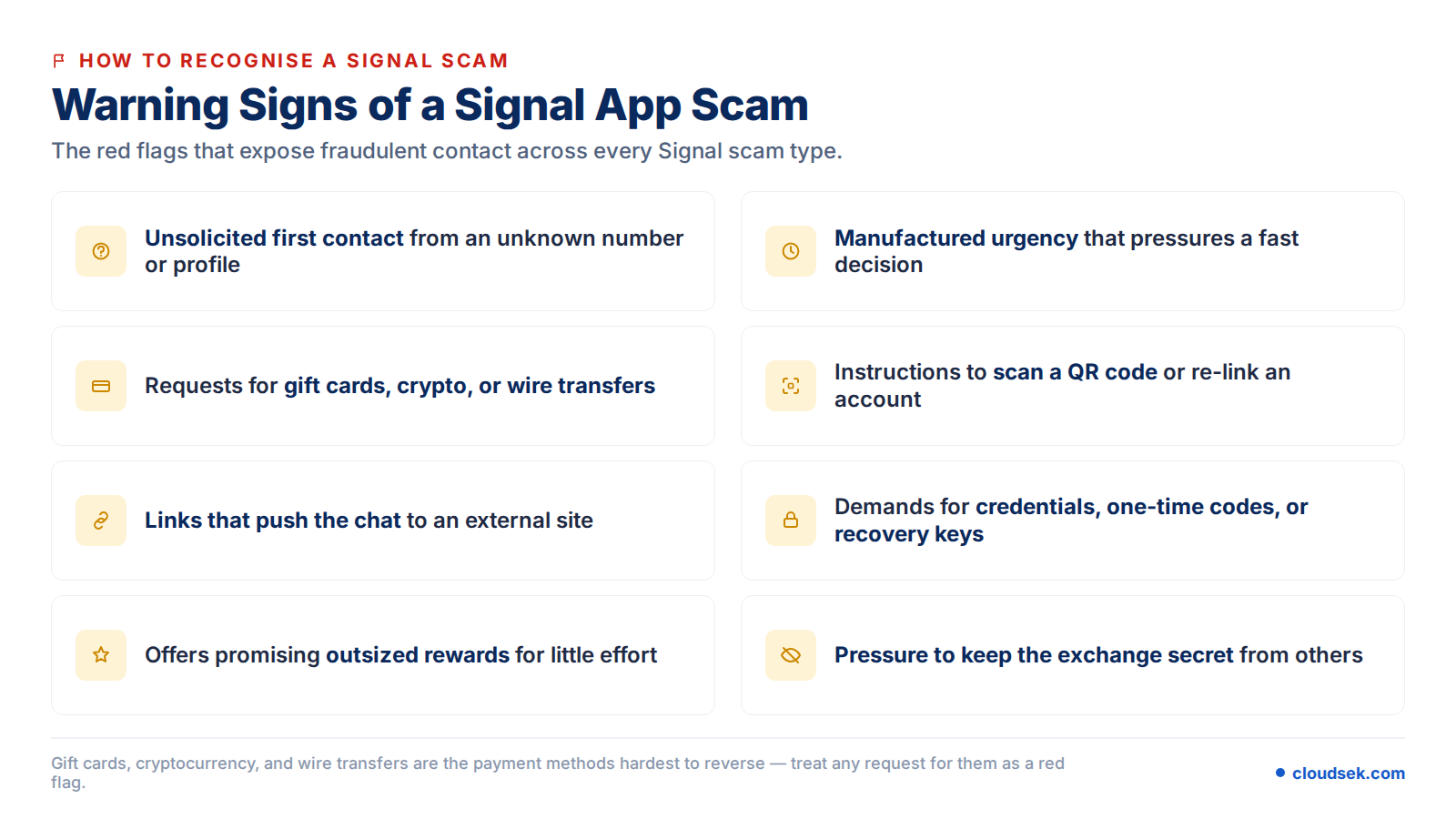
Most Signal scams share a small set of red flags. The following signs expose fraudulent contact across every scam type:
Protection against Signal scams rests on contact verification and disciplined device hygiene. Apply the following steps in order:
Fast action after a Signal scam contains the damage. Follow these steps in order:
Signal scams reach beyond individual victims into enterprise risk. Attackers impersonate executives and corporate brands on the platform, target employees with fake recruiters and support lures, and aim device-linking attacks at senior staff whose accounts hold sensitive business communication.
Security-awareness training reduces employee susceptibility, yet it does not surface the impersonation infrastructure that attackers build outside the corporate perimeter.
Signal scams are difficult to trace because end-to-end encryption hides message content and the app stores minimal user data. Investigators rely on payment trails, linked-device records, and reports filed with the platform and law enforcement.
Recovery depends on the payment method. Bank transfers reported quickly are sometimes reversible, while cryptocurrency and gift-card payments rarely return. Reporting to the bank and the FBI IC3 within hours improves the odds.
Yes. Signal is a secure messaging app built on end-to-end encryption. The risk comes from social-engineering scams and device-linking abuse, not from a flaw in Signal's encryption.
Yes. A device-linking attack mirrors messages to an attacker's device without breaking encryption and without an obvious alert. Checking Linked Devices in Signal's settings reveals any unauthorized session.
Report a scammer through Signal's in-app reporting option on the conversation, block the contact, then file with the FTC, the FBI IC3, or the relevant national fraud authority.
Scammers move to Signal because its encryption and minimal data retention shrink the evidence trail, while its trusted reputation lowers suspicion compared with email or SMS.
