🚀 أصبحت CloudSek أول شركة للأمن السيبراني من أصل هندي تتلقى استثمارات منها
اقرأ المزيد
.avif)

External vulnerability scanning is the automated inspection of an organization's internet-facing assets from the outside, identifying the weaknesses an attacker would reach first. It scans public-facing systems such as websites, servers, APIs, and firewalls for exploitable flaws, misconfigurations, and exposures.
The need is acute: research across 2,000 organizations found that 74 percent suffered a security incident from unknown or unmanaged assets, most of which live on the external attack surface.
This guide explains what external vulnerability scanning is, how it differs from internal scanning, what it detects, how the process works, why it matters, its role in PCI DSS compliance, best practices, and the tools that perform it.
External vulnerability scanning is a form of vulnerability scanning that assesses an organization's external-facing infrastructure from the perspective of an outside attacker. It targets the public IP addresses, domains, web applications, and services that anyone on the internet can reach, probing them for vulnerabilities that could grant unauthorized access.
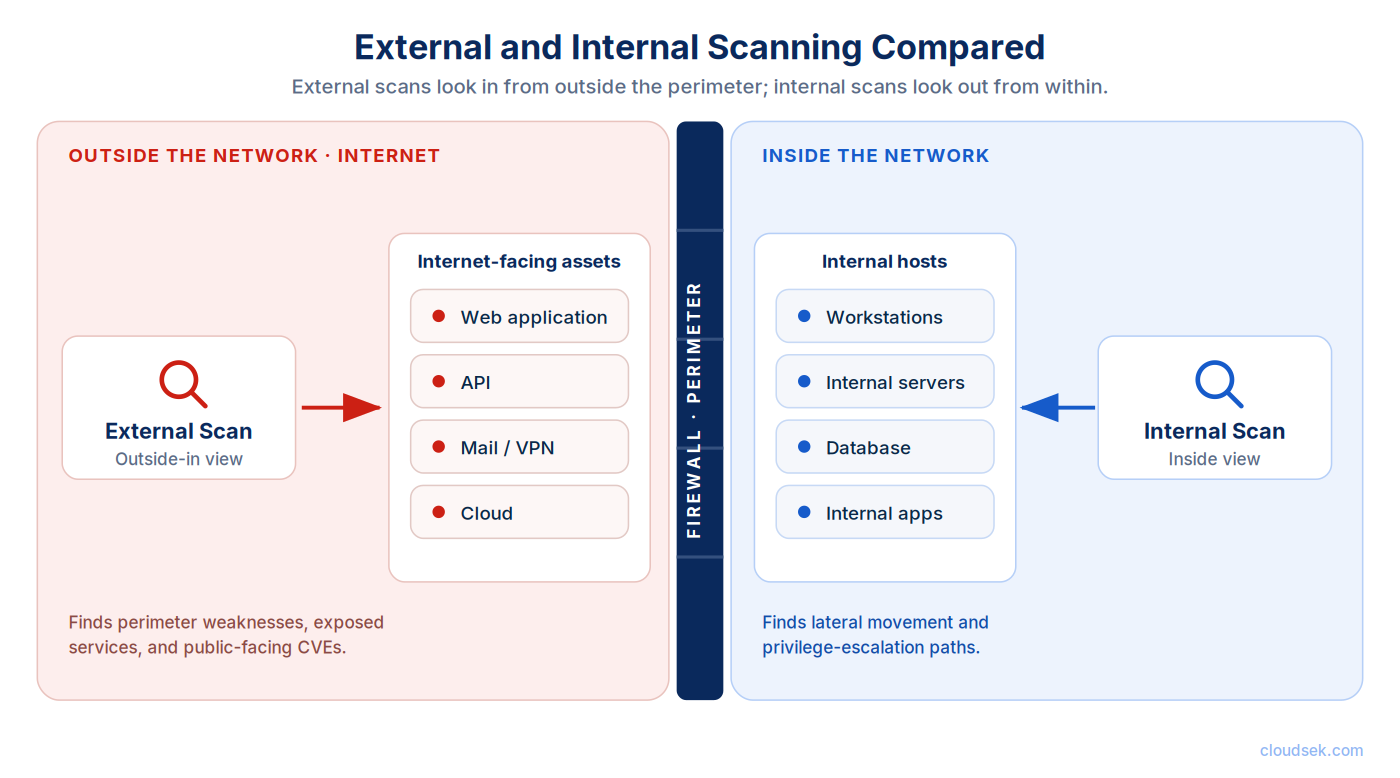
The defining trait is the vantage point. Rather than examining systems from inside the network, an external scan looks in from the outside, exactly as an adversary does when searching for a way in. It maps the internet-facing perimeter, then tests each exposed asset against databases of known vulnerabilities and common misconfigurations.
This perspective matters because the external attack surface is where intrusions begin. An attacker cannot exploit an internal flaw without first getting through the perimeter, so the weaknesses an external scan finds are the ones most directly tied to initial access. External scanning is the practice of finding those weaknesses before the attacker does.
External and internal vulnerability scans examine a network from opposite directions, and most security programs need both. The table below compares them.
Neither replaces the other. External scanning catches the front-door weaknesses that let an attacker in, while internal scanning reveals what they could do afterward. Together, they give a complete view, which is why standards such as PCI DSS require both.
External scanning surfaces the weaknesses visible from the public internet. Six categories appear most often.
External vulnerability scanning follows a four-stage process that mirrors how an attacker approaches a target.
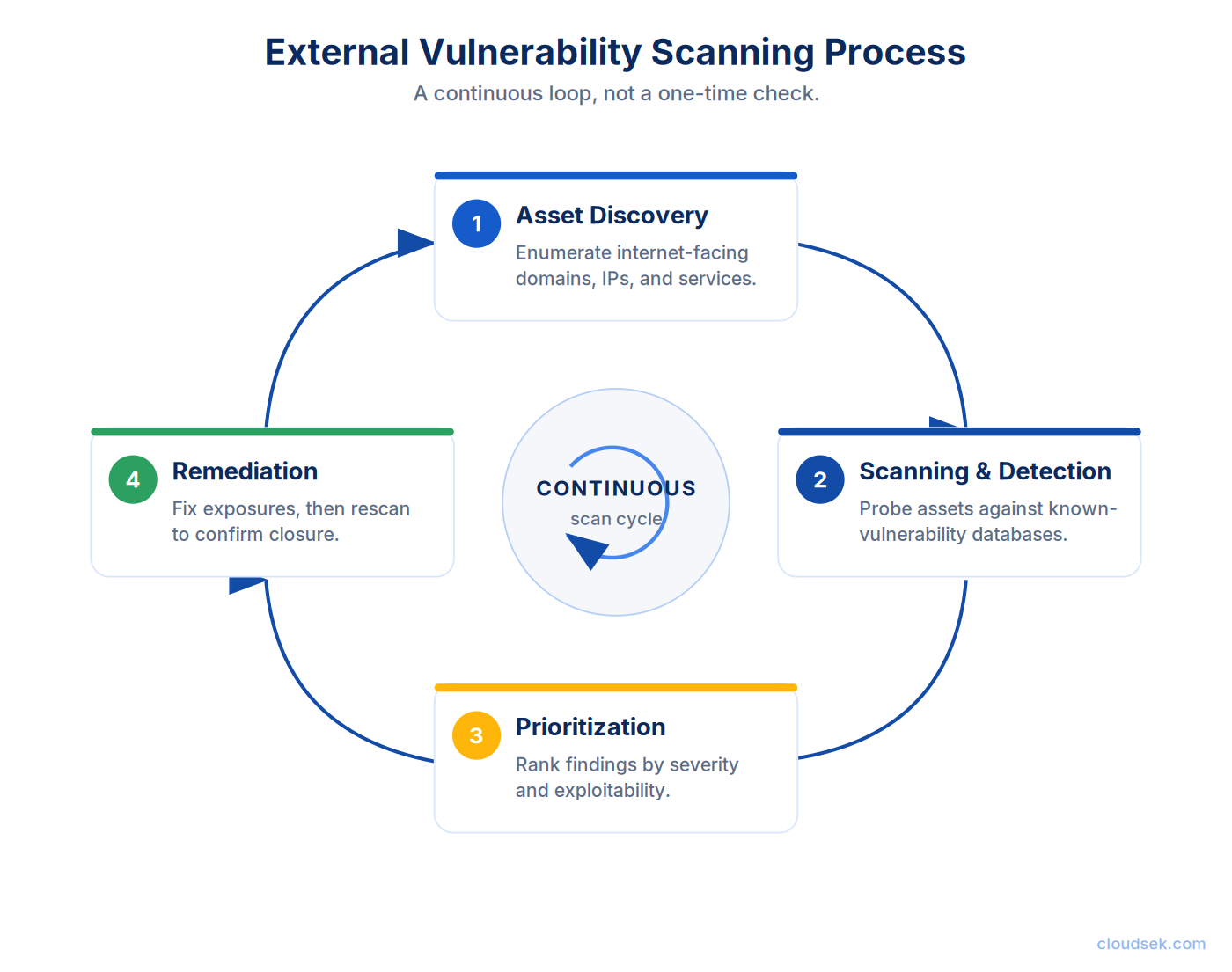
The scanner enumerates an organization's internet-facing footprint, discovering domains, subdomains, IP ranges, and services, including assets the organization may not know it has.
It probes each discovered asset from the outside, checking software versions, configurations, and exposed services against databases of known vulnerabilities. Most external scans run unauthenticated, seeing only what an outsider can, though authenticated external scans use credentials to inspect exposed services more deeply.
Findings are ranked by severity and exploitability, so teams address the perimeter weaknesses most likely to lead to a breach first.
After fixes are applied, a follow-up scan confirms the exposure is closed and that no new weakness was introduced.
Because the external attack surface changes constantly as assets are deployed and retired, the process is a continuous loop rather than a one-time check. Each cycle rediscovers the footprint before scanning, so newly exposed assets are caught rather than missed.
External scanning matters because it defends the entry points that attackers target first. Four reasons make it essential.
External vulnerability scanning has a specific, mandatory role in PCI DSS, the security standard for organizations that handle payment card data. The standard requires external scans to be performed at least quarterly, and again after any significant network change.
The defining requirement is who runs the scan. PCI DSS external scans must be conducted by an Approved Scanning Vendor, a company certified by the PCI Security Standards Council, and cannot be run by internal staff. An organization must keep rescanning until every high-severity vulnerability is resolved and a passing scan is achieved.
Internal scans, by contrast, may be run in-house. This split is deliberate: the external ASV scan provides an independent, outside view of the perimeter, the same view an attacker has, which is why the standard insists it come from a certified third party.
There is no single correct cadence for external scanning. The right frequency depends on how fast the environment changes, what compliance requires, and how much remediation capacity a team has. Five strategies help decide.
The case for going beyond a quarterly cadence is historical. Microsoft released the patch for the vulnerability behind WannaCry on March 14, 2017, roughly two months before the ransomware spread on May 12, 2017, with the exploit circulating publicly about a month before the attack, according to CISA. A purely quarterly scan could have missed that window entirely, which is why compliance timelines work as a minimum, and continuous or emerging-threat scanning closes the gaps between them.
Getting full value from external scanning depends on how the program is run. Five practices stand out.
Tools for external vulnerability scanning fall into a few categories, ranging from traditional scanners to platforms built around continuous external monitoring.
CloudSEK BeVigil is an external attack surface monitoring platform built for exactly this problem. BeVigil continuously discovers and fingerprints an organization's internet-facing assets, then scans them for known CVEs, misconfigurations, weak SSL/TLS, DNS issues, and exposed services across the external attack surface. It works from the same outside-in vantage point an attacker takes, surfacing the perimeter weaknesses that lead to initial access.
Because BeVigil runs continuously rather than on a quarterly cycle, it narrows the window between when an asset becomes exposed and when the weakness is found. A forgotten subdomain, an expired certificate, or a newly deployed cloud service is flagged as it appears, giving security teams the outside-in visibility attackers rely on, before the attackers act on it.
It varies with the size of the external footprint and scan depth. A focused scan can finish in a few hours, while a large estate or a deeper authenticated scan may run for a day or more. Continuous platforms scan in the background.
External scanning tests known internet-facing assets for vulnerabilities. External attack surface management is broader, continuously discovering unknown assets first, then monitoring and scanning them over time. Scanning is one capability within an attack surface management program.
No. External scanning is automated and reports known weaknesses on the perimeter. A penetration test is manual and exploits those weaknesses to prove impact. Scanning gives broad, frequent coverage, while pen testing adds depth. A pen tester does, however, use external scanners as a starting point to efficiently map out targets and discover initial vulnerabilities.
Usually not, since most external scans are unauthenticated and low-impact. Intensive or active scans can occasionally strain fragile services, so teams often schedule deeper scans for off-peak windows or use non-intrusive monitoring for production systems.
No. The Approved Scanning Vendor requirement is specific to PCI DSS. Organizations outside PCI scope can run external scans with any capable tool or provider, though frameworks such as SOC 2 and ISO 27001 still expect an effective scanning process.
A passing ASV scan typically means no vulnerabilities rated CVSS 4.0 or higher remain on in-scope external assets. Organizations rescan and remediate until the report comes back clean, then submit it as evidence of compliance.
