🚀 أصبحت CloudSek أول شركة للأمن السيبراني من أصل هندي تتلقى استثمارات منها
اقرأ المزيد
.avif)

External threat intelligence monitoring is an ongoing security practice focused on tracking risks and adversary activity outside organizational systems. Continuous observation of external environments helps teams identify exposure points before they are exploited.
Threat Intelligence delivers insights about threats, but monitoring turns those insights into daily operational activity. Signals are continuously observed, interpreted, and acted upon instead of being reviewed at fixed intervals.
Security teams within a Security Operations Center rely on this process to connect external signals with internal response actions. Faster visibility into emerging risks improves decision-making and limits the time attackers remain undetected.
Threat environments change continuously, making fixed assessment cycles insufficient for identifying risks as they emerge.
External threat intelligence monitoring should cover all areas where external risks can emerge, ensuring continuous visibility across evolving exposure points.
Lookalike domains, phishing infrastructure, and executive impersonation attempts directly target organizational trust. Early identification of these threats helps prevent fraud, customer deception, and reputational damage before they escalate.
Vendors and partners often introduce risks that remain outside direct control but still impact security posture. Monitoring their exposure ensures vulnerabilities in third-party ecosystems do not become indirect entry points.
External assets continuously change as new subdomains, services, or forgotten infrastructure appear over time. Alignment with Attack Surface Management helps detect these shifts before attackers exploit them.
Tracking behavior patterns of Threat Actor reveals how attacks evolve, who is being targeted, and what strategies are being used. This approach provides deeper insight than relying only on Indicators of Compromise.
External threats are often influenced by global events, regulatory changes, and sector-specific trends. Monitoring these signals helps anticipate attacks aligned with broader shifts in the threat landscape.
Threat coordination increasingly happens on platforms like Telegram, Discord, and closed communities. Expanding monitoring beyond traditional sources reduces blind spots and improves overall visibility.
External threat intelligence monitoring follows a structured workflow that converts external signals into actionable security outcomes.
Monitoring starts by identifying critical assets such as domains, executive identities, and sensitive data. Prioritization keeps attention on high-impact risks instead of scattered signals.
Scope determines which external environments are tracked, while frequency defines how often signals are collected. High-risk assets require real-time monitoring, whereas lower-risk areas can follow scheduled intervals.
Triage rules classify incoming signals based on severity and relevance. Proper escalation ensures critical threats move quickly from detection to action without delay.
Responsibility must be distributed across teams like the Security Operations Center, threat intelligence, and IT operations. Defined roles reduce confusion and improve response speed.
Monitoring outputs should continuously refine detection logic and response strategies. Feedback loops turn monitoring into an adaptive system that improves with every cycle.
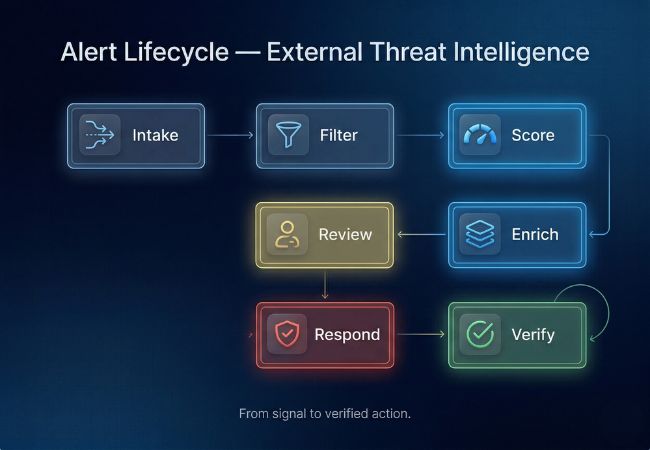
Turning external signals into action requires a structured sequence that connects detection, validation, and response without losing context.
Signals from external monitoring channels are gathered into a centralized stream. Centralization ensures consistent visibility and prevents fragmented analysis.
Raw inputs often contain duplicate or low-value alerts that slow down investigation. Filtering reduces overload and keeps attention on meaningful signals.
Relevant alerts are evaluated based on severity, asset sensitivity, and potential impact. Prioritization helps critical threats move forward without delay.
Additional intelligence such as historical activity and behavioral patterns is linked to each alert. Context improves clarity and supports accurate escalation decisions.
Validated assessment confirms whether alerts represent real threats or false positives. Human review adds judgment that automated systems cannot fully replicate.
Confirmed threats lead to actions such as takedowns, credential resets, or blocking malicious infrastructure. Timely execution limits exposure and reduces risk.
Follow-up checks determine whether the applied response successfully mitigated the threat. Verification closes the loop and strengthens future monitoring accuracy.
Measuring effectiveness requires linking monitoring activity to real risk reduction rather than just tracking alert volume.
Gaps in monitoring often emerge from how signals are interpreted, expanded, and operationalized across workflows.
Automated feeds generate large volumes of data but often miss context and intent behind the signals. Analyst validation connects patterns and transforms raw inputs into actionable intelligence.
Threat discussions frequently occur in regional and non-English communities. Expanding multilingual monitoring improves visibility into early-stage and localized risks.
Channels such as Telegram, Discord, and private forums host active threat coordination. Including these platforms reduces blind spots in modern threat ecosystems.
Focusing only on indicators limits visibility into how attacks evolve over time. Tracking behavior patterns provides deeper insight into attacker intent and campaign progression.
Monitoring outputs often remain isolated from security controls and response systems. Integrating findings into detection rules and defenses ensures real operational impact.
Excessive or irrelevant alerts overwhelm analysts and reduce efficiency. Refining thresholds improves signal quality and maintains focus on high-risk threats.
Treating all alerts equally slows down response and wastes resources. Risk-based prioritization ensures critical threats are addressed first.
Insights from resolved threats are not always used to improve monitoring strategies. Continuous feedback strengthens detection accuracy and long-term effectiveness.
Monitoring maturity reflects how organizations evolve from reactive visibility to proactive threat anticipation across external environments.
Monitoring happens irregularly without defined workflows or ownership. Visibility remains inconsistent, and response depends on manual effort.
External signals are collected through limited tools or feeds with narrow scope. Analysis remains surface-level, with minimal prioritization or coordination.
Defined workflows and assigned responsibilities bring consistency to monitoring efforts. Signals are triaged, validated, and aligned with operational decision-making.
ترتبط مخرجات المراقبة مباشرة بعمليات الأمان وآليات الاستجابة. يتم قياس الأداء من خلال مقاييس محددة، وتؤثر الرؤى بنشاط على استراتيجيات الدفاع.
تتيح الأنماط السلوكية والتتبع طويل المدى التعرف المبكر على التهديدات الناشئة. تتحول المراقبة نحو التوقع، مما يسمح للفرق بالتصرف قبل أن تتحقق المخاطر بالكامل.
تراقب CloudSek التهديدات الخارجية باستخدام محرك سياقي مدعوم بالذكاء الاصطناعي يرسم خريطة البصمة الرقمية للمؤسسة ويفحص باستمرار بيئات الويب السطحية والعميقة والمظلمة. يركز الاكتشاف على تحديد متجهات الهجوم الأولي (IAVs)، مما يسمح بمعالجة المخاطر قبل أن يتمكن المهاجمون من الوصول.
يتم توفير قدرات المراقبة من خلال منصات مثل xVigil و BeVigil، تغطي كل منها طبقات مختلفة من التعرض الخارجي. تتعامل xvigil مع الحماية من المخاطر الرقمية مثل مراقبة الويب المظلم وانتحال هوية العلامة التجارية واكتشاف تسرب البيانات، بينما تركز BeVigil على اكتشاف الأصول وتحديد الثغرات عبر البنية التحتية الخارجية.
تعتمد العمليات الأساسية على التحليل السياقي لربط الإشارات وتقليل الضوضاء وتحديد أولويات التهديدات بناءً على التأثير الحقيقي. يضمن تتبع عوامل التهديد وعمليات الإزالة الآلية والتكامل مع عمليات سير العمل الأمنية انتقال المخاطر المحددة بسرعة من الاكتشاف إلى الاستجابة.
