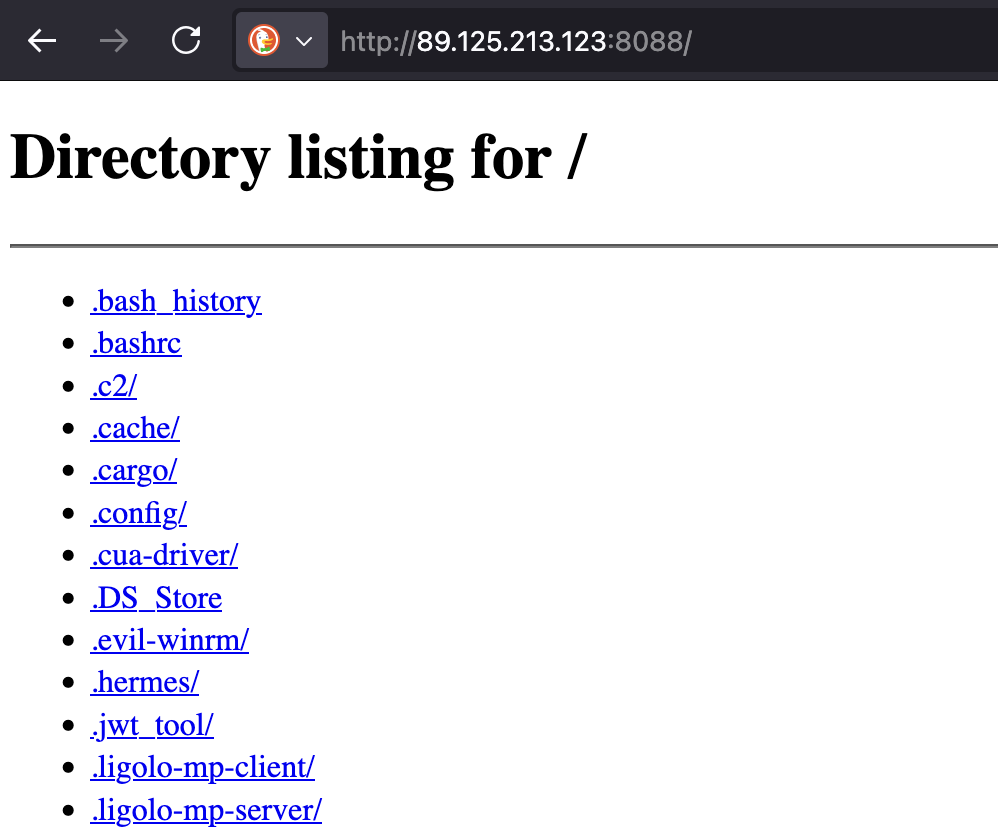
Off the Rails: Inside an Exposed Silent Lynx Server
CloudSEK's investigation into an exposed Silent Lynx server uncovered cyber espionage operations targeting Central Asian governments and critical infrastructure. Findings include compromised Tajik railway networks, thousands of defence-related government documents, intrusion into Uzbekistan's Smart Forestry platform, and phishing lures targeting Turkmenistan. The investigation also revealed DeepSeek-powered AI-assisted reconnaissance, data collection, and evidence cleanup, alongside indicators suggesting a Kazakhstan nexus.
قسم أبحاث التهديدات وتحليلات المعلومات في CloudSek
لم يتم العثور على أية عناصر.
Executive Summary
An exposed open directory belonging to Silent Lynx, a Central Asia-focused espionage cluster, gave CloudSEK an inside view of the group's operations through October 2026. The directory held the group's tooling alongside data from active intrusions into government and critical infrastructure organisations across the region, and the AI agent the operator relied on to run them.
We assess with high confidence that the directory belongs to a Silent Lynx operator, based on implant code markers and build paths shared with published samples. We assess with medium confidence that the operator has a Kazakhstan nexus: the operation runs in Russian, and the operator's own test traffic came from a residential Kazakh connection, which supports existing vendor assessments. The collection priorities, spanning transport, defence correspondence and resource ministries in neighbouring states, point to regional intelligence gathering rather than financial motive.
Key Findings
The exposed directory provided a timestamped record of the operator's tooling, intrusions and AI agent conversations spanning April to October 2026.
The operator held persistent, domain-level access to transport-sector networks and used a single compromised employee account to collect government correspondence at scale, including defence-related documents.
A government-run geospatial platform was taken to host-level command execution through a webshell and database access, with persistence in place at the time of exposure.
The implants match the group's known Laplas and Chvost families, alongside a previously unreported generation of service-installer implants and an AMSI-bypass delivery variant.
Lures impersonating Turkmenistan Railways and a Turkmen regional administration were built and tested in October 2026, pointing to an upcoming campaign against Turkmenistan.
A self-hosted AI agent running on DeepSeek handled reconnaissance, collection and log cleanup, with destructive commands pre-approved.
Server logins were routed through Tor, but the operator's own test sessions came from a residential Kazakhtelecom connection.
Background: Silent Lynx in prior reporting
Silent Lynx has been tracked publicly since January 2025 under several vendor names. Reporting has centred on spear-phishing of Central Asian government bodies with LNK and archive lures that lead to lightweight reverse shells.
Date
Source
Finding relevant to this server
Oct 2026
Cisco Talos and Recorded Future (UAT-6275 / TAG-193)
Four infection chains from mid-2025 to August 2026; Chvost, Laplas and PickleShell reverse shells; Smart Forestry activity in May 2026; Kazakhstan nexus at medium confidence
Nov 2025
Seqrite, Operation Peek-a-Baku
Dushanbe-focused campaign; LNK files pulling reverse shells through GitHub; diplomatic and infrastructure targets in Central Asia, Russia and China
Oct 2025
BI.ZONE, Cavalry Werewolf
Russian public sector targeted with FoalShell and StallionRAT; overlaps with Silent Lynx and Tomiris
Aug 2025
Group-IB, ShadowSilk
Dozens of government victims in Central Asia and APAC; infrastructure and tooling shared with YoroTrooper and Silent Lynx; stolen data offered for sale
Jan 2025
Seqrite, Silent Lynx
First public naming; government targets in Kyrgyzstan and neighbouring countries; Telegram used for C2; links to YoroTrooper
The exposed server
The server 89[.]125[.]213[.]123 is a Debian VPS on Baxet Group infrastructure, exposed without authentication on port 8088. It held more than a dozen gigabytes across hundreds of thousands of files, with no separation between tooling, victim data and operator workspace.
Folder
Contents
fish/
LNK phishing kit, PowerShell payload, decoy PDF, ISO and archive bundles, callback session logs
payloads/
Implant builds sorted by target country and victim
dikii/
Per-target working folders: recon, collectors, stolen documents, credentials
.c2/
Webshell wrapper and captured output from the Smart Forestry intrusion
.hermes/
AI agent state, memory, persona, scripts and logs
.ligolo-mp-server/, .nxc/
Pivot sessions and SMB credential databases
tools/, CVE-*
fscan, Ligolo, GOST, Inveigh, Responder, NetExec, Impacket, public exploits
Delivery kit
The fish/ folder holds the group's complete phishing chain: a PDF-themed shortcut that opens a decoy and runs a PowerShell reverse shell, the listener that receives the shell, and lures built for Turkmenistan. Shortcut names, test files and callback logs show the operator building and testing the chain one step at a time.
Infection chain
The target receives a shortcut with a PDF icon, packed in a ZIP, a password-protected archive or an ISO image.
Opening the shortcut loads a decoy PDF from the operator's server and starts a hidden PowerShell process.
PowerShell downloads P.ps1 from the same server and runs it in memory.
P.ps1 drops and opens a second decoy, Отчёт_2026.pdf ("Report_2026.pdf"), then opens a raw TCP shell to the operator.
On the operator's side, a dispatcher script runs whoami, hostname and ipconfig on every new shell and saves the output.
Prior reporting: Seqrite's Operation Peek-a-Baku and the Talos "Chain C" both describe shortcuts that launch PowerShell to fetch a remote script hosted on GitHub. This kit uses the same pattern but serves the script from the operator's own server.
Building the shortcuts
The shortcut names record the build order, from execution tests to the armed versions: