.avif)


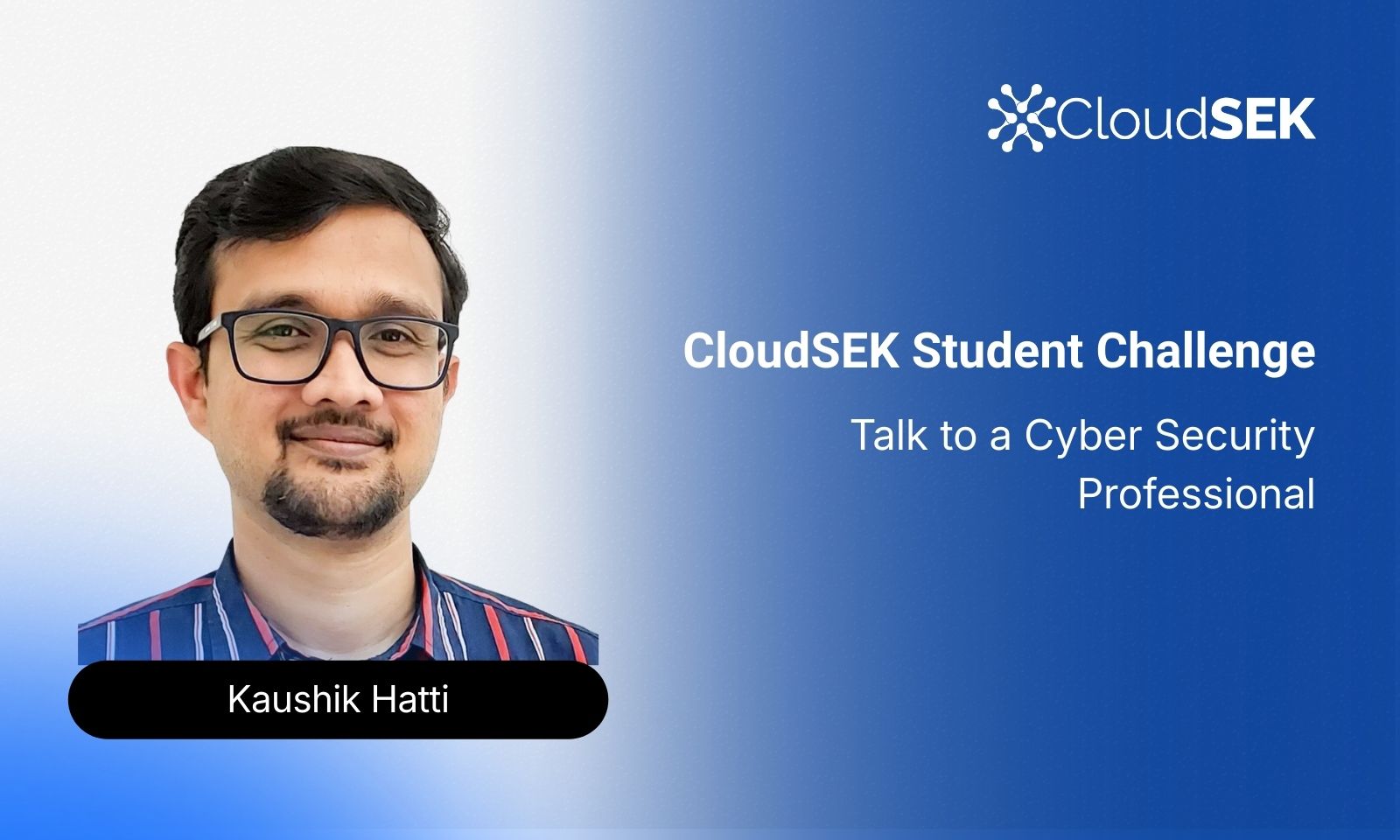
When we think of a Chief Information Security Officer (CISO), we often picture a career focused in code, networks, and firewalls. But what if the path to protecting our digital world began in a biology lab? As part of the CloudSEK Student Challenge: “Talk to a Cyber Security Professional,” I had the privilege of speaking with Mr. Kaushik Hatti, CISO at Pinochle.AI whose journey is a powerful testament to the common assumption that most vital skills in cybersecurity are always born from a tech background.
His story is filled with curiosity, adaptation, and a relentless focus on the one variable that transcends every field that is “data”.
A Scientist Who Fell in Love with Data
Mr. Kaushik began his academic journey in microbiology, fascinated by the complexity of living organisms. During his postgraduate studies, his project on Human Genome sparked his curiosity about data. He realised that the future lay not only in biology itself, but in how we interpret and manage massive amounts of biological data.
This realisation led him to pursue a one-year course in bioinformatics in Mysore, which opened the door to computational biology. A PhD at the Indian Institute of Science followed, where he unexpectedly found a relationship with mathematics. Far from being just equations, math became a tool for solving complex data problems, skills that would later prove invaluable beyond the world of biology to him.
Global Experience and Transition to Cybersecurity
Mr. Kaushik’s academic eagerness took him to Oxford University, where he presented his PhD work, and later to Cambridge University, where he collaborated with mathematicians and worked deeply on algorithm development. He then spent time in Scotland, building AI/ML pipelines for discovery research in chemistry and biology.
After five years in the UK, Mr. Kaushik wanted to return to India. A chance LinkedIn conversation introduced him to the cybersecurity world an area he had little formal exposure to at the time. He joined a company as Chief Data Scientist, but soon transitioned into the role of CISO. For him, data was still data whether it was biological, chemical, or cybersecurity-related and his expertise in handling complexity transitioned seamlessly.
Lessons from the Front Lines: Psychology, People, and Humility
When I asked Mr. Kaushik about the most significant challenge in his cybersecurity career, his answer wasn’t about technology. “I had completely underestimated the importance of psychology” he shared, “because the biggest problem in cybersecurity… is humans”. He learned that protecting an organisation is as much about understanding people as it is about deploying security tools.
He explained the difficulty in helping long-time practitioners, who are used to conventional methods, adapt to the rapidly evolving threat landscape. The key, he found, is effective data storytelling conveying the necessity of change without causing fear or denial.
This human-centric view extends to his leadership philosophy. Transitioning from leading small teams to large, hierarchical ones taught him that people management is a “constant journey” that requires active listening and humility, not a dictatorial approach.
Leadership Lessons as a CISO
Transitioning from small research teams to managing large, hierarchical security teams was another major shift for Mr. Kaushik. He emphasized that leadership in cybersecurity demands humility and active listening.
“If you think like a dictator, you’ll fail,” he said. “But if you remain a constant learner and an active listener, you build amazing teams.”
For aspiring leaders, this was a reminder that technical expertise is not enough emotional intelligence and people management are equally crucial.
Advice for Students Entering Cybersecurity
One of the most common struggles for beginners is knowing where to start. It’s equally difficult to start when you have too many options or no options, the entry point can seem unclear. Mr. Kaushik’s advice was simple yet powerful: start with your strengths.
He shared examples of how even someone from an acting or theatre background could contribute meaningfully to cybersecurity through storytelling, communication, and presenting complex insights in engaging ways. Cybersecurity, he stressed, is a field where diverse talents converge, and every unique skill can find relevance.
For those aspiring to become CISOs, Mr. Kaushik outlined three golden principles:
- Be a constant learner — Cybersecurity changes daily; yesterday’s best practices may already be obsolete.
- Value soft skills — Collaboration, delegation, and networking are essential.
- Stay humble — Be willing to accept when you’re wrong and treat mistakes as opportunities to learn.
Navigating Daily Threats: A Structured Approach
Mr. Kaushik also described his approach of handling the daily flood of cybersecurity threats. He classifies them into three categories:
- Known knowns — Facts you are sure of (servers, firewalls, employee systems)
- Known unknowns — Risks you know exist but cannot fully identify, such as insider threats
- Unknown unknowns — Emerging risks no one has anticipated, from new vulnerabilities to quantum-era cryptographic threats
To address this, he recommends a “defence in depth” strategy i.e., multiple layers of protection and monitoring systems that make it harder for even unknown threats to succeed.
Key Takeaways
Mr. Kaushik Hatti’s story is not just about becoming a CISO, it’s about embracing change, leveraging personal strengths, and realising that cybersecurity is as much about people as it is about technology.
For students like me, his journey emphasizes three truths:
- Background doesn’t limit you. Whether from biology, acting, or engineering, your unique strengths can add value to cybersecurity.
- Learning never stops. Curiosity and adaptability are the two most useful attributes in a quick-changing threat world.
- Cybersecurity is human. Success lies not only in technology, but in communication, empathy, and leadership.
As I left the conversation, I felt not only more informed about cybersecurity but also more inspired. Mr. Kaushik’s path shows that the future of cybersecurity will be shaped by those who dare to bridge disciplines, embrace uncertainty, and lead with both intellect and humanity.
About the Author: B Jagadish is an engineering student with a strong interest in technology, system-level programming, and cybersecurity. He has hands-on experience in programming, database systems, computer architecture, and low-level assembly concepts, and I am actively building my knowledge in secure systems and cyber defense fundamentals.