🚀 Introducing Cloudsek Launchpad: a incubator for early-stage cybersecurity founders, apply today!
Read more


CloudSEK XVigil detects phishing sites, fake domains, rogue apps, fake customer care numbers, and fake social media pages that misuse a brand, and CloudSEK's in-house team takes them down.


Global Enterprises and Fortune 500 companies trust CloudSEK to fortify their cybersecurity posture.
Brand threat monitoring is the continuous search of domains, websites, social media, and app stores for phishing sites, fake domains, rogue apps, and impersonating accounts that misuse an organization's brand.
Brand monitoring finds these threats, brand intelligence adds the context needed to judge them, and brand protection removes them through takedowns.
CloudSEK XVigil for brand threat monitoring
CloudSEK XVigil is a digital risk protection platform that continuously scans web pages, forums, marketplaces, social media pages, and app stores for exposed or impersonated brand assets, and reports each threat with the context needed for a takedown.
Brand impersonation takes a different form on each channel, so each threat type needs its own detection. XVigil gives visibility into exposed and impersonated brand assets within hours of them going live.
Fake domains and phishing sites imitate a brand's website to collect customer logins and payments. XVigil detects them and works with domain registrars to take impersonating sites down.
(i) Impersonated and infringing domains
(ii) Typosquatted domains
(iii) Phishing sites and fake webpages

Rogue and fake mobile apps pose as a brand's official app and can expose customer credentials. XVigil scans official and third-party app stores for them.
- Fake apps on third-party app stores
- Outdated apps on third-party app stores
- Apps that impersonate the brand
Fake customer care numbers are phone numbers posted as a brand's support line to draw customers into sharing sensitive details. XVigil scans forums and social media for them.
- Fake customer care numbers
- Customer care scams
- Alerts with details of the posting
Fake social media pages copy a brand's name and imagery to mislead its customers. XVigil monitors social media pages for brand impersonation.
- Fake brand pages
- Pages that pose as official support
- Fake social media accounts
Executive impersonation is the use of a senior leader's name or image to deceive employees, customers, or partners. XVigil monitors for impersonation of an organization's executives.
- Profiles created in an executive's name
- Accounts that reuse an executive's image
- Pages that pose as company leadership
Brand abuse is the unauthorized use of a brand name or brand assets on pages, listings, and forums. XVigil monitors web pages, forums, and marketplaces for it.
- Unauthorized use of the brand name
- Listings that pose as the brand
- Exposed brand assets
XVigil scans each channel where a brand can be impersonated and matches findings to the organization's assets and watchwords.

XVigil monitors domains and web pages for impersonated, infringing, and typosquatted versions of the brand.

XVigil monitors social media pages for fake brand pages and fake customer care numbers.

XVigil scans official and third-party app stores for fake, outdated, and impersonating apps.

XVigil monitors forums and marketplaces for listings and posts that misuse the brand.
Related use cases: Deep & Dark Web Monitoring and Leaked Credential Detection
Brand threat monitoring in XVigil runs as a continuous four-step loop, from asset registration to confirmed takedown.
XVigil starts from the organization's own asset and watchword list, such as brand names, domains, and app names.
XVigil scans web pages, forums, marketplaces, social media pages, and app stores continuously for matches.
XVigil reports each brand threat with the context needed to judge it and act on it.
CloudSEK's in-house team submits the takedown, follows up, and confirms the removal.
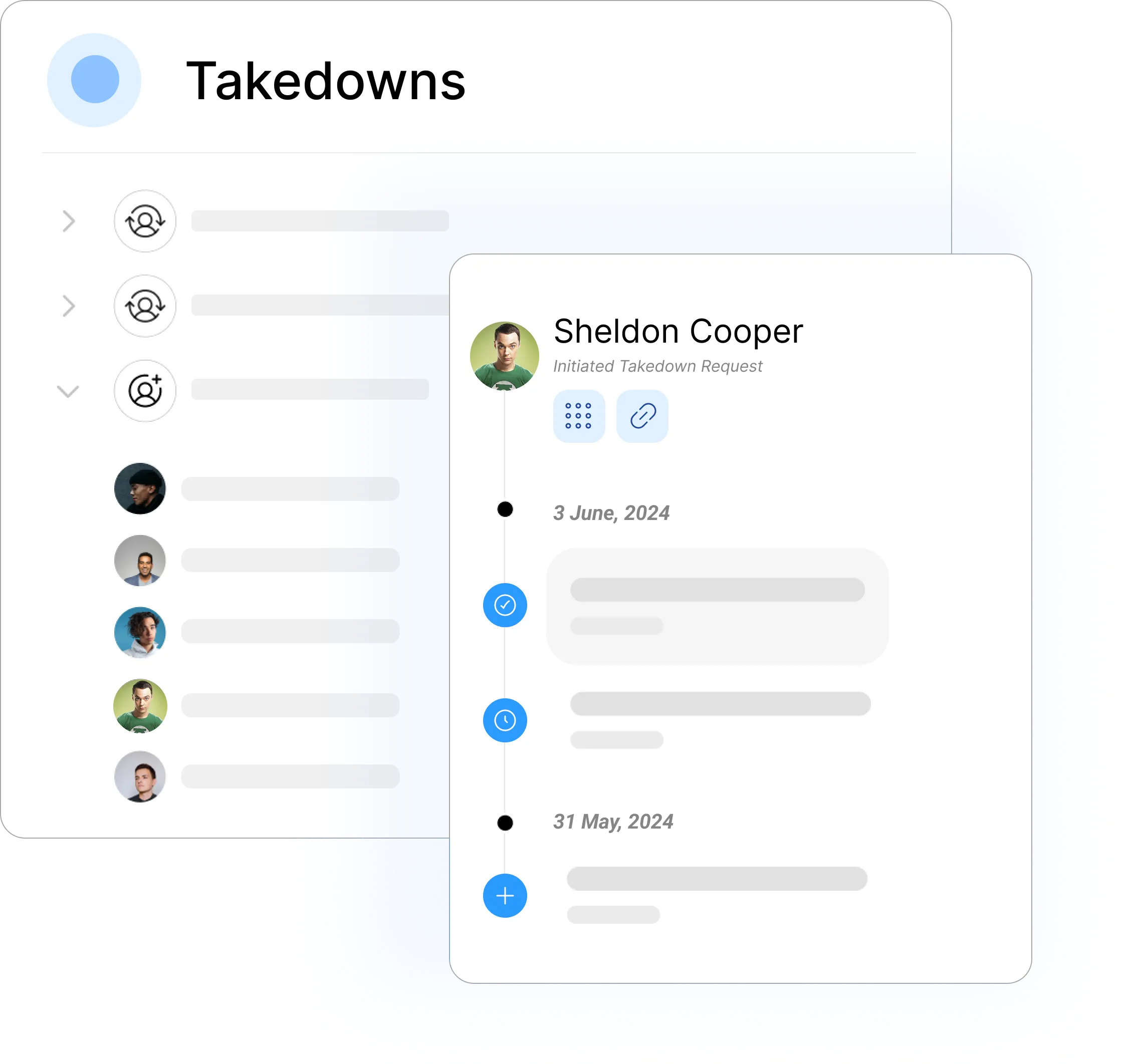
A brand takedown is the removal of impersonating content by the party that hosts it. CloudSEK manages takedowns end to end for XVigil customers, including submission, follow-ups, and confirmation, so security teams do not carry the manual work of chasing each removal.
The deciding difference is whether an impersonation is found within hours or after customers report it.


XVigil runs on CloudSEK's proprietary AI and machine learning models, which produce specific, actionable, and timely warnings.
Specific alerts
Each XVigil alert relates to the organization's own brand assets and watchwords.
Actionable alerts
Each XVigil alert carries the context needed to request a takedown.
High priority alerts so far
Rated by our Customers
Takedown success rate
Median time to takedown
Brand domain matched. Recommended: request takedown.
Brand name matched. Recommended: request removal.
App name matched. Recommended: review the listing.
Brand threat monitoring is the continuous search of domains, websites, social media, and app stores for phishing sites, fake domains, rogue apps, and impersonating accounts that misuse an organization's brand. Brand threat monitoring is a cybersecurity practice, and its findings feed the takedowns that remove impersonating content.
Brand monitoring, brand intelligence, and brand protection are three stages of the same practice. Brand monitoring finds content that misuses a brand, such as phishing sites and fake apps. Brand intelligence adds context, such as who posted the content and how it targets customers. Brand protection is the outcome: the content is taken down. CloudSEK XVigil covers all three stages in one platform.
Brand threat monitoring works by registering an organization's brand assets, scanning the channels where impersonation appears, and alerting on matches. In CloudSEK XVigil, an asset and watchword list drives continuous scans of domains, websites, social media pages, forums, and app stores. Each alert carries context about the threat, and CloudSEK's in-house team manages the takedown through to confirmation.
CloudSEK XVigil detects fake domains, phishing sites, rogue and fake mobile apps, fake customer care numbers, and fake social media pages. Domain coverage includes impersonated, infringing, and typosquatted domains. App coverage includes official and third-party app stores. XVigil reports each threat with context, and takedown support covers phishing sites, infringing domains, fake social media accounts, and unofficial apps.
Companies detect lookalike domains by monitoring domain registrations and live websites for names that imitate their own. Typosquatted domains swap, drop, or add characters, so matching has to go beyond the exact brand name. CloudSEK XVigil monitors for impersonated, infringing, and typosquatted domains and works with domain registrars to take impersonating sites down.
A phishing site takedown works by reporting the site, with evidence, to the parties that can remove it, such as the domain registrar or hosting provider. The request is followed up until the site is offline, and the removal is then confirmed. CloudSEK manages this process end to end for XVigil customers, including submission, follow-ups, and confirmation, through an in-house takedown team.
Brand threat monitoring is different from social listening. Social listening is a marketing practice that tracks mentions, sentiment, and campaign performance. Brand threat monitoring is a security practice that looks for impersonation, such as phishing sites, fake apps, and fake support numbers that target customers. The two can watch the same channels, and they answer different questions for different teams.
A fake customer care number scam is a fraud in which someone posts a phone number that poses as a brand's support line. The numbers appear on forums, social media, and online listings, and callers are led to share card details or account credentials. CloudSEK XVigil scans these channels for fake customer care numbers and alerts the organization with details of the posting.
CloudSEK XVigil provides brand monitoring. XVigil is CloudSEK's digital risk protection platform, and its brand monitoring scans web pages, forums, marketplaces, social media pages, and app stores for exposed or impersonated brand assets. Findings arrive as alerts with context, and CloudSEK's in-house team manages takedowns for XVigil customers.
Brand protection is one part of digital risk protection. Digital risk protection covers every external threat tied to an organization, including leaked credentials and data traded on the dark web. Brand protection focuses on impersonation: fake domains, phishing sites, rogue apps, and fake social media pages. CloudSEK XVigil delivers brand protection alongside deep and dark web monitoring in one platform.