🚀 CloudSEK featured in the 2026 Frost Radar™!
Read more
.avif)

Vendor compliance is the process of ensuring that an organization's third-party vendors meet the regulatory, security, contractual, and operational standards it requires. It confirms that the suppliers, service providers, and software vendors a business depends on follow the rules that protect its data, its customers, and its operations.
The scale of this task has grown sharply. EY's 2025 Global Third-Party Risk Management Survey found that newer third-party risk programs manage a median of 275 vendors each, and regulators now treat vendor oversight as mandatory rather than optional. The EU DORA and NIS2 directives and the United States SEC Regulation S-P amendments require documented due diligence and monitoring of service providers.
Vendor compliance is the discipline of verifying that third parties adhere to the standards an organization sets for them. Those standards span legal and regulatory obligations, security and data-protection controls, contractual terms, and internal policies. The goal is direct: confirm that a vendor operates the way the organization needs it to, both before and throughout the relationship.
Compliance differs from simply having a vendor under contract. A business can sign an agreement with a supplier and still have no assurance that the supplier encrypts data, holds the right certifications, or notifies anyone when an incident occurs. Vendor compliance turns those expectations into defined, verifiable requirements. It answers a single question: Does this vendor meet the standards the organization depends on?
Vendor compliance is often confused with vendor risk management and vendor management. The three overlap, yet each serves a different purpose.
Vendor compliance is the narrowest of the three and sits inside both vendor risk management and the wider third-party risk management program. Compliance confirms that the rules are met; risk management decides which rules matter and what level of risk the organization accepts.
Vendor compliance covers four main types of standards, and most vendor relationships involve more than one.
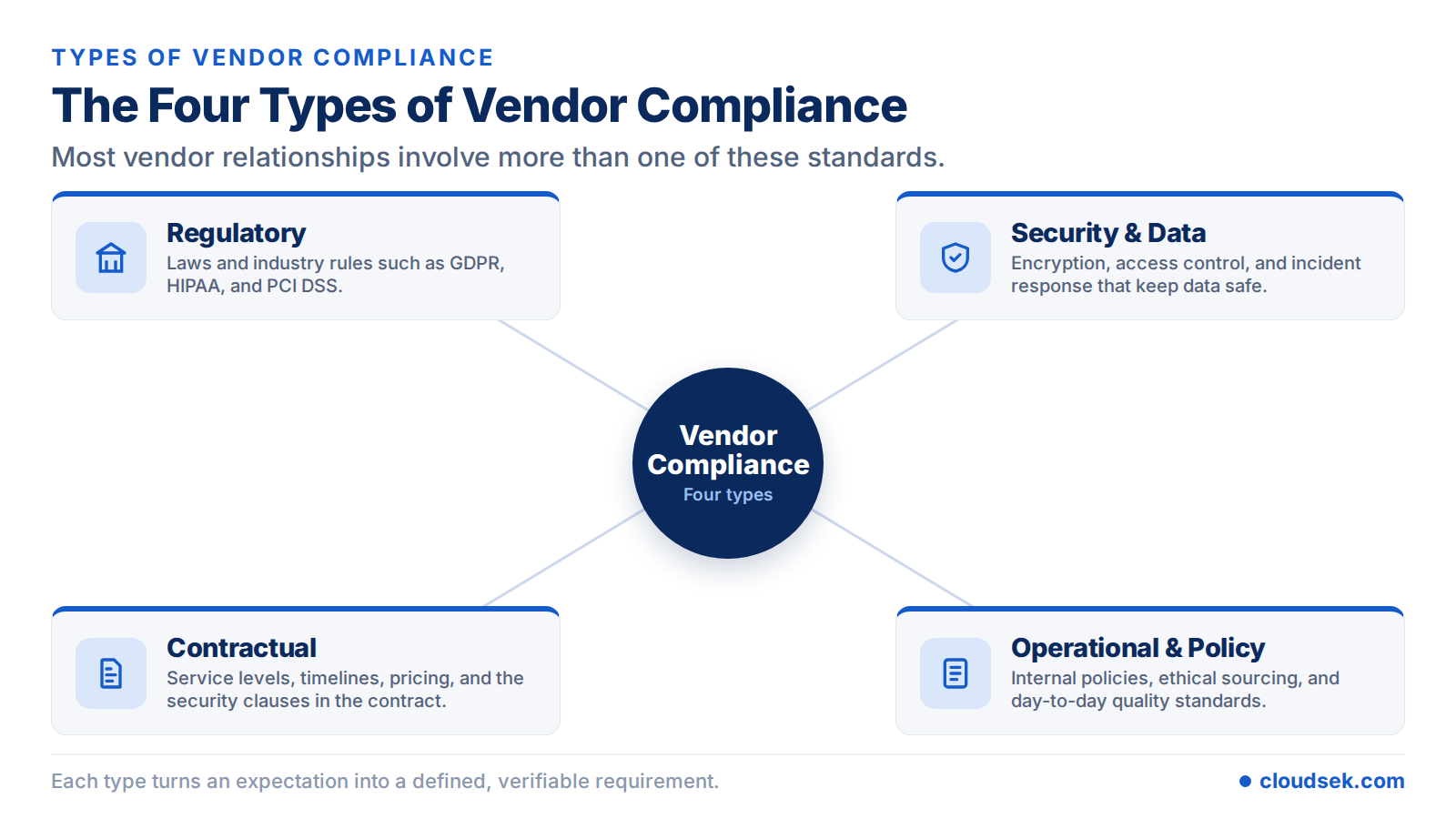
Adherence to the laws and industry regulations that apply to the data or service involved, such as GDPR for personal data, HIPAA for health information, and PCI DSS for payment cards. A vendor that processes regulated data inherits the obligations attached to it. A payroll provider handling employee records, for instance, falls under data-protection law alongside its client.
Adherence to the security and data-protection controls that keep information safe, including encryption, access control, and incident response. This dimension ties vendor compliance directly to breach prevention, because a compromised vendor is a common route for a supply chain attack that reaches the organization's data.
Adherence to the obligations written into the contract, including service levels, delivery timelines, pricing terms, and the security clauses the organization requires. Contractual compliance gives the organization legal recourse when a vendor falls short of what was agreed, such as missing a guaranteed uptime written into a service-level agreement.
Adherence to the organization's internal policies and quality expectations, such as a code of conduct, ethical sourcing, and performance standards. This dimension keeps vendors aligned with how the organization operates day to day.
Vendor compliance matters because a vendor's failure becomes the organization's problem. The consequences span across security, finance, law, and reputation.
The stakes are concrete. The Ncontracts 2025 Third-Party Risk Management Survey reported that 49% of financial institutions experienced a vendor-related cyber incident in the past year. Each incident carries investigation, notification, and recovery costs that fall on the organization, not the vendor.
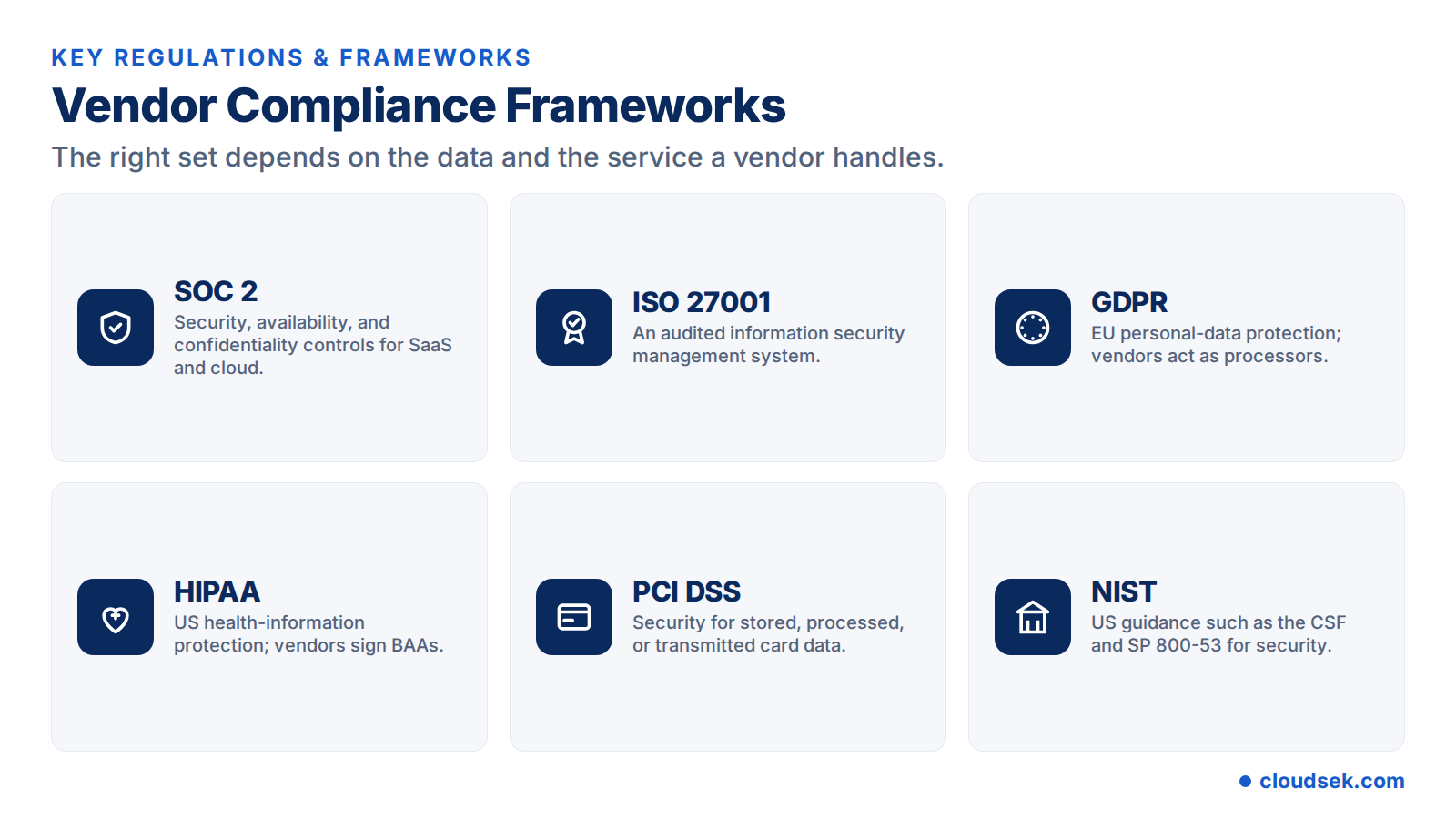
Vendor compliance programs hold vendors to recognized frameworks and regulations. The right set depends on the data and service involved.
Vendor Compliance by Industry
The standards that matter most shift by sector, because each industry handles different data under different regulators.
Vendor Compliance Checklist
A vendor compliance program defines what each vendor provides and maintains. A practical checklist includes the following requirements:
Defining these at the start of a relationship is far simpler than retrofitting them after a problem appears.
Building a vendor compliance program follows a repeatable sequence across the vendor lifecycle. Each stage feeds the next, so gaps close before a vendor gains access to data or systems.
A compliance check is accurate only on the day it happens. A vendor that passes an assessment in January can change its infrastructure, lose a certification, or suffer a breach by March, and a point-in-time review never sees it. This gap is the central limitation of compliance treated as a one-time event, and the longer the interval between checks, the wider the blind spot grows.
Continuous monitoring closes the gap. Rather than relying on an annual questionnaire, it tracks a vendor's external security posture and exposure on an ongoing basis, and flags changes as they happen. Continuous external monitoring of this kind catches a deteriorating posture, a new exposure, or early signs of compromise that a static attestation misses. Compliance confirms a vendor met the standard once. Monitoring confirms it still does.
Continuous monitoring of a vendor typically tracks:
A vendor compliance audit is a structured review that verifies a vendor meets the standards set for it, rather than trusting self-reported answers. It typically covers four areas.
An audit gives a deeper, evidence-based view than a questionnaire, though it captures a single point in time, which is why continuous monitoring runs alongside it.
Vendor compliance programs run into a consistent set of obstacles, particularly as the vendor count grows.
Certain signals indicate that a vendor is drifting out of compliance and warrants a closer review.
Catching these early is the difference between a managed remediation and a breach disclosure.
A focused set of practices keeps a vendor compliance program effective as it scales.
As vendor portfolios grow, manual compliance becomes impractical, and many programs adopt software to manage it. Vendor compliance management tools centralize vendor records, contracts, and evidence, automate questionnaires and reminders, monitor posture, and report status to leadership.
The aim is consistency at scale: every vendor measured against the same standard, with evidence on hand for auditors and a single view of status for leadership and regulators. Useful capabilities include a central vendor inventory, automated assessment workflows, continuous monitoring, and clear reporting.
Compliance tooling depends on accurate, current information about each vendor's security, and much of that signal sits outside the organization, on vendor infrastructure and across the open and dark web.
CloudSEK SVigil monitors third-party and supply chain security posture continuously, surfacing vendor exposures and weakening posture as they appear rather than at the next review. Signals of this kind feed the security dimension of a vendor compliance program, showing when a vendor's real posture drifts from what its attestations claim. SVigil complements the compliance and governance tooling that manages contracts, evidence, and workflows, and does not replace it.
A vendor compliance chargeback is a fee a buyer deducts when a vendor breaks an agreed requirement, such as late delivery, incorrect labeling, or a missed routing rule. It is common in retail supply chains and offsets the cost of the violation.
Responsibility is shared across procurement, IT and security, legal, and finance, usually coordinated by a vendor risk or compliance team. The organization that engages the vendor, not the vendor itself, holds final accountability to regulators for oversight.
It depends on the vendor's risk tier. High-risk vendors with access to sensitive data warrant assessment at least annually and after any major change, while low-risk vendors need review every two to three years. Continuous monitoring covers the gaps.
The organization issues a corrective action plan with a remediation deadline, and applies contractual penalties or escalation if the vendor does not comply. Persistent non-compliance can end the relationship, and severe cases bring regulatory or legal exposure.
Indirectly, yes. No single law names vendor compliance, but regulations such as GDPR, HIPAA, DORA, and the SEC Regulation S-P require organizations to oversee the third parties that handle their data. Vendor compliance is how organizations meet those obligations.
A vendor compliance score is a rating that summarizes how well a vendor meets required standards, based on assessments, certifications, and monitoring data. It lets teams compare vendors quickly and prioritize the ones that fall below an acceptable threshold.
