🚀 CloudSEK featured in the 2026 Frost Radar™!
Read more
.avif)

A routine-looking text can be the visible edge of a much larger fraud operation. Threat actors have built industrial-scale traffic brokerage frameworks that exploit trust in more than 300 global brands across 100+ countries, using localized lures to reach smartphone users and profile targets in real time for credential and financial fraud.
Reaching a phone is only the first step. The message still has to appear credible enough to provoke a response, so attackers frame their texts around identities, situations, and incentives that recipients are likely to recognize. Those choices shape how the deception unfolds, from the initial lure to the action the recipient is pushed to take.
Smishing, or SMS phishing, is phishing delivered via text messaging. It uses social engineering to induce an attacker-selected response, such as following a link, replying to the sender, calling a supplied number, or disclosing sensitive information. The term refers to the delivery channel: email phishing begins through email, while smishing begins through SMS.
After that initial contact, attackers may expose login credentials, MFA codes, payment details, and other sensitive information. The fraudulent exchange can therefore continue beyond the SMS itself.
CloudSEK’s research into BigBear 2.0 shows how automated phishing infrastructure can scale credential collection. The Phishing-as-a-Service framework used automated proxy layers and exfiltrated more than 5,137 credentials, including 474 MFA-bypassed tokens. BigBear 2.0 was a broader phishing infrastructure rather than a smishing-specific campaign, but its operation illustrates how industrialized phishing systems can collect authentication data at scale.
Common smishing patterns differ mainly in the scenario used to earn a response.
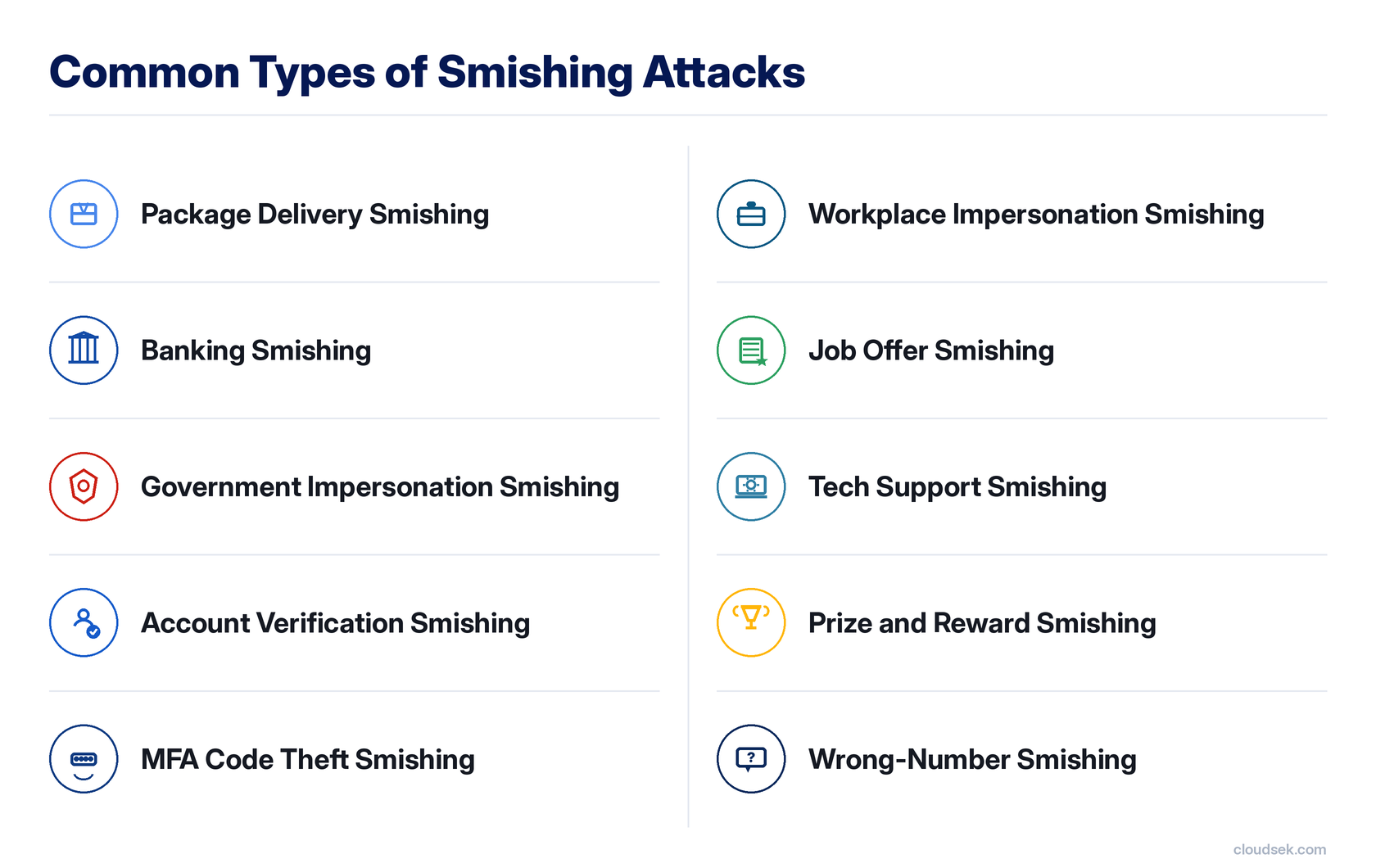
A text claiming that a parcel cannot be delivered until an address is updated or a small fee is paid creates the setup for package delivery smishing. Because the request remains tied to the shipment, correcting delivery details or arranging redelivery becomes the next expected task.
PHLPost warned on September 9, 2026, about fraudulent texts claiming that parcels could not be delivered due to incomplete addresses or unpaid redelivery fees. The messages included suspicious links and could seek card or financial details
A supposed fraud alert, unfamiliar transaction, or account issue places banking smishing inside an existing financial relationship. The recipient is pushed to review activity, provide bank details, or complete further verification under the bank’s identity.
Derbyshire Constabulary reported a two-stage case on September 21, 2026. Mohammed Gulzar sent smishing messages to six elderly women and obtained passwords and bank details. He later impersonated their banks to gather further financial information, and the victims lost more than £30,000 in total.
Taxes, tolls, fines, benefits, and court matters give an unexpected text the weight of an official obligation. Government impersonation smishing applies that public authority to payment demands or requests for identity information.
On September 9, 2026, the U.S. District Court for the District of Maine warned about fraudulent texts impersonating judges and court officials. Recipients were told they had failed to report for jury duty, while some messages threatened arrest or demanded payment.
Scammers use account verification smishing to present an error, suspension, or update as something the user needs to resolve. Even a one-word reply can move the exchange forward, allowing later requests to appear connected to restoring access.
The Canada Revenue Agency documented an example on August 6, 2026. Although the texts involved a government agency, the hook was an account error rather than a fine or legal threat. The sequence was straightforward:
Because multi-factor authentication requires more than a password, MFA code theft targets the temporary value needed to complete sign-in. That second factor can include:
UC Riverside warned on September 15, 2026, about fraudulent emails and text messages directing students to fake login pages built to collect passwords alongside authentication codes. The university specifically advised users not to provide Duo MFA codes through unsolicited texts or links.
Exposure of a code reveals the additional authentication factor, but disclosure alone does not prove that the associated account was successfully compromised.
Executives, managers, department heads, and payroll contacts give workplace impersonation smishing identities that already belong inside the organization. An unusual instruction can therefore arrive under the name or title of someone employees recognize.
Universities like Columbia University routinely issue cybersecurity advisories warning students and faculty against ongoing text message and email phishing scams. In these common scams, fraudsters impersonate department chairs or executives requesting immediate gift cards, wire transfers, or personal data
Where workplace impersonation borrows an existing professional relationship, job offer smishing creates a prospective one. Recruiter outreach, an interview invitation, or a vacancy provides the context for later requests involving money or information.
The Western Cape Education Department reported such a case on September 3, 2026. WhatsApp messages impersonating principals or district officials falsely offered teachers permanent positions. Recipients were later asked to pay about R2,800 for authorization of an appointment letter, and some paid before discovering that no position existed.
Because the case involved WhatsApp rather than SMS, it does not establish an SMS-delivered campaign. It does show how a mobile recruitment message can lead from a supposed job opportunity to a later fee request.
A threatened shutdown or service problem gives tech support smishing its point of entry. The sender presents technical help as the route to keeping an account active or restoring access.
Common instructions include:
Virginia Commonwealth University documented texts on July 28, 2026, threatening to shut down users’ email accounts. VCU advised anyone who had already replied with a username and password to reset those credentials.
Prize and reward smishing presents the requested action as part of claiming or preserving something valuable. Loyalty points, gift cards, promotions, and giveaways provide the incentive rather than an account warning or service problem.
Macquarie reported in August 2026 that customers were receiving texts claiming their Macquarie Rewards points were about to expire. The links led to fake Macquarie-branded phishing sites, and details entered there were later used for unauthorized payments.
Wrong-number smishing opens with an apparently accidental contact instead of an immediate financial or account-related demand. Continued conversation gives the sender time to introduce a different scheme later.
Cuyahoga County Consumer Affairs reported on September 3, 2026, that victims had entered investment scams after responding to wrong-number texts. Fraudsters later showed them fake investment applications displaying gains that did not exist.
Most smishing attacks unfold as a sequence. An SMS first attracts attention, then creates enough pressure or interest to push someone toward an action that moves the fraud forward.
A believable SMS opens the attack with a familiar situation, such as a delivery issue, account warning, workplace request, support problem, or reward. Brand names, known services, or recognizable roles help the contact look legitimate. Then attention is secured, the scam needs a reason for the person to respond.
Urgency, authority, financial concern, curiosity, or promised value makes the situation feel harder to ignore. That pressure turns a believable story into a reason to act.
Next comes a specific instruction: open a link, reply, call a number, enter login details, make a payment, or provide an MFA code. Each action moves the person beyond simply reading the SMS. Following the instruction takes the recipient to a page, phone call, or conversation controlled by the attacker.
Following a link may open a fake login or payment page. Calling the supplied number can connect the person to an impersonated support service, while replying may extend the exchange into a longer conversation. From there, the fraud no longer depends on the original text.
Once contact has moved beyond the initial SMS, the attacker can collect login details, payment data, personal information, or authentication codes. Some campaigns instead keep the conversation going so a later request feels more credible.
Questionable texts often contain inconsistencies in the identity presented, wording, destination, or requested action. None of these signs proves that an account has been compromised, but they provide a reason to verify the communication before responding.
No individual indicator confirms smishing. Risk becomes more credible when several elements fail to align, such as the sender identity, message context, destination, and requested action.
Organizations reduce smishing risk by putting safeguards around decisions prompted by text messages. Unusual instructions require independent verification, while account access needs stronger protection. Reporting and realistic training help staff respond consistently, and external monitoring covers threats that develop beyond internal systems.
Sensitive instructions belong outside the original text conversation. Staff can confirm the request through a known phone number, corporate directory, or established approval path. Payments and account changes should follow normal business procedures rather than directions supplied by SMS.
MFA limits the damage of an exposed password, but OTPs and recovery values require separate protection. Authentication factors belong inside approved login or recovery processes. Unsolicited texts should never become a channel for sharing them.
Questionable texts should reach the security team as soon as possible. Early escalation preserves useful evidence such as the phone number and URL before the campaign changes or disappears. Analysts can compare those details with other reports. A broader pattern may justify further investigation or containment.
Training should reflect decisions employees face during normal work. An exercise might involve an executive requesting a transfer or a support message asking for account action. The goal is to reinforce where independent verification fits before anyone proceeds.
Smishing infrastructure often appears beyond the corporate perimeter. Lookalike domains and fraudulent brand assets can support impersonation, while leaked credentials may increase the value of a targeted lure. External monitoring helps uncover that activity before employee reporting becomes the first signal.
Smishing does not always begin and end with the text itself. Fake domains, phishing pages, leaked credentials, and impersonated brand assets can sit outside the organization’s environment while supporting the campaign behind the message. Internal controls may help employees respond safely, but they do not provide direct visibility into infrastructure the organization does not own.
CloudSEK XVigil addresses that external layer through digital risk protection. It monitors organization-specific exposure across surface, deep, and dark web sources, including leaked credentials, data leaks, brand abuse, fake domains and apps, executive impersonation, and phishing infrastructure. Security teams can investigate those findings in the context of their own organization instead of treating every external signal as an isolated alert.
Validated phishing or impersonation assets can then move into takedown workflows supported by XVigil. That gives security teams a path from finding an external threat to investigating its relevance and acting on confirmed brand abuse. In a smishing program, XVigil therefore covers the external digital-risk layer around the campaign; it does not function as an SMS gateway, carrier filter, endpoint-security product, or incident-response service.
