🚀 CloudSEK featured in the 2026 Frost Radar™!
Read more
.avif)

A Security Operations Center (SOC) is a centralized function where security teams monitor systems, investigate alerts, and respond to potential threats. It brings together analysts, tools, and processes to ensure continuous visibility across an organization’s security environment.
Alerts generated within a SOC often lack the context needed for quick and accurate decisions. Threat intelligence addresses this gap by adding insight into attacker behavior, origin, and potential impact, making each alert more meaningful.
Increasing threat volume and complexity place pressure on SOC teams to act faster with limited clarity. Threat Intelligence Platforms provide continuous context, allowing teams to make informed decisions and respond with greater precision.
A threat intelligence platform becomes important for SOC teams when security operations lack clarity and actionable insight.

Security operations become more effective when context and intelligence are consistently embedded into workflows.
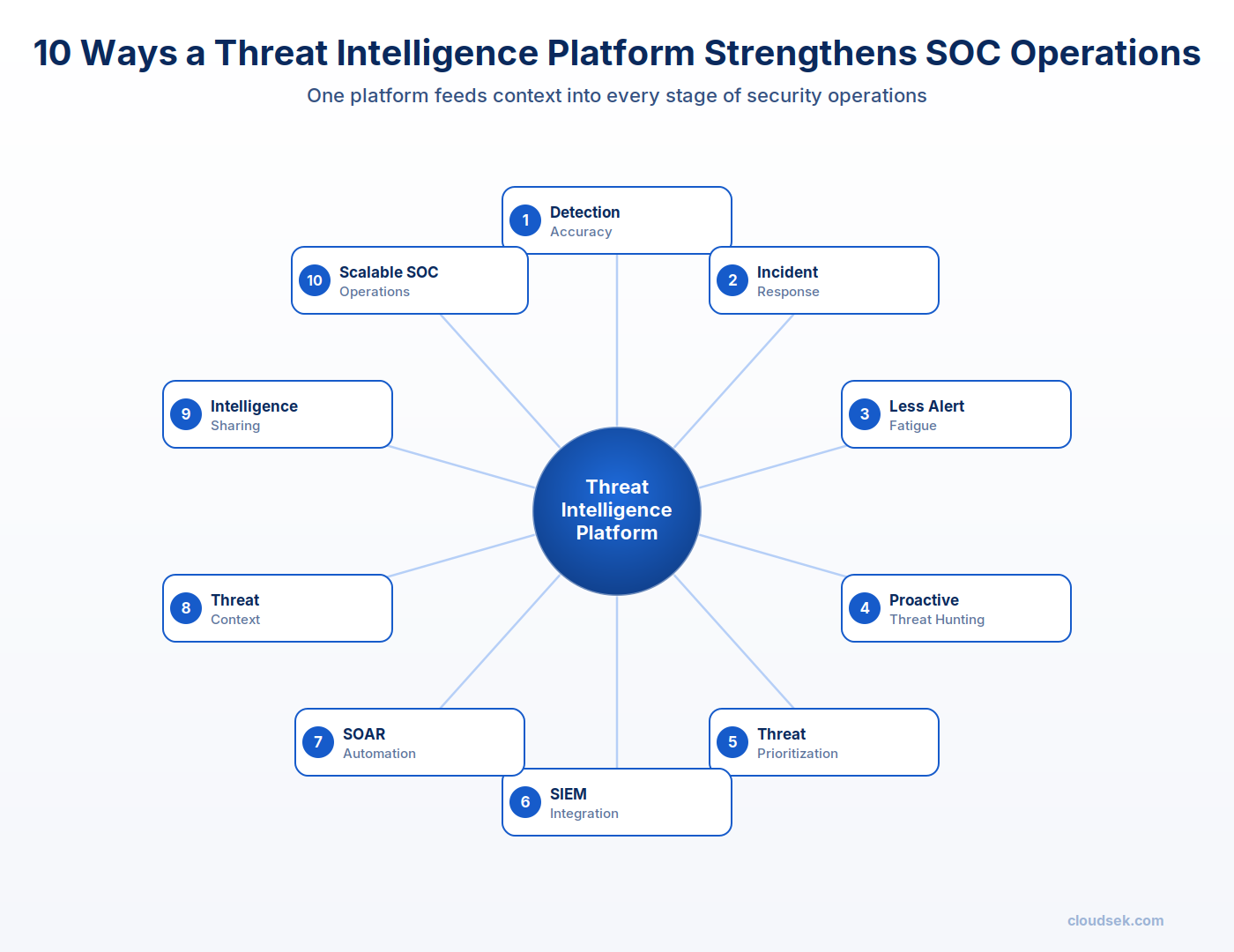
Reliable detection depends on recognizing patterns beyond isolated signals. Correlation between Indicators of Compromise and known attack techniques increases the ability to identify genuine risks early.
Visibility into adversary behavior changes how incoming events are interpreted. Signals that appear harmless in isolation can reveal malicious intent once enriched with external intelligence.
Mapping activity against structures like MITRE ATT&CK Framework exposes relationships between tactics and execution methods. Attack paths that remain hidden in raw data become easier to trace through structured mapping.
Time-sensitive investigations require immediate access to relevant details. Enriched datasets reduce delays caused by switching between disconnected sources.
Knowledge of intrusion flow supports faster containment decisions. Response actions align more closely with the actual behavior of the intrusion.
Automation workflows gain value from structured inputs during execution. Integration with SOAR enables coordinated actions without repeated manual steps.
Continuous event streams create overload and reduce effectiveness over time. Filtering mechanisms separate meaningful signals from repetitive noise.
Prioritization based on risk shifts attention toward high-impact situations. Security teams avoid spending time on low-value notifications.
Streamlined handling reduces operational strain across daily workflows. Focus remains on events that require immediate investigation.
Security teams gain investigative depth through continuous intelligence updates. Access to evolving datasets supports exploration beyond triggered notifications.
Patterns observed across campaigns reveal indicators that remain undetected in routine monitoring. Active searches expose suspicious behavior before escalation occurs.
Behavioral mapping guides exploratory analysis. Investigations follow structured paths instead of random discovery.
Risk evaluation improves when events are assessed with additional context. Intelligence-driven scoring highlights which situations require immediate action.
Separation between critical and low-risk activities reduces confusion during triage. Effort distribution becomes more intentional across workflows.
Decision processes rely on consistent evaluation signals. Teams respond based on impact rather than guesswork.
Centralized logging platforms gather large volumes of security data across environments. Enrichment layers convert raw records into usable insights.
Additional context attached to events within SIEM systems improves investigation quality. External lookups become less necessary during analysis.
Correlation across internal telemetry and external intelligence strengthens detection depth. Combined visibility improves monitoring outcomes.
Automation effectiveness depends on structured and relevant input data. Enriched inputs ensure response actions align with actual conditions.
Execution workflows operate with higher precision when guided by contextual signals. Processes within SOAR systems perform with greater consistency.
Reduced reliance on manual validation speeds up response cycles. Repetition decreases across operational tasks.
Isolated indicators rarely provide enough detail to assess risk. Enrichment layers introduce attributes such as origin, intent, and behavioral patterns.
Linking multiple data points builds a connected view of ongoing activity. Relationships between events become easier to interpret.
Structured context supports faster investigation outcomes. Fragmented signals turn into actionable sequences.
Collaboration depends on access to consistent and structured information. Standardized sharing ensures all teams operate with the same dataset.
Unified formats improve communication between personnel and integrated systems. Misalignment decreases across workflows.
Coordinated response efforts benefit from shared visibility. Teams align actions more effectively during active situations.
Operational growth introduces challenges related to data volume and complexity. Intelligence-driven workflows support expansion without proportional resource increases.
Automation combined with contextual data reduces dependency on manual processes. Teams handle larger workloads without performance decline.
Adaptability becomes critical in evolving environments. Scalable systems maintain stability under increasing pressure.
CloudSEK delivers AI-driven external threat intelligence by tracking risks from an attacker’s perspective across surface, deep, and dark web environments. Exposure related to credentials, misconfigured infrastructure, and early-stage attack signals becomes visible before exploitation occurs.
Continuous monitoring across social platforms, underground forums, and digital assets provides insight into an organization’s external attack surface. Security teams gain visibility into leaked data, vulnerable endpoints, and emerging threats without relying solely on internal telemetry.
Machine learning models assign risk levels to detected activity, helping teams focus on incidents with the highest potential impact. Real-time alerts and contextual threat data reduce investigation effort while improving detection speed and response timelines.
Threat Intelligence Platform enriches security data with external context, improving how events are detected and investigated. It connects indicators, behavior patterns, and risk signals to support faster and more accurate response actions.
Correlation between external intelligence and internal events helps identify malicious activity that may otherwise appear normal. Detection improves through pattern recognition and contextual enrichment of incoming signals.
Threat Intelligence Platform works alongside systems like SIEM and SOAR by enhancing the quality of data they process. Functionality improves through enriched inputs rather than system replacement.
Access to evolving datasets allows teams to identify emerging risks before they trigger alerts. Early detection of attacker activity enables preventive action instead of reactive response.
External intelligence reveals risks that originate outside internal systems, including leaked data and attacker activity. Broader visibility helps reduce blind spots in security monitoring.
