🚀 CloudSEK featured in the 2026 Frost Radar™!
Read more


Retail cybersecurity incidents in 2026 have exposed corporate files, compromised employee accounts, disrupted order processing, and placed customer records in the hands of unauthorized parties. US breach notifications documented 56 retail events involving approximately 300,000 reported information exposures during the first half of the year. Disclosures from retailers in Europe further demonstrate how an intrusion can affect customer communications, business partners, and sensitive records without necessarily compromising an online checkout system.
The consequences depend on which business function an intruder reaches. Social engineering led to file theft from employee computers at Five Below and Levi Strauss, while compromised credentials at ASOS enabled unauthorized use of customer communication platforms. An intrusion at a payroll provider exposed workforce information associated with Catalyst Brands, demonstrating how records maintained outside a retailer's own network create additional security responsibilities. Ransomware-related encryption introduces another challenge when stolen files remain outside the organization's control after its systems have been restored.
Consumer fraud presents a separate but related threat to retail commerce. Singapore recorded 3,865 e-commerce scam cases and approximately S$8.3 million in reported losses during January–June 2026, while CloudSEK documented checkout manipulation and a cross-industry network of fraudulent brand promotions. These cases reveal why retail cybersecurity must account for more than breached databases: employee identities, outsourced business functions, transaction integrity, and the availability of commercial systems all influence the consequences of an attack.
Official disclosures and original research provide the following measurements of retail breaches, consumer fraud, and cyber incidents affecting retail-related businesses in 2026.
The measurements concern separate populations. US breach notifications describe reported security incidents, Singapore's figures concern fraud against buyers and sellers, and Hasbro's financial results relate to a consumer-products company supplying retail channels. CloudSEK's impersonation research spans industries beyond retail, so its geographic reach does not represent the number of retailers compromised.
The available evidence establishes meaningful 2026 observations, but not a single worldwide rate of retail cyberattacks. Individual incident disclosures provide the technical and commercial context necessary to interpret those statistics.
Breach notifications provide a measurable picture of reported security incidents, although the records reflect disclosure requirements and the material made public by government agencies.
The Privacy Rights Clearinghouse 2026 Midyear Data Breach Report, published September 4, recorded 56 retail breach events involving approximately 300,000 reported information exposures during January–June 2026. Its full dataset contained 5,429 notification filings describing 1,969 distinct events across US industries. Retail accounted for roughly 2.8% of those documented breaches.
Those figures follow the period when events were first reported rather than necessarily the dates when intrusions began. Privacy Rights Clearinghouse groups notifications describing the same breach because an affected company might file notices with multiple states. For the number of people affected, it uses the largest disclosed count associated with an event, which measures reported exposures rather than necessarily unique individuals.
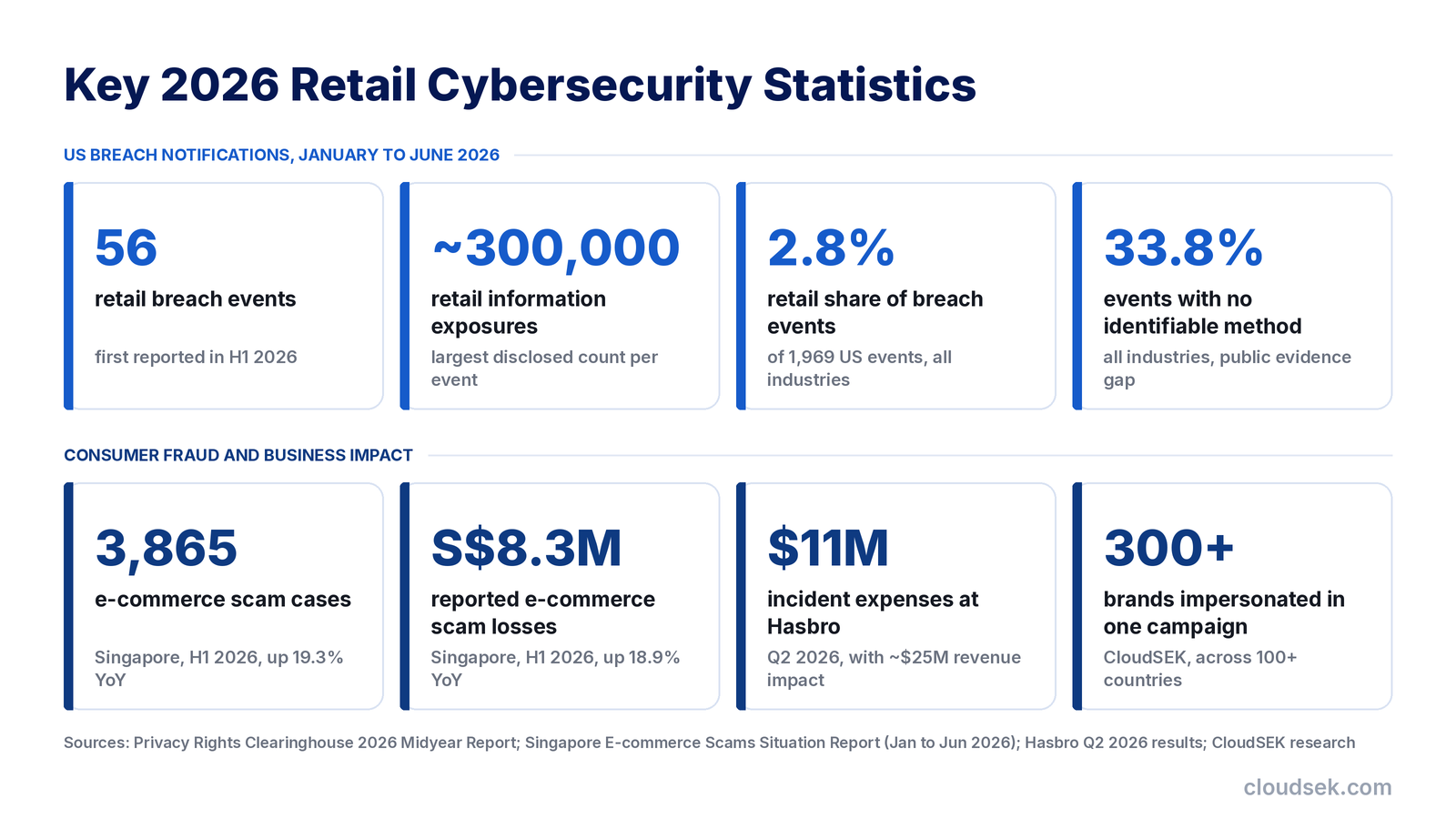
The dataset also illustrates a significant limitation in understanding intrusion methods. Approximately 33.8% of events across all industries lacked sufficient publicly available evidence to determine how the breach occurred. Some agencies publish summary tables without full notification letters, leaving researchers unable to classify those incidents as hacking, accidental disclosure, or another method.
This reporting gap affects how retail statistics should be interpreted. A disclosed breach confirms that an event entered the reporting system, but its presence alone does not reveal the initial entry point or whether customer payment systems were involved. The 56-event total therefore describes a documented US retail population, not every intrusion affecting merchants during the first six months of 2026.
Retail incidents disclosed outside the United States reveal different forms of disruption and data compromise. The following company statements describe events affecting customer communication, merchandise retailers, and third-party fulfillment infrastructure.
On October 6, 2026, ASOS customers received an unauthorized push notification through an application channel associated with the online fashion retailer. The message contained a link to an external destination, prompting ASOS to restrict the implicated communication platforms and advise customers not to engage with it.
In its updated customer statement following the initial notification, ASOS explained that an unauthorized party had impersonated a trusted contact to obtain an employee's login credentials. Those credentials were used to enter third-party platforms handling customer communications and retrieve certain personal details, including names and contact information.
According to ASOS's updated incident statement, the company's investigation found that payment-card details and account passwords had not been accessed. Its shopping website and application remained safe to use, although the unauthorized notification demonstrated that a familiar communication channel could be misused without interrupting the storefront.
Belgian furniture retailer WEBA acknowledged a cyberattack and confirmed leakage of certain customer records during 2026. A notice on WEBA's official website informed shoppers that the company was investigating which personal details had been affected and what consequences might follow.
The company announcement did not provide a verified total of affected individuals or a precise incident date. It also did not establish the full technical sequence or identify the responsible intruder, so those details cannot be inferred from the confirmation of customer-data leakage.
WEBA's disclosure differs from the unauthorized communication incident at ASOS. Here, the confirmed concern involved customer records that had left the retailer's control, requiring an investigation into the specific information acquired.
Dutch eyewear retailer Ace & Tate disclosed an incident involving its logistics partner, CEVA Logistics, after learning on August 1, 2026, that an unauthorized party had entered systems used to process orders. Ace & Tate suspended data exchange with the provider and investigated whether its own environment had been affected.
On September 10, CEVA confirmed that personal data belonging to Ace & Tate customers had been viewed and copied from its systems. The retailer explained in its official security incident statement that it had no evidence of an intrusion into its website or customer accounts.
The breach also affected fulfillment arrangements. According to Ace & Tate, order processing, shipping, and returns resumed on August 27, demonstrating how an incident at a logistics partner can interfere with commercial functions even without confirmed compromise of the merchant's shopping platform.
These disclosures demonstrate incident activity involving retailers in several European markets. They are not directly comparable national statistics, because the companies reported different types of breaches and consequences without a common measurement method.
Unauthorized entry into a retail environment begins with a particular security boundary, such as an employee device, an authenticated account, or an internet-facing application. The permissions available after that entry determine which business resources are exposed to further actions.
Five Below identified suspicious behavior involving an employee's company-issued computer on July 15, 2026. Its July 22 SEC filing established that social engineering had enabled unauthorized entry the previous day, followed by the exfiltration of files from the affected device.
The company activated its incident response procedures, isolated the activity, and initiated forensic investigation. At the time of filing, Five Below believed the intrusion remained limited to the employee's environment and had not affected its remaining corporate systems or personally identifiable information.
The confirmed compromise illustrates the relationship between a successful deception and the permissions available through the affected computer. An intruder who reaches a workforce device does not automatically control every connected application, but locally available files and authenticated sessions may require investigation.
A workforce identity can authenticate to email, administration interfaces, and business applications under separate permission rules. Stolen credentials therefore create consequences tied to the applications that accept them and the authority assigned to the account.
Once authentication succeeds, an intruder may attempt to retrieve stored records, change configuration settings, or use functions ordinarily available to the employee. Session theft creates a related concern where an existing authenticated session can be reused without repeating the original login process.
The investigation must establish which applications accepted the identity and what actions occurred afterward. The presence of a stolen password does not independently confirm entry into every connected system, just as an exposed session token does not establish that it was successfully reused.
Retail storefronts depend on web applications, administration panels, commerce extensions, and databases. Vulnerabilities in those components provide potential entry routes where unauthorized requests reach functions that were not intended to be public.
The impact changes according to the affected component's privileges. Exploiting a weakness in an order-management application might expose transaction records, whereas a flaw confined to a product-display feature does not necessarily grant the same authority.
Authorization checks remain necessary even after a person successfully authenticates. A shopping API that accepts a valid customer login must still verify permission to retrieve the requested order, while cloud repositories require storage settings that prevent unintended public retrieval.
Retail companies entrust providers with employee administration, payroll, order fulfillment, and technical infrastructure. Those arrangements extend the potential consequences of a security incident beyond systems directly managed by the retailer.
Catalyst Brands disclosed an intrusion involving servers administered by a third party responsible for HR and payroll-related functions. Its September 4, 2026 breach notification identified unauthorized entry around May 20 and stated that the subsequent investigation determined on August 5 that personal records had been obtained.
The affected material varied by individual and included names, Social Security numbers, dates of birth, government identification details, financial account numbers without account-entry information, and certain authentication credentials. Those categories concerned workforce administration rather than establishing unauthorized entry into the retailer's customer shopping database.
The provider's responsibility for retaining these records determines the relevant security exposure. Employee details stored in an outsourced payroll environment remain sensitive even when customer accounts are maintained through unrelated applications. A retailer therefore needs to establish which records its partners retain, which permissions they hold, and how confirmed incidents will be investigated and communicated.
The incident also demonstrates why third-party security cannot be assessed solely through the retailer's own storefront protections. A secure checkout application does not determine how an HR provider authenticates administrators or protects employee records.
Continuous vendor monitoring can surface these exposures before they become breach notifications. In one published CloudSEK case, SVigil identified a flaw in an e-commerce vendor’s dashboard that was exposing the personal and payment data of more than 375,000 online shoppers in real time, ahead of a major sales event.
Ransomware-related incidents create different consequences when intruders encrypt files, acquire copies, or threaten publication. Original victim disclosures are particularly important because criminal leak-site claims alone cannot establish which actions occurred.
See's Candies reported unauthorized network activity between April 11 and April 13, 2026. Its breach notification filed in Massachusetts describes an intrusion involving encryption of files on certain servers and acquisition of files before encryption.
The company's disclosed account also describes some acquired material appearing on the dark web. The Washington Attorney General's breach record independently confirms the incident dates and identifies affected information categories, including names and Social Security numbers, among records reported for Washington residents.
File acquisition and encryption require separate assessments because they produce different outcomes. Restoring the affected servers addresses availability, but the previously obtained copies remain beyond the retailer's direct control. Investigators must determine whose details were involved and whether the original intrusion route remains available after recovery.
Criminals may demand payment for decryption or threaten to release information taken during an intrusion. The existence of a demand does not establish that the victim paid, and an allegation of data theft requires independent evidence before being treated as confirmed acquisition.
Recovery priorities depend on the functions performed by affected applications. Encrypted corporate documents create a different immediate interruption from unavailable inventory databases, checkout components, or order-fulfillment connections. Restoring those systems also requires verifying that the credentials or vulnerabilities used in the intrusion have been addressed.
The available primary-source cases do not provide sufficiently complete outcomes to calculate an authoritative worldwide retail ransomware rate or average payment for 2026. The See's Candies evidence instead describes a specific incident involving file encryption and acquisition without requiring an unsupported industry-wide estimate.
Retail organizations retain customer, workforce, transaction, and corporate records in separate business applications. A breach's consequences depend on the contents acquired and whether the material provides personal identifiers, confidential commercial details, or credentials permitting further entry.
The record category determines what the victim and investigators need to address. Corporate-document theft raises confidentiality concerns, workforce breaches require identifying affected individuals, and acquired payment details introduce transaction-specific risks. Counting all three as generic data exposure obscures the different consequences documented in each incident.
Online commerce exposes shoppers to attacks against genuine merchant technology and scams carried out through unrelated websites or seller accounts. That separation is necessary because an intercepted checkout payment involves a different mechanism from a fraudulent merchandise listing.
Payment skimming manipulates the form a shopper uses during an otherwise legitimate purchase. Unauthorized code creates fields controlled by the intruder, allowing payment details to be collected without redirecting the customer to an obviously unrelated storefront.
In June 2026, CloudSEK analyzed a WooCommerce payment skimmer that imitated Stripe's payment interface. The recovered JavaScript introduced card-number, expiry-date, security-code, and email fields instead of extracting the information directly from Stripe's protected iframe.
The script used obfuscation and additional encoding to conceal portions of its behavior. It targeted the payment area of WooCommerce Payments and constructed a counterfeit interface through elements readable by the unauthorized script.
The critical security relationship is between the legitimate merchant page and the injected payment fields. Customers encounter a familiar checkout experience, but the entered card details are captured outside the intended processor-controlled component. The investigation documents this mechanism rather than a verified total of compromised stores or stolen cards.
CloudSEK found the skimmer validated cards in real time so shoppers never suspected a problem, and stayed dormant until it detected a matching WooCommerce Payments checkout, one reason such infections can persist for months. CloudSEK also traced the tradecraft to carding marketplaces where freshly validated card data is resold, the same markets where XVigil monitors for an organization’s leaked payment data.
Credential stuffing targets shopping accounts by testing passwords previously obtained from unrelated breaches. Successful authentication can expose information stored in the account, including delivery details, purchase history, and loyalty benefits.
A separate weakness occurs when an application fails to check permission for a requested resource. An authenticated shopper should not be able to retrieve another customer's order merely by changing an identifier in an API request.
These two failure points require different defenses. Strong authentication, rate restrictions, and session monitoring address unauthorized account entry, while resource-level authorization checks determine which records an authenticated identity is entitled to retrieve. Neither automated login attempts nor the presence of a vulnerable endpoint establishes a confirmed customer-data breach without evidence of successful misuse.
Singapore's E-commerce Scams Situation Report for January–June 2026, published August 24, documented 3,865 cases, representing a 19.3% increase compared with the corresponding period in 2025. Reported consumer losses reached approximately S$8.3 million, up 18.9% year over year.
Carousell accounted for the highest number of cases, while Facebook was associated with the greatest aggregate losses at approximately $2.7 million. Pokémon trading cards represented a particularly significant category, with 605 cases and roughly $1.2 million in losses.
The report identified several ways fraudulent transactions occurred:
The documented growth concerns consumer fraud involving online transactions. It does not establish equivalent growth in intrusions against the marketplaces themselves, making the distinction important when interpreting e-commerce cybersecurity trends.
Fraudulent promotions exploit familiarity with merchant identities to attract shoppers toward unauthorized websites. An initial page may resemble a giveaway or discount campaign, then direct visitors toward additional fraudulent destinations after checking the device or geographic location.
A CloudSEK investigation documented infrastructure using the identities of more than 300 brands in over 100 countries. The campaign involved retail alongside banking, telecommunications, transportation, and additional industries.
CloudSEK characterized the operation as traffic brokerage: fake offers drew visitors in, real-time profiling sorted them by device and location, and high-value victims were funneled into crypto fraud and account-takeover scams.
Closer to retail, CloudSEK’s holiday-season investigation found more than 2,000 fraudulent e-commerce sites impersonating well-known retail brands, using recycled templates, fake social-proof pop-ups, and typosquatted domains to harvest payment and personal data.”
Cyber incidents affect finances through investigation expenses, disrupted commercial processes, and revenue that cannot be recognized or generated as expected. Those categories are not interchangeable, and incident disclosures rarely provide enough comparable detail to calculate an average cost for the retail industry.
Ace & Tate's 2026 logistics-provider incident demonstrates a direct retailer consequence through interruption and subsequent restoration of order processing, shipping, and returns. The company's public notice identifies the affected functions and recovery date but does not establish a verified monetary loss attributable to the disruption.
Hasbro provides a separate example with quantified financial consequences. The consumer-products company identified unauthorized network entry in late March 2026, followed by interruptions to order processing, shipping, and invoicing during the second quarter. Normal business procedures were later restored.
In its July 21, 2026 SEC-filed financial results, Hasbro reported:
Hasbro also stated that further incident-related expenses were expected in subsequent periods. The two disclosed figures measure different financial consequences and cannot simply be combined into a single audited loss.
Its position as a consumer-products company supplying retailers also limits the applicability of those figures to merchandise retailers themselves. The available 2026 evidence establishes direct commercial effects in individual cases, but not a reliable worldwide average cost of retail cybersecurity incidents.
The reported incidents reveal specific security decisions concerning employee identities, application permissions, third-party records, shopping interfaces, and business recovery.
Priorities should follow the actual relationship between the security weakness and the affected business function. A compromised employee identity associated with a reachable administration interface deserves a different investigation from a fraudulent promotion that redirects customers to a counterfeit website.
Retail cybersecurity risks extend beyond isolated vulnerabilities or stolen credentials. A compromised workforce identity may become relevant to an exposed administrative interface, while a vulnerable supplier application introduces another potential route toward business resources. Assessing the relationship between those conditions helps security teams distinguish a standalone finding from a plausible intrusion path.
CloudSEK maps to the patterns these 2026 incidents show. XVigil detects brand impersonation, fake stores, and lookalike domains like those in the campaigns above, supports takedowns, and monitors dark-web and carding markets for leaked employee credentials and customer payment data. BeVigil finds exposed storefront applications, admin panels, and APIs. SVigil continuously monitors payroll, logistics, and e-commerce vendors of the kind involved in the Catalyst Brands and Ace & Tate incidents. CloudSEK Threat Intelligence tracks ransomware groups and actively exploited vulnerabilities. Nexus AI correlates these findings into potential attack paths and prioritizes the weaknesses involved.
For retail organizations, the resulting analysis connects externally visible risks with the identities, applications, and vendor relationships that influence their potential impact. It provides a basis for investigating credible intrusion routes without treating every exposed resource or criminal claim as evidence of a confirmed compromise.
