🚀 CloudSEK featured in the 2026 Frost Radar™!
Read more
.avif)

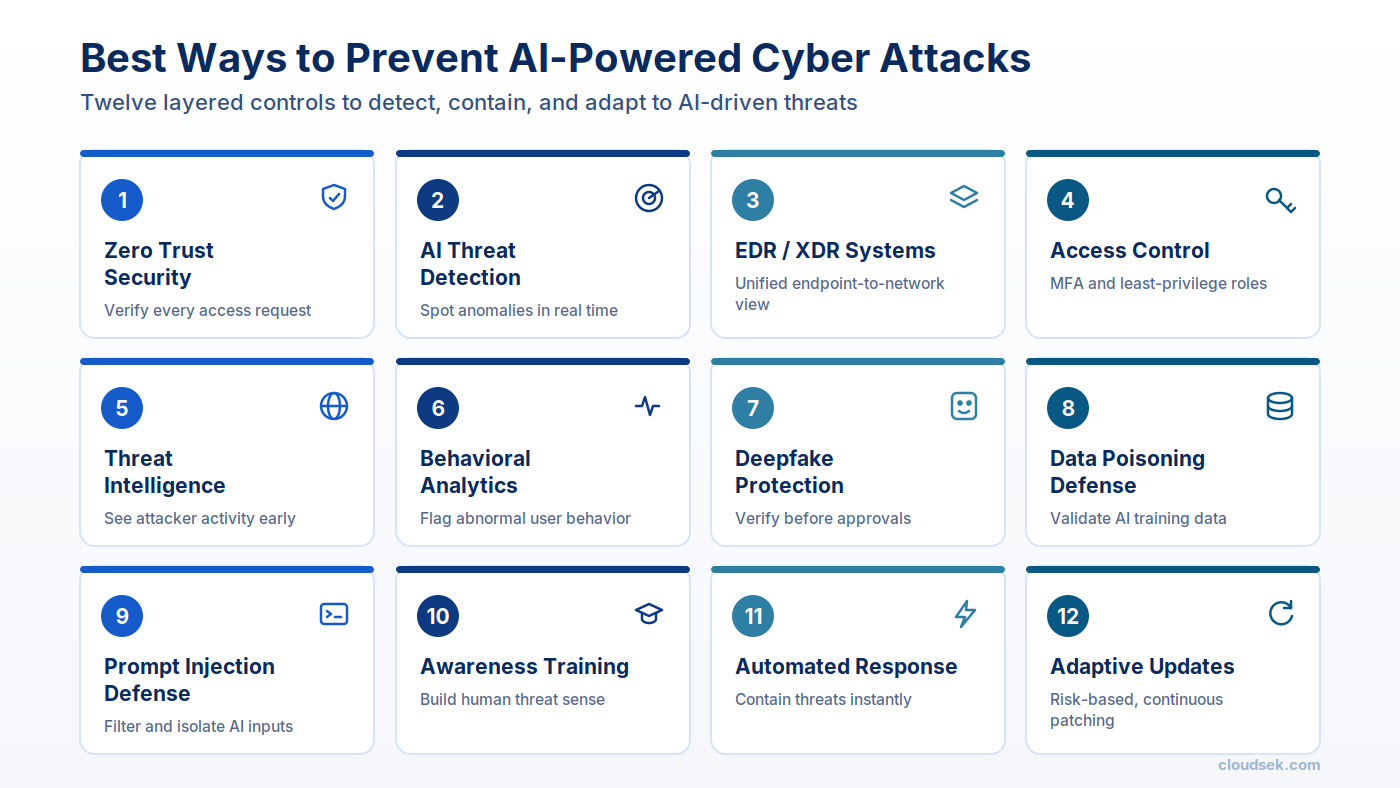
AI-powered cyber attacks can be prevented by using Zero Trust Architecture, AI-driven detection systems, and real-time threat intelligence to identify and stop threats early. Layered security controls combined with automated monitoring reduce exposure to rapidly evolving attack methods.
Emerging risks such as deepfake manipulation, prompt injection exploits, and data tampering demand targeted protection strategies. Effective defense relies on access control, behavioral tracking, and continuous awareness to limit potential entry points.
Modern protection frameworks rely on adaptive systems powered by machine learning, automated response mechanisms, and frequent updates. Applying these 12 proven methods helps maintain resilience against AI-driven threats and minimizes long-term security risks.
Prevent AI-powered cyber attacks in 2026 by strengthening identity controls, improving detection, securing AI workflows, and reducing the time between compromise and response.
Every access request undergoes verification before any system interaction is allowed, removing reliance on internal trust assumptions. Network segmentation and strict permission boundaries reduce the ability of intruders to move across environments.
A 2025 GAO assessment found that four major Department of Defense programs had not created Zero Trust implementation plans ahead of the 2027 requirement. Such delays indicate that critical systems remain exposed where verification models are not fully deployed.
Unusual behavior patterns become visible through AI models that analyze activity across endpoints, networks, and user sessions. Faster identification of anomalies helps reduce the time attackers remain undetected.
Microsoft's 2025 Digital Defense Report found that AI-driven phishing is now three times more effective than traditional campaigns. Higher effectiveness increases the need for detection systems capable of recognizing evolving attack patterns.
Security visibility improves when endpoint, identity, and network data connect into a unified detection layer. Early correlation of signals allows threats to be contained before spreading further.
IBM's Cost of a Data Breach Report found that organizations using AI and automation extensively across security operations reduced breach costs by close to 2 million USD compared to those with no AI or automation use. Financial impact reduction reflects the advantage of faster detection and coordinated response.
System entry becomes limited through multi-factor authentication and clearly defined user roles. Restricted permissions reduce the likelihood of unauthorized access even after credential exposure.
The FBI's IC3 report recorded 193,407 phishing and spoofing complaints in 2024, representing the highest volume among reported cybercrimes. High frequency of identity-based attacks reinforces the importance of stronger access controls.
Threat intelligence provides visibility into attacker behavior, exposed assets, and underground activity trends. Quick identification of risks allows defensive measures to be adjusted before incidents occur, a workflow covered in more detail in how threat intelligence improves incident response and threat hunting.
CloudSEK data shows that DarkForums contributed approximately 37 percent of monitored incidents, with more than 9,000 listings. High activity across underground platforms highlights the scale of ongoing threat coordination.
Unusual login behavior, abnormal data access, and unexpected privilege usage become easier to detect through behavior tracking. Pattern-based analysis helps uncover hidden threats that appear legitimate at first glance.
The ENISA Threat Landscape 2025 report documented 4,875 incidents between July 2024 and June 2025, showing how frequently complex attack behavior occurs across environments. Volume of activity demonstrates the need for continuous monitoring beyond static controls.
Verification processes reduce risks linked to manipulated audio and video used for impersonation, the same technique behind executive impersonation fraud. Sensitive actions such as approvals or financial transfers benefit from additional confirmation steps.
European Parliamentary research states that 49 percent of organizations experienced deepfake-related incidents during 2024. Rapid growth of synthetic media attacks increases exposure to deception-based fraud.
AI systems remain reliable when training data undergoes validation and controlled ingestion. Protection against manipulated datasets prevents inaccurate outputs and compromised decision-making.
NIST's adversarial machine learning taxonomy identifies data poisoning as one of the four major categories of AI system attacks, alongside evasion, privacy, and abuse attacks, and further breaks poisoning down into methods such as targeted and backdoor manipulation. Multiple attack paths confirm the need for strict data integrity controls.
AI systems require safeguards that prevent malicious inputs from altering expected behavior, one of the core risks covered in MCP security. Filtering and isolation controls reduce the risk of unintended outputs during external interactions.
MIT's 2025 AI Agent Index found documented prompt injection vulnerabilities in 2 out of 5 evaluated browser-based AI agents. Presence of exploitable weaknesses highlights ongoing risks in real-world deployments.
10. Security Awareness Training
User awareness reduces exposure to phishing, impersonation, and social engineering attempts. Regular training improves recognition of suspicious activity across communication channels.
The FBI's 2025 IC3 report recorded 22,364 AI-related complaints with losses reaching $893 million, the first year IC3 tracked AI as its own category. Financial impact demonstrates how human-targeted attacks continue to scale.
Immediate response actions such as isolation and access restriction help limit damage during active threats. Faster containment reduces the time attackers can operate within compromised systems.
Europol's takedown of the LabHost phishing-as-a-service platform identified 40,000 phishing domains linked to the service, used by approximately 10,000 individuals. Large-scale infrastructure shows how quickly attacks can expand without automated defenses.
Security resilience improves when updates follow a continuous and risk-based approach. Faster patching reduces exposure to vulnerabilities actively targeted by attackers.
OECD's AI Incidents Monitor findings indicate that media-reported AI-related cyberattack and fraud incidents have more than doubled since 2022. Increasing frequency highlights the importance of adapting defenses to changing threat patterns.
CloudSEK addresses AI-powered attacks from two directions: securing the AI systems attackers target, and monitoring the external channels attackers use to prepare and launch AI-driven campaigns.
AIVigil, CloudSEK's AI attack surface monitoring platform, is the direct answer to the AI-specific risks covered above. It continuously discovers and secures exposed AI infrastructure, MCP servers, leaked AI credentials, vector databases, agentic workflows, and shadow AI, addressing prompt injection and data poisoning risk at the source rather than only after an attack surfaces externally.
XVigil, CloudSEK's digital risk platform, scans surface, deep, and dark web environments for early threat signals tied to AI-powered campaigns. Its contextual AI engine tracks digital assets such as subdomains, IPs, and applications to identify weak points attackers may target, and dark web monitoring uncovers leaked credentials and planned campaigns, allowing preventive action before misuse begins. Within XVigil, ThreatMeter scores and prioritizes these risks so security teams act on the exposures most likely to be weaponized first.
Advanced capabilities such as AI-powered phishing detection, BeVigil security search, and automated takedowns extend visibility across threats. Real-time prioritization ensures faster response to critical risks, reducing exposure to credential leaks, phishing campaigns, and supply chain vulnerabilities.
