🚀 CloudSEK featured in the 2026 Frost Radar™!
Read more
.avif)

GDPR and AI intersect whenever an AI system processes the personal data of people in the EU. The General Data Protection Regulation is technology-neutral, so it applies to AI the same way it applies to any other processing, covering how data is collected, used to train models, and acted on.
Regulators enforce these rules against AI directly. The Dutch data protection authority fined Clearview AI €30.5 million for building a facial-recognition database from more than 30 billion images scraped without a lawful basis.
GDPR applies to AI whenever an AI system processes personal data that identifies a person in the EU. It governs both the training phase, where a model learns from data, and the deployment phase, where the model processes new inputs and produces outputs.
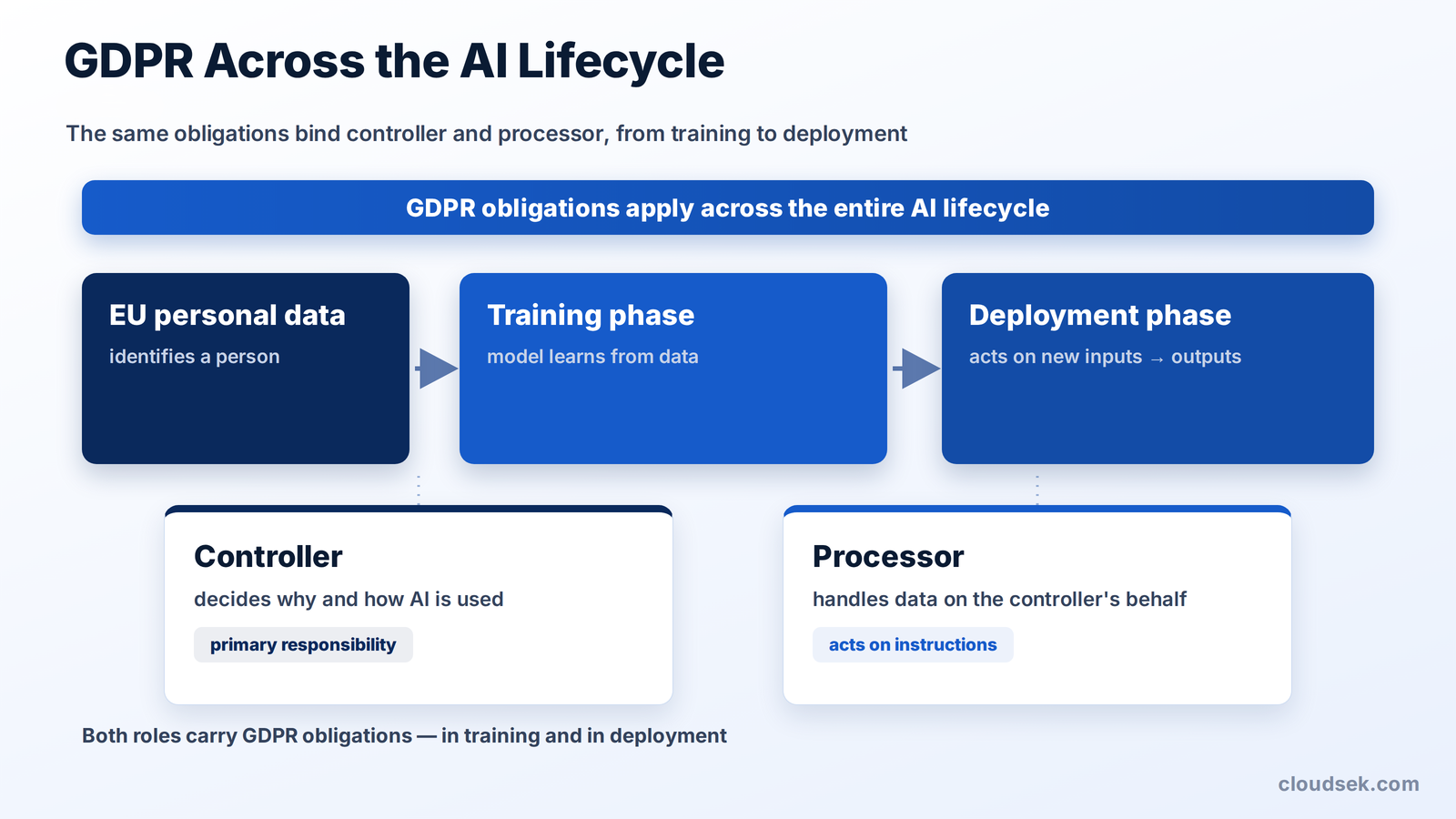
Two roles carry the obligations. The organization that decides why and how to use AI is the controller and holds primary responsibility, while a vendor that processes data on its behalf is the processor. GDPR binds both roles across the training and deployment stages.
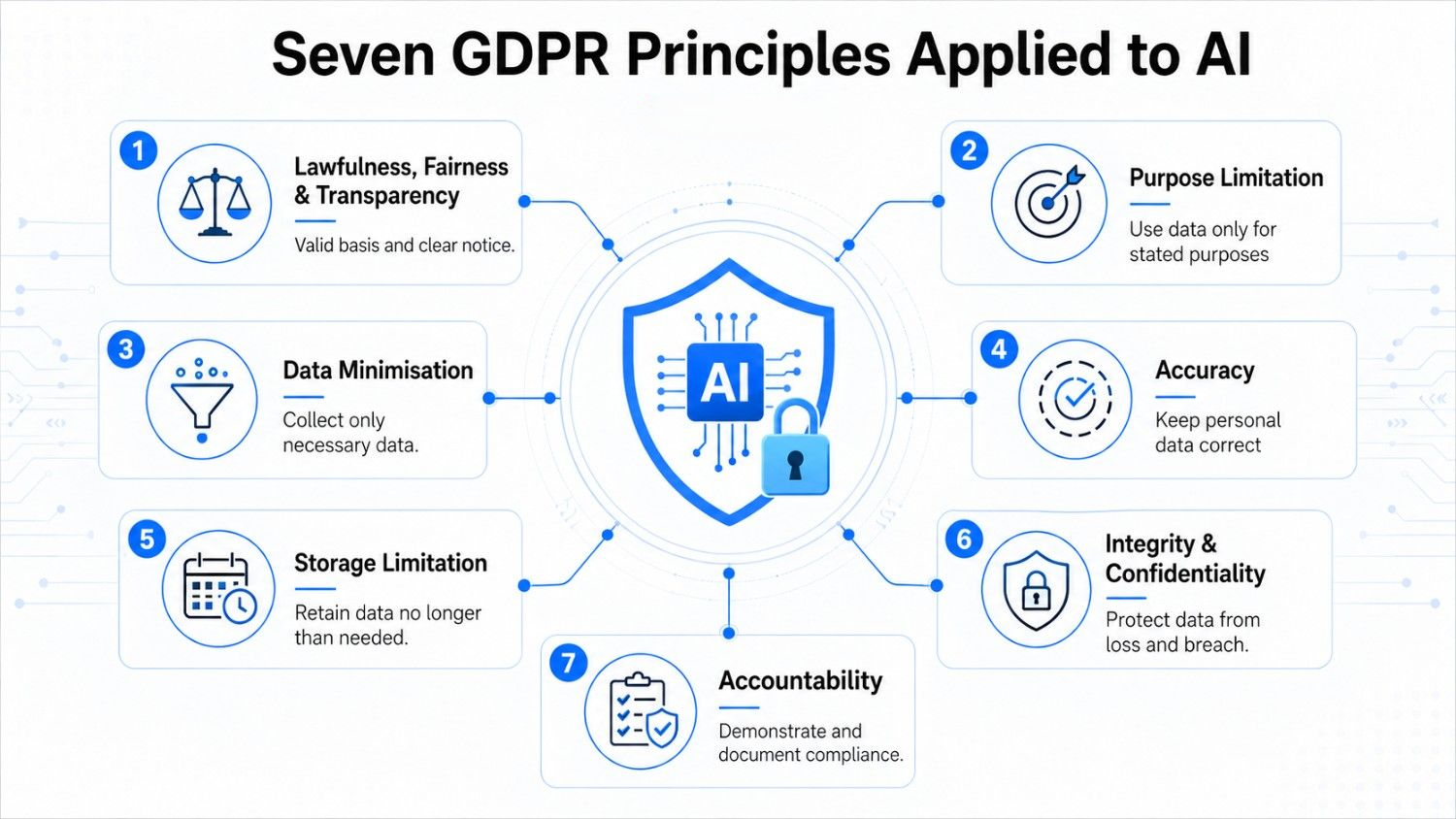
GDPR's seven core principles from Article 5 govern how AI processes personal data lawfully.
These principles apply at every stage, and AI's scale and opacity make several of them harder to satisfy than traditional software does.
Four tensions cause most GDPR compliance problems for AI systems.
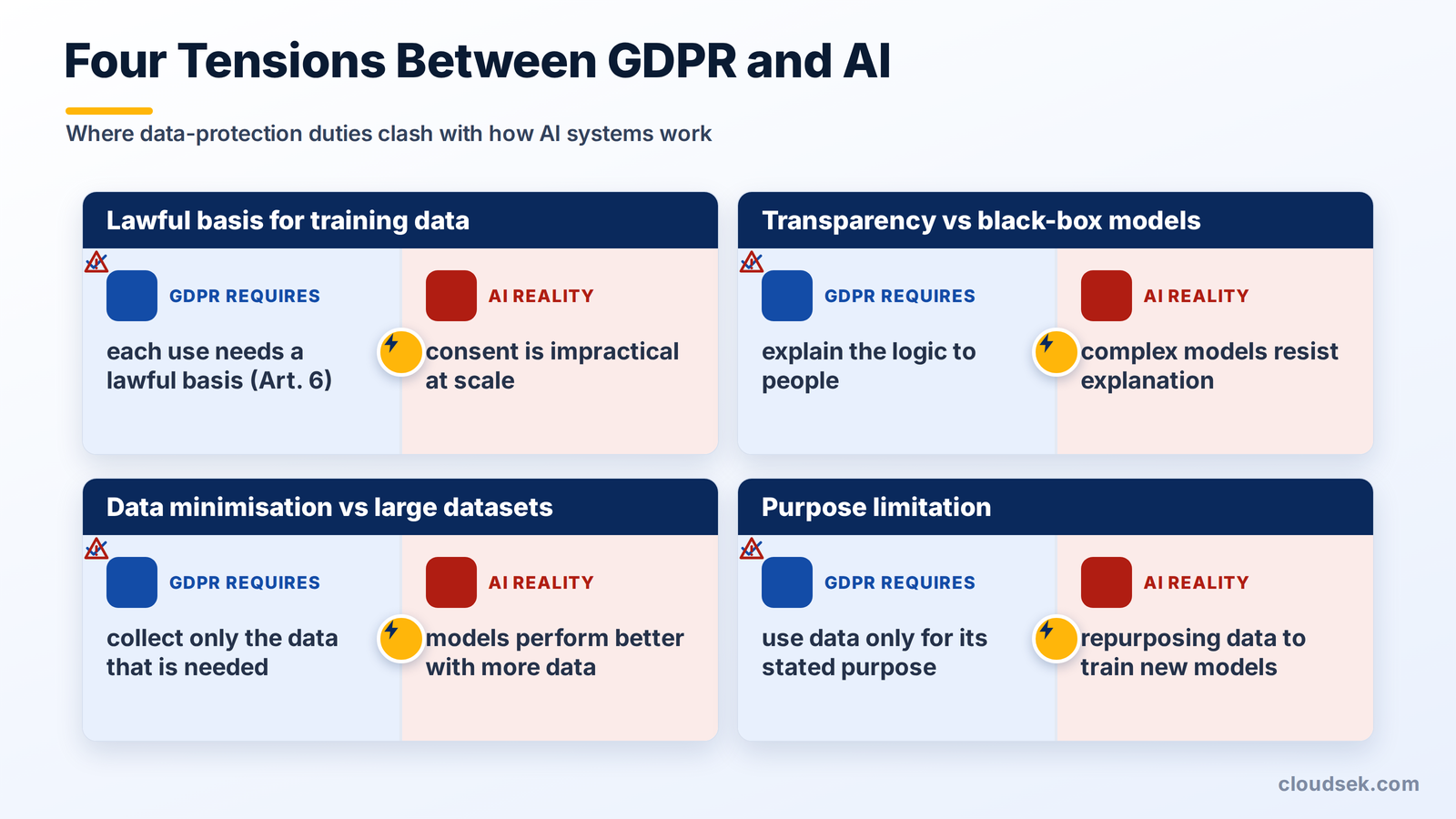
AI models train on large volumes of personal data, and each use needs a lawful basis under Article 6. Consent is rarely practical at scale, so many developers rely on legitimate interest, which requires a documented three-step balancing test. The EDPB's opinion on AI models sets out when that basis holds and when a model itself counts as personal data.
GDPR requires organizations to explain how they use personal data, but complex models resist plain explanation. Controllers still inform people that AI processes their data and describe the logic in terms a person understands.
AI performs better with more data, while GDPR demands that organizations collect only what they need. Teams reconcile the two by using anonymised or synthetic data and by justifying each field they retain.
Data collected for one purpose cannot flow freely into a model built for another. Repurposing personal data for AI needs a compatibility assessment or a fresh lawful basis.
Article 22 of the GDPR gives people the right not to be subject to a decision based solely on automated processing that carries legal or similarly significant effects. This directly limits AI used for credit scoring, hiring, and other high-stakes decisions.
Solely automated decisions are allowed only with explicit consent, a contract, or legal authorisation, and even then, GDPR requires the option of human review. People have the right to obtain human intervention, express their views, and contest the outcome.
The regulation requires meaningful information about the logic involved. In 2023, the EU Court of Justice confirmed in the SCHUFA case that credit scoring counts as automated decision-making under Article 22.
AI complicates the rights GDPR gives people over their personal data. Four rights raise the biggest challenges.
People have the right to ask what personal data an organization holds and how AI uses it. Answering fully means tracing data through training sets and model outputs.
The right to be forgotten requires deleting a person's data on request. Data absorbed into a trained model resists removal, so teams address it through retraining, filtering, or output controls.
GDPR requires the correction of inaccurate personal data on request. An AI system that infers or generates wrong details about a person needs a route to fix them.
People have the right to object to processing based on legitimate interest, including profiling. A valid objection forces the organization to stop unless it shows overriding grounds.
A DPIA is required whenever AI processing is likely to result in a high risk to people's rights. This covers most systems that use personal data at scale, including large-scale profiling, automated decisions, and sensitive data.
A Data Protection Impact Assessment (DPIA) documents what the AI does, why the processing is necessary, the risks to individuals, and the safeguards that reduce them. Running it before deployment turns compliance into a design step rather than an afterthought.
The EU AI Act works alongside GDPR rather than replacing it. GDPR governs how AI uses personal data, while the AI Act governs the AI system itself, sorting systems into risk tiers from prohibited to minimal. An AI system that processes personal data has to satisfy both at once.
The two frameworks overlap in impact assessments and oversight. A high-risk AI system often needs both a GDPR Data Protection Impact Assessment and an AI Act Fundamental Rights Impact Assessment (FRIA), and both demand meaningful human oversight of consequential decisions.
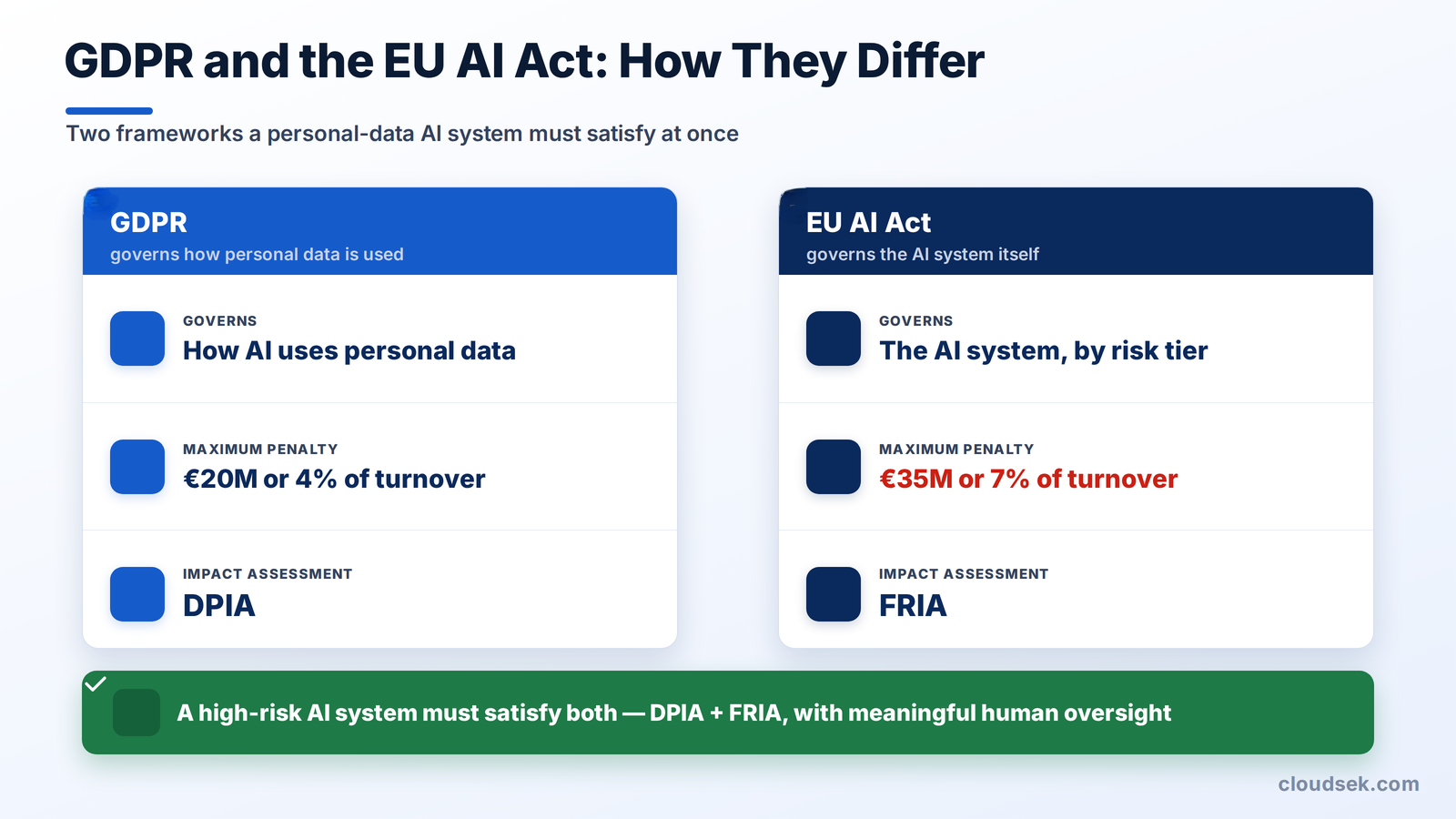
Penalties under the AI Act run higher than GDPR's. Prohibited AI practices carry fines up to €35 million or 7% of global turnover, above GDPR's ceiling of €20 million or 4%. Compliance means mapping each AI system against both regimes from the start.
Six practices keep AI systems on the right side of GDPR.
Embed data protection into the AI system from the start, following the privacy-by-design duty in Article 25. Default to the least data and the tightest access that still works.
Record the legal basis for every use of personal data in training and deployment. Where legitimate interest applies, complete and keep the balancing test.
Assess and document the risks before deploying AI that processes personal data. Update the DPIA when the system or its purpose changes.
Build workflows that let people access, correct, delete, and object to how AI uses their data. Design these paths before launch, not after a complaint.
Protect the personal data AI processes against breach, as Article 32 requires. The AI attack surface adds model endpoints, APIs, and pipelines that traditional controls miss.
Add human review to high-stakes automated decisions. Human oversight satisfies Article 22 and catches errors the model makes.
GDPR Article 32 requires appropriate technical measures to secure personal data, and AI adds a layer that most security tools do not cover. Every model endpoint, API, and agent that touches personal data becomes part of the attack surface that an organization protects.
CloudSEK AIVigil discovers and monitors this AI attack surface, flagging exposed AI assets, prompt injection, and model abuse before attackers reach the personal data behind them. Securing that surface supports the security-of-processing duty GDPR places on every controller.
No, GDPR does not ban AI; it regulates how AI processes personal data. AI stays lawful under GDPR when it has a valid legal basis, respects data subject rights, and protects the data it uses.
Yes, GDPR applies to AI chatbots whenever they process personal data from users. Prompts, conversation logs, and any personal data a chatbot stores or learns from fall under GDPR.
ChatGPT can be used in a GDPR-compliant way, though its data practices have faced regulatory scrutiny in the EU. OpenAI has added privacy controls, training opt-outs, and an EU entity to address concerns.
The maximum GDPR fine is €20 million or 4% of a company's global annual turnover, whichever is higher. A lower tier caps at €10 million or 2% for less severe violations.
Yes, GDPR applies to generative AI whenever it processes personal data. This covers personal data in training sets, in prompts, and in generated outputs that identify real people.
Yes, GDPR applies to any organization that processes the personal data of people in the EU, wherever the organization is based. The Clearview case confirmed this extraterritorial reach for AI providers.
