🚀 CloudSEK featured in the 2026 Frost Radar™!
Read more
.avif)

FBI FLASH-20260702-01 warns that TeamPCP compromised trusted software distribution channels through widely deployed development and security tools, including Trivy, KICS, LiteLLM, and the Telnyx Python SDK. CloudSEK’s August 11 reconstruction identified more than 2,500 organizations and approximately 434,000 potentially exposed CI/CD pipelines worldwide. Reconstructed exposure is not the same as confirmed compromise, and those figures do not show that malicious code ran in every identified pipeline.
Where the affected code ran determines which credentials and privileges were within reach. CI/CD pipelines, cloud workloads, and security workflows frequently contain cloud tokens, SSH keys, Kubernetes secrets, API credentials, and other authentication material required by running applications or jobs. Malicious code operating there could encounter identities with permissions extending well beyond the affected package.
Finding the package does not show whether its code actually ran. Security teams still need to establish whether the component ran, which identities were within reach, what permissions they carried, and whether they remained valid afterward.
TeamPCP did not rely on a single poisoned package; the FBI ties the group to compromises across trusted development and security tooling. FBI reporting shows how those trusted components gave malicious code a route into workflows already holding authentication material.
A copied token, key, or service credential creates a separate problem from the dependency that exposed it. Removing the affected package does not revoke the identity behind the credential or erase authentication material already taken.
Security teams therefore need to investigate both sides of the incident: malicious software execution and any identities exposed during that execution. Valid credentials can leave downstream systems reachable even after the original package disappears.
LiteLLM occupies a consequential position inside AI infrastructure. Its official proxy documentation describes LiteLLM as a centralized LLM Gateway, while the project repository says it provides a unified interface for more than 100 LLM providers. Depending on deployment, LiteLLM either runs between internal applications and downstream model services or operates directly inside application code through the Python SDK.
LiteLLM’s documentation shows which authentication material may be present in the same execution context:
Malicious code executing in the same context could encounter credentials already tied to downstream models or cloud services. An LLM provider key limited to one service creates a narrower path than an AWS IAM identity or Google Cloud service account carrying broader cloud permissions.
FBI FLASH-20260702-01 covers a wider TeamPCP software supply chain campaign, not an AI-specific incident alone. The AI connection comes from where software such as LiteLLM runs: between applications, model providers, and the credentials needed to authenticate those requests.
An organization should prioritize investigation based on whether the affected artifact ran and what it could reach, not simply whether the package was present. Confirmed execution raises the priority. Reachable credentials, third-party execution, or missing historical records can widen the investigation.
These are CloudSEK analytical applicability categories, not FBI classifications. CloudSEK’s exposure methodology distinguishes among artifacts that were downloaded, cached, executed, or merely referenced.
Scoping also requires input from teams holding different parts of the record. Application security, DevSecOps or platform engineering, cloud security and IAM, SOC or incident response, threat intelligence, AI platform teams, and package or repository owners may each hold evidence needed to reconstruct what happened.
Historical evidence must show more than a dependency entry in a repository or lockfile. Investigators need to connect the artifact to actual execution, reconstruct the surrounding context, and then trace any identities present at the time.
Historical build records, pipeline history, package caches, dependency records, and artifact provenance can separate actual execution from an artifact that was only downloaded, cached, or referenced.
CloudSEK’s methodology makes the same distinction. A package record tells investigators where to look. Evidence that the artifact actually ran provides a much stronger basis for assessing exposure.
A developer workstation, CI runner, container, or AI gateway exposes different credentials and privileges to the same code.
Relevant runtimes include:
A developer workstation and a build pipeline expose different credentials, files, and privileges to the same dependency. Reconstructing the location narrows the investigation to material present during the execution window.
Authentication material should be tied to the affected workload rather than to the enterprise as a whole. Environment variables, files, process memory, metadata services, and other runtime sources can show which tokens, keys, or service identities were within reach.
A concrete map of identities tied to the affected workload is more useful here than a broad inventory of every enterprise secret.
The permissions attached to each identity show whether it could modify a repository, publish a package, deploy a workload, or reach cloud resources.
Relevant actions include:
A credential limited to one service creates a very different exposure profile from an identity permitted to publish packages, change workflows, or deploy workloads.
Credential status after the suspected execution window shows whether an authentication path remained open. Investigators should record whether each identity was revoked, rotated, expired, replaced, or left valid.
Authentication records can then be checked for unexpected source locations, repository changes, or other activity associated with the same identity. Such records help distinguish simple credential reach from subsequent unauthorized authentication.
Final classification should match the strength of the available records:
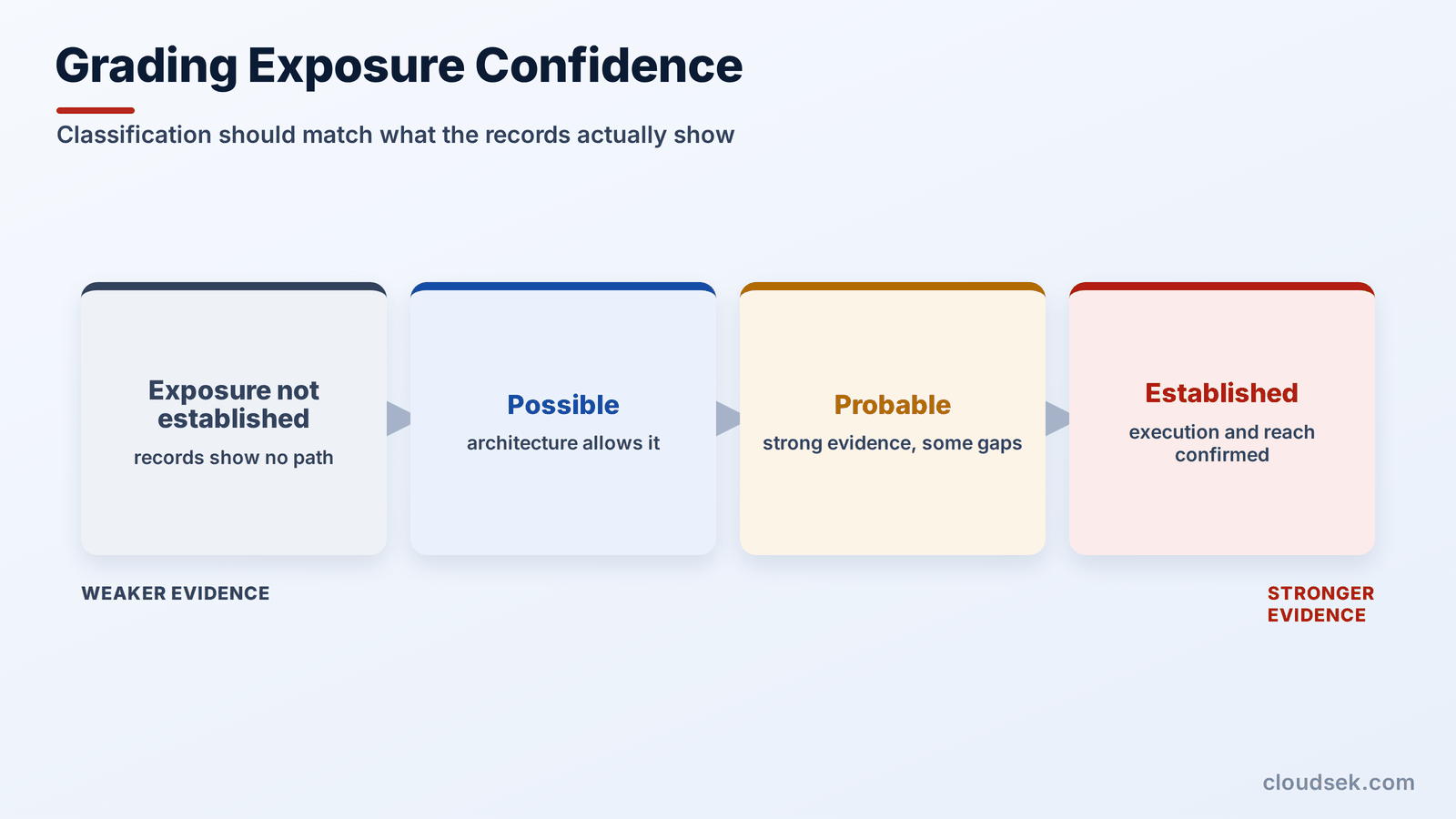
These are analytical confidence categories, not FBI terminology. They separate architectural possibility from demonstrated exposure and confirmed compromise.
Package removal does not automatically close the incident. FBI FLASH-20260702-01 tells affected organizations to treat exfiltrated data and credentials as a “persistent risk” because affiliated actors may continue exploiting them after the original compromise.
Removing the package changes what investigators need to track:
After package removal, investigators need to look for authentication performed with credentials that may have been copied earlier. Remaining permissions and activity recorded after the execution window determine whether the original incident still has a viable downstream path.
An indicator match is a lead, not a verdict. The FBI’s TeamPCP indicators of compromise include IP addresses, domains, file hashes, repository names, and CVEs, but the FLASH explicitly says individual indicators should be evaluated alongside the organization’s broader security evidence. Some artifacts, including IP addresses and filenames, may not indicate compromise on their own.
FBI investigation guidance calls for preserving package names and versions, CI/CD pipeline logs, network records, potentially exposed credentials, observed activity, and estimated infection timing. Correlation across those records carries more weight than any single IOC.
CloudSEK separates those findings into three confidence levels:
Keeping those categories separate prevents potential exposure from being presented as confirmed victimization.
Response teams need to preserve the records needed for investigation while revoking credentials that may still authenticate successfully.
Package versions, CI/CD records, build history, and retained workflow data should establish whether an affected artifact ran during the relevant period.
Identify tokens, keys, service identities, and other secrets associated with the affected workload. Keep the scope tied to authentication material present during execution.
Revoke or rotate persistent credentials linked to the exposure window, especially CI/CD secrets, publishing tokens, and cloud credentials that remain valid.
Retain CI/CD logs, network records, authentication events, package history, and other telemetry needed to investigate both the original execution and subsequent authentication.
Review repository settings, publishing workflows, pipeline configuration, and trusted automation for changes that survived removal of the affected package.
LiteLLM presence or another affected dependency should be treated as a screening signal, not a compromise finding. The first question is whether the affected dependency actually ran.
The identities present during execution, and the permissions attached to them, determine how far the exposure extends. A narrowly scoped provider key creates a different outcome from a cloud or publishing identity with authority over repositories, workloads, or other trusted systems.
Package removal closes the original software delivery path, while copied authentication material follows its own lifecycle. Valid credentials remain relevant until revocation, rotation, expiration, or another control makes them unusable.
A defensible assessment therefore rests on proof of execution, identities reachable from the workload, permissions attached to those identities, and their status after the incident window. Together, those findings separate package presence, meaningful exposure, and confirmed compromise.
