🚀 CloudSEK featured in the 2026 Frost Radar™!
Read more
.avif)

Behavioral threat detection is a cybersecurity approach that identifies malicious activity by analyzing abnormal user, system, application, and network behavior instead of relying only on known threat signatures or predefined attack indicators.
It works by monitoring how users, devices, applications, endpoints, and cloud environments normally operate, then flagging activity that differs from those expected patterns. Security teams use this to catch ransomware, credential abuse, insider threats, fileless malware, lateral movement, and unauthorized access, exactly the threats that signature-based tools tend to miss. The need for this behavioral visibility is reflected in recent UK government data: 14% of large businesses reported unauthorized access to files or networks by staff, compared with 5% of medium-sized businesses.
Modern attackers lean on stealthy techniques built to avoid conventional detection, which is what makes behavioral monitoring valuable in real time across cloud, hybrid, and on-premise environments. CISA recommends behavior analytics and anomaly-based detection to identify malicious activity involving legitimate tools and living-off-the-land techniques that can blend into normal network behavior. Catching these deviations earlier gives organizations a chance to respond before an attacker expands access, moves laterally, or disrupts operations.
Behavioral threat detection continuously analyzes user, device, application, network, and cloud activity to identify suspicious behavior that differs from normal operational patterns.
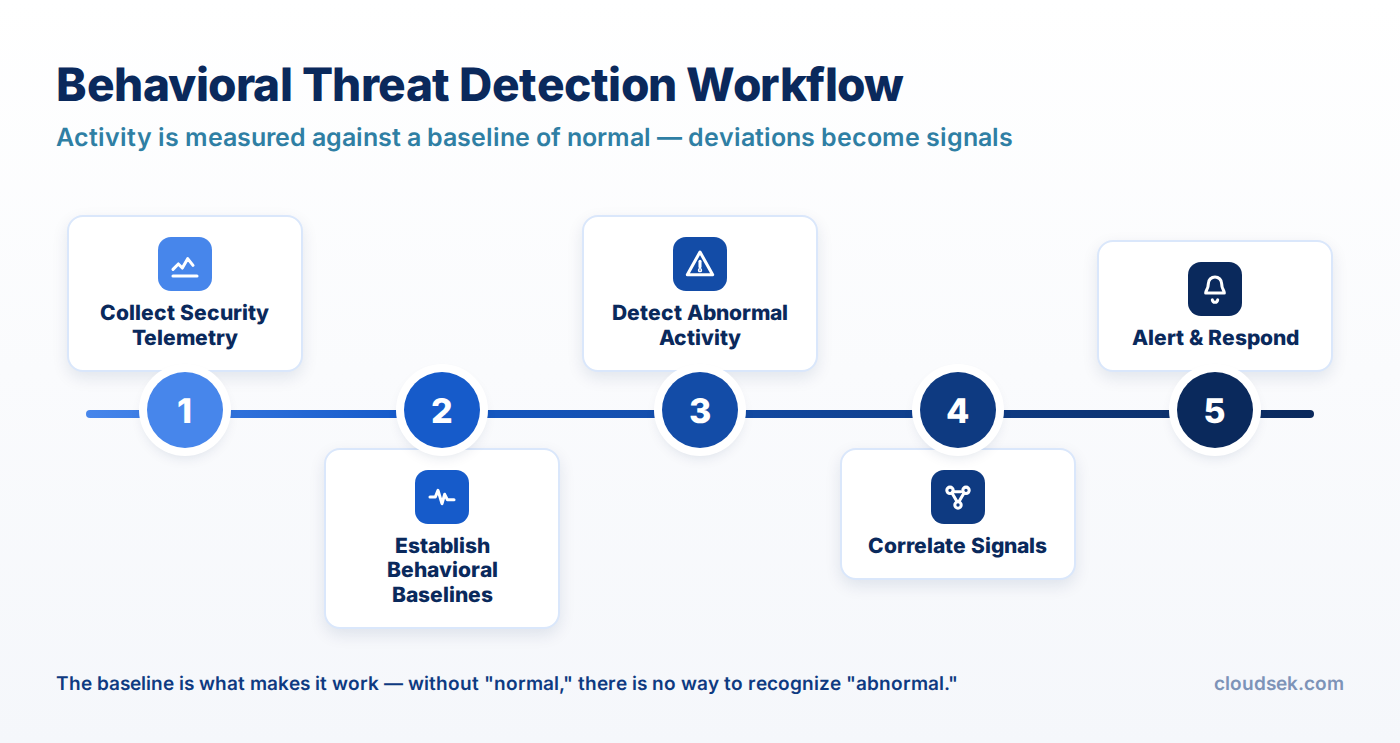
It starts with telemetry from endpoints, networks, cloud platforms, identity systems, applications, and SaaS environments, giving visibility into user actions, process activity, login behavior, file access, and network communication.
Next, the system builds baselines defining normal activity for users, devices, applications, and systems: typical login locations, working hours, device usage, application behavior, and communication patterns. Everything that follows gets measured against this.
This is where deviations from the baseline surface. Unusual login attempts, privilege escalation, lateral movement, unauthorized file access, suspicious PowerShell execution, and abnormal network communication all fall into this stage.
Accuracy improves once signals across identities, endpoints, cloud systems, applications, and networks get connected to each other. An event that looks harmless in isolation often reveals a coordinated attack once it's read alongside the others.
The process closes with alerts once suspicious activity crosses a risk threshold or matches known attacker behavior. High-risk alerts typically get prioritized automatically, triggering account isolation, device containment, or a security investigation.
Behavioral threat detection uses different monitoring techniques to identify malicious activity across users, endpoints, applications, cloud environments, and enterprise networks.
Monitors how users normally interact with enterprise systems and flags actions that break from that pattern, catching insider threats, compromised accounts, credential misuse, and impossible travel logins.
Applies the same logic to devices, servers, applications, and cloud workloads, surfacing abnormal system behavior, unauthorized resource access, and compromised devices operating outside normal patterns.
Watches network traffic patterns for malicious communication, command-and-control servers, lateral movement, DNS anomalies, and unauthorized outbound traffic.
Analyzes activity on laptops, servers, and workstations to catch ransomware activity, fileless malware execution, suspicious scripts, and abnormal file behavior.
Monitors authentication activity, cloud workloads, SaaS platforms, and identity systems for compromised accounts, unauthorized access attempts, privilege abuse, and suspicious API activity across hybrid environments.
Behavioral threat detection identifies advanced cyber threats by analyzing suspicious activity, attacker behavior, and abnormal operational patterns across enterprise systems and networks.
Suspicious encryption activity, abnormal file modifications, unauthorized process execution, and rapid file access behavior all give ransomware away earlier, even when the malware variant itself has never been seen before.
Compromised accounts leave a trail: abnormal login activity, repeated authentication failures, impossible travel behavior, unusual access requests. Behavioral analysis reads that trail to catch stolen credentials before an attacker turns temporary access into persistence.
That trail often has an earlier origin too: platforms like XVigil monitor the dark web for leaked employee credentials, so the login a behavioral tool eventually flags as anomalous can frequently be traced back to a credential that was already circulating externally days or weeks before it was used.
Excessive file access, unauthorized downloads, abnormal data transfers, and suspicious privilege usage are the fingerprints of insider misuse, whether the account belongs to a malicious employee or one that's simply been compromised.
Suspicious scripts, unauthorized PowerShell execution, and memory-based activity expose fileless attacks that never touch disk, which is exactly why they bypass traditional antivirus tools built to scan files.
Attackers moving across systems tend to use remote administration tools and request elevated permissions in ways that don't match their normal role. Behavioral monitoring watches for that mismatch directly.
Suspicious outbound traffic, abnormal DNS requests, and hidden external connections all point to an attacker's communication channel, and catching that channel is often what limits how much damage an intrusion can do.
Behavioral threat detection analyzes suspicious user, system, network, and application behavior to catch attacks, including unknown threats. Signature-based detection instead matches files, malware, or activity against known attack signatures and predefined indicators. Most enterprises run both, since behavioral analysis fills the gap signature-based tools structurally can't cover.
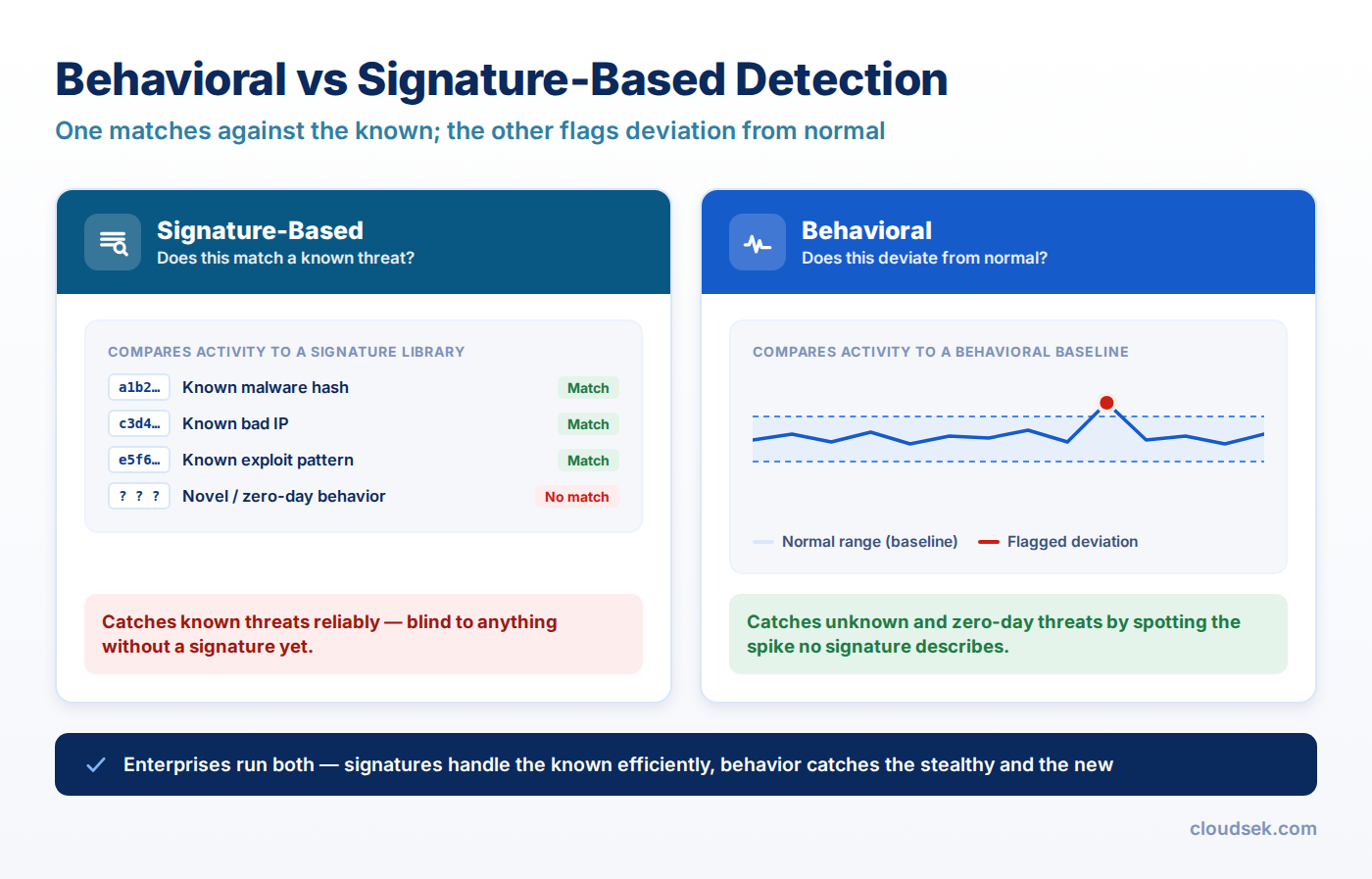
Behavioral threat detection improves enterprise security visibility by identifying suspicious activity, attacker behavior, and abnormal operational patterns that traditional security tools often fail to detect.
The rest compounds from there. Advanced persistent threats, which rely on operating quietly for long stretches, get exposed through the same lateral movement and persistence patterns behavioral tools already watch for. And because behavioral detection reduces dependence on static signatures, it holds up better across cloud and hybrid environments where identities, workloads, and applications generate activity no fixed signature list could ever keep pace with.
A handful of practices consistently separate effective behavioral threat detection programs from ones that generate noise without catching much:
AI changes what behavioral threat detection can realistically keep up with, mainly by processing far more telemetry, far faster, than a human team ever could.
The clearest gains show up in three places. AI analyzes the sheer volume of daily telemetry from endpoints, cloud platforms, and identities in ways manual review can't scale to, and it does so fast enough to catch abnormal login behavior or unauthorized access patterns in real time rather than after the fact. That same speed extends detection into unknown threats: zero-day attacks, fileless malware, and evolving attacker techniques are all easier to catch when the system is watching for abnormal behavior instead of matching against known indicators alone.
The other major benefit is trust. AI reduces false positives by weighing behavioral context, historical activity, and risk level before an alert ever reaches an analyst, and it automates the investigation and containment steps that follow, isolating accounts or blocking activity without waiting on a human to act first. Across cloud and hybrid environments specifically, that correlation, tying together identities, workloads, applications, and networks continuously, is what keeps detection coherent instead of fragmented across a dozen disconnected signals.
Behavioral threat detection identifies ransomware attacks, credential theft, insider threats, fileless malware, lateral movement, privilege escalation, account compromise, and command-and-control communication by analyzing suspicious behavior patterns.
Yes. Behavioral threat detection helps stop ransomware by identifying suspicious encryption activity, abnormal file access, malicious process execution, and unauthorized system behavior before ransomware spreads widely across the environment.
EDR, XDR, SIEM, UEBA, and NDR platforms, along with cloud security platforms, commonly build behavioral detection into their core functionality.
Yes. Modern behavioral threat detection platforms use AI and machine learning to analyze security telemetry, identify abnormal behavior, reduce false positives, and detect evolving attack techniques across enterprise environments.
Behavioral threat detection is important because modern attackers frequently bypass traditional signature-based security tools using stealthy and unknown attack techniques. Behavioral analysis improves visibility into suspicious activity across cloud, hybrid, SaaS, identity, and endpoint environments.
