🚀 CloudSEK featured in the 2026 Frost Radar™!
Read more


Attribute-based access control (ABAC) is an authorization model that grants or denies access by evaluating attributes of the user, the resource, the action, and the environment against defined policies, rather than assigning permissions to fixed roles. A request is judged on its full context at the moment it is made, which lets a single policy cover cases that would otherwise need many separate roles.
The model carries a formal definition. NIST Special Publication 800-162 describes ABAC as logical access control that determines authorization by evaluating attributes of the subject, the object, the requested operation, and environment conditions against policy. Access follows from what is true about the request, not from a label attached to the user in advance.
That shift matters because roles describe who someone is, while attributes describe the whole situation. A rule such as permitting a cardiologist to open records only for patients in their own department expresses in one policy what role-based systems would scatter across many role assignments.
Every ABAC decision draws on four categories of attributes: subject, resource, action, and environment. NIST SP 800-162 frames these as subject and object attributes evaluated alongside the requested operation and environment conditions.
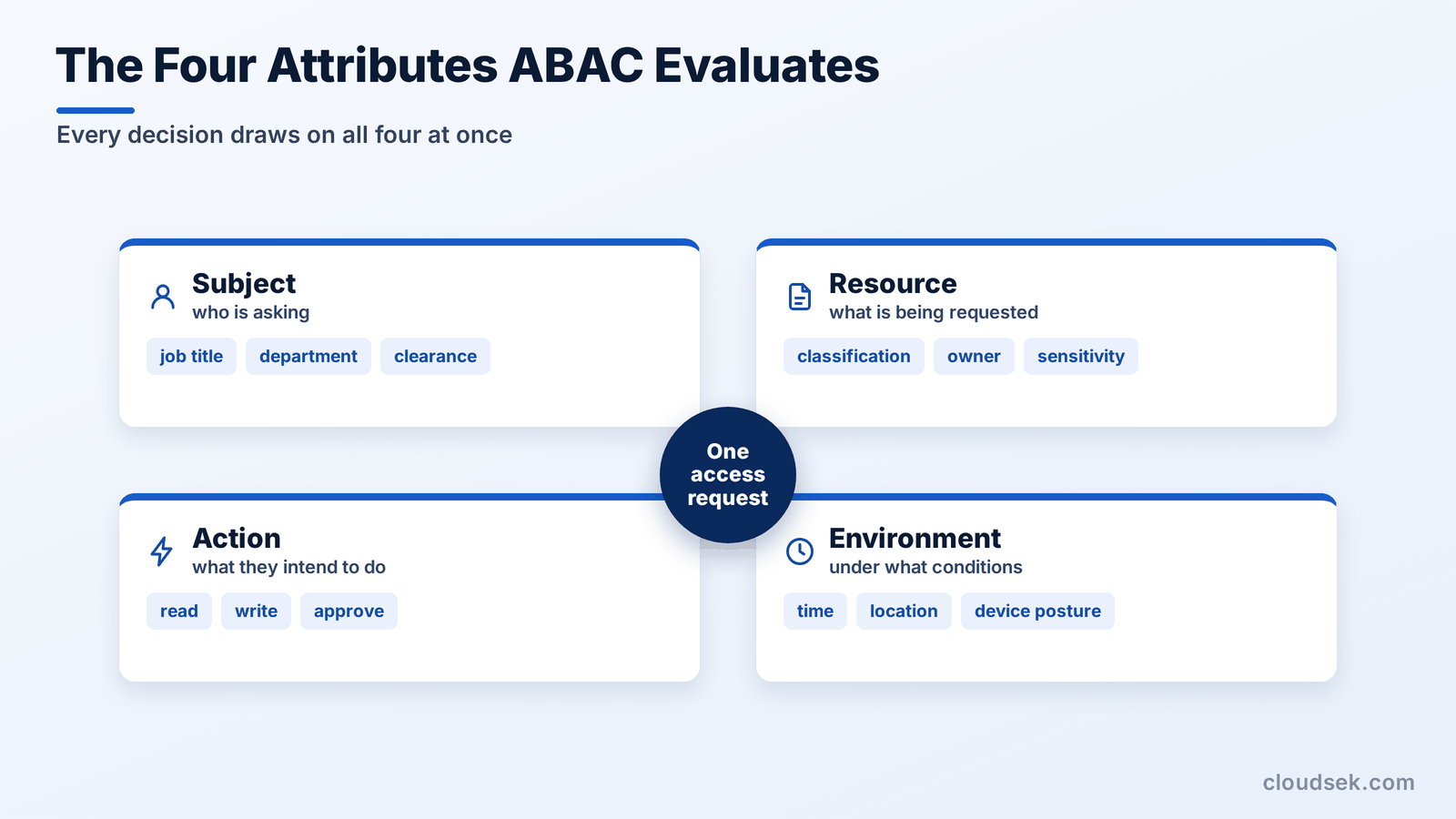
Subject attributes describe the user or service requesting access. They include identity, job title, department, security clearance, group membership, and project assignment, and they answer who is asking.
Resource attributes, called object attributes in NIST terms, describe the asset being accessed. They include data classification, owner, file type, creation date, and sensitivity level, and they answer what is being requested.
Action attributes describe the operation the subject wants to perform. Read, write, edit, delete, approve, and transfer are common values, and they answer what the subject intends to do with the resource.
Environment attributes describe the context surrounding the request. Time of day, location, device posture, network, and current threat level fall into this category, and they let a policy respond to conditions no role could capture.
ABAC evaluates a request in real time through a five-step decision flow, split between three main components. A policy decision point judges the request, and a policy enforcement point carries out the verdict.
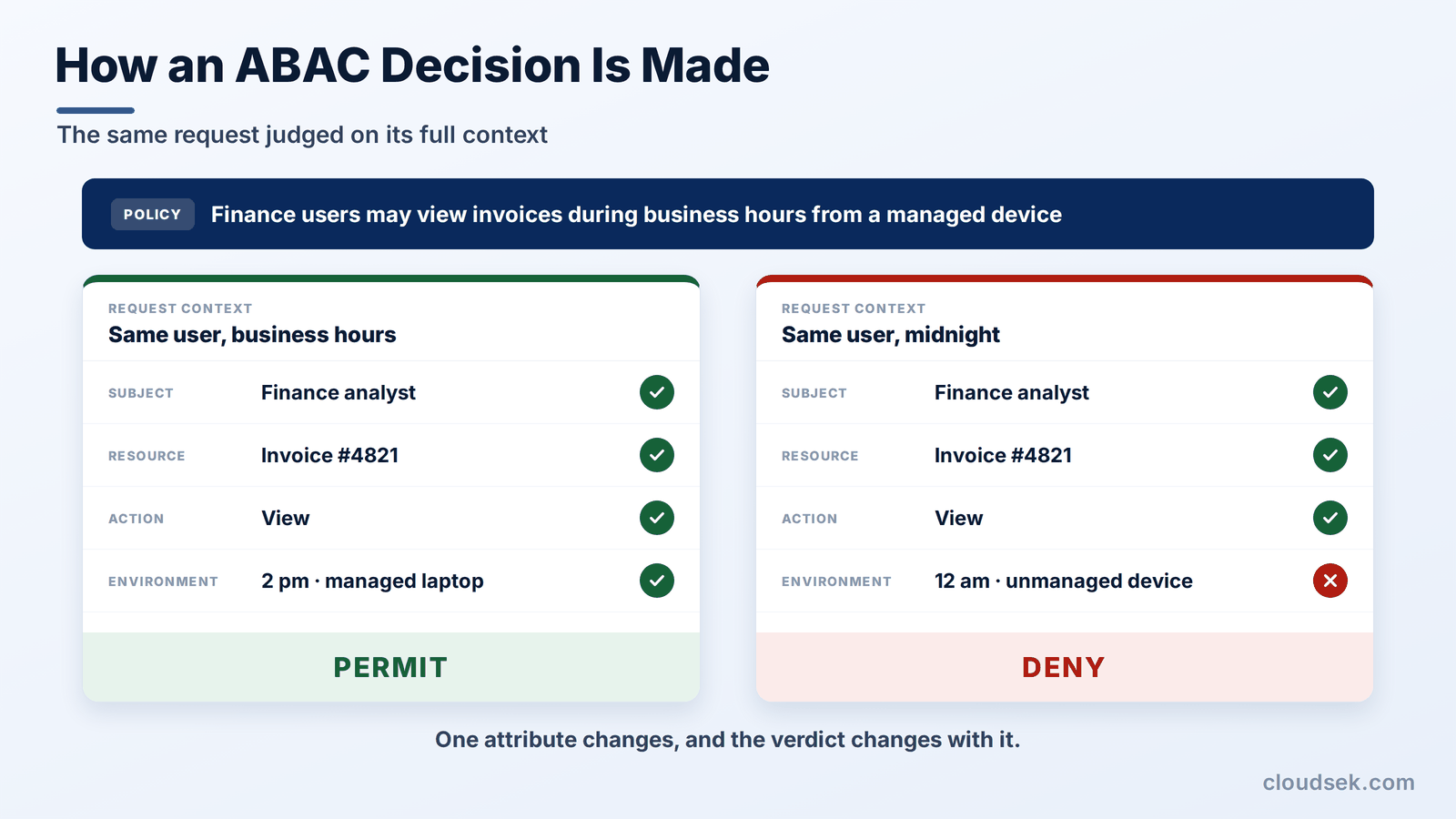
A worked example shows the logic. A policy allows a finance-department user to view invoices during business hours from a managed device. A finance analyst requesting an invoice at 2 pm from a company laptop matches every attribute, so access is granted, while the same request at midnight from an unmanaged device fails the environment condition and is denied.
Role-based access control (RBAC) grants permissions through predefined roles, while ABAC grants them by evaluating attributes of the user, resource, action, and environment at request time.
RBAC stays easier to reason about for small, stable organizations, and ABAC earns its complexity where access depends on shifting context or where role counts would otherwise explode.
ABAC sits among several access control models, and two are close relatives. Policy-based access control (PBAC) is often used interchangeably with ABAC, describing the same attribute-and-policy approach with an emphasis on centrally defined business rules. Relationship-based access control (ReBAC) grants access from the connections between entities, such as the owner of a document or a member of a team, rather than from standalone attributes.
Two older models predate both. Mandatory access control (MAC) enforces access from classification labels set by a central authority, common in defense systems, while discretionary access control (DAC) lets the owner of a resource decide who else gets access. DAC still underlies everyday file permissions and MAC remains standard in high-security systems, but ABAC and RBAC handle most enterprise application access, offering finer control and easier administration at scale.
ABAC trades operational complexity for precision and flexibility. Weighing both sides shows where the model pays off and where it demands care.
ABAC suits environments where access depends on context rather than a fixed job title. Five settings show its fit.
ABAC is a natural fit for zero trust, the security model that removes implicit trust and verifies every request on its merits. NIST Special Publication 800-207 defines zero trust around per-session, least-privilege access decisions made from multiple signals, which is exactly the evaluation ABAC performs.
Attributes supply the signals a zero-trust decision needs: identity, device posture, location, and risk context assessed at the moment of access rather than assumed from a network position. ABAC turns those signals into an enforceable allow-or-deny outcome for each request.
Many organizations combine the two models rather than choosing one. A common pattern sets a coarse RBAC baseline for broad access, then layers ABAC policies on top to add the contextual conditions that zero trust demands, capturing the simplicity of roles and the precision of attributes together.
A successful ABAC rollout depends on clean attributes and disciplined policy design. Six best practices reduce the risk.
ABAC governs access inside an organization, deciding what a verified identity is allowed to do. CloudSEK does not provide access control or an ABAC engine, which remain the domain of identity and authorization platforms.
The connection is indirect but real. Every access model, ABAC included, trusts that the identity presenting valid attributes is genuine. That trust fails when an attacker holds an employee’s stolen password, a session cookie lifted by infostealer malware, or a service’s leaked API key. Each arrives with legitimate attributes attached.
CloudSEK XVigil monitors dark-web markets, forums, and stealer logs for an organization’s leaked and validated credentials, and flags employee machines that show signs of infostealer infection. AIVigil finds and validates leaked AI API keys, the credentials behind the non-human identities ABAC increasingly governs. Security teams can treat these findings as risk signals, resetting credentials, revoking sessions, or raising an identity’s risk level so that attribute-based policies respond. ABAC decides what a verified identity may do; external monitoring catches the cases where the identity is no longer who it claims to be.
The difference between ABAC and PBAC is mostly terminology: the two are often used interchangeably, though PBAC stresses centrally managed business policies while ABAC stresses the attributes those policies evaluate.
The four attributes in ABAC are subject attributes about the user, resource attributes about the asset, action attributes about the operation, and environment attributes about the context such as time and location.
ABAC is a natural fit for zero trust rather than a requirement of it. Zero trust calls for dynamic, context-aware access decisions made per session, and ABAC is one of the most direct ways to implement them.
XACML (eXtensible Access Control Markup Language) is the OASIS standard for expressing ABAC policies in an XML-based format. It remains the formal reference model, though many modern deployments use newer policy languages such as Rego (Open Policy Agent) or Cedar.
Use ABAC instead of RBAC when access needs are dynamic, fine-grained, or context-dependent, such as large or regulated environments. RBAC fits better when roles are stable, simple, and few.
Yes, ABAC is more difficult to implement than RBAC. It demands upfront attribute design, policy engineering, and clean attribute data, though starting from an RBAC baseline reduces that effort.
