🚀 CloudSEK featured in the 2026 Frost Radar™!
Read more
.avif)

Vulnerability scanning finds individual weaknesses; attack path mapping shows how those weaknesses chain into a route to a critical asset. Vulnerability scanning answers what is broken, while attack path mapping answers what an attacker would actually use.
The distinction decides where effort goes. Only about 1.4% of disclosed vulnerabilities are known to be exploited in real-world attacks, so a scan that lists thousands of findings says little about which few an attacker would use. Attack path mapping closes that gap.
This guide defines vulnerability scanning and attack path mapping, compares them across the dimensions that matter, and explains why severity differs from exploitability. It covers the terminology, how mapping works, whether the two replace each other, internal versus external paths, and how to choose.
Vulnerability scanning is an automated check that finds known weaknesses across systems, applications, and infrastructure. It compares assets against a database of known vulnerabilities and flags every match.
A scanner reports findings such as unpatched software, open ports, and misconfigurations, then ranks them by severity using a CVSS score. The output is a list ordered from critical to low.
Scanners come in several forms: network scanners check infrastructure, web application scanners probe sites and APIs, and authenticated scanners log in to inspect a system from the inside. Each form widens coverage of what is broken.
Vulnerability scanning gives broad coverage, the foundation of any security program. Its limit is context. It lists each weakness in isolation, so a long list of findings says little about which ones connect into a real attack.
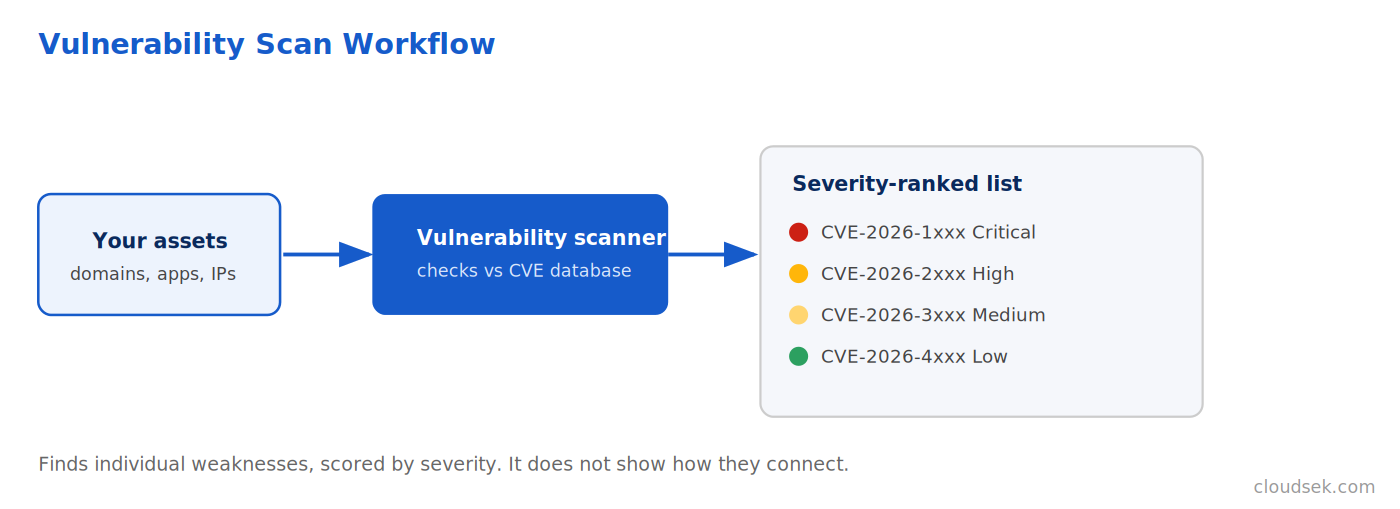
A vulnerability scan checks assets against a CVE database and returns a list ranked by severity.
Attack path mapping identifies how an attacker could move through an environment to reach a high-value asset. It connects exposures, misconfigurations, identities, and trust relationships into the routes an adversary would take.
Where a scanner lists weaknesses, attack path mapping shows how they chain. A single exposed service can look minor until it leads to a privileged identity that unlocks a database.
Mapping shows what is exposed, and analysis shows which paths matter most. Together, they shift the focus from severity to the routes that actually reach critical assets.
A realistic attack path has three parts: an entry point where the attacker gains a foothold, a chain of weaknesses that allows movement, and a target asset worth reaching. Mapping connects all three into one route.
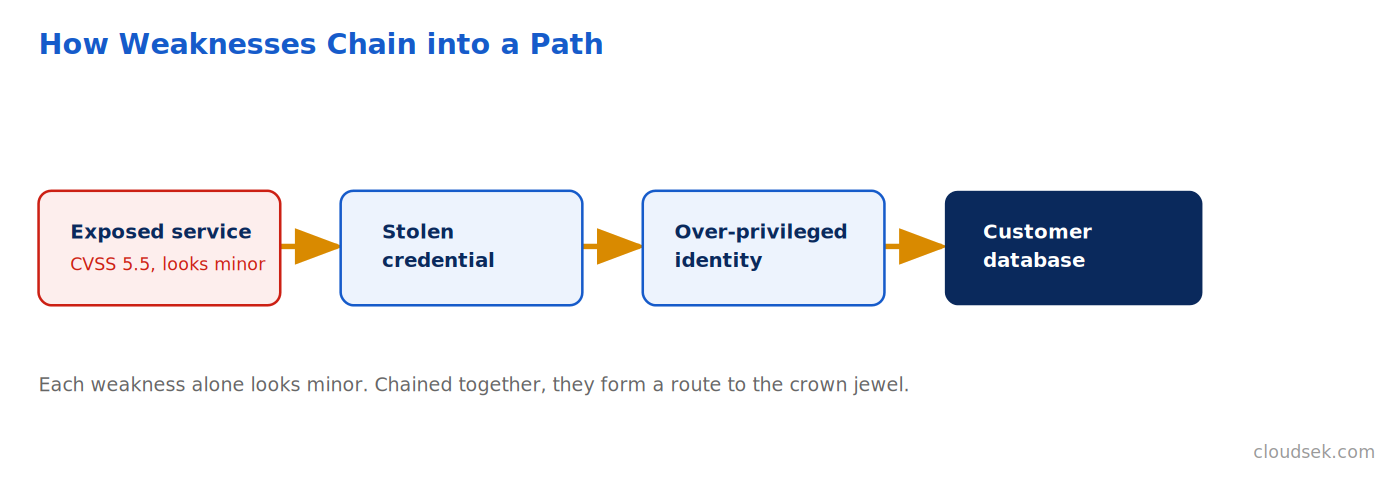
Individually minor weaknesses chain into a single route that reaches the crown jewel.
Vulnerability scanning and attack path mapping differ across several dimensions:
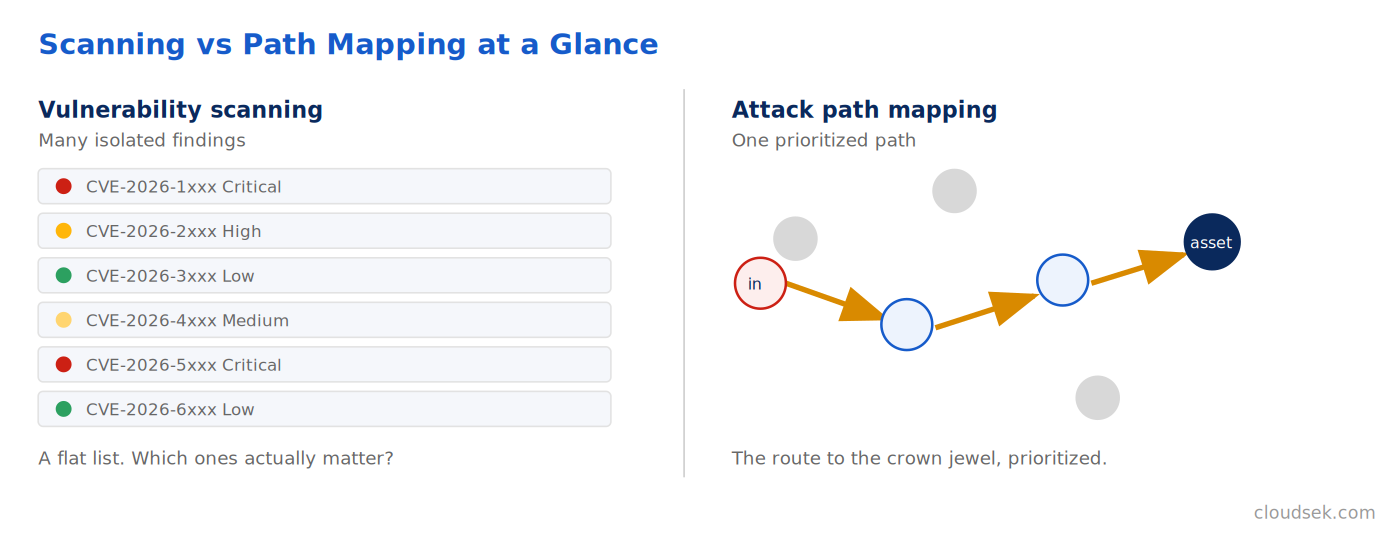
The pattern is consistent. Scanning measures volume and severity, while attack path mapping measures reachability and impact.
Severity and exploitability are not the same thing. A high CVSS score flags theoretical damage, while exploitability asks whether an attacker can actually reach and use the flaw in a given environment.
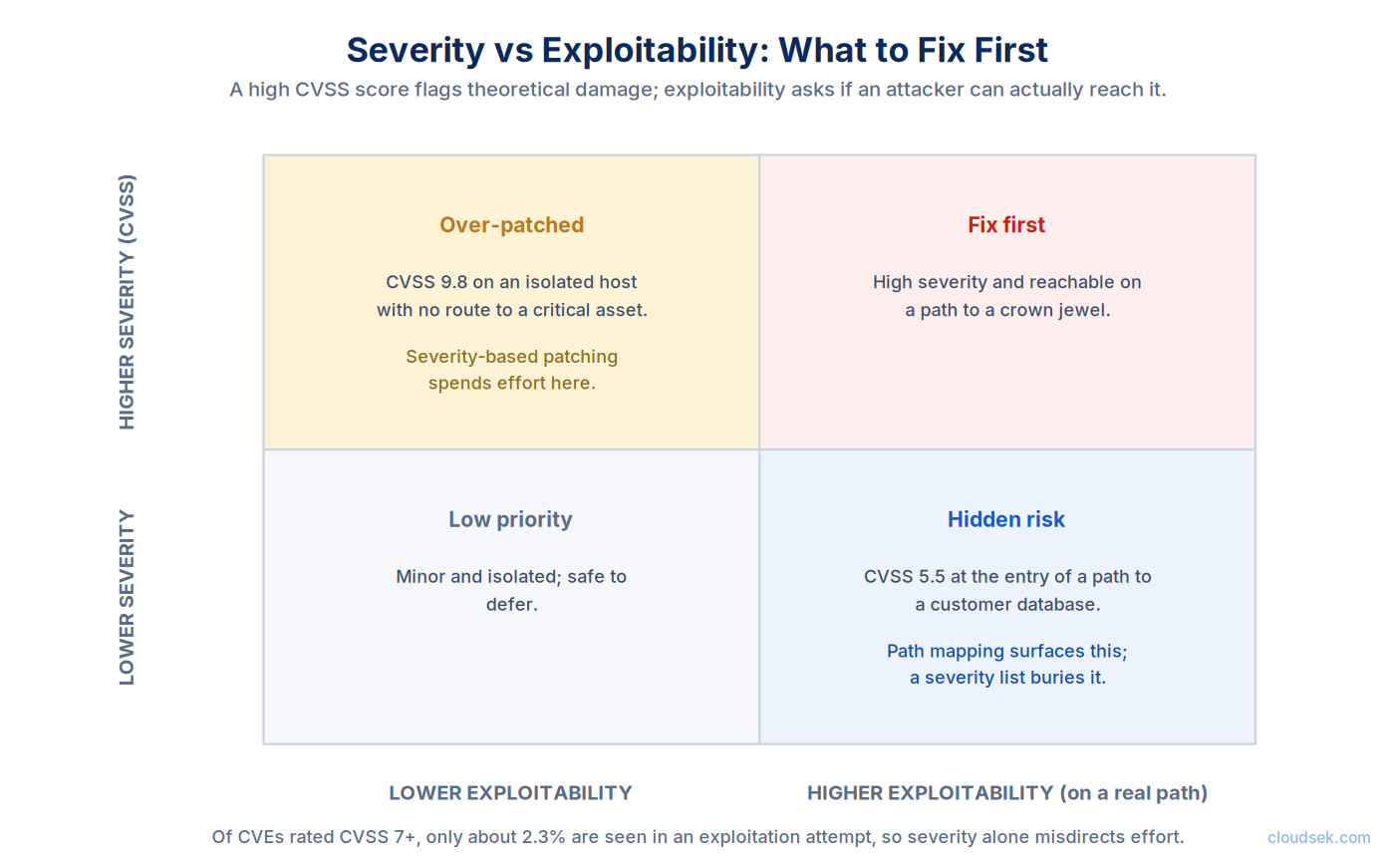
The numbers expose the gap. Of all CVEs rated CVSS 7 or higher, only about 2.3% were observed in an exploitation attempt, which means severity-based patching spends most of its effort on flaws no attacker touches.
Context flips the priority. A CVSS 9.8 on an isolated host can matter less than a CVSS 5.5 that sits at the entry of a path to a customer database. Attack path mapping surfaces that 5.5, while a severity-ranked list buries it.
The mismatch compounds because teams remediate only a fraction of their backlog each month. Spending that limited capacity on high-severity flaws that no attacker can reach leaves the real paths open.
Exploitability signals such as EPSS and the CISA KEV catalog improve on severity alone, yet they rate a flaw in general rather than its place in a specific environment. Attack path mapping adds that missing context.
Several related terms get used interchangeably. These definitions keep them distinct:
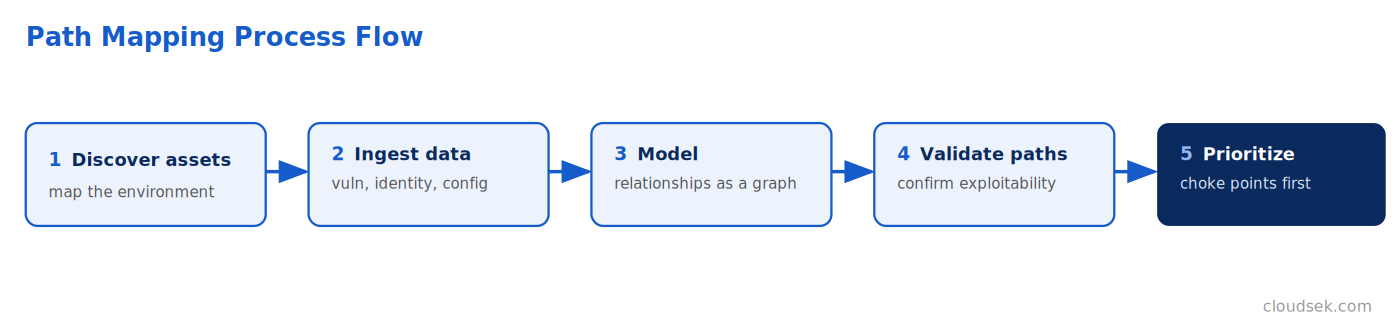
Attack path mapping works by turning isolated findings into connected routes. It follows five steps:
Mapping often aligns each step to MITRE ATT&CK techniques, connecting exposures to known attacker behavior.
A worked example shows the output. Mapping links an exposed web server, a reused admin credential, and a flat network into one path that ends at the customer database. The exposed server alone rates low, yet its place on the path makes it the first thing to fix.
Attack path mapping does not replace vulnerability scanning. Scanning supplies the raw data about what is weak, and mapping supplies the context about what is reachable. Without good scan data, mapping has nothing to work with.
The two are complementary. Vulnerability scanning is the foundation, giving broad coverage and meeting compliance needs. Attack path mapping is the prioritization layer, showing which scanned weaknesses sit on a route to real impact.
Maturity decides the mix. Teams start with solid scanning, then add attack path mapping as their program grows, and the volume of findings outpaces the capacity to fix them.
Attack paths exist in two places. Internal attack paths run inside the network, where an attacker moves laterally from host to host toward a target. A compromised laptop, a shared local-admin password, and an unsegmented network become one internal path. Mapping them is the work of internal security tooling.
External attack paths begin outside the firewall. They start at an initial access vector, an exposed asset, a leaked credential, or a vulnerable vendor, and show how an attacker gets in before any internal movement begins.
Most breaches start with an external path. A leaked credential, an exposed admin panel, and a vulnerable vendor become the first steps before any internal movement begins. Mapping the external attack surface shows how an attacker reaches the door, while internal mapping shows how they move once through it.
The choice is not either/or. Use each where it fits:
The mature program runs both, feeding scan coverage into attack path mapping so remediation effort lands on the routes that reach real impact.
What is the difference between attack path mapping and attack path analysis?
Mapping identifies the routes that exist, while analysis judges which of those routes matter most and where to break them.
Why is a CVSS score not enough to prioritize?
A CVSS score measures theoretical severity, not whether an attacker can reach and use the flaw in a specific environment. Most high-severity flaws are never exploited.
Can a vulnerability scanner find attack paths?
No. A scanner lists isolated findings. Building those findings into a route requires attack path mapping, which models the relationships between them.
How often does each one run?
Vulnerability scanning runs on a regular schedule or continuously to keep coverage current. Attack path mapping runs continuously too, remodeling paths as assets, exposures, and identities change.
Is attack path mapping only for internal networks?
No. It applies to internal lateral movement and to external attack paths, where it maps how an attacker reaches the network from outside.
