THE 5060 SIEGE - Industrialized Attacks Against the SIP Telephony Ecosystem
Uncover how an 18-day honeypot captured 15 million automated attacks targeting telephony ecosystems in the "Copy of SIP Honeypot Report.pdf". Download the full report to expose active VoIP fraud networks and access 277,632 recovered attacker passwords.
Get the latest industry news, threats and resources.
Vikas Kundu
A naturally curious mind driven by the need to understand how things work and how to make them better. Passionate about learning, experimenting, and exploring new ideas across technology and security.
No items found.
Executive Summary
Over an 18-day window, a single Internet-facing SIP service recorded 15,183,358 telemetry events — roughly 3,787,791 distinct SIP requests — from 323 unique source addresses. The traffic was not random noise. It was a sustained, automated assault on the telephony layer, dominated by industrial-scale credential theft and a parallel stream of international toll-fraud call attempts.
Two activities account for almost all of the intent-bearing traffic. The first is SIP registration brute force at industrial scale: 1,869,521 authentication attempts carrying full Digest credentials, spread across 29,433 distinct extension identities. The second is toll fraud: 89,465 call-setup (INVITE) attempts, overwhelmingly aimed at United Kingdom revenue-share number ranges and executed through mechanical dial-plan probing. A smaller but strategically important slice of traffic replays authentication challenges harvested from other, real PBX systems — evidence that this sensor sits inside a much larger credential-harvesting economy.
Because the captured authentication material is complete, the actual plaintext password behind 96.09% of all 1,869,521 credential attempts could be determined. The result is a recovered dictionary of 277,632 unique passwords and 1,499,846 unique extension/password pairs — a direct, unobstructed view into the wordlist an active VoIP-fraud operation is spraying across the Internet today.
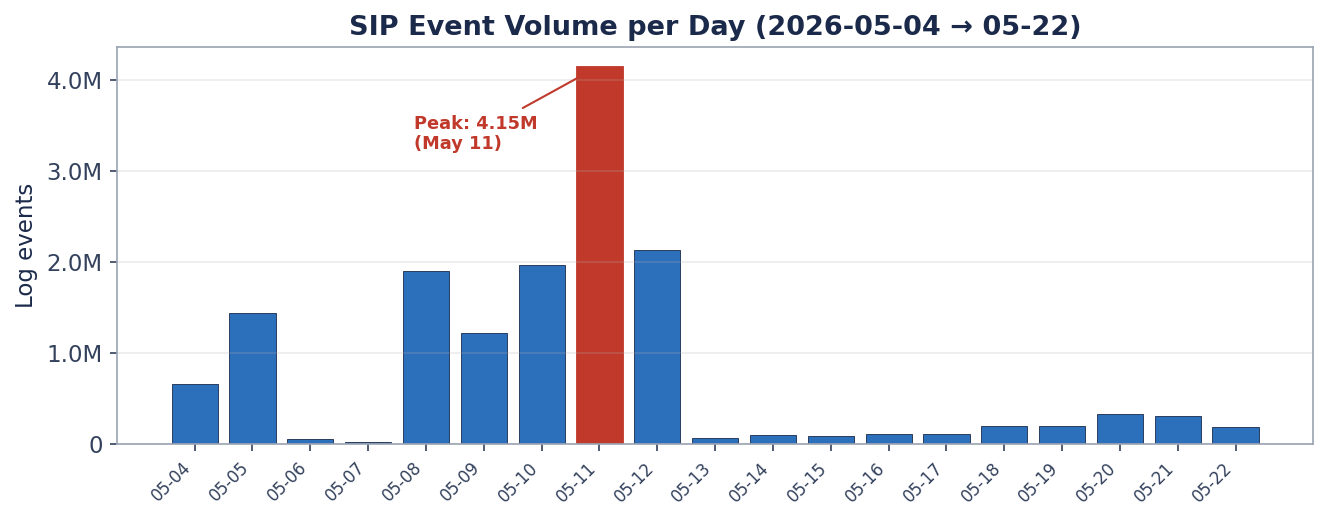
Figure 1. Daily SIP event volume. A concentrated high-tempo campaign on 8–12 May dwarfs the surrounding baseline.
Key Judgments
The dominant threat is credential harvesting, not opportunistic guessing. A handful of hosts sprayed a curated dictionary of 277,632 passwords — weighted toward medium- and high-complexity strings, not just 1234 — against every common PBX extension number.
Toll fraud is targeted and revenue-driven. 47,273 of 89,465 call attempts targeted UK numbers, concentrated on a small set of rural and Northern Ireland ranges consistent with International Revenue Share Fraud (IRSF).
The attack infrastructure is cheap, European, and highly concentrated. A single hosting network (OVH, AS16276) originated 6,559,589 events; one /24 (15.204.157.0/24) produced 5,178,084 on its own.
The sources are known-bad and server-hosted, not victims' home connections. Cross-referenced against third-party IP intelligence, 93.5% of attacker addresses already appear on a known-abuser list and 99.8% of source-attributed traffic originated from datacenter/hosting ranges.
Operations run around the clock and rotate identity, not behavior. Tooling impersonates FreePBX, Cisco, Polycom and Avaya user agents, yet leaves stable signatures — most notably a hardcoded registration Contact of sip:[email protected] present in 3,396,685 registration requests.
The honeypot never granted access. Every authentication was rejected; the value here is intelligence — adversary wordlists, target numbers, tooling, and infrastructure — not breach impact.
.avif)