🚀 أصبحت CloudSek أول شركة للأمن السيبراني من أصل هندي تتلقى استثمارات منها
اقرأ المزيد
.avif)

Domain takedown is the process of removing a malicious or infringing domain from the internet by submitting evidence-backed requests to the registrars, hosting providers, and platforms that can suspend or remove it. Most compliant takedowns are complete within 24 to 72 hours, while immediate browser and gateway blocking protects users within minutes.
The Cybercrime Information Center recorded more than 1.5 million domains used in phishing in 2025, a 38 percent year-over-year rise and the highest figure ever recorded, which is why fast, reliable takedown matters.
This guide explains what domain takedown is, the types of domains and content removed, how the process works, how long it takes by channel, who can request a takedown, the legal routes available, why takedowns sometimes fail or recur, and how to evaluate a takedown service.
Domain takedown is the coordinated removal of an abusive or fraudulent domain and its associated content from the internet. It works by submitting abuse or infringement reports to the registrar that manages the domain, the hosting provider that serves its content, and any platform involved in distribution. When the request is accepted, the domain is suspended, the content is removed, or the listing is de-indexed from search results.
Takedown covers two distinct actions that work best together. Blocking delivers immediate, temporary protection by flagging the malicious site through browser Safe Browsing providers, email and web gateways, and DNS sinkholing, which shields users within minutes while removal is pending. Removal is the permanent action that suspends the domain at the registrar, strips the content at the host, revokes the certificate, and de-indexes the page, which dismantles the attacker infrastructure rather than hiding it.
Takedowns are performed by in-house security teams, by brand protection and digital risk protection vendors acting on a brand's behalf, or by national CERTs and law enforcement for criminal infrastructure. The party with the strongest registrar and host relationships usually achieves the fastest removal.
Domain takedown targets six common categories of malicious or infringing assets.
Domain takedown typically follows a six-step process from detection to confirmed removal. Each step builds the case that registrars and hosts require before they act.
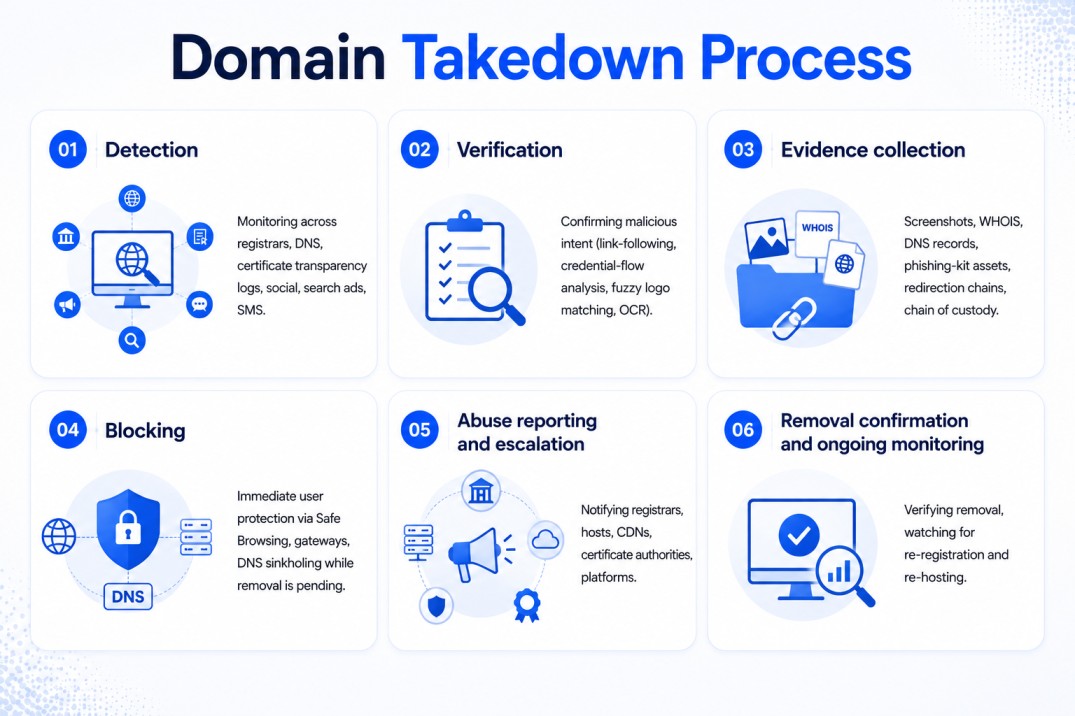
The process starts by finding the malicious domain as early as possible. Monitoring runs across newly registered domains, DNS records, certificate transparency logs, social platforms, search ads, and SMS messages, because attackers seed links through every one of these channels. The earlier a domain is found, the smaller the window in which it can harm customers, which is why detection coverage and speed matter more than any other single factor.
A domain name that resembles a brand is not proof of abuse on its own, so the suspected site is examined to confirm malicious intent. Analysts follow the links, test whether the page captures credentials, and use fuzzy logo matching and optical character recognition to confirm the site is copying brand assets. Verification prevents false positives that would waste a takedown request and damage the requester's credibility with registrars.
Once abuse is confirmed, the case is documented in the format providers expect. This package includes timestamped screenshots, WHOIS and DNS records, copies of the phishing-kit assets, and the redirection chain that shows where stolen data is sent. A clear, documented chain of custody makes the evidence admissible and removes any reason for a provider to hesitate or ask for more.
Because removal depends on third parties and takes time, blocking protects users in the meantime. Browser Safe Browsing providers, email and web gateways, and DNS-level controls flag or sinkhole the domain within minutes, so customers who click the link are warned or stopped while the slower removal process runs in parallel. Blocking buys safety; it does not end the threat.
. The documented case is submitted to every party that can disable the domain or its content: the registrar that manages the domain, the hosting provider that serves it, the content delivery network in front of it, the certificate authority that secured it, and any platform distributing the link. Established relationships and direct contacts move a request past a generic abuse inbox, which is the difference between removal in hours and removal in days.
A takedown is not finished when a provider agrees to act. The final step verifies that the domain and its content are actually unreachable, then keeps watching for the same attacker re-registering a new domain or moving the content to a different host. Continuous monitoring turns a one-time removal into ongoing protection against the campaign behind it.
Most compliant takedowns are complete within 24 to 72 hours, though the timeline varies by channel and by how quickly each provider responds. Blocking is far faster than removal, which is why the two run concurrently. The table below shows typical timelines by target.
Anyone whose services are being abused can report a malicious domain, because registrar and hosting terms of service prohibit phishing, malware, and impersonation. Four parties typically initiate takedowns.
Most takedowns succeed through terms-of-service enforcement without legal action. When a registrar or host does not cooperate, three legal routes apply.
Takedown is necessary but not sufficient on its own. Five factors limit its effectiveness, and understanding them shapes a stronger defense.
Continuous monitoring, preemptive registration of lookalike variants, and immediate blocking during the removal window together close the gaps that single takedowns leave open.
Domain takedown services vary widely in how much exposure they actually remove, and a polished dashboard is not the same as a fast, high-rate removal.
The following six criteria separate a service that reduces risk from one that simply reports activity. Each criterion below includes what to ask a prospective provider so that the answer is verifiable rather than vague.
Ask for measured mean time to detect, time to block, and median time to removal, not marketing claims. Speed is the single biggest determinant of how much damage a campaign does, since most credential theft happens before removal completes. A provider confident in its speed will share real numbers and explain how they are measured.
Request the percentage of confirmed malicious assets actually removed or suspended, not just reported to a registrar. A high detection count means little if the assets stay online. Clean reporting separates domain suspension, hosting removal, and page removal, so the closure figure reflects real exposure reduction rather than tickets opened.
Confirm that the service monitors more than one domain. Modern campaigns span social media, app stores, SMS, and dark web sources, and a provider that watches only domains misses the channels where many attacks now begin. Broad coverage means a threat is caught wherever it surfaces, not only on the web.
Check whether the provider has direct contacts and established escalation channels with major registrars and hosts. These relationships move a request past a generic abuse inbox, which is often the difference between removal in hours and removal in days. Years of trusted reporting build the credibility that makes providers act quickly.
Verify the provider produces forensic-grade evidence packages that registrars and hosts accept without repeated requests for more information. Weak evidence stalls a takedown in back-and-forth, while a complete, well-documented package is approved on first submission. Strong evidence is what converts a report into a removal.
Establish what happens after an asset is removed. Attackers re-register and re-host the same campaign under new names, so the service should detect a return and re-action it automatically. Monitoring after removal is what turns a single takedown into durable protection against a persistent threat actor.
Weigh these criteria against the brand's actual threat exposure rather than treating them as a uniform checklist. A retailer facing constant fake-store campaigns prioritizes channel coverage and closure rate, while a bank targeted by fast credential phishing prioritizes speed and registrar relationships. The strongest service combines measurable speed, a high closure rate, broad coverage, and persistent monitoring rather than excelling at only one.
Detection is the hardest part of domain takedown, and it is where CloudSEK XVigil begins. Its Fake Domain Finder surfaces lookalike and phishing domains across the surface, deep, and dark web, including domains advertised in underground forums before they go live, using a permutation engine that generates and tracks typosquatted variations of a brand's assets. Confirmed threats move to an in-house takedown team that packages the evidence registrars and hosts require and drives the request from submission through confirmed removal.
Scale and persistence are where the approach proves out. CloudSEK reports more than 2,200 takedowns in Q4 2024 with a 96 percent success rate and an average turnaround of about 4.1 business days. Because monitoring runs continuously, a domain that reappears under a new name after removal is caught and actioned again, which answers the recurrence problem that defeats one-and-done takedowns. For deeper coverage of providers and how outcomes compare, see CloudSEK's guide to phishing domain takedown services.
Yes. Anyone can report abuse to a domain's registrar and hosting provider, whose terms of service prohibit phishing and malware. The process is free but requires evidence, persistence, and follow-up, which is why many organizations use a specialist service.
Blocking flags a malicious site in browsers, gateways, and DNS so users are protected within minutes, but the site stays online. Takedown removes the domain or content permanently at the registrar or host. Effective programs do both at once.
Yes. Takedown follows the registrar and hosting provider rather than the victim's location, so cross-border removal is routine. Speed depends on the provider's jurisdiction and cooperation, and non-compliant hosts in some regions slow or block the process.
Registrars and hosts typically require the malicious URL, WHOIS, and DNS data, timestamped screenshots, and proof of abuse such as a credential-harvesting form or cloned brand assets. Forensic-quality, well-documented evidence speeds approval.
Domain suspension is one outcome of a takedown, where the registrar disables the domain so it no longer resolves. Domain takedown is the broader process that may instead remove content at the host, revoke a certificate, or de-index the page.
Pricing varies by provider, volume, and channel coverage, and most vendors quote based on the brand's threat exposure rather than a fixed rate. Cost is usually weighed against the fraud losses and brand damage that a fast takedown prevents.
