🚀 أصبحت CloudSek أول شركة للأمن السيبراني من أصل هندي تتلقى استثمارات منها
اقرأ المزيد
.avif)

AI model security threats are attacks that target the AI model and inference layer, manipulating how a model processes input, behaves, or consumes resources rather than exploiting the code around it. AI model security threats map to the OWASP Top 10 for LLM Applications.
The research frames the scale. OWASP ranks prompt injection as the number-one risk on its Top 10 for LLM Applications, published in November 2024 and held at the top across three editions. The same list names ten distinct AI model threats, from data poisoning to unbounded consumption. Independent testing through 2025 jailbroke leading models with success rates that climbed as the attacks grew more advanced.
This guide explains what AI model security threats are, why the model layer is a target, and the main threat types enterprises face. It covers prompt injection, jailbreaking, model abuse, data poisoning, information disclosure, and agentic abuse, with the defenses that reduce each.
AI model security threats are attacks that operate at the model and inference layer rather than the code layer. They manipulate the natural-language input a model reads, the behavior its training sets, the data it learns from, or the resources it consumes. Traditional scanners built for application code cannot see these threats, because the weakness lives in how the model reasons, not in a code defect.
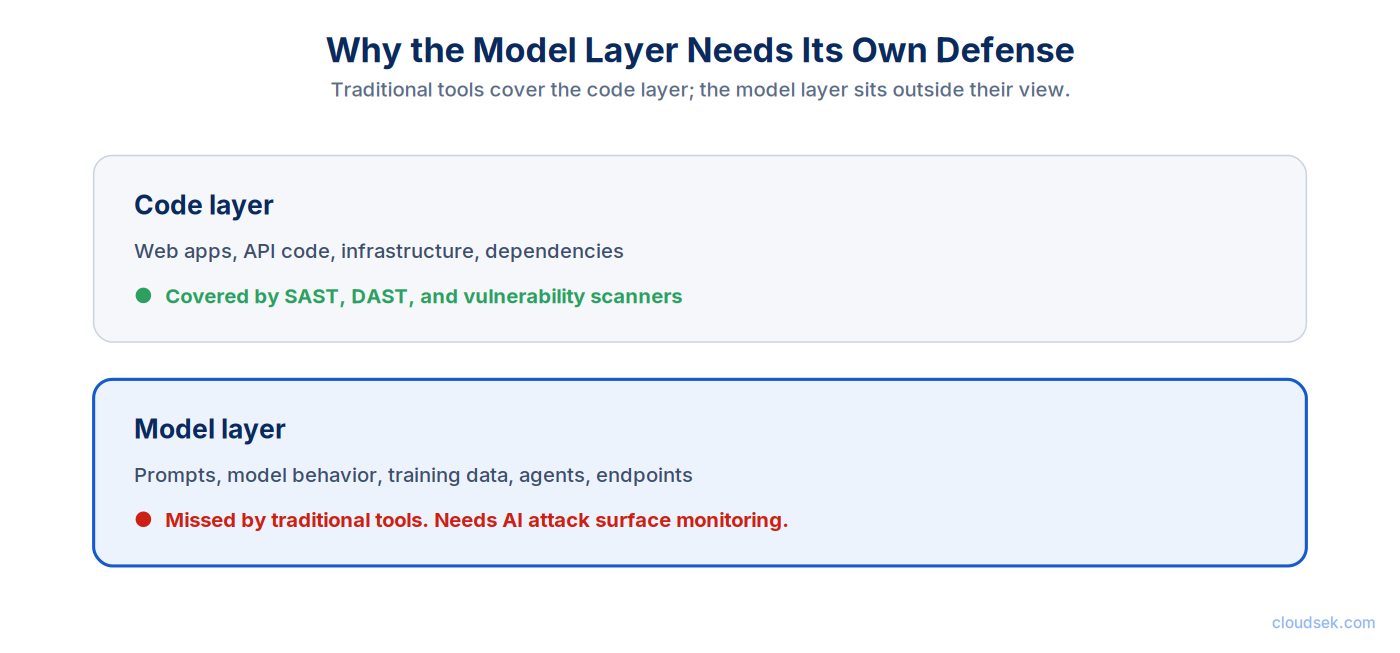
The threats share a root. Models accept open-ended input and act on it, so attackers shape that input, the data behind it, or the access around it to bend the model's output.
AI model security threats grow with adoption. Every chatbot, copilot, and agent an enterprise deploys adds model-layer exposure that sits outside traditional AI security tooling. The OWASP Top 10 for LLM Applications gives security teams a shared map of these threats.
Four traits define AI model security threats:
Attackers target AI models because the model layer expands the enterprise attack surface in ways traditional defenses miss. Every prompt, API, agent, and training pipeline becomes a new entry point. In agentic systems, a single manipulated model reaches connected tools, data, and other systems, so one model threat turns into a wider compromise. The AI attack surface maps these exposed components.
A successful model threat carries real cost, from data leaks and compliance breaches to reputational damage when a public AI fails.
AI model security threats fall into eight main types, most mapped to the OWASP Top 10 for LLM Applications:

Prompt injection hides malicious instructions in the text a model reads, so the model follows the attacker instead of the developer. Direct injection arrives in the input field, while indirect injection hides in the content that the model processes. This full prompt injection guide covers the types, examples, and defenses.
Jailbreaking bypasses a model's safety guardrails to make it produce restricted content it would refuse. It uses role-play personas, gradual multi-turn escalation, or obfuscation. Jailbreaking differs from prompt injection because one bypasses safety rules while the other overrides instructions. The full jailbreaking guide covers the techniques and defenses.
Model abuse is the use of an AI model for unintended or unauthorized purposes, or the exhaustion of its resources, without necessarily bypassing its guardrails. Where jailbreaking defeats safety rules, model abuse misuses the model's intended function or the compute behind it.
Model abuse takes four common forms:
Model abuse maps to OWASP's unbounded consumption category and overlaps model theft. It often needs no jailbreak at all, because the model behaves as designed while serving the attacker. A denial-of-wallet attack turns a metered AI API into a runaway cloud bill, and functionality abuse quietly offloads an attacker's workloads onto the victim's compute.
Data and model poisoning corrupt the data a model learns from, or the model itself, to implant bias, backdoors, or degraded reliability. An attacker who slips malicious records into a training set, or publishes a tampered open-source model, shapes the output long before deployment. A backdoor planted in fine-tuning data can sit dormant until a trigger phrase activates it. Poisoning maps to OWASP LLM04 and stays hard to detect after training.
Sensitive information disclosure happens when a model reveals training data, connected data, or credentials in its output. System prompt leakage is a related threat, where the model exposes the hidden instructions that define its behavior. A leaked system prompt hands an attacker the blueprint for bypassing the model's controls. Both give attackers material to refine further attacks, and they map to OWASP LLM02 and LLM07.
Excessive agency is the risk that an over-permissioned AI agent acts beyond its intended scope. When an agent holds broad access to tools, data, and APIs, any successful threat reaches further. A single prompt injection or jailbreak then becomes a real-world initial access vector across connected systems. Excessive agency maps to OWASP LLM06, and the more autonomy an agent holds, the larger the blast radius of any single compromise.
No single control covers every AI model threat, so defense means layered protection. Seven measures reduce the risk:
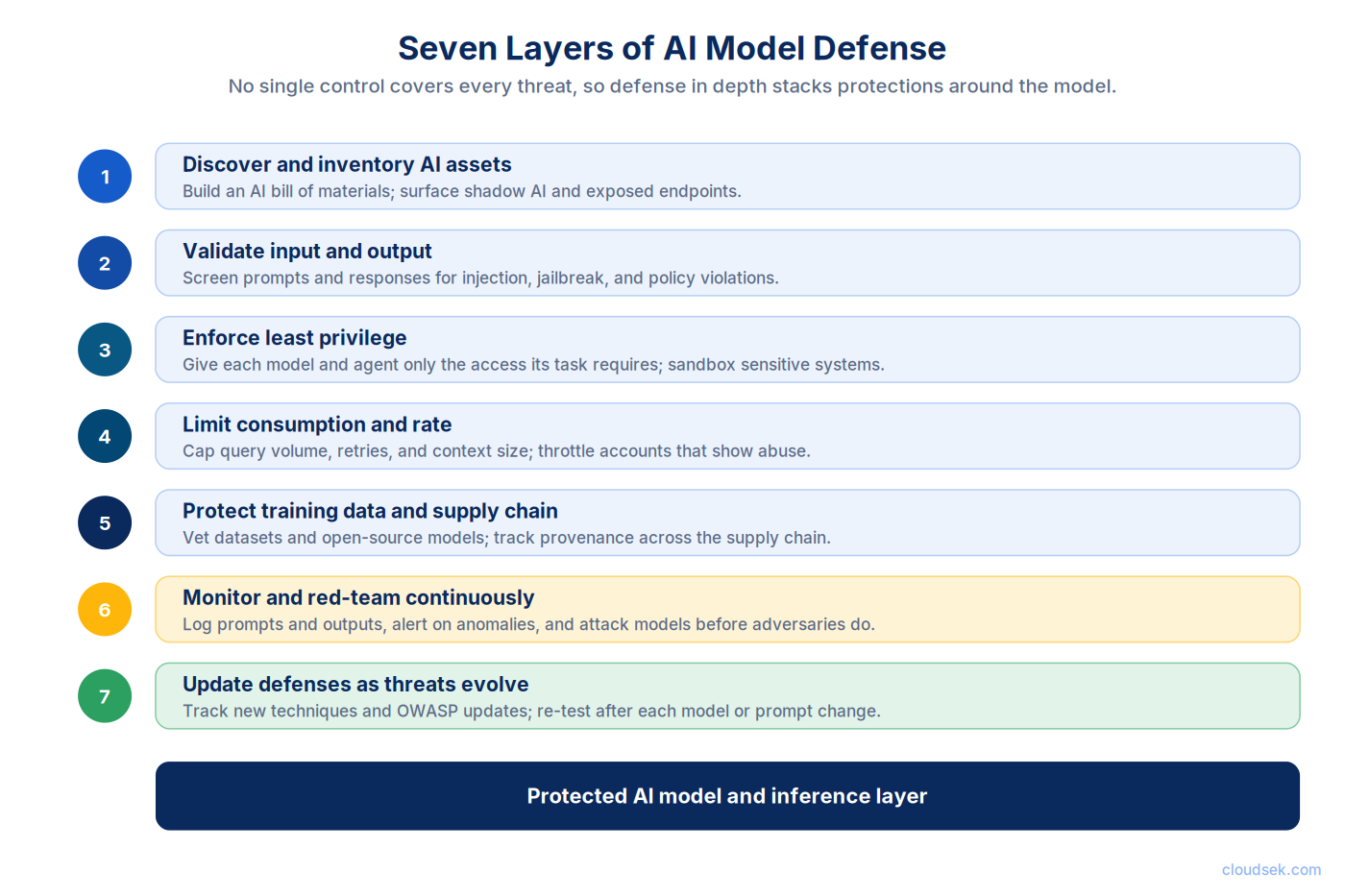
Together, these measures form defense in depth, the only realistic posture across threats with no single cure.
No tool removes every AI model threat, yet continuous monitoring closes the gap between exposure and exploitation. CloudSEK AIVigil discovers an organization's AI assets and monitors LLM endpoints, AI APIs, and agentic workflows for prompt injection, jailbreaks, and model abuse. AIVigil runs active red-teaming and treats each finding as an AI-layer initial access vector.
AIVigil makes AI attack surface monitoring a continuous workflow, scoring each exposure by the agent's agency, authentication state, and blast radius. It monitors and tests the model layer rather than remediating poisoned pipelines by hand, and it answers the question every enterprise running AI now carries: where can attackers reach our models?
AI model security threats are attacks on the AI model and inference layer, including prompt injection, jailbreaking, model abuse, and data poisoning.
Model abuse is using an AI model for unintended or unauthorized purposes, or exhausting its resources, without necessarily bypassing its guardrails.
Model abuse misuses a model's function or resources, while jailbreaking bypasses its safety guardrails to elicit restricted content.
Prompt injection is the most common, ranked number one on the OWASP Top 10 for LLM Applications.
Enterprises protect AI models by inventorying AI assets, validating input and output, limiting agent access, and red-teaming models continuously.
The OWASP Top 10 for LLM Applications is a community list of the ten most critical security risks for large language model applications, updated in 2025.
