🚀 CloudSEK featured in the 2026 Frost Radar™!
Read more
.avif)

Red teaming is a form of ethical hacking in which security professionals emulate the tactics, techniques, and procedures (TTPs) of real attackers to test an organization's defenses. The exercise is authorized, scoped, and nondestructive: red teamers carry written permission and avoid real harm to systems or users.
Attack speed makes that test urgent: IBM's X-Force Threat Intelligence Index found the time to execute a ransomware attack fell 94%, from 68 days in 2019 to under four days in 2023.
Red teaming measures detection and response across people, processes, and technology, rather than the presence of vulnerabilities alone. This guide explains what red teaming is, how an engagement works, the types and tools involved, how red teams differ from blue and purple teams and from penetration testing, the frameworks behind the work, and the rise of AI red teaming.
A red team engagement runs through six phases, from scoping to the final readout.
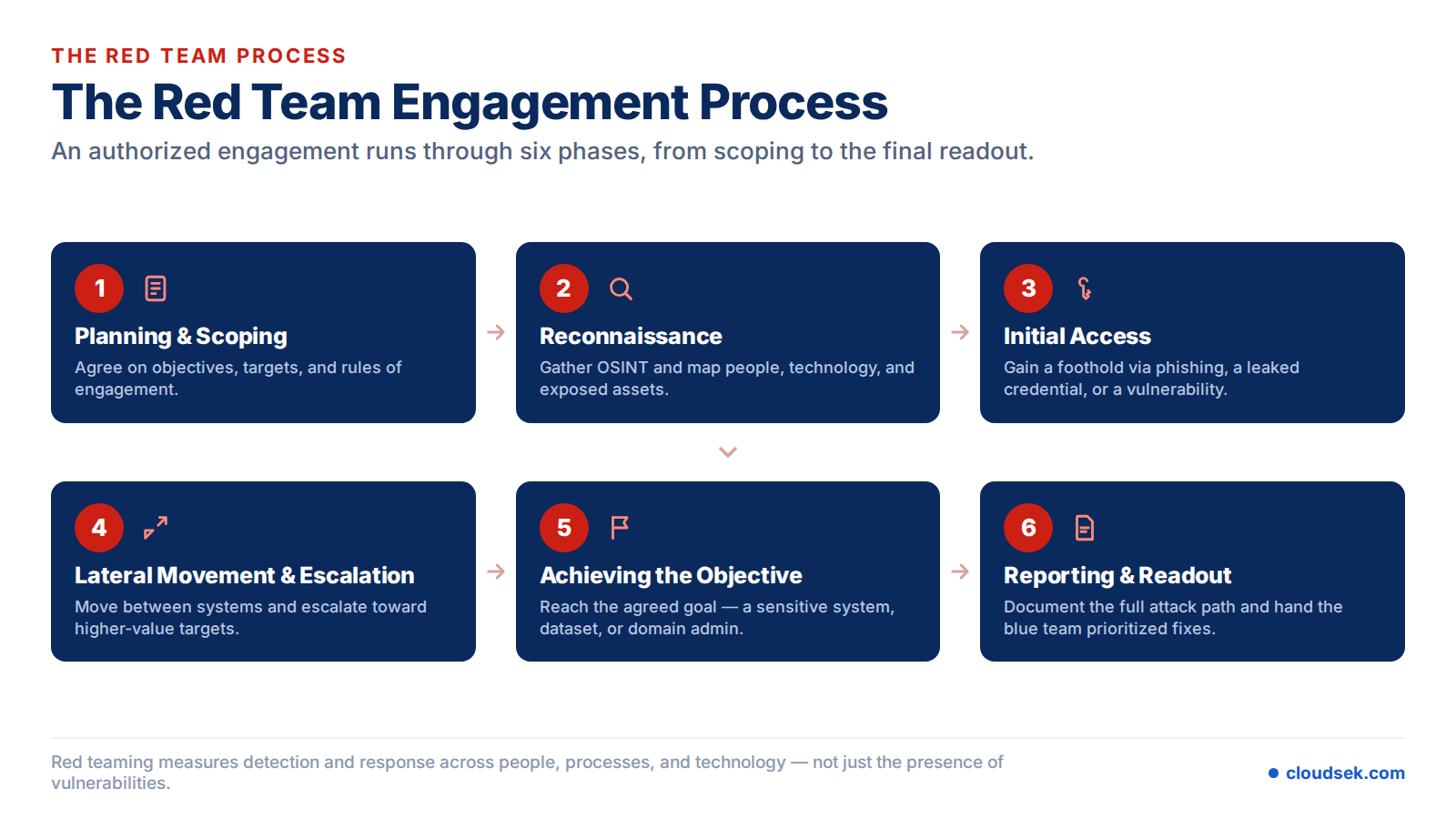
The red team and the organization agree on objectives, targets, and rules of engagement. This phase sets what is in scope, what is off-limits, and the goal the team works toward, such as access to a specific system or dataset.
The team gathers open-source intelligence and probes the attack surface to map people, technology, and exposed assets. Reconnaissance shapes the attack plan and identifies the likeliest entry points.
The team gains a foothold through a phishing lure, an exposed credential, or an exploitable vulnerability. Initial access turns external reconnaissance into a position inside the environment.
From the first foothold, the team moves between systems and escalates privileges toward higher-value targets. This phase mirrors how a real intruder expands access after breaching the perimeter.
The team reaches the agreed goal, such as a sensitive dataset, a critical system, or domain-admin control. Reaching the objective proves the attack path is viable from end to end.
The team documents the full attack path and meets with the blue team to share findings and remediation steps. The readout converts the exercise into prioritized fixes.
A short scenario shows how the phases connect. A red team is hired to test whether an attacker could reach a retailer's customer database. The team starts with reconnaissance, finding employee emails and an exposed login portal through open sources. A spear-phishing email harvests one employee's credentials, which grant access to an internal workstation.
From there, the team escalates privileges, moves laterally across the network, and reaches a server holding customer records. The blue team detects unusual database queries late in the exercise. In the readout, the red team maps the full attack path and recommends phishing-resistant authentication, network segmentation, and earlier detection rules.
Red teaming covers several domains, each targeting a different part of the attack surface.
Tests servers, devices, and internal networks for exploitable weaknesses. It examines how an attacker moves through internal systems after gaining a foothold.
This focuses on web applications and APIs, probing for flaws such as injection and broken access control. It reflects how attackers target the software that faces the internet.
This tests human defenses through phishing, vishing, and pretexting. It measures whether employees can be manipulated into granting access or revealing information.
This attempts entry to offices and facilities, testing locks, badges, and surveillance. It reveals whether an intruder could reach systems in person.
This targets Wi-Fi and other wireless protocols for weak configuration and rogue access points. It checks an often-overlooked path into the internal network.
This tests AI models and AI-enabled applications for prompt injection, jailbreaks, and model abuse. The dedicated AI red teaming section below covers it in detail.
Red teams use the same tools and techniques as real attackers, applied under authorization:
Red teaming is performed by an internal team, an external specialist firm, or a hybrid of both. Internal teams know the environment and run frequent tests, while external teams bring independence and a fresh adversarial perspective. A red team draws on several skill sets:
Red, blue, and purple teams divide the work of testing and defending an organization. The red team attacks, the blue team defends, and the purple team connects the two.
Purple teaming is a process rather than a standing team, turning each red-team finding into a defensive improvement.
Red teaming and penetration testing are both forms of ethical hacking, yet they answer different questions. A penetration test finds and validates exploitable vulnerabilities within a defined scope. Red teaming is broader and scenario-based: it emulates a real adversary working toward an objective, stays stealthy to test detection, and measures how people, processes, and technology respond.
Established frameworks give red team work a consistent structure:
AI red teaming tests artificial-intelligence and large language model systems for failures that traditional red teaming misses. Red teamers probe models with adversarial prompts to trigger prompt injection, jailbreaks, model abuse, training-data extraction, and unsafe outputs. The discipline differs from traditional red teaming because model outputs are probabilistic and the attack surface spans the prompt, the training data, and the model's integrations.
Real techniques show the risk. CloudSEK research on weaponized AI summarizers demonstrated how an attacker can hide instructions inside a web page with CSS so that an AI summarizer relays malicious ClickFix commands to the user while the human reader sees only benign text. AI red teaming maps to frameworks, including MITRE ATLAS, the OWASP Top 10 for LLM Applications, and the NIST AI Risk Management Framework, and it increasingly runs continuously inside CI/CD pipelines with each model update.
Common targets of an AI red team include:
Red teaming delivers value that vulnerability scanning and routine testing cannot:
Red teaming carries practical limits that shape how often it runs:
These constraints are the reason many organizations add continuous automated testing between full engagements.
Continuous automated red teaming (CART) uses automation to run red-team-style testing continuously rather than as a periodic engagement. A traditional red team exercise captures security posture at one moment, and that posture changes as systems and configurations shift. CART tools discover assets, prioritize weaknesses, and run simulated attacks on an ongoing basis, closing the gap between scheduled tests. Human red teamers still add the creativity and judgment that automation cannot replicate, focusing on novel scenarios while automation covers known techniques.
Yes. Red teaming is legal when the organization authorizes it in writing and defines the scope. Red teamers operate under rules of engagement and a strict code of conduct, and they cause no real harm to systems or users.
Adversary emulation replicates the specific TTPs of one known threat actor, guided by threat intelligence. Red teaming is broader, working toward an objective across the whole attack surface without limiting itself to a single adversary's methods.
A red team engagement usually runs from a few weeks to more than a month. The duration depends on the scope, the size of the attack surface, and whether the test covers physical, social, and technical layers.
A red teamer needs offensive skills across networks, web applications, and social engineering, plus knowledge of adversary TTPs and frameworks such as MITRE ATT&CK. Strong reporting and communication turn findings into fixes.
No. Ethical hacking is the broad practice of authorized hacking, and red teaming is one type of it. Penetration testing and vulnerability assessment are other forms of ethical hacking.
Most organizations run a red team exercise once or twice a year, with more frequent testing for high-risk environments. Continuous automated red teaming fills the gaps between full engagements.
