🚀 CloudSEK featured in the 2026 Frost Radar™!
Read more
.avif)

ProtonMail is the best anonymous email service in 2025 because it offers encrypted communication with anonymous sign-up. Its strong legal protections and minimal metadata exposure make it a dependable choice for long-term privacy.
Anonymous email services help limit digital traces by reducing the collection of identifiable information. They provide a safer way to communicate when users want to keep personal data private.
Choosing the right anonymous email service depends on the level of encryption, storage needs, and device compatibility. Evaluating these factors ensures the service aligns with the user’s privacy requirements.
The review process began with a close look at encryption methods, anonymity options, and data-handling practices to understand how well each service protects user identity. This helped separate truly private platforms from those offering only basic privacy layers.
Technical strengths were then compared with everyday usability, including storage capacity, device compatibility, and general workflow experience. This balance ensured the evaluation reflected both security depth and practical communication needs.
Pricing structures, free-tier limits, and long-term value were added to round out the analysis. These factors made it easier to identify services that deliver reliable privacy without unnecessary complexity.
ProtonMail offers end-to-end encryption and anonymous sign-up backed by Switzerland’s strong privacy framework. Its multi-device support and alias features make it suitable for secure daily communication.
Users looking for a reliable encrypted mailbox with minimal metadata exposure benefit most from ProtonMail. Its blending of usability and strong legal protections keeps it among the top privacy tools in 2025.
Tutanota delivers an open-source encrypted email service with anonymous registration and reduced metadata collection. Its integrated encrypted calendar strengthens privacy for everyday communication.
It is designed for users who prefer transparent encryption systems and a fully privacy-focused environment. Its open-source architecture increases trust and ensures long-term reliability.
StartMail supports anonymous account creation and powerful alias features that reduce exposure during online registration. It benefits from GDPR-aligned Dutch privacy laws that limit unnecessary data handling.
Users wanting a stable private mailbox without linking personal details find StartMail effective. Its unlimited aliases make it useful for secure browsing and identity masking.
Mailfence combines end-to-end encryption with digital signature capabilities, giving users authentication and confidentiality in one platform. Its secure document storage and calendar enhance workflow privacy.
This service works well for users needing encrypted communication with verifiable sender identity. Its support for IMAP, SMTP, and POP3 ensures flexibility across clients.
AnonAddy masks incoming mail through alias forwarding, preventing exposure of the user’s real email address. It focuses on minimal data retention and does not operate as a traditional mailbox.
Individuals who frequently register on websites or want protection from spam and tracking find AnonAddy valuable. Its lightweight, identity-shielding structure is ideal for privacy-first users.
SimpleLogin provides relay-based aliases that forward messages while hiding the user's actual email. Its flexible alias management system offers granular control over identity exposure.
Users who juggle multiple identities across sites benefit from SimpleLogin’s simple relay structure. Its seamless integration with existing inboxes makes privacy adoption easy.
Posteo supports anonymous sign-up and anonymous payment, allowing users to maintain complete separation between identity and mailbox. It avoids logging IP addresses and runs without advertising or tracking.
Privacy-focused users appreciate Posteo’s commitment to strict anonymity and transparent privacy practices. Its no-logs environment makes it one of the most identity-protective full mailbox providers.
CounterMail uses diskless servers and browser-based encryption to protect user data from server compromise. Its optional USB-key authentication adds a strong layer of access security.
It suits users requiring enhanced anonymity and minimal metadata retention. CounterMail’s infrastructure is designed specifically to reduce long-term traceability.
Guerilla Mail delivers instantly available disposable email addresses with no registration required. The inboxes expire automatically, reducing long-term data retention risk.
It works well for one-time sign-ups, verifications, or quick anonymous interactions. Its simplicity makes it ideal for short-term anonymity needs.
10MinuteMail generates temporary email addresses that expire after ten minutes, ensuring no persistent data remains. It provides immediate, anonymous inbox access for short-lived tasks.
The service is perfect for quick account verification or any activity where identity should not be revealed. Its short lifespan prevents data traces from accumulating.
Anonymous email services allow users to communicate without revealing personal information such as name, phone number, IP address, or device identifiers. These platforms focus on privacy-first design, preventing email providers, advertisers, and malicious actors from linking messages to individual identities.
They matter in 2026 because digital tracking, mass data collection, and identity breaches have become more common. Anonymous email helps preserve personal confidentiality by limiting the amount of metadata exposed during communication.
As privacy concerns grow, more individuals rely on anonymous email for secure conversations, online registrations, and identity-sensitive communication. This shift makes anonymous email a valuable tool for maintaining online safety in a data-driven world.
Anonymous email providers rely on privacy-focused security methods that separate user identity from email activity. These safeguards work together to reduce traceability and protect sensitive communication.
Encryption prevents anyone other than the intended recipient from reading your messages. This keeps email content secure even if the data is intercepted.
Many providers avoid collecting IP addresses, device details, and connection records. Reducing logs limits the data that could link activity back to a user.
Some services allow account creation without names, phone numbers, or recovery emails. Skipping personal details removes direct identifiers from the mailbox.
Aliases act as alternate email addresses that forward messages without revealing the real inbox. This helps protect identity when signing up on websites or communicating with unknown contacts.
Providers based in strong privacy regions face fewer requirements to store or share user data. Legal protections add another layer of safety for identity-sensitive communication.
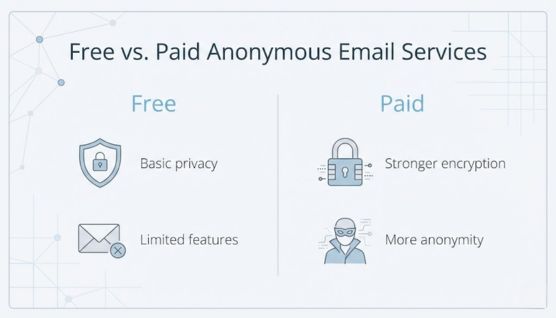
Free anonymous email services often offer basic privacy tools such as masked email addresses and disposable accounts. These options are useful for low-risk activities and casual use.
Paid services typically include stronger encryption, larger storage, enhanced anonymity, and zero-knowledge architectures.
Free providers may limit message history, attachment size, or mailbox duration. These constraints can affect long-term communication needs.
Paid platforms offer extended features such as multiple aliases, custom domains, security upgrades, and priority support.
Paid services are valuable when users require high security, sustained anonymity, or professional-level encryption. These tools support advanced privacy needs.
Individuals engaged in sensitive communication, ongoing private correspondence, or digital-risk situations benefit most from paid anonymous email options.
Sending an anonymous email safely involves hiding identifying details and using tools that protect message content. A few practical steps help ensure the message cannot be traced back to the sender.
Use a Privacy-Focused Email Service
Choose a provider that supports anonymous sign-up and encrypted communication. This prevents personal information from being tied to your email activity.
Routing your connection through a VPN or Tor hides your IP address from the email provider. This adds another layer of protection by masking your location and device details.
Keep your message free of names, accounts, or details that could reveal identity. Even one piece of personal data can compromise anonymity.
Aliases let you send and receive messages without exposing your main inbox. They act as a buffer that protects your primary email address from unwanted tracking.
Skip recovery phone numbers or secondary emails when possible. These fields can link an anonymous account back to identifiable data.
Selecting an anonymous email service requires attention to the features that directly influence privacy, usability, and long-term security. Focusing on a few core factors helps identify a platform that matches your communication needs.
Strong encryption ensures your messages remain unreadable to anyone other than the intended recipient. This protects your communication even if the data is intercepted.
Services that avoid requesting names, phone numbers, or recovery details provide stronger anonymity. Minimal account information reduces the chance of personal data being linked to your email.
Adequate storage supports long-term use and allows you to keep messages and attachments without constant clearing. Limited storage may work for occasional use but not for regular communication.
A good anonymous email service should work smoothly across the devices you use most. Web access, mobile apps, and mail client support all improve everyday usability.
Understanding the cost structure helps you decide whether a free or paid plan fits your needs. Paid plans often include larger storage, more aliases, and additional security features.
CloudSEK provides digital risk monitoring tools that help users understand their exposure across online platforms. These insights can inform safer communication strategies.
Its privacy intelligence features support anonymous communication by identifying potential vulnerabilities that could compromise identity. CloudSEK enhances overall digital safety when used alongside anonymous email tools.
Anonymous email services limit the personal information collected during sign-up and reduce metadata that could link messages to a specific user. Many also use encryption and IP masking to keep communication private.
Most privacy-focused providers avoid storing IP addresses to prevent identity tracing. It is still important to review each provider’s policy, as data practices can vary.
Yes, full encrypted email providers typically support attachments while keeping them protected through encryption. Temporary or disposable email services may restrict file uploads due to storage limitations.
Using anonymous email services is legal in most regions, as long as the platform is used responsibly. Privacy tools are widely recognized as a way to protect personal information online.
Most privacy-first email providers work well with VPNs or the Tor Browser to add an extra layer of anonymity. These tools help hide your IP address before your email ever reaches the provider.
Anonymous email is helpful when you want to keep personal identity separate from online accounts, newsletters, or sensitive communication. It provides an extra layer of safety in situations where exposing a real email address may increase privacy risk.
Anonymous email greatly reduces traceability by minimizing metadata and avoiding personal identifiers. However, complete untraceability is never guaranteed, so combining anonymous email with tools like VPNs or Tor strengthens protection.
ProtonMail provides the strongest overall offering due to its encryption standards, anonymous sign-up, and dependable privacy safeguards. Its blend of usability and legal protections positions it as the most complete choice for long-term anonymous email needs.
Tutanota and StartMail deliver reliable alternatives for users who prioritize open-source transparency or private sign-up processes. Their encryption models and flexible features make them solid fits for individuals seeking structured, privacy-focused communication.
Alias-based tools like AnonAddy and SimpleLogin excel in situations where identity masking is more important than mailbox storage. Temporary providers such as Guerilla Mail and 10MinuteMail remain effective for short-term anonymity, offering quick, disposable access without ongoing commitment.
